Many custom options...


And formats...



Tie in Chinese / Japanese...
Buy a Tie calligraphy wall scroll here!
Personalize your custom “Tie” project by clicking the button next to your favorite “Tie” title below...
3. Iron Fist
4. Tai Chi Chuan / Tai Ji Quan
5. Blacksmith
6. Considerate of the Needs of Others
7. Iron Heart
8. Iron Palm
9. Iron Dragon
11. Taotie
12. Esther
13. Iron Man
15. Consideration / Meticulous Care
16. Gutierrez
The Red String
Thread of Lover's Destiny / Fate
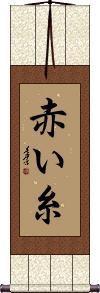
This literally translates as “the red string” or “the red thread” in Japanese, but the real meaning is much deeper...
In Japanese culture, it's believed that fate, destiny, or karma joins lovers by an unseen string, tied around one little finger of each. 赤い糸 is how soul mates find and are drawn to each other.
The Japanese concept of the red thread of fate, by most estimations, comes from Chinese folklore, where it's known as 姻緣紅線. The only difference is that in China, the celestial red thread is tied around the ankles of the lovers (versus what is usually represented as the pinky finger in Japan).
Guide / Help / Cooperate
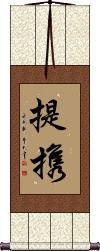
提携 varies a bit depending on which language you are reading it in.
提携 means to guide and help (younger people) in Chinese.
Cooperation or “working in concert” in Korean.
And cooperation, tie-up, joint business, and link-up in Japanese.
Iron Fist
Tie Quan / Tieh Chuan
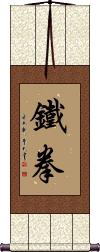
鐵拳 is a common theme used by various schools of martial arts.
鐵 means “iron” but, in some cases, can mean “indisputable.”
拳 means fist.
Some schools use the older/Taiwanese way to Romanize the iron fist, so you may have seen it spelled “Tieh Chuan” instead of “Tie Quan.” Neither way is technically incorrect.
Note that in Mandarin, the first part of the first character sounds like the English word “tea,” blending into a soft “-eh” sound. The second character sounds a lot like “chew on” but as if it is one syllable.
 After WWII in Japan, the Kanji for iron was simplified. This new Kanji form is shown to the right. If you want this modern Japanese version, please click on the Kanji to the right, instead of the button above. The characters shown to the left would still be considered the old or ancient Japanese version of this title.
Tai Chi Chuan / Tai Ji Quan
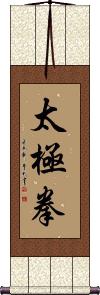
太極拳 is the famous Taoist meditation and martial art exercise. The direct translation of these characters would be something like “grand ultimate fist,” but that does not quite hit the mark for what this title really means.
An early-morning walk through any city in China near a park or an open area will yield a view of Chinese people practicing this ancient technique.
A typical scene is an old man of no less than 80 years on this earth, with a wispy white beard and perhaps a sword in one hand. He makes slow moves that are impossibly smooth. He is steady-footed and always in balance. For him, time is meaningless and proper form, and technique is far more important than speed.
For the younger generation, faster moves may look impressive and seem smooth to the casual observer. But more discipline and mental strength are needed to create perfectly smooth moves in virtual slow motion.
Note: There are two ways to Romanize these Chinese characters, as seen in the title above. The pronunciation and actual characters are the same in Chinese. If you really used English sounds/words to pronounce this, it would be something like “tie jee chew-on” (make the “chew-on” one flowing syllable).
Blacksmith
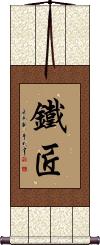
鐵匠 means blacksmith or ironworker in Chinese.
鐵 means iron or tough metal.
匠 means craftsman or artisan. 匠 can also mean carpenter (in the context of woodworking rather than metal forging).
Considerate of the Needs of Others
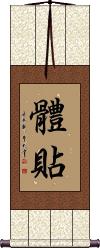
體貼 is a Chinese word that means to be considerate (of other people's needs).
Iron Heart
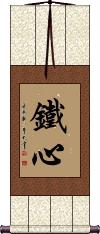
鐵心 can be translated as “iron heart,” “steel core,” or “iron mind” in Chinese and Japanese Kanji.
This is not a common term, but I added it here since so many were looking for “iron heart.” This is almost like saying you are without emotions or feelings - a very stoic person. This is not a Buddhist trait.
Iron Palm
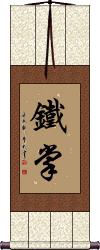
鐵掌 means “iron palm,” the martial arts technique taught by Brian Gray and others.
This term can mean different things to different people. The consensus is that rather than a type or style of martial arts, this is a technique for refining hand position and strengthening hands to strike blows with maximum force and effect.
The regime may include herbal treatments and special exercises to fortify the hands.
In more extreme versions, the carpals and metacarpal bones in the hand are systematically broken so that when they heal, they will become stronger.
Japanese note: This does make sense in Japanese (though the version shown above is the ancient form of the first Kanji), this is far from a commonly-known term.
Iron Dragon
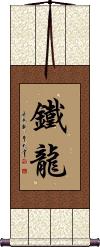
鐵龍 is the title Iron Dragon in Chinese.
Ironman Triathlon Event
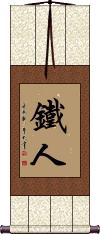
鐵人 is the Chinese name for the Ironman Triathlon Event.
The literal meaning of these characters is “iron person.”
This can also refer to a Japanese toy, Tetsujin (a big blue tin man).
Taotie

In ancient China, 饕餮 was a ferocious mythological animal and the fifth son of the dragon king.
饕餮 can also refer to a zoomorphic mask motif found on Shang and Zhou ritual bronzes.
As an adjective, this can mean gluttonous, sumptuous (banquet), covetousness, greed, avarice, or intense desire.
Esther
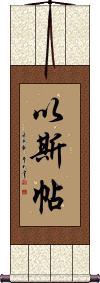
以斯帖 is the name Esther in Chinese (Mandarin).
Iron Man
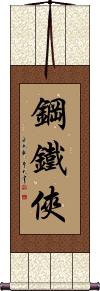
鋼鐵俠 is the Chinese title for Iron Man, the comic book superhero.
Unshakable / Determined
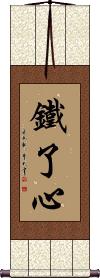
鐵了心 is a Chinese title that means determined or unshakable.
This literally means “Iron Heart” or “Heart of Iron.”
Consideration / Meticulous Care
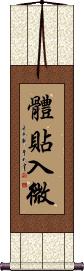
體貼入微 is a Chinese idiom that means “to show every possible consideration.”
This can also mean “meticulous care of others.”
Gutierrez
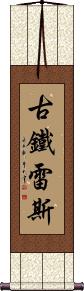
古鐵雷斯 is the name Gutiérrez in Chinese (Mandarin).
These search terms might be related to Tie:
Bond
Family Bond / Family Ties
Fix
Fix the Roof Before the Rain; Dig the Well Before You Are Thirsty
Karma Connection
Lash
Link
Safe / Secure
The Mysterious Bond Between People
Not the results for tie that you were looking for?
Below are some entries from our dictionary that may match your tie search...
| Characters If shown, 2nd row is Simp. Chinese |
Pronunciation Romanization |
Simple Dictionary Definition |
鐵人 铁人 see styles |
tiě rén tie3 ren2 t`ieh jen tieh jen |
More info & calligraphy: Ironman Triathlon Event |
鐵匠 铁匠 see styles |
tiě jiang tie3 jiang5 t`ieh chiang tieh chiang |
More info & calligraphy: Blacksmith |
鐵拳 铁拳 see styles |
tiě quán tie3 quan2 t`ieh ch`üan tieh chüan |
More info & calligraphy: Iron Fist |
饕餮 see styles |
tāo tiè tao1 tie4 t`ao t`ieh tao tieh toutetsu / totetsu とうてつ |
More info & calligraphy: Taotie(1) (hist) taotie (Chinese mythological creature commonly represented as a motif on ritual bronzes from the Shang and Zhou dynasties); (2) (archaism) covetousness; greed; avarice intense desire |
體貼 体贴 see styles |
tǐ tiē ti3 tie1 t`i t`ieh ti tieh |
More info & calligraphy: Considerate of the Needs of Others |
以斯帖 see styles |
yǐ sī tiě yi3 si1 tie3 i ssu t`ieh i ssu tieh |
More info & calligraphy: Esther |
鋼鐵俠 钢铁侠 see styles |
gāng tiě xiá gang1 tie3 xia2 kang t`ieh hsia kang tieh hsia |
More info & calligraphy: Iron Man |
鐵了心 铁了心 see styles |
tiě le xīn tie3 le5 xin1 t`ieh le hsin tieh le hsin |
More info & calligraphy: Unshakable / Determined |
帖 see styles |
tiè tie4 t`ieh tieh chou / cho ちょう |
rubbing from incised inscription (1) folding book; (counter) (2) counter for units of paper and nori (48 pages of Mino paper; 20 pages of hanshi; 10 sheets of nori); (counter) (3) counter for folding books, folding screens, shields, etc.; (counter) (4) counter for pairs (of curtains); (counter) (5) (See 畳・じょう) counter for tatami mats; (place-name) Chō |
怗 see styles |
tiē tie1 t`ieh tieh |
peaceful; quiet |
萜 see styles |
tiē tie1 t`ieh tieh |
terpene (chemistry) |
貼 贴 see styles |
tiē tie1 t`ieh tieh chou / cho ちょう |
to stick; to paste; to post (e.g. on a blog); to keep close to; to fit snugly; to subsidize; allowance (e.g. money for food or housing); sticker; classifier for sticking plaster: strip (suf,ctr) (See 服・ふく・2) counter for doses of medicine, etc. To stick, attach to; make up, add. |
銕 see styles |
tiě tie3 t`ieh tieh tetsu てつ |
old variant of 鐵|铁[tie3] (surname) Tetsu |
鐡 see styles |
tiě tie3 t`ieh tieh tetsu てつ |
variant of 鐵|铁[tie3], iron (surname) Tetsu |
鐵 铁 see styles |
tiě tie3 t`ieh tieh tetsu てつ |
iron (metal); arms; weapons; hard; strong; violent; unshakeable; determined; close; tight (slang) (out-dated kanji) (1) iron (Fe); (adj-no,n) (2) strong and hard (as iron); (n,n-suf,n-pref) (3) (abbreviation) railway; (n,n-pref) (4) (colloquialism) railway enthusiast; (surname, given name) Tetsu Iron. |
餮 see styles |
tiè tie4 t`ieh tieh |
(literary) greedy; gluttonous |
驖 see styles |
tiě tie3 t`ieh tieh |
dark brown horse |
三鐵 三铁 see styles |
sān tiě san1 tie3 san t`ieh san tieh |
triathlon (Tw); (athletics) throwing events excluding the hammer throw (i.e. discus, javelin and shot put) |
乳貼 乳贴 see styles |
rǔ tiē ru3 tie1 ju t`ieh ju tieh |
pasties |
亞鐵 亚铁 see styles |
yà tiě ya4 tie3 ya t`ieh ya tieh |
ferrous |
倒貼 倒贴 see styles |
dào tiē dao4 tie1 tao t`ieh tao tieh |
to lose money instead of being paid (i.e. sb should pay me, but is actually taking my money) |
利貼 利贴 see styles |
lì tiē li4 tie1 li t`ieh li tieh |
Post-It note (3M trademark) |
刪帖 删帖 see styles |
shān tiě shan1 tie3 shan t`ieh shan tieh |
to delete a forum post |
名帖 see styles |
míng tiě ming2 tie3 ming t`ieh ming tieh |
name card; business card |
呫呫 see styles |
tiè tiè tie4 tie4 t`ieh t`ieh tieh tieh |
to whisper |
呫嗶 呫哔 see styles |
tiè bì tie4 bi4 t`ieh pi tieh pi |
to read aloud |
呫囁 呫嗫 see styles |
tiè niè tie4 nie4 t`ieh nieh tieh nieh |
(onom.) muttering; to whisper; mouthing words |
呫畢 呫毕 see styles |
tiè bì tie4 bi4 t`ieh pi tieh pi |
to read aloud; also written 呫嗶|呫哔 |
喜帖 see styles |
xǐ tiě xi3 tie3 hsi t`ieh hsi tieh |
wedding invitation |
囁呫 嗫呫 see styles |
niè tiè nie4 tie4 nieh t`ieh nieh tieh |
to whisper |
Click here for more tie results from our dictionary
The following table may be helpful for those studying Chinese or Japanese...
| Title | Characters | Romaji (Romanized Japanese) | Various forms of Romanized Chinese | |
| The Red String | 赤い糸 | akai ito / akaiito | ||
| Guide Help Cooperate | 提携 | tei kei / teikei | tí xié / ti2 xie2 / ti xie / tixie | t`i hsieh / tihsieh / ti hsieh |
| Iron Fist | 鐵拳 铁拳 / 鉄拳 | tekken / teken | tiě quán / tie3 quan2 / tie quan / tiequan | t`ieh ch`üan / tiehchüan / tieh chüan |
| Tai Chi Chuan Tai Ji Quan | 太極拳 太极拳 | tai kyoku ken taikyokuken | tài jí quán tai4 ji2 quan2 tai ji quan taijiquan | t`ai chi ch`üan taichichüan tai chi chüan |
| Blacksmith | 鐵匠 铁匠 | tiě jiang tie3 jiang5 tie jiang tiejiang | t`ieh chiang tiehchiang tieh chiang |
|
| Considerate of the Needs of Others | 體貼 体贴 | tǐ tiē / ti3 tie1 / ti tie / titie | t`i t`ieh / titieh / ti tieh | |
| Iron Heart | 鐵心 铁心 | tetsu kokoro / tesshin tetsukokoro / tesshin tetsu kokoro / teshin | tiě xīn / tie3 xin1 / tie xin / tiexin | t`ieh hsin / tiehhsin / tieh hsin |
| Iron Palm | 鐵掌 铁掌 | tetsu-tenohira | tiě zhǎng tie3 zhang3 tie zhang tiezhang | t`ieh chang tiehchang tieh chang |
| Iron Dragon | 鐵龍 铁龙 | tiě lóng / tie3 long2 / tie long / tielong | t`ieh lung / tiehlung / tieh lung | |
| Ironman Triathlon Event | 鐵人 铁人 | tetsu jin / tetsujin | tiě rén / tie3 ren2 / tie ren / tieren | t`ieh jen / tiehjen / tieh jen |
| Taotie | 饕餮 | tou tetsu / toutetsu / to tetsu | tāo tiè / tao1 tie4 / tao tie / taotie | t`ao t`ieh / taotieh / tao tieh |
| Esther | 以斯帖 | yǐ sī tiē yi3 si1 tie1 yi si tie yisitie | i ssu t`ieh issutieh i ssu tieh |
|
| Iron Man | 鋼鐵俠 | gāng tiě xiá gang1 tie3 xia2 gang tie xia gangtiexia | kang t`ieh hsia kangtiehhsia kang tieh hsia |
|
| Unshakable Determined | 鐵了心 铁了心 | tiě le xīn tie3 le5 xin1 tie le xin tielexin | t`ieh le hsin tiehlehsin tieh le hsin |
|
| Consideration Meticulous Care | 體貼入微 体贴入微 | tǐ tiē rù wēi ti3 tie1 ru4 wei1 ti tie ru wei titieruwei | t`i t`ieh ju wei titiehjuwei ti tieh ju wei |
|
| Gutierrez | 古鐵雷斯 古铁雷斯 | gǔ tiě léi sī gu3 tie3 lei2 si1 gu tie lei si gutieleisi | ku t`ieh lei ssu kutiehleissu ku tieh lei ssu |
|
| In some entries above you will see that characters have different versions above and below a line. In these cases, the characters above the line are Traditional Chinese, while the ones below are Simplified Chinese. | ||||

Successful Chinese Character and Japanese Kanji calligraphy searches within the last few hours...



