I am shipping orders on Thursday this week. News and More Info
Buy a Holy Man calligraphy wall scroll here!
Personalize your custom “Holy Man” project by clicking the button next to your favorite “Holy Man” title below...
1. Holy Land
4. Holy Diver
6. Holy Warrior
8. Holy Bible
10. The Saint
11. Warrior Saint / Saint of War
13. Warrior of the Heavenly Realm
17. Vatican City
19. Galatians 5:25
20. Sacred Fire
聖地 can be titled or translated in a lot of different ways: sacred ground, the Holy Land, Holy city, sacred place, Holy ground, or shrine.
I have seen all of these English translations used when coming from Chinese, Japanese, and Korean.
聖靈 is the title for the Holy Spirit or Holy Ghost as used by Jewish, Catholic, and Protestant (and other Christian) Chinese people.
And yes, Chinese Jews do exist, but there are not many of them.
The first character means Holy, Sacred, Saint, or Sage. The second means ghost, spirit, efficacious, or intelligence.
This is valid in Chinese characters and old Korean Hanja. This will be recognized in Japan but see the note below...
In modern Japan, they now use a variant/simplified Kanji of the second character of Holy Spirit. If you want this Japanese version, click on the Kanji to the right instead of the button above.
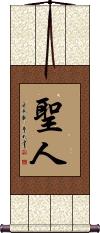
聖人 can mean saint, sage, or holy man.
Note: There is more than one way to express this idea. This one really matches “Holy man” because the second character means “human” or “person” (therefore, this could equally mean “Holy woman”).
ホーリーダイバー is the Japanese Katakana title for “Holy Diver.”
The Holy Diver video game this title refers to was published by Irem in 1989 for the Famicom (Japanese version of the Nintendo Entertainment System).
Note: Because this title is entirely Japanese Katakana, it should be written by a Japanese calligrapher.
三位一體 is the Chinese and old Korean way to write Holy Trinity.
This would be understood in Japanese as well, but they tend to write it with the last character simplified like 三位一体 in modern Japan.
This can be translated literally as “Three Thrones, One Body.”
Asian Christians will understand this as the Trinity, God the Father, the Son, and the Holy Spirit.
聖經 is how to write Bible in Chinese.
The first character means Holy, sacred, saint, or sage.
The second character means sacred book or scripture.
Each Sunday morning, if you are near a Catholic or Protestant Church, you will see plenty of Chinese people carrying their Bibles. Virtually every large or medium city in China has at least one Christian church. Beijing has about 14 Christian churches of Catholic and various Protestant denominations. That number doubles if you count all the church services that are for foreigners only and doubles again if you count all of the underground Christian Churches. Many Embassies (Canadian, Italian, French, etc.) offer Protestant and Catholic services. However, the U.S. Embassy is the most unfriendly in all of China, offering no such religious services, regularly denying entry, and kicking out Americans and others, whether or not they have official business.
聖母 is the title for the Holy Mother, Madonna, or Virgin Mary used by Catholic Chinese, Korean, and Japanese people.
I think this would be a very cool wall scroll for a devout Catholic who also appreciates Asian artwork and language.
Note: Koreans often put a third character after these two, which creates a title that means “Hail Mary”; however, this character is not added or used in the same way in Japanese or Chinese. If you want that Korean title, just let me know, and we'll add that character for you. The two-character title shown to the left is universal, so I think it's the best choice.
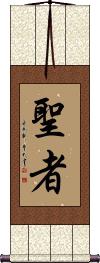
聖者 is the religious way to express the idea of “Saint” in Chinese, Korean Hanja, and Japanese Kanji.
Some may translate this as “Holy man” or “Holy person.”
聖 is the simple, single-character religious form of “saint” in Chinese (also holds the same meaning in Japanese and Korean, though rarely used alone like this).
This can also mean holy, sage, master, or priest.
Note: 聖 is often used in compound words (words of more than one character) to create further meanings. In compounds, it can mean holy, sacred, or divine.
聖 is also used as the first word for Spanish and English place names such as “San Diego” and “St. Louis” in Chinese (not Japanese).
In the Buddhist context, this can represent ārya or sādhu. And mean a sage; wise and good; upright, or correct in all his character; sacred, holy, or saintly.
天力士 means “Heavenly Warrior,” or “Hero of Heaven,” in Chinese, old Korean, and Japanese.
Often used in a Buddhist context.
天界力士 means “warrior of the heavenly realm” in Chinese, old Korean Hanja, and Japanese Kanji.
This is also known as Narayana in Buddhism.
神兵 is a Japanese, Chinese, and Korean title that means “soldier dispatched by a god,” or “soldier under the protection of the gods.”
神兵 is used more in Japanese (especially in animation) than the other languages.
上帝使你神聖 means “Sanctified by God,” in Chinese.
This was added at the request of a customer. This may be more appropriate for a priest or reverend than a layman. But that depends on how your religion sees the order of things.
If you directly translate, you get something like, “God made you Holy.”
Here's the character breakdown:
上帝 = God
使 = Makes; Made; Let
你 = You
神聖 = Sacred; Holy; Sanctification; Divine; Hallow; Holiness
聖心会 is the Japanese martial arts title “Seishinkai” or “Seishin-Kai.”
It literally means “Sacred Heart Association” or “Pure-Heart Club.”
聖 can mean holy, sacred, saint, sage, virtuous, expert, wise and good, upright, or correct.
心 can mean heart, mind, center, core, spirit, soul, or vitality.
聖心 creates a word meaning sacred heart, or the holy mind (that of Buddha).
会 in Japanese means association, club, meeting, assembly, party, gathering, conference, athletic meet, or society.
聖職 can be translated as a ministry, priesthood, holy orders, or sacred profession in Chinese, Japanese, and Korean.
If we live in the Spirit, let us also walk in the Spirit
我們若是靠聖靈得生就當靠聖靈行事 is the translation of Galatians 5:25 into Mandarin Chinese via the Chinese Union Bible.
KJV: If we live in the Spirit, let us also walk in the Spirit.
NIV: Since we live by the Spirit, let us keep in step with the Spirit.
The annotation of this Chinese translation:
1.我们 wǒ men - we / us / ourselves
2.若是 ruò shì - if
3.靠 kào - depend upon / lean on / near / by / against / to support
4.圣灵 shèng líng - Holy Ghost
5.得 děi - to have to / must / ought to / degree or possibility
6.生就 shēng jiù - born one way or another (nervous, suspicious, etc.)
7.当 dàng - suitable / adequate / fitting / proper
8.靠 kào - depend upon / lean on / near / by / against / to support
9.圣灵 shèng líng - Holy Ghost
10.行事 xíng shì - how one does things / how one runs things (in this case, it suggests, “to walk in step with”)
聖火 is a Chinese, Japanese and Korean term that applies to the sacred fire of the ancient Greek Olympic torch or games.
This could also apply to other sacred or holy fires, as it can be a somewhat generic term.
八聖道 is one of two titles for the Buddhist Noble Eightfold Path.
This version specifically has the “noble” idea in the middle character, which also means holy, sacred, wise and good, or upright.
The other title also romanizes as Hasshoudou or Hasshōdō in Japanese but is written 八正道.
神龍庇護 is not the most common thing to say in Chinese, but it is grammatically correct and a cool title.
The first character means “supernatural or saintly.” The second is “dragon.” The last two mean protection. You could also translate this as something like “Protected by the Dragon God” or more closely “Holy Dragon.”
天龍 can mean Heavenly Dragon (Dragon of Heaven), Sky Dragon, Holy Dragon, Celestial Dragon, or Divine Dragon.
This can be a given name in both China and Japan (天龍 is pronounced Tenryū and sometimes written 天竜 in Japanese).
In an older Buddhist context, this can refer to Brahma, Indra, and the devas, together with the nāgas. It can also refer to celestials and snake spirits.
The following table may be helpful for those studying Chinese or Japanese...
| Title | Characters | Romaji (Romanized Japanese) | Various forms of Romanized Chinese | |
| Holy Land | 聖地 圣地 | seichi | shèng dì / sheng4 di4 / sheng di / shengdi | sheng ti / shengti |
| Holy Spirit Holy Ghost | 聖靈 / 聖霊 圣灵 | sei rei / seirei | shèng líng sheng4 ling2 sheng ling shengling | |
| Holy Man Saint | 聖人 圣人 | seijin | shèng rén sheng4 ren2 sheng ren shengren | sheng jen shengjen |
| Holy Diver | ホーリーダイバー | Houriidaibaa Horidaiba | ||
| The Holy Trinity | 三位一體 三位一体 | sān wèi yì tǐ san1 wei4 yi4 ti3 san wei yi ti sanweiyiti | san wei i t`i sanweiiti san wei i ti |
|
| Holy Warrior | 聖戦士 | sei senshi / seisenshi | ||
| The Holy Trinity | 三位一体 | sanmiittai / sanmittai | ||
| Holy Bible | 聖書 圣书 | seisho | ||
| Holy Bible | 聖經 圣经 | shèng jīng sheng4 jing1 sheng jing shengjing | sheng ching shengching |
|
| Holy Mother Saint Mary | 聖母 圣母 | seibo | shèng mǔ / sheng4 mu3 / sheng mu / shengmu | |
| The Saint | 聖者 圣者 | seija | shèng zhě sheng4 zhe3 sheng zhe shengzhe | sheng che shengche |
| The Saint | 聖 圣 | sei | shèng / sheng4 / sheng | |
| Warrior Saint Saint of War | 武聖 武圣 | wǔ shèng / wu3 sheng4 / wu sheng / wusheng | ||
| Warrior of Heaven | 天力士 | ten riki shi tenrikishi | tiān lì shì tian1 li4 shi4 tian li shi tianlishi | t`ien li shih tienlishih tien li shih |
| Warrior of the Heavenly Realm | 天界力士 | ten kai riki shi tenkairikishi | tiān jiè lì shì tian1 jie4 li4 shi4 tian jie li shi tianjielishi | t`ien chieh li shih tienchiehlishih tien chieh li shih |
| Soldier of the Gods | 神兵 | shin pei / shinpei | shén bīng shen2 bing1 shen bing shenbing | shen ping shenping |
| Sanctified by God | 上帝使你神聖 上帝使你神圣 | shèng dì shǐ nǐ shén shèng sheng4 di4 shi3 ni3 shen2 sheng4 sheng di shi ni shen sheng shengdishinishensheng | sheng ti shih ni shen sheng shengtishihnishensheng |
|
| Seishin-Kai Seishinkai | 聖心会 / 聖心會 聖心会 | sei shin kai seishinkai | ||
| Vatican City | 梵蒂岡城 梵蒂冈城 | fàn dì gāng chéng fan4 di4 gang1 cheng2 fan di gang cheng fandigangcheng | fan ti kang ch`eng fantikangcheng fan ti kang cheng |
|
| Ministry Priesthood | 聖職 圣职 | seishoku | shèng zhí sheng4 zhi2 sheng zhi shengzhi | sheng chih shengchih |
| Galatians 5:25 | 我們若是靠聖靈得生就當靠聖靈行事 我们若是靠圣灵得生就当靠圣灵行事 | wǒ men ruò shì kào shèng líng shēn jiù dāng kào shèng líng xíng shì wo3 men ruo4 shi4 kao4 sheng4 ling2 dei3 shen1 jiu4 dang1 kao4 sheng4 ling2 xing2 shi4 wo men ruo shi kao sheng ling dei shen jiu dang kao sheng ling xing shi | wo men jo shih k`ao sheng ling tei shen chiu tang k`ao sheng ling hsing shih wo men jo shih kao sheng ling tei shen chiu tang kao sheng ling hsing shih |
|
| Sacred Fire | 聖火 圣火 | seika | shèng huǒ sheng4 huo3 sheng huo shenghuo | |
| Noble Eightfold Path | 八聖道 八圣道 | hasshoudou / hashodo | bā shèng dào ba1 sheng4 dao4 ba sheng dao bashengdao | pa sheng tao pashengtao |
| Under the Protection of the Dragon Saint | 神龍庇護 神龙庇护 | shén lóng bì hù shen2 long2 bi4 hu4 shen long bi hu shenlongbihu | shen lung pi hu shenlungpihu |
|
| Celestial Dragon Tian Long | 天龍 天龙 | tenryuu / tenryu | tiān lóng tian1 long2 tian long tianlong | t`ien lung tienlung tien lung |
| In some entries above you will see that characters have different versions above and below a line. In these cases, the characters above the line are Traditional Chinese, while the ones below are Simplified Chinese. | ||||
Successful Chinese Character and Japanese Kanji calligraphy searches within the last few hours...

All of our calligraphy wall scrolls are handmade.
When the calligrapher finishes creating your artwork, it is taken to my art mounting workshop in Beijing where a wall scroll is made by hand from a combination of silk, rice paper, and wood.
After we create your wall scroll, it takes at least two weeks for air mail delivery from Beijing to you.
Allow a few weeks for delivery. Rush service speeds it up by a week or two for $10!
When you select your calligraphy, you'll be taken to another page where you can choose various custom options.
The wall scroll that Sandy is holding in this picture is a "large size"
single-character wall scroll.
We also offer custom wall scrolls in small, medium, and an even-larger jumbo size.
Professional calligraphers are getting to be hard to find these days.
Instead of drawing characters by hand, the new generation in China merely type roman letters into their computer keyboards and pick the character that they want from a list that pops up.
There is some fear that true Chinese calligraphy may become a lost art in the coming years. Many art institutes in China are now promoting calligraphy programs in hopes of keeping this unique form
of art alive.
Even with the teachings of a top-ranked calligrapher in China, my calligraphy will never be good enough to sell. I will leave that to the experts.
The same calligrapher who gave me those lessons also attracted a crowd of thousands and a TV crew as he created characters over 6-feet high. He happens to be ranked as one of the top 100 calligraphers in all of China. He is also one of very few that would actually attempt such a feat.
Check out my lists of Japanese Kanji Calligraphy Wall Scrolls and Old Korean Hanja Calligraphy Wall Scrolls.
Some people may refer to this entry as Holy Man Kanji, Holy Man Characters, Holy Man in Mandarin Chinese, Holy Man Characters, Holy Man in Chinese Writing, Holy Man in Japanese Writing, Holy Man in Asian Writing, Holy Man Ideograms, Chinese Holy Man symbols, Holy Man Hieroglyphics, Holy Man Glyphs, Holy Man in Chinese Letters, Holy Man Hanzi, Holy Man in Japanese Kanji, Holy Man Pictograms, Holy Man in the Chinese Written-Language, or Holy Man in the Japanese Written-Language.
66 people have searched for Holy Man in Chinese or Japanese in the past year.
Holy Man was last searched for by someone else on Oct 18th, 2025