Didn't find what you want?
Try these methods:
1. Make your search more specific.
2. Use other similar-meaning words.
3. Use less words or just one word.
4. Post your request on our forum so that we can translate/create what you want.
We'll build you a handmade custom "Alive" calligraphy wall scroll if you wish!
Quick links to words on this page...
Check out all the Custom Calligraphy Options
Click on a![]()
to select your calligraphy and start customizing your artwork project...


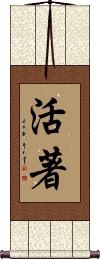
This is the word that means alive, as in the state of living or being alive (Chinese only).
Score: 100/100


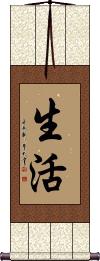
This means life, living, to live, or the state of being alive. It can also refer to your daily existence or livelihood.
This is also the term used in other titles such as "healthy living" or Lance Armstrong's "Livestrong" campaign (Chinese title for Livestrong only).
If you need a reminder that you are alive, and to take a breath, this might be the perfect wall scroll for you.
Score: 39/100
Used in modern times for
divorced couples that come back together
Mandarin: pò jìng chóng yuán


A husband and wife separated and reunited.
About 1500 years ago in China, there lived a beautiful princess named Le Chang. She and her husband Xu De Yan loved each other very much. But when the army of the Sui Dynasty was about to attack their kingdom, disposed of all of their worldly possessions and prepared to flee into exile.
They knew that in the chaos, they might lose track of each other, so the one possession they kept was a bronze mirror which is a symbol of unity for a husband and wife. They broke the mirror into two pieces, and each of them kept half of the mirror. They decided that if separated, they would try to meet in the fair during the 15th day of the first lunar month (which is the lantern festival). Unfortunately, the occupation was brutal, and the princess was forced to become the mistress of the new commissioner of the territory, Yang Su.
At the Lantern Festival the next year, the husband came to the fair to search for his wife. He carried with him, his half of the mirror. As he walked through the fair, he saw the other half of the mirror for sale at a junk market by a servant of the commissioner. The husband recognized his wife's half of the mirror immediately, and tears rolled down his face as he was told by the servant about the bitter and loveless life that the princess had endured.
As his tears dripped onto the mirror, the husband scratched a poem into his wife's half of the mirror:
You left me with the severed mirror,
The mirror has returned but absent are you,
As I gaze in the mirror I seek your face,
I see the moon, but as for you, I see not a trace.
The servant brought the inscribed half of the mirror back to the princess. For many days, the princess could not stop crying when she found that her husband was alive and still loved her.
Commissioner Yang Su, becoming aware of this saga realized that he could never obtain the love of the princess. He sent for the husband and allowed them to reunite.
This phrase in Chinese is now used to describe a couple who has been torn apart for some reason (usually divorce), but have come back together (or remarried).
It seems to be more common these days in America for divorced couples to reconcile and get married to each other again. This would be a great gift if you know someone who is about to remarry their ex.
Score: 20/100
Mandarin:
shuǐ néng zài zhōu
yì néng fù zhōu
Korean:
수능재주역능복주


Many things have opposite properties. The water you drink can also drown you. Pork may nourish you and keep you alive, but under-cook it and it could kill you. Potassium nitrate is often used as a fertilizer to grow the food that sustains us, but it's also been used as an explosive to topple buildings and destroy us.
This concept is easily associated with "yin yang" where an element has two opposite properties that are as different as night and day.
This proverb's meaning can be summed up this way: "Anything that can lead you to success may also contain great risks."
This phrase is known in literary circles by Korean people (scholars or literature). It is therefore also a valid proverb in Korean Hanja, though most Koreans would not be able to make sense of it.
Please note that there is an unwritten rule when the same character appears twice in the same phrase, the calligrapher will alter the appearance so that no two characters are exactly alike in the same piece. This calligraphy has two repeating characters that will be written differently than they appear here.
Score: 20/100


This is the title of a healing practice that is now found throughout the world but with origins in Japan.
Special note: Outside of the context of the healing practice of Reiki, this means "aura" or "spiritual essence that surrounds all living things". A Japanese person not familiar with the practice will take the "aura" meaning.
Reiki is a technique for stress reduction and relaxation that also heals. It can be compared to massage, but is based on the idea that an unseen "life force energy" flows through us and is what causes us to be alive. If your life force energy is low, you'll be more likely to get sick or feel stress. If your life force energy is abundant and flowing well, you become more capable of being happy and healthy.
There is a lot of information available if you want to Google this term - my job is to offer the calligraphy, while you can decide if it is right for you.
Note: We are showing the ancient (traditional) form of the Reiki Kanji. I have seen Reiki written with both the slightly simplified version and this more classic form. If you want the form of Reiki with the two strokes in the shape of an X on the second character and reformed first character, simply click on the Kanji characters to the right.
Note: This is also a Chinese word, but in Chinese, these characters create a word that refers to a smart person, or someone with high aspirations. It is not read as a healing method in Chinese.
In Korean Hanja, this can be read as "mysterious atmosphere" by a Korean who is not familiar with the practice of Reiki (still has a cool meaning in Korean).
Score: 10/100


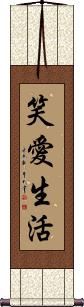
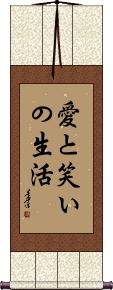
In English, the word order shown in the title is the most natural or popular. In Chinese, the natural order is a little different:
The first character means laugh (sometimes means smile).
The second character means love.
The last two characters mean "live" as in "to be alive" or "pursue life".
Please note: This is not a normal phrase, in that it does not have a subject, verb, and object. It is a word list. Word lists are not common in Asian languages/grammar (at least not as normal as they are in English). We only added this entry because so many people requested it.
We put the characters in the order shown above, as it almost makes a single word with the meaning, "A life of laughter and love". It's a made-up word, but it sounds good in Chinese.
Score: 10/100


This is the "art of the ninja" in Japanese. Most Japanese people associate ninjas with some degree of romance and reverence to Japan's ancient past. But most will accept that the ninja is an idea or way of life whose time has passed. However, this has not stopped floods of movies about ninjas and dojos offering Ninjutsu training from keeping the idea of the ninja alive in modern times.
My modern Japanese dictionary defines this term as "assassination, stealth and combat techniques", or "fighting art of the ninja".
These character are sometimes Romanized as two words: Shin obi, or Shin-obi.
Note that when writing this as Kanji, Japanese will tend to write the first character in the form shown to the right. Because this is specifically a Japanese title, we only suggest our Japanese master calligrapher for this selection - and you will get the form shown to the right if you do that (please ignore the fact that some of the images you see during the following pages in the options process will be the Chinese/alternate form).
Score: 10/100
Wall scroll artwork shown on this page is priced as follows:
2-3 characters $39.88 each
4 characters $49.88 each
5-10 characters $59.88 each
After you select your calligraphy, our website will take you through the process of customizing your artwork.
Options for other mounting such as portraits are available for $13 less.
We also offer the services of a famous master calligrapher for a $40 fee on any scroll if you are looking for investment-quality calligraphy.
If you chose our famous master-calligrapher, you also get more choices for silk and paper colors and the option for larger artwork.
All of our calligraphy is completely done by hand in the ancient way.
When the calligrapher finishes creating your artwork, it is taken to our art mounting workshop in Beijing where a wall scroll is made by hand from a combination of silk, rice paper, and wood.
After we create your wall scroll, it takes at least two weeks for air mail delivery from Beijing to you.
Therefore, allow at least 3 weeks for delivery from the time you place your order.
When you select your calligraphy, you'll be taken to another page where you can choose various custom options.
The scroll that I am holding in this picture is a "regular size"
4-character wall scroll.
As you can see, it is a great size to hang on your wall.
(We also offer custom wall scrolls in larger sizes)
Professional calligraphers are getting to be hard to find these days.
Instead of drawing characters by hand, the new generation in China merely type roman letters into their computer keyboards and pick the character that they want from a list that pops up.
There is some fear that true Chinese calligraphy may become a lost art in the coming years. Many art institutes in China are now promoting calligraphy programs in hopes of keeping this unique form
of art alive.
Even with the teachings of a top-ranked calligrapher in China, my calligraphy will never be good enough to sell. I will leave that to the experts.
The same calligrapher who gave me those lessons also attracted a crowd of thousands and a TV crew as he created characters over 6-feet high. He happens to be ranked as one of the top 100 calligraphers in all of China. He is also one of very few that would actually attempt such a feat.
The following table is only helpful for those studying Chinese (or Japanese), and perhaps helps search engines to find this page when someone enters Romanized Chinese or Japanese
| Title | Characters Simplified Traditional |
Japanese Romaji (Romanized Japanese) | Various forms of Hanyu-Pinyin (Romanized Chinese) | |||
| Alive | 活着 活著 | n/a | huó zhe huo zhe | huo2 zhe huozhe | ||
| Life / Living / Live | 生活 生活 | sei katsu seikatsu | shēng huó sheng huo | sheng1 huo2 shenghuo | ||
| Broken Mirror Rejoined | 破镜重圆 破鏡重圓 | n/a | pò jìng chóng yuán po jing chong yuan | po4 jing4 chong2 yuan2 pojingchongyuan | ||
| Not Only Can Water Float A Boat, It Can Sink It Also | 水能载舟亦能覆舟 水能載舟亦能覆舟 | n/a | shuǐ néng zài zhōu yì néng fù zhōu shui neng zai zhou yi neng fu zhou | shui3 neng2 zai4 zhou1 yi4 neng2 fu4 zhou1 | ||
| Reiki | 灵气 霊気 靈氣 | reiki | líng qì ling qi | ling2 qi4 lingqi | ||
| Live Laugh Love | 笑爱生活 笑愛生活 | shou ai sei katsu shouaiseikatsu sho ai sei katsu | xiào ài shēng huó xiao ai sheng huo | xiao4 ai4 sheng1 huo2 xiaoaishenghuo | ||
| Ninjutsu / Ninjitsu | 忍术 忍術 | ninjutsu | rěn shù ren shu | ren3 shu4 renshu | ||
| If you have not set up your computer to display Chinese, the characters in this table probably look like empty boxes or random text garbage.
This is why we spent hundreds of hours making images so that you could view the characters in the "alive" listings above. If you want your Windows computer to be able to display Chinese characters you can either head to your Regional and Language options in your Win XP control panel, select the [Languages] tab and click on [Install files for East Asian Languages]. This task will ask for your Win XP CD to complete in most cases. If you don't have your Windows XP CD, or are running Windows 98, you can also download/run the simplified Chinese font package installer from Microsoft which works independently with Win 98, ME, 2000, and XP. It's a 2.5MB download, so if you are on dial up, start the download and go make a sandwich. | ||||||
Some people may refer to this entry as Alive Kanji, Alive Characters, Alive in Chinese Writing, Alive in Japanese Writing, Alive in Asian Writing, Alive Ideograms, Chinese Alive symbols, Alive Hieroglyphics, Alive Glyphs, Alive in Chinese Letters, Alive Hanzi, Alive in Japanese Kanji, Alive Pictograms, Alive in the Chinese Written-Language, or Alive in the Japanese Written-Language.
All custom calligraphy items are made-to-order in our little Beijing artwork-mounting workshop.
Please note: Rush service can be as fast as two weeks, but regular service is over a month for delivery.
Copyright Oriental Outpost 2002-2009 - All Rights Reserved
Image Use Policy | Privacy Policy
This page of alive Chinese calligraphy dictionary search results was generated in 0.534555912018seconds.