Adventures in Asian Art

Custom Hard-Working / Industrious Chinese & Japanese Calligraphy Wall Scroll

We have many options to create artwork with Hard-Working / Industrious characters on a wall scroll or portrait.
If you want to create an Hard-Working / Industrious Asian character tattoo, you can purchase that here: Asian / Chinese / Japanese Tattoo Image Service ...and we'll give you many tattoo image templates of the ancient Asian symbols that express the idea of Hard-Working / Industrious.

Quick links to words on this page...

  1. Acceptance of Fate / Happy With Your Fate
  2. Angel
  3. Asian Pride / Oriental Pride...
  4. Wisdom from Hard Knocks
  5. Bravery / Courage
  6. You May Learn from Victory,...
  7. Commitment
  8. Black Eagle / Condor
  9. Confucius: Golden Rule / Ethic of Reciprocity
10. Cooperation / Collaboration
11. Cooperation
12. Determination
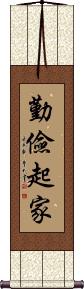
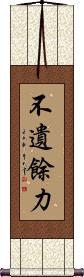
13. Diligence
14. Failure Teaches Success
15. Good Good Study, Day Day Up
16. Guide / Help / Cooperate
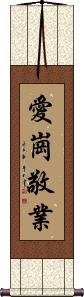
17. Industrious / Hard Working
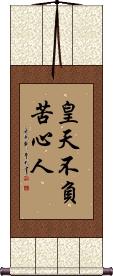
18. Heaven Blesses the Diligent
19. Inner Strength is Better than...
20. Jesus
21. Joyfulness / Happiness
22. Live Strong
23. A House Might be Worth 1 Million Dollars,...
24. Musashi
25. No Pain, No Gain
26. Appreciation & Love...
27. Read 10,000 Books, Travel 10,000 Miles
28. Always Striving for Inner Strength
29. Strong / Powerful
30. Strong bones come from hard knocks
31. Tenacious / Tenacity
32. Turtle
33. Unity / United
34. Each Time You Stumble & Fall,...

Acceptance of Fate / Happy With Your Fate

lè tiān
樂
天

This word is hard to define. One dictionary defines this as, "acceptance of fate and happy about it". There is one rare English word equivalent which is sanguinity.

You can also say that this means, "Be happy with whatever Heaven provides", or "Find happiness in whatever fate Heaven bestows upon you". This is kind of a way to suggest being an optimist in life.

Note: This is sometimes used as a given name in China.

Angel

(Name - Version 2)

ān hè ěr
安
赫
爾

This is another common transliteration to Mandarin Chinese for the name Angel. This one misses the mark too - It uses a hard "H" sound to simulate the "J" sound of the "G" in this name. I don't know who transliterated these first and how it became the standard.
Again, I recommend using the meaning of Angel above.

If anything, this is the more masculine form of Angel. This is also the form commonly used for the masculine Latin name Ángel.

Asian Pride / Oriental Pride
Asian Pryde / AZN Pryde

dōng fāng zì zūn
dung fong chi juen
tou hou zi son
동방자존
東
方
自
尊

We worked on this one for a long time. The effort involved both Chinese and Japanese translators and lengthly discussions. If you have been searching for this term, there is a reason that it's hard to find the way to write "Asian Pride" in Chinese and Japanese - it's because of the inherent difficulties in figuring out a universal combination of characters that can be read in all languages that use forms of Chinese characters.

This final solution that you see to the left creates a reasonable title in Chinese, and an exotic (perhaps unusual) title in Japanese (This could be read as "Eastern Self-Respect" in Japanese").
Although not as natural, it does have the same meaning in Korean Hanja and the older-generation of Vietnamese people will be able to read it too.

The first two characters literally mean "Oriental" and the second two mean "pride", "self-esteem", or "self-respect" (we chose the most non-arrogant way to say "pride"). If you have "Asian Pride" (sometimes spelled Asian Pryde) these are the characters for you.

Note: For those of you that wonder, there is nothing technically wrong with the word "Oriental". It is the most correct word, and any bad meanings were created by so-called "Asian Americans" and Caucasians in the United States. To say "Asian" would not completely correct to the intended meaning, since that would include people from Saudi Arabia, Iraq, Iran, India, and portions of Russia.

For further proof, if you were of East Asian ancestry and born in England, you would be known as a "British Oriental" (The "Oriental stigma" is basically an American creation and therefore applies mostly to the American English language - where they get a bit overzealous with political correctness).

Further, since the Chinese and Japanese word for Oriental is not English, it can not be construed having ill-meaning. One trip to China or Japan, and you will find many things titled with these two characters such as malls, buildings, and business names. These places also use "Oriental" as their English title (much as we do, since our Chinese business name starts with these same two characters).

In short, the first two character have the meaning that Americans attach to "Asian" but is more technically correct.

Wisdom from Hard Knocks

ái yī quán dé yī zhāo ái shí quán biàn zhū gě
挨
十
拳
變
諸
葛
挨
一
拳
得
一
招

Characters shown
above are read
vertically, starting
from the right

This literally translates as: Receive on blow, [and one] learns a lesson; Receive ten blows, [and one] becomes a great Zhuge [Liang]. You must first understand that a man named Zhuge Liang was one of the great strategists and philosophers in Chinese history. He's known as a man of great wisdom.

Figuratively, this phrase means:
One can learn much from failure or "hard knocks".

Bravery / Courage

Courage in the face of Fear

yǒng gǎn
yuu kan
용감
勇
敢

This word is about courage is bravery in the face of fear. You do the right thing even when it is hard or scary. When you are courageous, you don't give up. You try new things. You admit mistakes. This kind of courage is the willingness to take action in the face of danger and peril.

These characters can also be translated as: braveness, valor, heroic, fearless, boldness, prowess, gallantry, audacity, daring, dauntless and/or courage in Japanese, Chinese, and Korean. This version of bravery/courage can be an adjective or a noun. The first character means bravery and courage by itself. The second character means "daring" by itself. The second character just emphasizes the meaning of the first, but adds an idea that you are not afraid of taking a dare, and you are not afraid of danger.

This is about brave behavior versus the mental state of being brave. You'd more likely use this to say, "He fought courageously in the battle", rather than "He is very courageous".

See Also...  Warrior

You May Learn from Victory,
You Will Learn from Failure

bǎi shèng nán lǜ dí
sān zhé nǎi liáng yī

三
折
乃
良
醫
百
勝
難
慮
敵

Characters shown
above are read
vertically, starting
from the right

This literally translates as: [Even a general who has won a] hundred victories [may be] hard put to see through the enemy's [strategy], [but one who has] broken [his] arm three [times] [will] be a good doctor.

Figuratively, this means: One cannot always depend on past successes to guarantee future success, but one can always learn from lessons drawn from failure.

See Also...  Failure - Mother Of Success | Experience - Mother Of Success | Fall Down 7 Times Get Up 8 | Hard Knocks

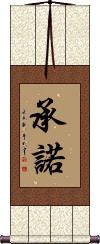
Commitment

chéng nuò
shoudaku
승낙
承
諾

Commitment is caring deeply about something or someone. It is deciding carefully what you want to do, and then giving it 100%, holding nothing back. You give your all to a friendship, a task, or something you believe in. You finish what you start. You keep your promises.

In Chinese, this word directly means to undertake something or to make a promise to do something.

Within the idea of commitment, this word also means to make a big effort, or undertaking a great task. Outside of the commitment idea, this particular word can also mean approval, acceptance, consent, assent, acquiescence, or agreement depending on context (especially in Japanese and Korean). Therefore this word is probably best if your audience is Chinese.

See Also...  Partnership | Hard Work | Dedication

Back to the top of this page

Black Eagle / Condor

jiù
washi
鷲

This is the way to write black eagle, or condor in Chinese. It means eagle (sometimes vulture) in Japanese Kanji. This character hasn't been in common use in Korean for hundreds of years, so it's hard to say what bird it represented in old Korean Hanja.

There are other multi-character words which express different specific species of birds of prey (bald eagle, osprey, golden eagle, etc).

If you need a more specific title, just post a special Asian calligraphy title request on our forum.

Confucius: Golden Rule / Ethic of Reciprocity

Do not do to others what
you do not want done to yourself

jǐ suǒ bú yù wù shī yú rén
기소불욕물시어인
己
所
不
欲
勿
施
於
人

Some may think of this as a "Christian trait" but actually it transcends many religions.

This Chinese teaching dates back to about 2,500 years ago in China. Confucius had always taught the belief in being benevolent (ren) but this idea was hard to grasp for some of his students, as benevolence could be kind-heartedness, or an essence of humanity itself.

When answering Zhong Gong's question as to what "ren" actually meant, Confucius said:

"When you go out, you should behave as if you were in the presence of a distinguished guest, when people do favors for you, act as if a great sacrifice was made for you. Whatever you wouldn't like done to you, do not do that thing to others. Don't complain at work or at home."

Hearing this, Zhong Gong said humbly, "Although I am not clever, I will do what you say."

From this encounter, the Chinese version of the "Golden Rule" or "Ethic of Reciprocity" came to be.
The characters you see above express, "Do not do to others whatever you do not want done to yourself."

See Also...  Confucius Teachings | Benevolence

Cooperation / Collaboration

xié zuò
kyousaku
협작
協
作

Cooperation is working together and sharing the load. When we cooperate, we join with others to do things that cannot be done alone. We are willing to follow the rules which keep everyone safe and happy. Together we can accomplish great things.

The first character means "united" or "to coordinate". The second character means "to do", "to make", or "to compose". Knowing this, you can understand why together, these characters create a word that can be defined as "cooperation" in Chinese, Japanese, and Korean.

It is implied that you are cooperating to create some project or product.

See Also...  Partnership | Commitment

Back to the top of this page

Cooperation (Japanese / Korean)

xié lì
kyouryoku
협력
協
力

If you look at the second character, which means "strength" or "power", and then you look at the first character, you will see that the first character seems to represent multiple "strengths" together. Thus you can visually see the meaning of this word as "stronger when working together". The combination of characters that form this word is commonly seen in Japanese Kanji and Korean Hanja, but not used in China (however, a Chinese person could probably guess the meaning, and it can be pronounced in Chinese).

It is implied that you are cooperating to create some project or product.

This can also be translated as "joint effort".

See Also...  Partnership | Commitment

Determination

jué xīn
kesshin
결심
決
心

You focus your energy and efforts on a task and stick with it until it is finished. Determination is using your will power to do something when it isn't easy. You are determined to meet your goals even when it is hard or you are being tested. With determination we make our dreams come true.

The first characters means "to determine" or "determined". The second character means "heart" or "soul", so you can imagine that this form of "determination" partially means to put your heart into something. It can also be translated as resolve, resolution, or decision (as in a decision made and followed).

See Also...  Devotion | Tenacious | Passion | Dedication | Will-Power

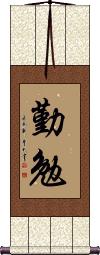
Diligence

qín miǎn
kinben
근면
勤
勉

Diligence is working hard and doing your absolute best. You take special care by doing things step by step. Diligence helps you to get things done with excellence and enthusiasm. Diligence leads to success.

These characters can also be translated as industry, industrious, assiduity, assiduous, diligent, or sedulity.

See Also...  Hard Work | Tenacity | Commitment | Passion For A Cause

Back to the top of this page

Diligence

(single character)

qín
kin
勤

This single-character means diligence or "sense of duty" in Chinese and Korean (also understood in Japanese, but not commonly-seen as a stand-alone Kanji).

As a single character on a wall scroll, this will only be seen with this meaning. However, in certain context, it can mean "frequent".

If you, or someone you know is a hard-worker (or needs a reminder to be diligent), then this is the wall scroll to have in your/their office.

See Also...  Tenacity | Undaunted

Failure Teaches Success

shi ppai ha sei kou no mo to
功
の
も
と
失
敗
は
成

Characters shown
above are read
vertically, starting
from the right

This Japanese proverb means "Failure is base of success" or "Every failure is a stepping stone to success".

The basic idea is that you must learn what does not work (though failure) before you can discover what does work.

Virtually every successful person has many failures in their history. Ask them and most will tell you that they learned more from their failures than their successes.

See Also...  Wisdom From Hard Knocks

Good Good Study, Day Day Up

hǎo hǎo xué xí tiān tiān xiàng shàng
好
好
學
習
天
天
向
上

This is a famous phrase by Chairman Mao Zedong that sounds really strange when directly translated into English. I include it in our database of phrases to illustrate how different the construction and grammar can be between Chinese and English. The direct translation is "Good Good Study, Day Day Up". In Chinese, a repeated character/word can often serve to reinforce the idea (like saying "very" or suggesting "a lot of"). So "good good" really means "a lot of good". While "day day" can be better translated as "day in day out". The idea of "up" has a meaning in China of "rising above" or "improving".

After understanding all of this, we come up with a slightly better translation of "With lot of good study, day in day out, we raise above".

The more natural translation of this phrase would be something like, "study hard, and keep improving".

Back to the top of this page

Guide / Help / Cooperate

tí xié
tei kei
제휴
提
携

This word varies a bit depending on which language you are reading it in.

This means to guide and help (younger people) in Chinese.
Cooperation or "working in concert" in Korean.
And, cooperation, tie-up, joint business, link-up in Japanese.

Industrious / Hard Working

ài gǎng jìng yè
愛
崗
敬
業

Used to refer to someone who puts forth maximum effort and achieves much. We might call this kind of person a "go-getter" in English.

See Also...  Dedication | Tenacious | Devotion

Heaven Blesses the Diligent
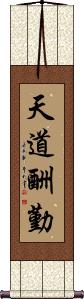
tiān dào chóu qín
천도수근
天
道
酬
勤

This can be interpreted a few different ways:
God blesses those who work hard.
It is the way of Heaven to smile on the diligent.
God will reward those that are worthy.
Heaven blesses those who are diligent.

Whichever translation you like, a scroll like this on your wall may serve as a reminder to work hard because your diligence will pay off both in this life and the next.


Note: This can be pronounced in Korean, but it's not a commonly-used term.

Back to the top of this page

Inner Strength is Better than
Outward Appearance

biǎo zhuàng bù rú lǐ zhuàng
如
裡
壯
表
壯
不

Characters shown
above are read
vertically, starting
from the right

This literally translates as:
[Better to be] strong inside than [to be] strong outside.

The ancient original meaning was:
[An] able [husband] outside [working to support a family is] not as good as [an] able [wife] inside [working and saving to take care of the family].

The current meaning is:
Inner strength is more important than outward appearance.

Jesus

yē sū
耶
穌

This is simply the name "Jesus" transliterated into Chinese. These characters hold a pronunciation in Mandarin that is closer to the real and original Hebrew Yeshua, instead of the incorrect way we have always pronounced Jesus in English with a hard "J" sound. While this name sounds like the real "Jesus" in Chinese, Christians in China are more likely to say "Christ" (Jidu) which holds more meaning than just sound.

If you are Latino and have been given the name "Jesus", this is also how to write your name in Chinese.

Joyfulness / Happiness

kuài lè
kai raku
쾌락
快
樂

Joyfulness is an inner sense of peace and happiness. You appreciate the gifts each day brings. Without joyfulness, when the fun stops, our happiness stops. Joy can carry us through the hard times even when we are feeling very sad.

This word can also mean pleasure, enjoyment, delight, cheerful, or merry. In some ways, this is the essence that makes someone to be perceived as a charming person.

See Also...  Happiness

Back to the top of this page

Live Strong

jiān qiáng shēng huó
堅
強
生
活

While hard to translate directly, this is the best way to write "Live Strong" in Chinese. If you are a cancer survivor, or simply support Lance Armstrong's ideas, this is a nice selection for a wall scroll.

The first two characters mean strong or staunch. The last two mean living or life (daily existence). While the Chinese version is the reverse order of "Live Strong" it is the only way to write it in a natural form that is also grammatically correct.

Note that we are in no way affiliated or connected to Lance, nor his foundation. This translation is offered because of multiple requests from customers whose philosophies or ideas match those of the Live Strong idea.

See Also...  Strength | Vitality | Health | Determination | Discipline

A House Might be Worth 1 Million Dollars,
But Good Neighboors are Worth 10 Million.

bǎi wàn mǎi zhái qiān wàn mǎi lín
千
萬
買
鄰
百
萬
買
宅

Characters shown
above are read
vertically, starting
from the right

This literally translates as:
[It may cost a] million to buy a house, [but] ten million to find [good] neighbors.

Figuratively, this means:
Good neighbors are hard to find.
Good neighbors are even more important than the quality of one's house.

Musashi

The most famous Samurai

mu sashi
武
蔵

This is the short title for a man long in legend. Miyamoto Musashi is probably the most famous Samurai in all of Japanese history. While coming from a lower class, his new sword and fighting techniques put him on par with the best that feudal Japan had to offer. His long career started with his first duel was at age 13!

He is credited both with using two swords at once, and never losing a single battle in his career. After becoming a Buddhist, and getting older, like many old warriors, he took up a peaceful and solitary life until his death around 1645 A.D.

Note: Technically, Musashi is his given name, and Miyamoto is his surname. However, it's suggested that he assumed both of these names, and also had a few other names at childhood, as well as being given a Buddhist name. It's hard to know what to call him, as with most Kanji, there are multiple pronunciations. The characters for Musashi can also be pronounced "Takezō". But, everyone in modern times seems to know him by the name Musashi.

Back to the top of this page

No Pain, No Gain

Literally: No Pain, No Strength

bú tòng bù qiáng
不
痛
不
強

This is close to our idea of "no pain, no gain" in English. It holds this meaning in the context of working out at the gym etc.

This literally means, "no pain, no strength", meaning that if you don't experience a little pain, you will not gain any strength.

Appreciation & Love
for Your Parents

shuí yán cùn cǎo xīn bào dé sān chūn huī
誰
言
寸
草
心
報
得
三
春
暉

This is the last line of a famous poem. It is perceived as a tribute or ode to your parent's or mother from a child or children that have left home.

The poem was written by Meng Jiao during the Tang Dynasty (about 1200 years ago). The Chinese title is "You Zi Yin" which means "The Traveler's Recite".

The last line as shown here speaks of the generous and warm spring sun light which gives the grass far beyond what the little grass can could ever give back (except perhaps by showing its lovely green leaves and flourishing). The metaphor is that the sun is your mother or parents, and you are the grass. Your parents raise you and give you all the love and care you need to prepare you for the world. A debt which you can never repay, nor is repayment expected.

The first part of the poem (not written in the characters to the left) suggests that the thread in a loving mother's hands is the shirt of her traveling offspring. Vigorously sewing while wishing them to come back sooner than they left.
...This part is really hard to translate into English that makes any sense, but maybe you get the idea. We are talking about a poem that is so old that many Chinese people would have trouble reading it (as if it was the King James Version of Chinese).

Read 10,000 Books, Travel 10,000 Miles

dú wàn juǎn shū, xíng wàn lǐ lù
行
萬
裡
路
讀
萬
卷
書

Characters shown
above are read
vertically, starting
from the right

This is a lifelong suggestion for expanding your horizons by gaining knowledge, experience, and seeing the world.

Of course, this was written long ago when it was hard to travel 10,000 miles.
With air travel and the business I'm in, I often achieve that lifetime goal on a monthly basis.
However, I am a little behind in the book count.

Note: An ancient Chinese mile (lǐ) referred to in this phrase is a bit shorter than a British/American mile.

Back to the top of this page

Always Striving for Inner Strength

zì qiáng bú xī
自
強
不
息

This proverb or idiom suggests that the pursuit self-improvement is eternal. The first two characters mean inner-strength with the idea of self-improvement. The last two characters mean "never rest" or "striving without giving up".

Some will translate these four characters as, "Exert and strive hard without any let up".

Strong / Powerful

qiáng
kyou
強

This "strong" character means strength, force, powerful, better, stubborn, and stiff (yes, all of this in one character). This "strong" has less to do with physical strength and more to do with having a winning attitude, or just having the ability to win at something.

Note that most of the time, this character is pronounced "qiang", but when used with the meaning of stubborn, unyielding, or stiff, it is pronounced "jiang" in Chinese.

Also, sometimes "qiang" is used in modern Chinese to describe people that do crazy things (Example: Bicycling from Beijing to Tibet alone). I sometimes can be found outside my Beijing apartment wearing nothing but shorts and a tee-shirt while eating an ice cream during a snow storm, just to hear my neighbors call me "qiang". Maybe they mean "strong" but perhaps they are using the new meaning of "crazy strong".

Also a Korean Hanja with same meaning, but mostly used in compound words.

This is used in Japanese (though normally in compound words). In Japanese, it has the same meaning, but in some context can mean "a little more than..." or "a little over [some amount]". Most Japanese would read this as tough, strength, stiff, hard, inflexible, obstinate, or stubborn.

Strong bones come from hard knocks

bù kē bù pèng bù yìng
骨
頭
不
硬
不
磕
不
碰

Characters shown
above are read
vertically, starting
from the right

This literally translates as: Without being knocked around a bit, [one's] bones won't become hard.

Figuratively, this means: One can't become strong without first being tempered by "hard knocks".

While true for everyone, this sounds like the "Iron Body" form of Kung Fu, where practitioners bodies are beaten (and often bone fractured) in order to become stronger.
For the rest of us, this is just about how we can be tempered and build character through the hardships in our lives.

Back to the top of this page

Tenacious / Tenacity

wán qiáng
gan kyou
완강
頑
強

These two characters together mean "Tenacious", "Hard to Defeat", or "Dogged".

Alone, the first character means mischievous, obstinate or stubborn. But it loses some of the mischievous meaning when the second character is added.

The second character means strength, force, powerful or better.

See Also...  Determination | Dedication | Devotion | Never Give Up

Turtle

...also means tortoise

guī
kame
龜

This is the generic term for turtle in Chinese, and old Korean Hanja. It's like saying "turtle" (or "tortoise") without being specific about species of turtle.

Please note that there are many special characters in Chinese and a few in Japanese that denote specific species of turtle, and do not include this character. We can't possibly cover all of these species, but if you want a certain one, such as "loggerhead" or a "leatherback", just post your request for a special Chinese / Japanese Kanji / Korean Hanja calligraphy word and we'll do our best to research your special species.

If you noticed, I said species names that do not include this character. This is because, in much the same way we can do it in English by just saying, "loggerhead", instead of "loggerhead turtle", the same can be done in Chinese and Japanese.

亀This may be hard to believe, but the image shown to the right is an alternate version of this character, which is currently used in Japan. This was originally an alternate form in ancient China for turtle - but it's so obscure now, that most Chinese people would just think this is the Japanese version of turtle (I did a lot of research on this). The version shown in the upper left is traditional Chinese (also used in Korea, prior to 100 years ago). It will generally not be recognized by the new generation of Japanese people. If your audience is Japanese, please click on the Kanji image shown to the right to have the calligrapher write that version (instead of clicking the button above).

Unity / United

Join Forces / Rally Together

tuán jié
단결
團
結

There's not a perfect match to the English word "unity" in Chinese. But this word is pretty close. It speaks to the idea of joining forces, and working as one. It could even mean to rally together to achieve a goal, or defeat a common enemy.

Back to the top of this page

Each Time You Stumble & Fall,
You Gain Experience & Wisdom

chī yí qiàn, zhǎng yí zhì
흘일참장일지
吃
一
塹
長
一
智

This Chinese proverb means:

"Fall into a moat and you will gain wisdom from the experience"

It really suggests that the failures, troubles, frustrations, and setbacks that you encounter in your life are actually helping you to find wisdom. Some would also translate this proverb as:

"Learn from your mistakes" or "Learn from your experience".

If you are studying Chinese, you will recognize the first character as "eat", but in this case, it means to "experience" (as used in this proverb, it is suggesting that you have fallen into a moat and/or had a hard time crossing it).
Literally translated character by character, this whole proverb is:

"Experience one moat, gain one wisdom/knowledge".

Note: This can be pronounced in Korean, but it's not a commonly-used phrase.


You should look at these ready-to-ship pieces of artwork:

Jujube Village - Southern Chinese Folk Art Painting

Jujube Village
Southern Chinese Folk Art Painting

This is a nice village scene with everyone working together to pick and harvest jujubes from this grove of trees.

Typical Gallery Price: $60.00

Your Price: $29.95 

Euro €22.76 
CAD $30.02 

GBP £18.94 
AUD $28.02 


MORE INFO 

Jujube Village - Southern Chinese Folk Art Painting

Jujube Village
Southern Chinese Folk Art Painting

This is a nice village scene with everyone working together to pick and harvest jujubes from this grove of trees.

Typical Gallery Price: $60.00

Your Price: $29.95 

Euro €22.76 
CAD $30.02 

GBP £18.94 
AUD $28.02 


MORE INFO 

Picking Jujubes - Southern Chinese Folk Art Painting

Picking Jujubes
Southern Chinese Folk Art Painting

This is a nice village scene with everyone working together to pick and harvest jujubes from this grove trees.

Typical Gallery Price: $60.00

Your Price: $29.95 

Euro €22.76 
CAD $30.02 

GBP £18.94 
AUD $28.02 


MORE INFO 

Mountain Village Harvest - Huxian Chinese Folk Art

Mountain Village Harvest
Huxian Chinese Folk Art

The colors in this painting certainly portray the Autumn season. Villagers work hard carrying baskets from the trees in the mountains back to their village.

Typical Gallery Price: $70.00

Your Price: $29.95 

Euro €22.76 
CAD $30.02 

GBP £18.94 
AUD $28.02 


MORE INFO 


A nice Chinese calligraphy wall scroll

The scroll that I am holding in this picture is a "medium size"
4-character wall scroll.
As you can see, it is a great size to hang on your wall.
(We also offer custom wall scrolls in larger sizes)

A professional Chinese Calligrapher

Professional calligraphers are getting to be hard to find these days.
Instead of drawing characters by hand, the new generation in China merely type roman letters into their computer keyboards and pick the character that they want from a list that pops up.

There is some fear that true Chinese calligraphy may become a lost art in the coming years. Many art institutes in China are now promoting calligraphy programs in hopes of keeping this unique form of art alive.

Trying to learn Chinese calligrapher - a futile effort

Even with the teachings of a top-ranked calligrapher in China, my calligraphy will never be good enough to sell. I will leave that to the experts.


A high-ranked Chinese master calligrapher that I met in Zhongwei

The same calligrapher who gave me those lessons also attracted a crowd of thousands and a TV crew as he created characters over 6-feet high. He happens to be ranked as one of the top 100 calligraphers in all of China. He is also one of very few that would actually attempt such a feat.


See: Our list of specifically Japanese Kanji Calligraphy Wall Scrolls. And, check out Our list of specifically old Korean Hanja Calligraphy Wall Scrolls.

The following table is only helpful for those studying Chinese (or Japanese), and perhaps helps search engines to find this page when someone enters Romanized Chinese or Japanese

TitleCharacters
Simplified
Traditional
Japanese Romaji
(Romanized Japanese)
Various forms of Romanized Chinese
Acceptance of Fate / Happy With Your Fate乐天
樂天
n/alè tiān
le tian
le t`ien
le4 tian1
letian
letien
le tien
Angel安赫尔
安赫爾
n/aān hè ěr
an he er
an ho erh
an1 he4 er3
anheer
Asian Pride / Oriental Pride / Asian Pryde / AZN Pryde东方自尊
東方自尊
tou hou zi son
touhouzison
to ho zi son
dōng fāng zì zūn
dong fang zi zun
tung fang tzu tsun
dong1 fang1 zi4 zun1
dongfangzizun
Wisdom from Hard Knocks挨一拳得一招挨十拳变诸葛
挨一拳得一招挨十拳變諸葛
n/aái yī quán dé yī zhāo ái shí quán biàn zhū gě
ai yi quan de yi zhao ai shi quan bian zhu ge
ai i ch`üan te i chao ai shih ch`üan pien chu ko
ai2 yi1 quan2 de2 yi1 zhao1 ai2 shi2 quan2 bian4 zhu1 ge3
ai i chüan te i chao ai shih chüan pien chu ko
Bravery / Courage勇敢
勇敢
yuu kan
yuukan
yu kan
yǒng gǎn
yong gan
yung kan
yong3 gan3
yonggan
You May Learn from Victory, You Will Learn from Failure百胜难虑敌三折乃良医
百勝難慮敵三折乃良醫
n/abǎi shèng nán lǜ dí sān zhé nǎi liáng yī
bai sheng nan lv di san zhe nai liang yi
pai sheng nan lü ti san che nai liang i
bai3 sheng4 nan2 lv4 di2 san1 zhe2 nai3 liang2 yi1
Commitment承诺
承諾
shoudaku
shodaku
chéng nuò
cheng nuo
ch`eng no
cheng2 nuo4
chengnuo
chengno
cheng no
Black Eagle / Condor
washijiù
jiu
chiu
jiu4
jiu
Confucius: Golden Rule / Ethic of Reciprocity己所不欲勿施于人
己所不欲勿施於人
n/ajǐ suǒ bú yù wù shī yú rén
ji suo bu yu, wu shi yu ren
chi so pu wu shih yü jen
ji3 suo3 bu2 yu4, wu4 shi1 yu2 ren2
jisuobuyu,wushiyuren
Cooperation / Collaboration协作
協作
kyousaku
kyosaku
xié zuò
xie zuo
hsieh tso
xie2 zuo4
xiezuo
Cooperation (Japanese / Korean)协力
協力
kyouryoku
kyoryoku
xié lì
xie li
hsieh li
xie2 li4
xieli
Determination决心
決心
kesshin
keshin
jué xīn
jue xin
chüeh hsin
jue2 xin1
juexin
Diligence勤勉
勤勉
kinbenqín miǎn
qin mian
ch`in mien
qin2 mian3
qinmian
chinmien
chin mien
Diligence
kinqín
qin
ch`in
qin2
qin
chin
chin
Failure Teaches Success失敗は成功のもと
失敗は成功のもと
shi ppai ha sei kou no mo to
shippaihaseikounomoto
shi pai ha sei ko no mo to
n/a
Good Good Study, Day Day Up好好学习天天向上
好好學習天天向上
n/ahǎo hǎo xué xí tiān tiān xiàng shàng
hao hao xue xi tian tian xiang shang
hao hao hsüeh hsi t`ien t`ien hsiang shang
hao3 hao3 xue2 xi2 tian1 tian1 xiang4 shang4
hao hao hsüeh hsi tien tien hsiang shang
Guide / Help / Cooperate提携
提携
tei kei
teikei
tí xié
ti xie
t`i hsieh
ti2 xie2
tixie
tihsieh
ti hsieh
Industrious / Hard Working爱岗敬业
愛崗敬業
n/aài gǎng jìng yè
ai gang jing ye
ai kang ching yeh
ai4 gang3 jing4 ye4
aigangjingye
Heaven Blesses the Diligent天道酬勤
天道酬勤
n/atiān dào chóu qín
tian dao chou qin
t`ien tao ch`ou ch`in
tian1 dao4 chou2 qin2
tiandaochouqin
tientaochouchin
tien tao chou chin
Inner Strength is Better than
Outward Appearance
表壮不如里壮
表壯不如裡壯
n/abiǎo zhuàng bù rú lǐ zhuàng
biao zhuang bu ru li zhuang
piao chuang pu ju li chuang
biao3 zhuang4 bu4 ru2 li3 zhuang4
biaozhuangburulizhuang
Jesus耶稣
耶穌
n/ayē sū
ye su
yeh su
ye1 su1
yesu
Joyfulness / Happiness快乐
快樂
kai raku
kairaku
kuài lè
kuai le
k`uai le
kuai4 le4
kuaile
kuaile
kuai le
Live Strong坚强生活
堅強生活
n/ajiān qiáng shēng huó
jian qiang sheng huo
chien ch`iang sheng huo
jian1 qiang2 sheng1 huo2
jianqiangshenghuo
chienchiangshenghuo
chien chiang sheng huo
A House Might be Worth 1 Million Dollars, But Good Neighboors are Worth 10 Million.百万买宅千万买邻
百萬買宅千萬買鄰
n/abǎi wàn mǎi zhái qiān wàn mǎi lín
bai wan mai zhai qian wan mai lin
pai wan mai chai ch`ien wan mai lin
bai3 wan4 mai3 zhai2 qian1 wan4 mai3 lin2
pai wan mai chai chien wan mai lin
Musashi武蔵
武蔵
mu sashi
musashi
n/a
No Pain, No Gain不痛不强
不痛不強
n/abú tòng bù qiáng
bu tong bu qiang
pu t`ung pu ch`iang
bu2 tong4 bu4 qiang2
butongbuqiang
putungpuchiang
pu tung pu chiang
Appreciation & Love
for Your Parents
谁言寸草心报得三春晖
誰言寸草心報得三春暉
n/ashuí yán cùn cǎo xīn bào dé sān chūn huī
shui yan cun cao xin bao de san chun hui
shui yen ts`un ts`ao hsin pao te san ch`un hui
shui2 yan2 cun4 cao3 xin1 bao4 de2 san1 chun1 hui1
shui yen tsun tsao hsin pao te san chun hui
Read 10,000 Books, Travel 10,000 Miles读万卷书行万里路
讀萬卷書行萬裡路
n/adú wàn juǎn shū, xíng wàn lǐ lù
du wan juan shu xing wan li lu
tu wan chüan shu hsing wan li lu
du2 wan4 juan3 shu1 xing2 wan4 li3 lu4
duwanjuanshuxingwanlilu
Always Striving for Inner Strength自强不息
自強不息
n/azì qiáng bú xī
zi qiang bu xi
tzu ch`iang pu hsi
zi4 qiang2 bu2 xi1
ziqiangbuxi
tzuchiangpuhsi
tzu chiang pu hsi
Strong / Powerful
kyou
kyo
qiáng
qiang
ch`iang
qiang2
qiang
chiang
chiang
Strong bones come from hard knocks不磕不碰骨头不硬
不磕不碰骨頭不硬
n/abù kē bù pèng bù yìng
bu ke bu peng gutou bu ying
pu k`o pu p`eng pu ying
bu4 ke1 bu4 peng4 gu3tou bu4 ying4
bukebupenggutoubuying
pukopupengpuying
pu ko pu peng pu ying
Tenacious / Tenacity顽强
頑強
gan kyou
gankyou
gan kyo
wán qiáng
wan qiang
wan ch`iang
wan2 qiang2
wanqiang
wanchiang
wan chiang
Turtle龟 / 亀
kameguī
gui
kuei
gui1
gui
Unity / United团结
團結 / 糰結
n/atuán jié
tuan jie
t`uan chieh
tuan2 jie2
tuanjie
tuanchieh
tuan chieh
Each Time You Stumble & Fall, You Gain Experience & Wisdom吃一堑长一智
吃一塹長一智
n/achī yí qiàn, zhǎng yí zhì
chi yi qian zhang yi zhi
ch`ih i ch`ien chang i chih
chi1 yi2 qian4 zhang3 yi2 zhi4
chiyiqianzhangyizhi
chihichienchangichih
chih i chien chang i chih

If you have not set up your computer to display Chinese, the characters in this table probably look like empty boxes or random text garbage.
This is why I spent hundreds of hours making images so that you could view the characters in the "hard-work" listings above.
If you want your Windows computer to be able to display Chinese characters you can either head to your Regional and Language options in your Win XP control panel, select the [Languages] tab and click on [Install files for East Asian Languages]. This task will ask for your Win XP CD to complete in most cases. If you don't have your Windows XP CD, or are running Windows 98, you can also download/run the simplified Chinese font package installer from Microsoft which works independently with Win 98, ME, 2000, and XP. It's a 2.5MB download, so if you are on dial up, start the download and go make a sandwich.

Some people may refer to this entry as Kanji, Characters, in Mandarin Chinese, Characters, in Chinese Writing, in Japanese Writing, in Asian Writing, Ideograms, Chinese symbols, Hieroglyphics, Glyphs, in Chinese Letters, Hanzi, in Japanese Kanji, Pictograms, in the Chinese Written-Language, or in the Japanese Written-Language.


Copyright Oriental Outpost 2002-2011   -   All Rights Reserved
Image Use Policy Privacy Policy