Many custom options...


And formats...



Profound Word in Chinese / Japanese...
Buy a Profound Word calligraphy wall scroll here!
Personalize your custom “Profound Word” project by clicking the button next to your favorite “Profound Word” title below...
1. Intense / Serious / Deep / Profound
2. Words Have Enormous Weight: One Word Worth Nine Caldrons
4. I am Enough
5. Mysterious
6. Sangha
Intense / Serious / Deep / Profound
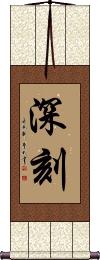
深刻 is a Chinese word that is the form of intense that describes a person who is deep, serious, and a true thinker.
If you find yourself contemplating the world and coming up with profound ideas, this might be the word for you. In some contexts (especially Korean), it can mean seriousness, gravity, or acuteness.
In Japanese, this can mean “serious problem” or can be a rare given name, Misa. You should not use this if your audience is Japanese.
Words Have Enormous Weight: One Word Worth Nine Caldrons
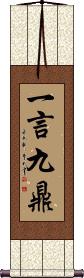
一言九鼎 is an ancient Chinese proverb used in modern times to talk of profound or powerful words.
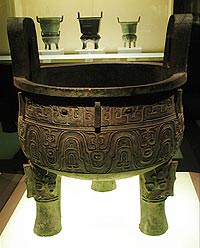 The literal meaning is “one word [worth] nine [sacred] tripods.” The tripod is a highly-prized three-legged (sometimes four-legged) metal pot or kettle of ancient China. They are often made of bronze, and the Emperor would have large ones gilded in gold. See the image to the right for an example.
Intense / Serious
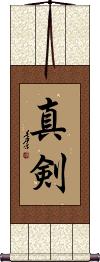
真剣 is a Japanese word that means intense, serious, or earnest. It describes a person who is deep, serious, and a true thinker or dreamer.
Literally, this means “true sword,” as compared to a sharpened wooden practice sword blank. It's real, true, and serious.
I am Enough
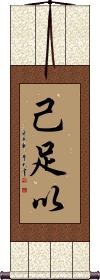
己足以 is a profound and philosophical way to say “I am enough” in Chinese.
The first character means self or oneself.
The last two characters are a word that means sufficient or enough.
Mysterious
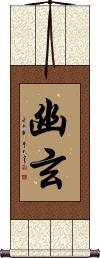
幽玄 is the Chinese, Japanese Kanji, and old Korean Hanja word meaning dim, deep, mysterious, subtle grace, hidden beauty, mysterious profundity, elegant simplicity, or subtle and profound.
This can also be the Japanese personal name Yuugen or Yugen.
Sangha
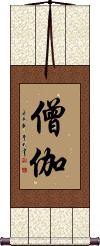
In Buddhism, 僧伽 refers to a community of monks and/or nuns (one of the “Three Jewels”). In general terms, it can simply mean “all followers of the Buddha.”
Notes: Though there are not vast numbers of Chinese Hindus, in the Hindu faith, this term means “community together.”
The original Sanskrit word is also Romanized as samgha.
The first character means “monk.” The second character means Buddha or Shakyamuni.
僧伽 is a transliteration of the original Sanskrit, but it uses two very profound Chinese characters related to Buddhism.
Some may pronounce this as “seng qie” or “seng jia” in Mandarin (two possible pronunciations for the second character). Note that “qie” sounds like “chee-ah” using typical English pronunciation. Chinese Romanization is not actually designed to match English sounds.

 Note that when writing this as Kanji, Japanese will tend to write the first character in the form shown to the right. If you select our Japanese master calligrapher, please expect this special Kanji form. However, it should also be noted that this is not a common term in Japanese (except by certain sects of Buddhism or perhaps devout Buddhists in Japan).
This in-stock artwork might be what you are looking for, and ships right away...
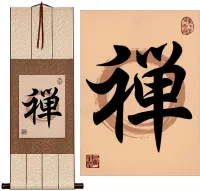
Gallery Price: $90.00
Your Price: $49.88

Gallery Price: $108.00
Your Price: $59.88
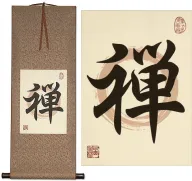
Not the results for profound word that you were looking for?
Below are some entries from our dictionary that may match your profound word search...
| Characters If shown, 2nd row is Simp. Chinese |
Pronunciation Romanization |
Simple Dictionary Definition |
禪 禅 see styles |
shàn shan4 shan yuzuri ゆずり |
More info & calligraphy: Zen / Chan / Meditation(out-dated kanji) (1) (Buddhist term) dhyana (profound meditation); (2) (abbreviation) Zen (Buddhism); (surname) Yuzuri To level a place for an altar, to sacrifice to the hills and fountains; to abdicate. Adopted by Buddhists for dhyāna, 禪 or 禪那, i.e. meditation, abstraction, trance. dhyāna is 'meditation, thought, reflection, especially profound and abstract religious contemplation'. M.W. It was intp. as 'getting rid of evil', etc., later as 靜慮 quiet meditation. It is a form of 定, but that word is more closely allied with samādhi, cf. 禪定. The term also connotes Buddhism and Buddhist things in general, but has special application to the 禪宗 q.v. It is one of the six pāramitās, cf. 波. There are numerous methods and subjects of meditation. The eighteen brahmalokas are divided into four dhyāna regions 'corresponding to certain frames of mind where individuals might be reborn in strict accordance with their spiritual state'. The first three are the first dhyāna, the second three the second dhyāna, the third three the third dhyāna, and the remaining nine the fourth dhyāna. See Eitel. According to Childers' Pali Dictionary, 'The four jhānas are four stages of mystic meditation, whereby the believer's mind is purged from all earthly emotions, and detached as it were from his body, which remains plunged in a profound trance.' Seated cross-legged, the practiser 'concentrates his mind upon a single thought. Gradually his soul becomes filled with a supernatural ecstasy and serenity', his mind still reasoning: this is the first jhāna. Concentrating his mind on the same subject, he frees it from reasoning, the ecstasy and serenity remaining, which is the second jhāna. Then he divests himself of ecstasy, reaching the third stage of serenity. Lastly, in the fourth stage the mind becomes indifferent to all emotions, being exalted above them and purified. There are differences in the Mahāyāna methods, but similarity of aim. |
The following table may be helpful for those studying Chinese or Japanese...
| Title | Characters | Romaji (Romanized Japanese) | Various forms of Romanized Chinese | |
| Intense Serious Deep Profound | 深刻 | shinkoku / misa | shēn kè / shen1 ke4 / shen ke / shenke | shen k`o / shenko / shen ko |
| Words Have Enormous Weight: One Word Worth Nine Caldrons | 一言九鼎 | yī yán jiǔ dǐng yi1 yan2 jiu3 ding3 yi yan jiu ding yiyanjiuding | i yen chiu ting iyenchiuting |
|
| Intense Serious | 真剣 | shin ken / shinken | ||
| I am Enough | 己足以 | jǐ zú yǐ ji3 zu2 yi3 ji zu yi jizuyi | chi tsu i chitsui |
|
| Mysterious | 幽玄 | yū gen / yūgen | yōu xuán / you1 xuan2 / you xuan / youxuan | yu hsüan / yuhsüan |
| Sangha | 僧伽 | sougya / sogya | sēng qié / seng1 qie2 / seng qie / sengqie | seng ch`ieh / sengchieh / seng chieh |

Successful Chinese Character and Japanese Kanji calligraphy searches within the last few hours...



