Many custom options...


And formats...



Find a Way in Chinese / Japanese...
Buy a Find a Way calligraphy wall scroll here!
Personalize your custom “Find a Way” project by clicking the button next to your favorite “Find a Way” title below...
3. Immovable Mind Way / Fudoshin Way
4. A Truly Determined Person Will Find a Solution
5. Mark the boat to find the lost sword / Ignoring the changing circumstances of the world
6. Achieve Inner Peace; Find Deep Understanding
8. True Religion / Buddha Truth
10. Wave
11. The Way of Light
14. The Way of Tea
15. Buddha Way
18. The Way of Five Pecks of Rice
19. Dharma / The Law
20. Kendo / The Way of the Sword
21. Milky Way Galaxy
23. Bushido / The Way of the Samurai
24. Where there’s a will there’s a way
25. The Middle Way
26. Milky Way Galaxy
27. Where There is a Will, There is a Way
28. Karate-Do
29. Move On / Change Way of Thinking
30. Where There is a Will, There is a Way
33. There is one single thread binding my Way together
34. The Way of Learning Has No End
35. Isshin-Kai
36. Daoism / Taoism
37. Tang Soo Do / Tang Hand Way
40. Walking 100 Miles: Stopping at 90 miles, is the same as stopping half-way
42. Nankurunaisa
43. The Guts Theory
44. Woman
45. To a Willing Heart, All Things Are Possible
47. Danger
Love Will Find A Way
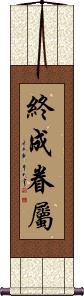
終成眷屬 is a Chinese proverb that translates roughly as “Love will find a way to come together.”
Love Will Find A Way
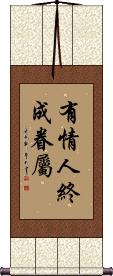
有情人終成眷屬 is the long version of the Chinese proverb that translates as “Where there are lovers, love will find a way (to come together).”
Walk in the Way
The Way of Buddha Truth
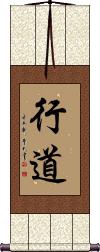
In Taoist and Buddhist contexts, 行道 means to “Walk in the Way.” In Buddhism, that further means to follow the Buddha truth. In some Buddhist sects, this can mean making a procession around a statue of the Buddha (always with the right shoulder towards the Buddha).
Outside of that context, this can mean route (when going somewhere), the way to get somewhere, etc.
In Japanese, this can be the surname or given name Yukimichi.
Immovable Mind Way / Fudoshin Way

A Truly Determined Person Will Find a Solution
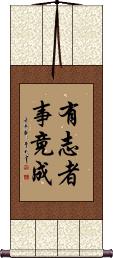
有志者事竟成 is a Chinese proverb that means “A really determined person will find a solution.”
It figuratively means “Where there's a will, there's a way.”
Mark the boat to find the lost sword / Ignoring the changing circumstances of the world
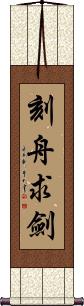
刻舟求劍 is an originally-Chinese proverb that serves as a warning to people that things are always in a state of change.
Thus, you must consider that and not depend on the old ways or a way that may have worked in the past but is no longer valid.
This idiom/proverb comes from the following story:
A man was traveling in a ferry boat across a river. With him, he carried a treasured sword. Along the way, the man became overwhelmed and intoxicated by the beautiful view and accidentally dropped his prized sword into the river. Thinking quickly, he pulled out a knife and marked on the rail of the boat where exactly he had lost his sword.
When the boat arrived on the other side of the river, the man jumped out of the boat and searched for his sword right under where he'd made the mark. Of course, the boat had moved a great distance since he made the mark, and thus, he could not find the sword.
While this man may seem foolhardy, we must take a great lesson from this parable: Circumstances change, so one should use methods to handle the change. In modern China, this is used in business to mean that one should not depend on old business models for a changing market.
This proverb dates back to the Spring and Autumn period (770–476 BC) of the territory now known as China. It has spread and is somewhat known in Japan and Korea.
Achieve Inner Peace; Find Deep Understanding
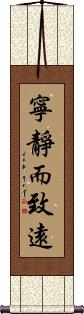
寧靜而致遠 is five characters from a longer ten-character proverb composed by Zhuge Liang about 1800 years ago.
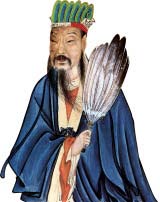
诸葛亮 Zhuge Liang
The proverb means “Your inner peace/tranquility/serenity will help you see or reach far (into the world).”
The last word means “far” but the deeper meaning is that you will surpass what you can currently see or understand. Perhaps even opening up vast knowledge and understanding of complex ideas.
There is always a way out
Never say die
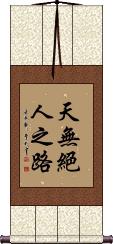
天無絕人之路 is a proverb that means “Heaven never bars one's way,” “Don't despair and you will find a way through,” and “Never give up hope,” and is the Chinese way to say “Never say die.”
True Religion / Buddha Truth
The way of the truth
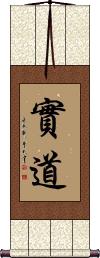
實道 is a Buddhist title that means “The true way,” “The true religion,” “The way of the truth,” or “The absolute Buddha-truth.”
Thirst for Truth
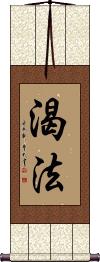
渴法 means to thirst for the truth or the Buddha-way.
渴法 is the internal need to seek the way of the truth in Buddhism.
Wave
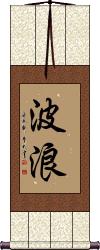
If you like to ride a surfboard, and/or “The Way of the Wave” is your life, 波浪 could be the scroll for you.
The additional meanings contained in these characters include ripple, storm, surge, breaker, wandering, and unrestrained.
The Way of Light

光道 can be translated as “The Way of Light,” “The Way of Radiance/Brightness,” or “Light Way.”
The Way of the Dragon
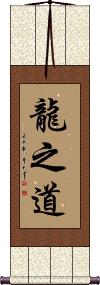
龍之道 is how the way of the dragon is written in Chinese.
龍之道 is not the same as the Chinese movie that was titled in English as “The Way of the Dragon.” 龍之道 is, rather, the literal meaning of the dragon's way. The first character is dragon, the second is a possessive article, and the third character means way or path.
The Way of the Wave
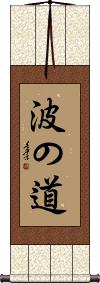
波の道 is the simple way to write “The Way of the Wave” in Japanese.
I added this at the request of several customers. 波の道 is not a very common Japanese phrase.
波 = Wave
の = Of
道 = Way
The word order is the opposite of English. Most Japanese phrases that end in “の道” are translated to English as “The Way of...”
Technically, you could write “波道” as a shorter version of “The Way of the Wave.” However, without context, 波道 can mean channel or suggest a path to redirect ocean flow.
The Way of Tea
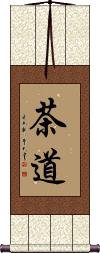
茶道 means The Way of Tea (literally, “tea way”) in Chinese and Japanese.
This may refer to a tea ceremony or a general lifestyle of tea preparation and drinking.
In Japanese, this can be pronounced sadō or chadō (seems that sadō refers more often to a tea ceremony, and chadō when it's the Way of Tea).
茶道 is also used in the Buddhist context with the same meaning as the Way of Tea.
Buddha Way
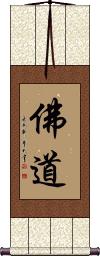
佛道 is “The way of Buddha, leading to Buddhahood” or the way to becoming a bodhi and enlightened.
Known in Japanese as Butsudō, in Mandarin Chinese as Fódào, and in Korean as Buldo or 불도.
The Way of the Dragon
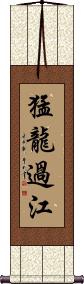
猛龍過江 is the title of the 1972 movie, “The Way of the Dragon.”
This means “Fierce dragons crossing the river.”
If you want a title that means “way of the dragon,” please see the more accurate 龍之道 3-character title.
The Way of the Wave
The Tao of the Waves
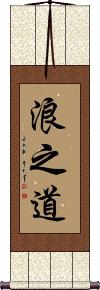
浪之道 is a great title for a surfer whose lifestyle is entwined with the surf and waves.
This can be translated a few different ways:
The Way of the Wave
The Dao of the Wave
The Tao of the Waves
Note: Dao and Tao are the same character (道), just sometimes romanized differently.
The Way of Five Pecks of Rice
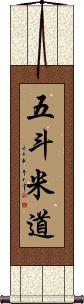
This Chinese and Japanese Kanji title means “Way of the Five Pecks of Rice.”
五斗米道 is a Taoist/Daoist movement that later became known as “The Way of the Celestial Masters.”
Dharma / The Law
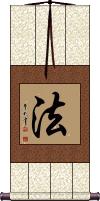
法 is the simple way to write “law” or in a Buddhist context “Dharma.”
This can also mean method, way, or Buddhist teaching. It's also an abbreviation for the country of France.
The Buddhist context exists in Chinese and Korean Hanja but I have not yet confirmed that this means more than “law” when used alone in Japanese.
Kendo / The Way of the Sword
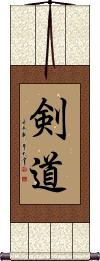
Often associated with Kenjutsu, 剱道/劍道 means “The way of the sword” in Japanese (and Korean with an alternate form of the first character).
This is also the term used for swordsmanship and even fencing in Japanese and Korean, depending on context.
Note: These same characters are also used separately in Chinese, but this exact combination yields a common title in Japanese only (perhaps someone who is really into swords would use this in China).
Note: There is more than one way to write the “sword” character (shown above is the Japanese version - if you want the Korean version, please let me know when you place your order).
Milky Way Galaxy
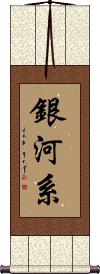
銀河系 is the long form of the Chinese, Japanese, and old Korean name for the Milky Way Galaxy (our galactic system).
Godo / The Hard Way

Bushido / The Way of the Samurai
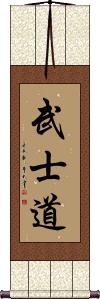
武士道 is the title for “The Code of the Samurai.”
Sometimes called “The Seven Virtues of the Samurai,” “The Bushido Code,” or “The Samurai Code of Chivalry.”
This would be read in Chinese characters, Japanese Kanji, and old Korean Hanja as “The Way of the Warrior,” “The Warrior's Way,” or “The Warrior's Code.”
It's a set of virtues that the Samurai of Japan and ancient warriors of China and Korea had to live and die by. However, while known throughout Asia, this title is mostly used in Japan and thought of as being of Japanese origin.
The seven commonly-accepted tenets or virtues of Bushido are Rectitude 義, Courage 勇, Benevolence 仁, Respect 礼(禮), Honour 名誉, Honesty 誠, and Loyalty 忠実. These tenets were part of oral history for generations, thus, you will see variations in the list of Bushido tenets depending on who you talk to.
See our page with just Code of the Samurai / Bushido here
Where there’s a will there’s a way
persevere and you will succeed
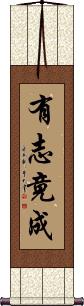
有志竟成 is a Chinese proverb that means “persevere and you will succeed.”
It's very much like the English idiom, “where there's a will, there's a way.”
The Middle Way
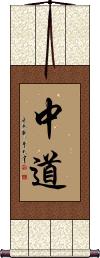
In the most basic translation, 中道 means road through the middle or middle road.
The expanded meaning can be moderation or the golden mean.
But if you are looking for this title, you are probably seeking the Buddhist definition, which is more complex.
中道 is the middle way or middle path of Buddhism. This has various interpretations. In general, it denotes the mean between two extremes and has special reference to the mean between realism and nihilism, or eternal substantial existence and annihilation.
The Buddha teaches that one should not take things to extremes. Don't be extremely evil and engage in debauchery and murder. But do not spend every waking out trying to be a perfect saint. Instead, take the middle path, try to help others, show loving kindness wherever you can, and try not to do harm. If you inadvertently harm another being, make amends if you can, and move on. Realize you are not perfect, but in time, a path of moderation lead toward proper living and enlightenment.
Milky Way Galaxy
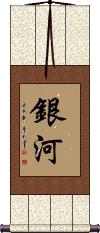
銀河 is the Chinese, Japanese Kanji, and old Korean Hanja name for the Milky Way (our galaxy).
This can also be the Japanese female given name Ginga.
Where There is a Will, There is a Way
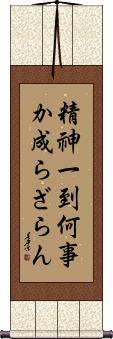
精神一到何事か成らざらん is a Japanese expression that means “Where there is a will, there is a way. There are other Japanese phrases with similar meanings but this one is the most commonly used (according to the number of results on Japanese Google).
This can also be romanized as “seshinittonanigotokanarazaran.”
Note: Because this selection contains some special Japanese Hiragana characters, it should be written by a Japanese calligrapher.
Karate-Do
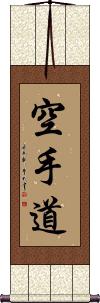
The literal meaning of 空手道 is “empty hand method” or “empty hand way.”
It is acknowledged that karate originated in China but migrated to Japan, where it was refined and became widely popular.
Karate is a martial art that uses no blades or weapons other than the “natural weapons” God gave to humans (fists and feet). The last character somehow became optional, but the meaning of that character is “method” or “the way” as in Taoism / Daoism.
Karate-Do reached Korea, where it is known as 공수도 which can be romanized as “Kong Soo Do” or “Gong Su Do.”
Move On / Change Way of Thinking
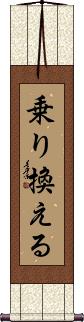
乗り換える is the Japanese way to say “move on.” This can also be translated as “to change one's mind,” “to change methods,” or “to change one's way of thinking.” For instance, if you changed your love interest or political ideology, you might describe the act of that change with this title.
Colloquially in Japan, this is also used to describe the act of transferring trains or changing from one bus or train to another.
Note: Because this selection contains some special Japanese Hiragana characters, it should be written by a Japanese calligrapher.
Where There is a Will, There is a Way
A determined effort can move a mountain
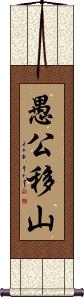
愚公移山 is the Chinese proverb (also somewhat known in Japan and Korea) for “the silly old man moves a mountain.”
Figuratively, this means “where there's a will, there's a way.”
Based on a fable of Lord Yu (愚公). He moved the soil of the mountain in front of his house. After years of effort, he finally moved the entire mountain (some versions of the story have God seeing how determined the man was, and sending two angels to whisk the mountains away).
The moral of the story: Anything can be accomplished if one works at it ceaselessly.
The Japanese version of this is 愚公山を移す (gu kou yama wo utsu su). But better to get the Chinese version, since this is originally a Chinese proverb.
See Also: Nothing is Impossible
Danketsu Karate-Do
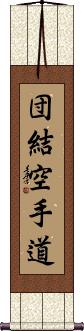
団結空手道 is the title for Danketsu Karate-Do, a dojo located in Stroudsburg, PA.
団結 (danketsu) means union, unity, or combination.
空手道 (karate-do) means “empty hand way.”
If you need you martial arts school/dojo/academy added to my database, just give me the info (actual Chinese/Japanese text if you have it).
Zendo / The Zen Way
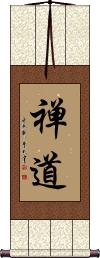
禪道 is a title used in certain contexts but is not widely known by the general population of China or Japan.
In Japanese, you will see this title romanized as “zendo,” which is the brand name of a board game, and also a title used by some martial arts studios and karate dojos. Oddly, many translate this as “zen fist,” although there is no “fist” in the title. If you literally translated this title, it would be “meditation way” or “meditation method.”
In Chinese, this would be “chan dao” with the same literal meaning as the Japanese title. It's used in China by just a handful of martial arts styles/studios.
You should only order this title if you really understand the meaning, and it has some personal connection to you (such as practicing a martial art style that uses this title, or if you love the board game Zendo). Many who see your wall scroll will not be familiar with this title, and you'll have some explaining to do.
 The first character can also be written in a more complex traditional way as shown to the right. Let us know in the special instructions for your calligraphy project if you want this style.
 If you order this from the Japanese master calligrapher, the first character will automatically be written with an extra dot on top. This is the variant form of the original Chinese character which is commonly used in modern Japan Kanji. See sample to the right.
There is one single thread binding my Way together
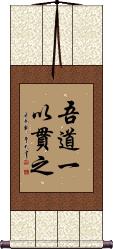
吾道一以貫之 is a phrase from the Analects of Confucius that translates as “My Way has one thread that runs through it.”
Other translations include:
My Way is penetrated by a single thread.
There is one single thread binding my Way together.
My Way is run through with a unifying thread.
My Way is Consistent.
And sometimes poetic license is taken, and it is translated as:
My Way is the only one; I'll treasure it and stick to it with humility until the end.
After this was said, some 2500+ years ago, another disciple of Confucius clarified the meaning by stating, “Our master's Way is to be loyal and have a sense of reciprocity.”
In Japanese, this is purported to be romanized as “Waga michi ichi wo motte kore wo tsuranuku,” though some will argue the true pronunciation.
Note: Sometimes written 吾道以一貫之 instead of 吾道一以貫之 with no difference in meaning.
The Way of Learning Has No End
Kyudo Mugen

究道無限 or Kyudo Mugen can be translated as “The way of learning has no end,” “The path of study never ends,” or “Infinite Pursuit.”
Isshin-Kai
Isshin Society

一心会 is the Japanese martial arts title “Isshinkai” or “Isshin-Kai.”
It literally means “One Heart Association” or “Single-Heart Club.” This title is often associated with Isshin-Ryu Aikido and Isshin-Ryu Karate-Do. This title is an appropriate name for a dojo that teaches these styles.
In calligraphy, 一心会 conveys legitimacy, unity, and shared standards.
一心会 is understood as Chinese and Korean Hanja (though written as 一心會 in Traditional Chinese, and in modern times, 일심회 in Korean Hangul).
Daoism / Taoism
Literally: The Way or Road
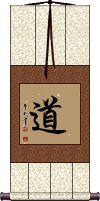
道 is the character “dao” which is sometimes written as “tao” but pronounced like “dow” in Mandarin.
道 is the base of what is known as “Taoism.” If you translate this literally, it can mean “the way” or “the path.”
Dao is believed to be that which flows through all things and keeps them in balance. It incorporates the ideas of yin and yang (e.g. there would be no love without hate, no light without dark, no male without female.)
The beginning of Taoism can be traced to a mystical man named
Lao Zi (604-531 BC), who followed, and added to the teachings of Confucius.
More about Taoism / Daoism here.
Note that this is pronounced “dou” and sometimes “michi” when written alone in Japanese but pronounced “do” in word compounds such as Karate-do and Bushido. It's also “do” in Korean.
Alternate translations and meanings: road, way, path; truth, principle province.
Important Japanese note: In Japanese, this will generally be read with the road, way, or path meaning. Taoism is not as popular or well-known in Japan so Daoist/Taoist philosophy is not the first thing a Japanese person will think of when they read this character.
See our Taoism Page
Tang Soo Do / Tang Hand Way
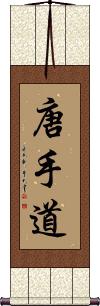
唐手道 is the alternate title for Karate-do.
This title uses a character, 唐, which represents the Tang Dynasty of China. Thus, this is often translated as the “Tang Hand Way” or incorrectly, “Tang Fist Way.”
I have also seen some call it “China Hand Way.”
Many in Korea refer to and romanize these characters as “Tang Soo Do” (당수도) where these characters refer to a kind of Korean style of Karate.
There is not a lot of information on this title but some believe that a simplified form of Kung Fu that started in China and ended up very popular in Japan used this title initially. It was later changed in Japan to a different Karate title which means “Empty Hand” (as in, without weapons).
Note: When used in Korean, this is pronounced 당수도. This title is often romanized as “Tang Soo Do,” “Tangsudo,” “Dang Su Do,” or “Dangsudo.” The last two romanizations on that list are the official Korean government romanization, though martial arts schools tend to use other non-standard versions.
The Old Way / Old School
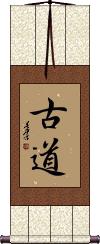
古道 is the Japanese word meaning “The Old Way.” The first character means old or ancient. The second character means “the way” and is the same character as used in Taoism / Daoism (Taoism literally means “the way”).
This second character can also be translated as “method,” as in a way of doing things.
古道 is sometimes Romanized as “Kodo,” though officially, the Romaji should be “Kodou.”
My Japanese-English dictionary further translates this word as the old road, ancient methods, ancient moral teachings, and the way of learning.
Note that this would be understood differently in Chinese. Most Chinese people would just read this as “The old road” without the other meanings derived in Japanese.
Way of Life / Art of Life
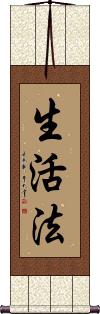
生活法 is a Japanese and Chinese title meaning “art of living” or “way of life.”
This can also be translated in a few other ways, such as “rule of life” and “the act of living.”
The “art” title kind of comes from the fact that the last character is the same as the book, “The Art of War.” So when you write your book, this is the title for “The Art of Life,” in Chinese and Japanese.
Walking 100 Miles: Stopping at 90 miles, is the same as stopping half-way
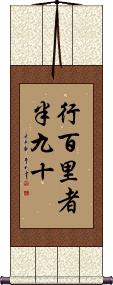
行百里者半九十 is an old Chinese proverb that speaks to the act of giving up. This phrase suggests that no matter how close you are to finishing your task or journey, giving up just before you finish is just as bad as giving up halfway.
50% finished or 90% finished, the result is the same: “You are not finished.”
You can take what you want from this proverb, but I think it suggests that you should finish what you start, and especially finish that last 10% of your journey or project so that you can honestly say “it's finished.”
Some notes: The character, 里, that I am translating as “mile” is an ancient “Chinese mile” which is actually about half a kilometer - it just doesn't sound right to say “When walking 100 half-kilometers...”
Martial Arts / Budo
Way of the Warrior
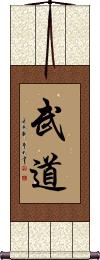
武道 is the very common Japanese way to say “Martial Arts.”
武道 is used mostly in Japanese dojos but is also understood in Chinese and Korean.
Some will use this title to mean chivalry (the conduct of a knight) or military art. The way this word is understood would depend on the context in which it is used.
The first character means “force,” “warlike,” or “essence of a warrior.”
The second character means “method,” “path,” and “the way.” It is the same character used to describe/mean the philosophy of Taoism / Daoism.
Some will also translate this as “The Way of the Warrior”; especially in the context of Korean martial arts.
Nankurunaisa
Everything will be all right, it will all work out one way or another
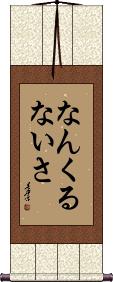
なんくるないさ or Nankurunaisa means “Everything will be all right” and/or “It will all work out one way or another.”
なんくるないさ is an Okinawan (琉球 / Ryūkyū Islands) word written in Japanese.
You might see this romanized with breaks like nankurunai-sa or nankuru-nai-sa. It's the same word either way. However, there is a separate word, なんくるない, in there which is nankurunai, translated as “Don't worry, be happy.” The “sa” or さ part indicates an assertion or interjection.
Note: Because this title is entirely Japanese Hiragana, it should be written by a Japanese calligrapher.
The Guts Theory
The belief that where there's a will, there's a way.
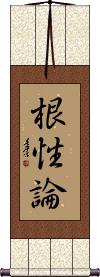
根性論 is a Japanese title that refers to the belief that where there's a will, there's a way.
Another way to translate this is “The Guts Theory” or “The Doctrine of Will-Power.” Maybe breaking down the meaning of the characters will help clarify this:
根性 = will-power; guts; temper; nature; spirit; nature and character; the nature of the powers of any sense.
論 = theory; doctrine; treatises on dogma, philosophy, discipline, etc.
Woman
The ancient way to say Woman
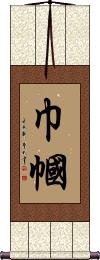
巾幗 is the very old way to say woman in Chinese.
A common title in ancient China, this actually refers to the scarf or head wrapping worn by virtually all women at that time.
巾幗 is kind of a cool way to say Woman now. The actual gender character alone on a wall scroll would actually look like a fancy sign for the woman's restroom (WC).
 If you are curious, the character to the right means female or woman. Knowing 女 is useful information if you are a woman searching for a toilet in China or Japan.
To a Willing Heart, All Things Are Possible
Where there is a will, there is a way
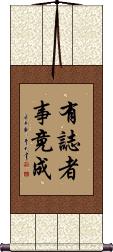
有志者事竟成 is an old Chinese proverb that has been translated many different ways into English. As you read the translations below, keep in mind that in Chinese, heart=mind.
Nothing is impossible to a willing heart.
Nothing is impossible to a willing mind.
Nothing is difficult to a willing heart.
Where there is a will, there is a way.
Nothing in the world is impossible if you set your mind to doing it.
A willful man will have his way.
If you wish it, you will do it.
A determined heart can accomplish anything.
All things are possible with a strong mind.
Hell / Judges of Hell
Ancient way to say Hell
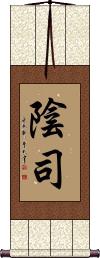
陰司 is the ancient way to say “Hell” or “Netherworld” in Chinese.
This title can also refer to the officials of Hell or the judges of Hades or the Netherworld.
Please note that this is a somewhat terrible selection for a wall scroll. Hanging this in your home is like telling the world that your home is hell. Oddly, a lot of people search for this on my website, so I added it for reference.
Danger
A dangerous character in every way
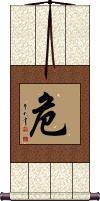
危 means danger, peril, or “to endanger” in Chinese, Japanese, and old Korean.
If you live a dangerous life or want to subtly warn others that you are a dangerous person, this may be the selection for you.
This also means “danger” and sometimes “fear” in Japanese and Korean but is seldom seen outside of compound words in those languages (as a single character, it's kind of like an abbreviation for danger in Japanese and Korean). 危 is also a rather odd selection for a wall scroll anyway. It's only here because people search for danger on our website.
The following table may be helpful for those studying Chinese or Japanese...
| Title | Characters | Romaji (Romanized Japanese) | Various forms of Romanized Chinese | |
| Love Will Find A Way | 終成眷屬 终成眷属 | zhōng chéng juàn shǔ zhong1 cheng2 juan4 shu3 zhong cheng juan shu zhongchengjuanshu | chung ch`eng chüan shu chungchengchüanshu chung cheng chüan shu |
|
| Love Will Find A Way | 有情人終成眷屬 有情人终成眷属 | yǒu qíng rén zhōng chéng juàn shǔ you3 qing2 ren2 zhong1 cheng2 juan4 shu3 you qing ren zhong cheng juan shu | yu ch`ing jen chung ch`eng chüan shu yu ching jen chung cheng chüan shu |
|
| Walk in the Way | 行道 | yukimichi | xíng dào / xing2 dao4 / xing dao / xingdao | hsing tao / hsingtao |
| Immovable Mind Way Fudoshin Way | 不動心道 | fu dō shin dō fudōshindō | bù dòng xīn dào bu4 dong4 xin1 dao4 bu dong xin dao budongxindao | pu tung hsin tao putunghsintao |
| A Truly Determined Person Will Find a Solution | 有志者事竟成 | yǒu zhì zhě shì jìng chéng you3 zhi4 zhe3 shi4 jing4 cheng2 you zhi zhe shi jing cheng youzhizheshijingcheng | yu chih che shih ching ch`eng yuchihcheshihchingcheng yu chih che shih ching cheng |
|
| Mark the boat to find the lost sword Ignoring the changing circumstances of the world | 刻舟求劍 刻舟求剑 | kokushuukyuuken kokushukyuken | kè zhōu qiú jiàn ke4 zhou1 qiu2 jian4 ke zhou qiu jian kezhouqiujian | k`o chou ch`iu chien kochouchiuchien ko chou chiu chien |
| Achieve Inner Peace; Find Deep Understanding | 寧靜而致遠 宁静而致远 | níng jìng ér zhì yuǎn ning2 jing4 er2 zhi4 yuan3 ning jing er zhi yuan ningjingerzhiyuan | ning ching erh chih yüan ningchingerhchihyüan |
|
| There is always a way out | 天無絕人之路 天无绝人之路 | tiān wú jué rén zhī lù tian1 wu2 jue2 ren2 zhi1 lu4 tian wu jue ren zhi lu tianwujuerenzhilu | t`ien wu chüeh jen chih lu tienwuchüehjenchihlu tien wu chüeh jen chih lu |
|
| True Religion Buddha Truth | 實道 实道 | jitsu dou / jitsudou / jitsu do | shí dào / shi2 dao4 / shi dao / shidao | shih tao / shihtao |
| Thirst for Truth | 渴法 | katsuhō | kě fǎ / ke3 fa3 / ke fa / kefa | k`o fa / kofa / ko fa |
| Wave | 波浪 | harou / haro | bō làng / bo1 lang4 / bo lang / bolang | po lang / polang |
| The Way of Light | 光道 | kō dō / kōdō | guāng dào guang1 dao4 guang dao guangdao | kuang tao kuangtao |
| The Way of the Dragon | 龍之道 龙之道 | lóng zhī dào long2 zhi1 dao4 long zhi dao longzhidao | lung chih tao lungchihtao |
|
| The Way of the Wave | 波の道 | nami no michi naminomichi | ||
| The Way of Tea | 茶道 | cha dou / chadou / cha do | chá dào / cha2 dao4 / cha dao / chadao | ch`a tao / chatao / cha tao |
| Buddha Way | 佛道 | butsudō | fó dào / fo2 dao4 / fo dao / fodao | fo tao / fotao |
| The Way of the Dragon | 猛龍過江 猛龙过江 | měng lóng guò jiāng meng3 long2 guo4 jiang1 meng long guo jiang menglongguojiang | meng lung kuo chiang menglungkuochiang |
|
| The Way of the Wave | 浪之道 | làng zhī dào lang4 zhi1 dao4 lang zhi dao langzhidao | lang chih tao langchihtao |
|
| The Way of Five Pecks of Rice | 五斗米道 | gotobeidou / gotobeido | wǔ dǒu mǐ dào wu3 dou3 mi3 dao4 wu dou mi dao wudoumidao | wu tou mi tao wutoumitao |
| Dharma The Law | 法 | hou / ho | fǎ / fa3 / fa | |
| Kendo The Way of the Sword | 剱道 / 劍道 剣道 | kendou / kendo | jiàn dào / jian4 dao4 / jian dao / jiandao | chien tao / chientao |
| Milky Way Galaxy | 銀河系 银河系 | gingakei | yín hé xì yin2 he2 xi4 yin he xi yinhexi | yin ho hsi yinhohsi |
| Godo The Hard Way | 剛道 | gō dō / gōdō | gāng dào / gang1 dao4 / gang dao / gangdao | kang tao / kangtao |
| Bushido The Way of the Samurai | 武士道 | bu shi do / bushido | wǔ shì dào wu3 shi4 dao4 wu shi dao wushidao | wu shih tao wushihtao |
| Where there’s a will there’s a way | 有志竟成 | yǒu zhì jìng chéng you3 zhi4 jing4 cheng2 you zhi jing cheng youzhijingcheng | yu chih ching ch`eng yuchihchingcheng yu chih ching cheng |
|
| The Middle Way | 中道 | chuu dou / chuudou / chu do | zhōng dào zhong1 dao4 zhong dao zhongdao | chung tao chungtao |
| Milky Way Galaxy | 銀河 银河 | ginga | yín hé / yin2 he2 / yin he / yinhe | yin ho / yinho |
| Where There is a Will, There is a Way | 精神一到何事か成らざらん | seishin ittou nanigoto ka nara zaran seishin itto nanigoto ka nara zaran | ||
| Karate-Do | 空手道 | kara te dou karatedou kara te do | kōng shǒu dào kong1 shou3 dao4 kong shou dao kongshoudao | k`ung shou tao kungshoutao kung shou tao |
| Move On Change Way of Thinking | 乗り換える | norikaeru | ||
| Where There is a Will, There is a Way | 愚公移山 | yū gōng yí shān yu1 gong1 yi2 shan1 yu gong yi shan yugongyishan | yü kung i shan yükungishan |
|
| Danketsu Karate-Do | 団結空手道 | dan ketsu kara te dou danketsukaratedou dan ketsu kara te do | ||
| Zendo The Zen Way | 禅道 / 禪道 禅道 | zen dou / zendou / zen do | chán dào / chan2 dao4 / chan dao / chandao | ch`an tao / chantao / chan tao |
| There is one single thread binding my Way together | 吾道一以貫之 吾道一以贯之 | ware dou tsurayuki waredoutsurayuki ware do tsurayuki | wú dào yī yǐ guàn zhī wu2 dao4 yi1 yi3 guan4 zhi1 wu dao yi yi guan zhi wudaoyiyiguanzhi | wu tao i i kuan chih wutaoiikuanchih |
| The Way of Learning Has No End | 究道無限 | kyuu do mu gen kyuudomugen kyu do mu gen | ||
| Isshin-Kai | 一心会 / 一心會 一心会 | isshin kai / isshinkai / ishin kai | yī xīn huì yi1 xin1 hui4 yi xin hui yixinhui | i hsin hui ihsinhui |
| Daoism Taoism | 道 | michi / -do | dào / dao4 / dao | tao |
| Tang Soo Do Tang Hand Way | 唐手道 | kara te do / karatedo | táng shǒu dào tang2 shou3 dao4 tang shou dao tangshoudao | t`ang shou tao tangshoutao tang shou tao |
| The Old Way Old School | 古道 | kodou / kodo | ||
| Way of Life Art of Life | 生活法 | seikatsuhou seikatsuho | shēng huó fǎ sheng1 huo2 fa3 sheng huo fa shenghuofa | |
| Walking 100 Miles: Stopping at 90 miles, is the same as stopping half-way | 行百里者半九十 | xíng bǎi lǐ zhě bàn jiǔ shí xing2 bai3 li3 zhe3 ban4 jiu3 shi2 xing bai li zhe ban jiu shi xingbailizhebanjiushi | hsing pai li che pan chiu shih hsingpailichepanchiushih |
|
| Martial Arts Budo | 武道 | bu dou / budou / bu do | wǔ dào / wu3 dao4 / wu dao / wudao | wu tao / wutao |
| Nankurunaisa | なんくるないさ | nan ku ru nai sa nankurunaisa | ||
| The Guts Theory | 根性論 | kon jou ron konjouron kon jo ron | ||
| Woman | 巾幗 巾帼 | jīn guó / jin1 guo2 / jin guo / jinguo | chin kuo / chinkuo | |
| To a Willing Heart, All Things Are Possible | 有志者事竟成 / 有誌者事竟成 有志者事竟成 | yǒu zhì zhě shì jìng chéng you3 zhi4 zhe3 shi4 jing4 cheng2 you zhi zhe shi jing cheng youzhizheshijingcheng | yu chih che shih ching ch`eng yuchihcheshihchingcheng yu chih che shih ching cheng |
|
| Hell Judges of Hell | 陰司 阴司 | yīn sī / yin1 si1 / yin si / yinsi | yin ssu / yinssu | |
| Danger | 危 | ki | wēi / wei1 / wei | |
| In some entries above you will see that characters have different versions above and below a line. In these cases, the characters above the line are Traditional Chinese, while the ones below are Simplified Chinese. | ||||

Successful Chinese Character and Japanese Kanji calligraphy searches within the last few hours...



