I am shipping orders on Thursday this week. News and More Info
Buy a Catch Me if You Can calligraphy wall scroll here!
Personalize your custom “Catch Me if You Can” project by clicking the button next to your favorite “Catch Me if You Can” title below...
Ability is more important than looks
不管黑猫白猫能捉着老鼠的就是好猫 literally translates as: It doesn't matter [if a] cat [is] black [or] white, [as long as it] can catch mice, it's a good cat.
This proverb was either composed or made famous by Deng XiaoPing in 1961 when he exclaimed, “I don't care if it's a white cat or a black cat. It's a good cat so long as it catches mice” when his critics pointed out that his ideas were Capitalistic (free market). The response was meant to say, “It does not matter if it's Communist or Capitalist, as long as it works.”
This is a Chinese proverb that can be used to suggest one should disregard looks or a person's race, as long as they can do the job. It can also be used as a metaphor for many other situations.
Deng XiaoPing probably saved China from collapse (as the Soviet Union experienced). He changed China’s economy from pure Communism to a hybrid where the free market (Capitalism) is encouraged. More about Deng XiaoPing
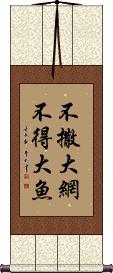
不撒大網不得大魚 is a Chinese proverb that literally translates as: [if one does] not cast a big net, [one can] not get big fish.
Figuratively, this means: One cannot make great accomplishments without making great efforts or taking great pains.
This is sort of the fishing version of, “No pain, no gain.”
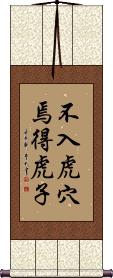
Nothing ventured, nothing gained
While perhaps no longer politically correct, this Chinese proverb is a reminder that you must take risks if you want rewards.
不入虎穴焉得虎子 is similar to the English proverb, “Nothing ventured, nothing gained.”
The literal word order of the Chinese is, “If (you) don't enter the tiger's lair/cave, how can (you) get/obtain tiger cubs?.”
Nothing ventured, nothing gained
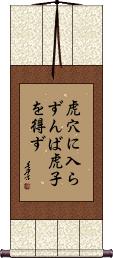
虎穴に入らずんば虎子を得ず is the Japanese version of an ancient Chinese proverb. 虎穴に入らずんば虎子を得ず is a reminder that you must take risks if you want the reward.
虎穴に入らずんば虎子を得ず is similar to the English proverb, “Nothing ventured, nothing gained.”
Note: Because this selection contains some special Japanese Hiragana characters, it should be written by a Japanese calligrapher.
Surname
羅 is a character that can be the Chinese surname Luo.
This can also be the Japanese surname Ra, Ami, Ai, Rou, or Ro (and a few others).
The meaning is to collect, gather, catch, or sift. It may also refer to gauze, a lightweight fabric, or thin silk.
Kill the goose that lays the golden eggs
In 632 BC, Duke Wen of the Kingdom of Jin was about to lead an army against the forces of the Kingdom of Chu.
The Duke asked one of his advisers, Jiu Fan, how they could win the impending battle, as they were drastically outnumbered.
Jiu Fan said, “All is fair in war,” and suggested a plan of dishonorable tactics (cheating).
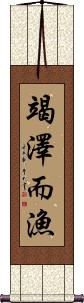
The Duke was unsure of this advice, so he asked another adviser, Yong Ji, who replied, “If you catch fish by draining the pond, you can certainly get all the fish. But there will be no fish the following year. You can cheat this one time in battle, but such tactics can only be used once, as the enemy will be wise in future encounters.”
The Duke heard the words of his wiser adviser but cheated to gain victory in the battle. However, he rewarded Yong Ji more than Jiu Fan at the victory celebration, stating that while Jiu Fan's advice gained one victory, the wise words of Yong Ji would last forever.
This Chinese idiom/proverb is still used, over 2600 years later to remind people not to burn bridges, cheat, or dishonor themselves in exchange for a short-term gain while sacrificing the future.
竭澤而漁 is very similar to the meaning of the English phrase, “Kill the goose that lays the golden eggs.”
Below are some entries from our dictionary that may match your catch me if you can search...
| Characters If shown, 2nd row is Simp. Chinese |
Pronunciation Romanization |
Simple Dictionary Definition |
漁 渔 see styles |
yú yu2 yü ryouzaki / ryozaki りょうざき |
More info & calligraphy: Fishing(n,n-suf) (1) fishing; gathering seafood (e.g. clams, seaweed); (2) (See 豊漁・ほうりょう) catch (e.g. of fish); haul; (surname) Ryōzaki |
羅 罗 see styles |
luó luo2 lo rou / ro ろう |
More info & calligraphy: Rowe(abbreviation) (See 羅甸語) Latin (language); (surname) Rou A net (for catching birds), gauze, open work; sieve; to arrange in order; translit. la and ra sounds, e.g. 南羅 S. Lāra; Lāḍa; Lāṭa, in Gujarāt; 北羅 N. Lāra, Valabhī, on the western coast of Gujarāt. |
空軍 空军 see styles |
kōng jun kong1 jun1 k`ung chün kung chün kuugun / kugun くうぐん |
More info & calligraphy: Air Forceair force |
たくる see styles |
takuru タクる |
(v5r,vi) (slang) (See タクシー) to catch a taxi; to take a taxi |
丮 see styles |
jǐ ji3 chi |
to catch |
抓 see styles |
zhuā zhua1 chua |
to grab; to catch; to arrest; to snatch; to scratch |
拿 see styles |
ná na2 na |
to hold; to seize; to catch; to apprehend; to take; (used in the same way as 把[ba3]: to mark the following noun as a direct object) |
捕 see styles |
bǔ bu3 pu fu |
to catch; to seize; to capture Arrest, catch. |
接 see styles |
jiē jie1 chieh setsu |
to receive; to answer (the phone); to meet or welcome sb; to connect; to catch; to join; to extend; to take one's turn on duty; to take over for sb To receive, take; join on; graft. |
攆 撵 see styles |
niǎn nian3 nien |
to expel; to oust; (dialect) to chase after; to try to catch up with |
染 see styles |
rǎn ran3 jan riyou / riyo りよう |
to dye; to catch (a disease); to acquire (bad habits etc); to contaminate; to add color washes to a painting dyeing; printing; (surname) Riyou To dye, infect, contaminate, pollute; lust. |
炟 see styles |
dá da2 ta |
(used in transliterating foreign words); (used in names); (archaic) to explode; to catch fire |
獲 获 see styles |
huò huo4 huo gyaku |
(literary) to catch; to capture; (literary) to get; to obtain; to win To catch, seize, obtain, recover. 獲得. |
趕 赶 see styles |
gǎn gan3 kan |
to overtake; to catch up with; to hurry; to rush; to try to catch (the bus etc); to drive (cattle etc) forward; to drive (sb) away; to avail oneself of (an opportunity); until; by (a certain time) |
逮 see styles |
dài dai4 tai tai |
(literary) to reach; used in 逮捕[dai4 bu3] (Taiwan pr. [dai3]) To reach, catch up, until, when, wait for. |
鉤 钩 see styles |
gōu gou1 kou magari まがり |
to hook; to sew; to crochet; hook; check mark or tick; window catch (out-dated or obsolete kana usage) (1) needle; pin; (2) hook; (3) stinger; thorn; (4) hand (e.g. clock, etc.); pointer; (5) staple (for a stapler); (6) needlework; sewing; (7) malice; (ctr,n-suf) (8) counter for stitches; (1) hook; (2) (abbreviation) hook bracket (Japanese quotation mark); (surname) Magari hook |
闆 板 see styles |
pàn pan4 p`an pan |
to catch sight of in a doorway (old) See: 板 |
不漁 see styles |
furyou / furyo ふりょう |
(ant: 大漁) poor catch (fishing) |
偏題 偏题 see styles |
piān tí pian1 ti2 p`ien t`i pien ti |
to go off-topic; to stray from the topic; obscure question; trick exam question; catch question (CL:道[dao4]) |
傷風 伤风 see styles |
shāng fēng shang1 feng1 shang feng |
to catch cold |
兜風 兜风 see styles |
dōu fēng dou1 feng1 tou feng |
to catch the wind; to go for a spin in the fresh air |
初物 see styles |
hatsumono はつもの |
(1) first of the season (e.g. produce, catch); (2) virgin |
刺す see styles |
sasu さす |
(transitive verb) (1) to pierce; to stab; to prick; to stick; to thrust; (transitive verb) (2) (See 螫す) to sting; to bite; (transitive verb) (3) to sew; to stitch; to embroider; (transitive verb) (4) (See 差す・11) to pole (a boat); (transitive verb) (5) to catch (with a limed pole); (transitive verb) (6) {baseb} to put (a runner) out; to pick off |
及く see styles |
shiku しく |
(v5k,vi) (1) (archaism) to match; to equal; (2) to catch up with; to overtake |
収獲 see styles |
shuukaku / shukaku しゅうかく |
(noun/participle) catch (fishing); bag (hunting); haul |
収穫 see styles |
shuukaku / shukaku しゅうかく |
(noun, transitive verb) (1) harvest; crop; ingathering; (2) fruits (of one's labors); gain; result; returns; (noun, transitive verb) (3) (See 収獲) catch (fishing); bag (hunting); haul |
取る see styles |
toru とる |
(transitive verb) (1) to take; to pick up; to grab; to catch; to hold; (transitive verb) (2) to pass; to hand; to give; (transitive verb) (3) to get; to obtain; to acquire; to win; to receive; to earn; to take (e.g. a vacation); (transitive verb) (4) to adopt (a method, proposal, etc.); to take (a measure, attitude, etc.); to choose; (transitive verb) (5) to remove; to get rid of; to take off; (transitive verb) (6) to take away; to steal; to rob; (transitive verb) (7) (See 摂る) to eat; to have (e.g. lunch); to take (e.g. vitamins); (transitive verb) (8) to pick (e.g. flowers); to gather; to extract (e.g. juice); to catch (e.g. fish); to harvest (a crop); (transitive verb) (9) to take up (time, space); to occupy; to spare; to set aside; (transitive verb) (10) to secure; to reserve; to save; to put aside; to keep; (transitive verb) (11) to take (e.g. a joke); to interpret; to understand; to make out; to grasp; (transitive verb) (12) to record; to take down; (transitive verb) (13) to subscribe to (e.g. a newspaper); to take; to buy; to get; (transitive verb) (14) to order; to have delivered; (transitive verb) (15) to charge; to fine; to take (tax); (transitive verb) (16) to take (e.g. a wife); to take on (e.g. an apprentice); to adopt; to accept; (transitive verb) (17) to take control of; to take (the rudder); (transitive verb) (18) to compete (in sumo, cards, etc.); to play |
受寒 see styles |
shòu hán shou4 han2 shou han |
affected by cold; to catch cold |
受涼 受凉 see styles |
shòu liáng shou4 liang2 shou liang |
to catch cold |
召す see styles |
mesu めす |
(transitive verb) (1) (honorific or respectful language) to call; to summon; to send for; to invite; (transitive verb) (2) (honorific or respectful language) to eat; to drink; (transitive verb) (3) (honorific or respectful language) to put on; to wear; (transitive verb) (4) (honorific or respectful language) to buy; to purchase; (transitive verb) (5) (honorific or respectful language) to take (a bath); (v5s,vi) (6) (honorific or respectful language) to ride; to get in (a vehicle); to take; (transitive verb) (7) (honorific or respectful language) to catch (a cold); (transitive verb) (8) (honorific or respectful language) (as お年を召す) to put on (years); to get old; (v5s,vi) (9) (honorific or respectful language) (as お気に召す) to strike one's fancy; to please one; (transitive verb) (10) (honorific or respectful language) (See 召される・1) to do; (transitive verb) (11) (honorific or respectful language) (as お腹を召す) to commit seppuku; (aux-v,v5s) (12) (honorific or respectful language) (after -masu stem of verb) indicates respect |
The following table may be helpful for those studying Chinese or Japanese...
| Title | Characters | Romaji (Romanized Japanese) | Various forms of Romanized Chinese | |
| Black or white cat matters not as long as it can catch mice | 不管黑貓白貓能捉著老鼠的就是好貓 不管黑猫白猫能捉着老鼠的就是好猫 | bù guǎn hēi māo bái māo néng zhuō zhe lǎo shǔ de jiù shì hǎo mǎo bu4 guan3 hei1 mao1 bai2 mao1 neng2 zhuo1 zhe lao3 shu3 de jiu4 shi4 hao3 mao3 bu guan hei mao bai mao neng zhuo zhe lao shu de jiu shi hao mao | pu kuan hei mao pai mao neng cho che lao shu te chiu shih hao mao | |
| Without a big net, how can you catch fish? | 不撒大網不得大魚 不撒大网不得大鱼 | bù sā dà wǎng bù dé dà yú bu4 sa1 da4 wang3 bu4 de2 da4 yu2 bu sa da wang bu de da yu busadawangbudedayu | pu sa ta wang pu te ta yü pusatawangputetayü |
|
| How can you catch tiger cubs without entering the lair of the tiger? | 不入虎穴焉得虎子 | bú rù hǔ xué yān dé hǔ zǐ bu2 ru4 hu3 xue2 yan1 de2 hu3 zi3 bu ru hu xue yan de hu zi buruhuxueyandehuzi | pu ju hu hsüeh yen te hu tzu pujuhuhsüehyentehutzu |
|
| How can you catch tiger cubs without entering the lair of the tiger? | 虎穴に入らずんば虎子を得ず | koketsu ni haira zun ba tora ko o e zu | ||
| Luo | 羅 罗 | ra | luō / luo1 / luo | lo |
| Drain the pond to get all the fish | 竭澤而漁 竭泽而渔 | jié zé ér yú jie2 ze2 er2 yu2 jie ze er yu jiezeeryu | chieh tse erh yü chiehtseerhyü |
|
| In some entries above you will see that characters have different versions above and below a line. In these cases, the characters above the line are Traditional Chinese, while the ones below are Simplified Chinese. | ||||
Successful Chinese Character and Japanese Kanji calligraphy searches within the last few hours...

All of our calligraphy wall scrolls are handmade.
When the calligrapher finishes creating your artwork, it is taken to my art mounting workshop in Beijing where a wall scroll is made by hand from a combination of silk, rice paper, and wood.
After we create your wall scroll, it takes at least two weeks for air mail delivery from Beijing to you.
Allow a few weeks for delivery. Rush service speeds it up by a week or two for $10!
When you select your calligraphy, you'll be taken to another page where you can choose various custom options.
The wall scroll that Sandy is holding in this picture is a "large size"
single-character wall scroll.
We also offer custom wall scrolls in small, medium, and an even-larger jumbo size.
Professional calligraphers are getting to be hard to find these days.
Instead of drawing characters by hand, the new generation in China merely type roman letters into their computer keyboards and pick the character that they want from a list that pops up.
There is some fear that true Chinese calligraphy may become a lost art in the coming years. Many art institutes in China are now promoting calligraphy programs in hopes of keeping this unique form
of art alive.
Even with the teachings of a top-ranked calligrapher in China, my calligraphy will never be good enough to sell. I will leave that to the experts.
The same calligrapher who gave me those lessons also attracted a crowd of thousands and a TV crew as he created characters over 6-feet high. He happens to be ranked as one of the top 100 calligraphers in all of China. He is also one of very few that would actually attempt such a feat.
Check out my lists of Japanese Kanji Calligraphy Wall Scrolls and Old Korean Hanja Calligraphy Wall Scrolls.
Some people may refer to this entry as Catch Me if You Can Kanji, Catch Me if You Can Characters, Catch Me if You Can in Mandarin Chinese, Catch Me if You Can Characters, Catch Me if You Can in Chinese Writing, Catch Me if You Can in Japanese Writing, Catch Me if You Can in Asian Writing, Catch Me if You Can Ideograms, Chinese Catch Me if You Can symbols, Catch Me if You Can Hieroglyphics, Catch Me if You Can Glyphs, Catch Me if You Can in Chinese Letters, Catch Me if You Can Hanzi, Catch Me if You Can in Japanese Kanji, Catch Me if You Can Pictograms, Catch Me if You Can in the Chinese Written-Language, or Catch Me if You Can in the Japanese Written-Language.
104 people have searched for Catch Me if You Can in Chinese or Japanese in the past year.
Catch Me if You Can was last searched for by someone else on Oct 18th, 2025