Many custom options...


And formats...



Bow and Arrow in Chinese / Japanese...
Buy a Bow and Arrow calligraphy wall scroll here!
Personalize your custom “Bow and Arrow” project by clicking the button next to your favorite “Bow and Arrow” title below...
Archer
Modern Chinese Version
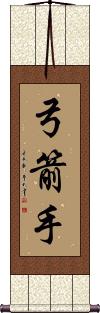
弓箭手 is how to write “archer” in modern Chinese.
弓箭手 literally means “bow arrow hand.”
There are other ways to write “archer” in Chinese, but this is probably the most common title for modern China. The other, less-common version of “archer” is also more universal because it has the same meaning in Japanese (this one is not used in Japan).
Archer
Ancient title for Archer
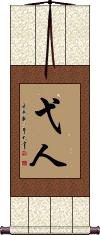
弋人 is the ancient way to write archer in both Chinese, Korean and Japanese.
If you carried a bow into battle in an army of ancient Asia, this would be your title.
Note: 弋人 is an antiquated term that is rarely used in modern Chinese, Korean or Japanese. Beyond archer, this can also mean a ceremonial hunter in Japanese.
Note: This title is so old, that most Asian people will not recognize this as a normal word. It has not been in regular use for many generations.
Archer
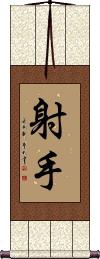
射手 means archer, shooter, or marksman in Chinese, Japanese Kanji, and old Korean Hanja.
Depending on the context, it can also mean “goal-getter” in Chinese. This would also be the word for a bowman.
射手 is modern in Asia, meaning that it's only been in use for a few hundred years. However, the more ancient version of the archer is often not even recognized by the current generation of Chinese and Japanese people.
The first character means “shoot” or “fire” (in the context of a gun or bow). It's also a suffix for radioactive things (in the context of chemistry) - radioactive things “fire off” electrons. In Japanese, the first Kanji is a short name and suffix for archery.
The second character means “hand,” but the hand can also mean a person, in the same way, that a “farmhand” is a person in English.
Not the results for bow and arrow that you were looking for?
Below are some entries from our dictionary that may match your bow and arrow search...
| Characters If shown, 2nd row is Simp. Chinese |
Pronunciation Romanization |
Simple Dictionary Definition |
弭 see styles |
mǐ mi3 mi mi はず |
to stop; repress (1) (kana only) expectation that something took place, will take place or was in some state; it should be so; bound to be; expected to be; must be; (2) nock (of a bow); (3) nock (of an arrow); (4) (sumo) nock-shaped grip (between thumb and forefinger); (5) wooden frame on the tip of the mast of a Japanese ship that prevents the hawser from falling out Stop, put down. |
彀 see styles |
gòu gou4 kou |
to draw a bow to the full; the range of a bow and arrow; old variant of 夠|够[gou4], enough |
筈 see styles |
guā gua1 kua hazu はず |
arrow end (1) (kana only) expectation that something took place, will take place or was in some state; it should be so; bound to be; expected to be; must be; (2) nock (of a bow); (3) nock (of an arrow); (4) (sumo) nock-shaped grip (between thumb and forefinger); (5) wooden frame on the tip of the mast of a Japanese ship that prevents the hawser from falling out |
射殺 射杀 see styles |
shè shā she4 sha1 she sha shasatsu しゃさつ |
to shoot dead (with a gun, or bow and arrow) (noun, transitive verb) shooting to death |
弓矢 see styles |
yumiya ゆみや |
bow and arrow; (surname) Yumiya |
弓箭 see styles |
gōng jiàn gong1 jian4 kung chien kyuusen / kyusen きゅうせん |
bow and arrow (1) bow and arrow; arms; weapons; (2) archer; warrior; (3) fighting with bows and arrows; war; battle |
彀中 see styles |
gòu zhōng gou4 zhong1 kou chung |
within the range of a bow and arrow; (fig.) under sb's control |
的射 see styles |
matoi まとい |
(rare) target shooting (with bow and arrow) |
箭道 see styles |
jiàn dào jian4 dao4 chien tao sendō |
An arrow-shot, or bow-shot, in distance. |
調度 调度 see styles |
diào dù diao4 du4 tiao tu choudo / chodo ちょうど |
to dispatch (vehicles, staff etc); to schedule; to manage; dispatcher; scheduler (1) household items; furniture; furnishings; fixtures; supplies; (2) (archaism) bow and arrow To arrange, calculate, manage, especially relating to provision for material needs. |
大悲弓 see styles |
dà bēi gōng da4 bei1 gong1 ta pei kung daihi kyū |
The bow of great pity. Pity, a bow in the left hand; wisdom 智, an arrow in the right hand. |
Variations: |
tarashi たらし |
(archaism) bow (and arrow; esp. of a noble) |
弓引く see styles |
yumihiku ゆみひく |
(v5k,vi) (1) to bend a bow; to shoot an arrow; (v5k,vi) (2) to rise up against; to rebel against |
破魔弓 see styles |
hamayumi はまゆみ |
(ceremonial) bow used to drive off evil; toy bow and arrow |
衣服天 see styles |
yī fú tiān yi1 fu2 tian1 i fu t`ien i fu tien ebuku ten |
The Vajradeva in the Vajradhātu group who guards the placenta and the unborn child; his colour is black and he holds a bow and arrow. |
開弓不放箭 开弓不放箭 see styles |
kāi gōng bù fàng jiàn kai1 gong1 bu4 fang4 jian4 k`ai kung pu fang chien kai kung pu fang chien |
lit. to draw the bow without shooting the arrow (idiom); fig. to bluff; to be all talk and no action; false bravado |
Variations: |
hazu はず |
(auxiliary) (1) (kana only) should (be); bound (to be); expected (to be); must (be); (2) nock (of a bow); (3) nock (of an arrow); (4) {sumo} (See はず押し・はずおし) nock-shaped grip (between thumb and forefinger); (5) wooden frame on the tip of the mast of a Japanese ship that prevents the hawser from falling out |
精進弓智慧箭 精进弓智慧箭 see styles |
jīng jìn gōng zhì huì jiàn jing1 jin4 gong1 zhi4 hui4 jian4 ching chin kung chih hui chien shōjin kyū chie sen |
Zeal as the bow, wisdom the arrow. |
Variations: |
yumiya(p); kyuushi(弓矢) / yumiya(p); kyushi(弓矢) ゆみや(P); きゅうし(弓矢) |
(1) bow and arrow; (2) (ゆみや only) weapon; arms |
Variations: |
hazu はず |
(auxiliary) (1) (kana only) should (be); bound (to be); expected (to be); must (be); (2) nock (of a bow); (3) nock (of an arrow); (4) {sumo} (See はず押し・はずおし) nock-shaped grip (between thumb and forefinger); (5) wooden frame on the tip of the mast of a Japanese ship that prevents the hawser from falling out |
Variations: |
yumiya(p); kyuushi(弓矢) / yumiya(p); kyushi(弓矢) ゆみや(P); きゅうし(弓矢) |
(1) bow and arrow; (2) (ゆみや only) weapon; arms |
強弩の末魯縞に入る能わず see styles |
kyoudonosuerokouniiruatawazu / kyodonosuerokoniruatawazu きょうどのすえろこうにいるあたわず |
(expression) (proverb) (See 魯・ろ) even the strong will grow weak; (even an arrow fired from) a strong bow loses momentum until it cannot even penetrate a piece of thin silk from Lu |
Variations: |
subiki すびき |
(n,vs,vi) drawing a bow without an arrow nocked |
The following table may be helpful for those studying Chinese or Japanese...
| Title | Characters | Romaji (Romanized Japanese) | Various forms of Romanized Chinese | |
| Archer | 弓箭手 | gōng jiàn shǒu gong1 jian4 shou3 gong jian shou gongjianshou | kung chien shou kungchienshou |
|
| Archer | 弋人 | yokujin | yì rén / yi4 ren2 / yi ren / yiren | i jen / ijen |
| Archer | 射手 | i te / sha shu ite / shashu | shè shǒu / she4 shou3 / she shou / sheshou | |

Successful Chinese Character and Japanese Kanji calligraphy searches within the last few hours...



