Many custom options...


And formats...



Arms in Chinese / Japanese...
Buy an Arms calligraphy wall scroll here!
Personalize your custom “Arms” project by clicking the button next to your favorite “Arms” title below...
1. Arms
2. Realize Your Ambitions / Embrace Your Ambition
4. Soldiers
5. Marine Corps
6. Marine
7. Soldiers Adapt Actions to the Situation
8. 5. Right Living / Right Livelihood / Perfect Livelihood
9. You are always a beauty in your lover’s eyes
10. Fundamental Principles of Tai Chi Chuan
Arms

阿姆斯 is the name Arms in Chinese (Mandarin).
Arms

アームズ is the name Arms in Japanese Katakana.
Note: Because this title is entirely Japanese Katakana, it should be written by a Japanese calligrapher.
Realize Your Ambitions / Embrace Your Ambition
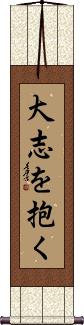
大志を抱く is a Japanese proverb that suggests you should embrace, pursue, and realize your ambitions.
The first part means ambitions or aspirations.
The last part means to embrace or to hold in your arms.
Here's the character breakdown:
大志 (taishi) ambition; aspiration.
を (o) particle
抱く (idaku) to embrace; to hold in the arms (e.g. a baby); to hug; to harbor/harbour; to bear (e.g., a grudge); to entertain (e.g., suspicion); to sleep with; to sit on eggs.
Note: Because this selection contains some special Japanese Hiragana characters, it should be written by a Japanese calligrapher.
Army / Military
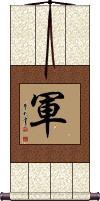
Soldiers
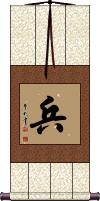
兵 can be used to express soldiers, troops, a force, an army, weapons, arms, military, warfare, tactics, strategy, or warlike.
The final meaning depends on context. It's also part of the Chinese title for the Terracotta soldiers. In fact, this character is usually used in compound words (words of more than one character). Sometimes this single character is the title used for the pawns in a chess game (in a related issue, this is also a nickname for soldiers with the rank of Private).
Marine Corps
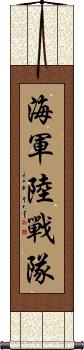
海軍陸戰隊 is the Chinese way to express “Marine Corps.” This could be the Marine Corps of virtually any country that has an amphibious military force.
Let me know if you want a more specific title, such as British Royal Marines or U.S. Marine Corps.
The Chinese title for Marines is very verbose...
Breaking down each character this means:
“ocean/sea military/arms shore/land fighting/war/battle corps/team/group.”
See Also: Military
Marine
Amphibious Warrior
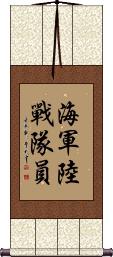
海軍陸戰隊員 is the Chinese way to express “Marine.” (as in a member of the Marine Corps). It is not country-specific, so it could be the Royal Marines, U.S. Marines, Chinese Marines, etc.
In Australian English, they would translate this as “Naval Infantryman.”
Breaking down each character this means:
“ocean/sea military/arms shore/land fighting/war/battle corps/team/group person/member.” Note that the first two characters are presented together but outside of this phrase mean “navy” (sea military).
See Also: Warrior | Military | Navy | Art of War
Soldiers Adapt Actions to the Situation
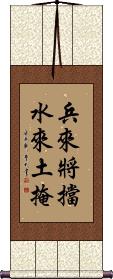
This Chinese military proverb means, counter soldiers with arms and counter water with an earthen dam.
兵來將擋水來土掩 is about how different situations call for different actions. You must adopt measures appropriate to the actual situation.
To explain the actual proverb, one would not attack a flood of water with gunfire, nor would you counter-attack soldiers by building an earth weir. You must be adaptable and counter whatever threatens with relevant action.
5. Right Living / Right Livelihood / Perfect Livelihood
Samyag Ajiva / Samma Ajiva
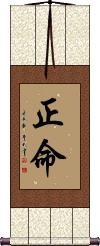
正命 (right living) is one of the Noble Eightfold Paths of Buddhism.
Right Living, along with Right Speech and Right Action, constitute the path to Virtue.
Right Living means that a Buddhist should only take a job or pursue a career in a field that does no harm. Buddhists should not work in the arms trade, as pimps or in the field of prostitution, as a butcher or in a shop that kills or sells meat, in a laboratory that does animal research, or in any other business that involves scheming or unethical behavior.
Another definition: Avoidance of professions that are harmful to sentient beings, such as slaughterer, hunter, dealer in weaponry or narcotics, etc.
This term is exclusively used by devout Buddhists. It is not a common term, and is remains an unknown concept to most Japanese and Chinese people.
See Also: Buddhism | Enlightenment | Noble Eightfold Path
You are always a beauty in your lover’s eyes
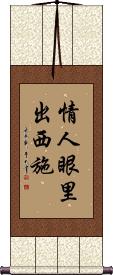
Any woman with affection for Asian art will love a gift of this Chinese proverb calligraphy on a wall scroll.
She will melt in your arms as you tell her the meaning of these characters.
Contained in this phrase is a reference to the most beautiful woman in Chinese history. Her name was Xi Shi, and she was known to have good looks that need not have fine robes or makeup. Her charms were so powerful that she brought down an entire kingdom (in a successful effort to bring honor and pride back to her people).
情人眼里出西施 is a great way to express that the woman in your life is your one love.
Fundamental Principles of Tai Chi Chuan
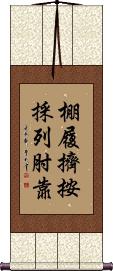
Peng, Lu, Ji, An, Cai, Lie, Zhou, and Kao are the eight fundamentals or forces of Tai Chi Chuan or Taiqiquan.
棚 (Peng) refers to the outward (or upward) expansion of energy.
履 (Lu) is often referred to as “rollback.” Lu is the ability to absorb, yield/deflect incoming force.
擠 (Ji) is often thought of as a “forward press.” However, it is also best described as a “squeezing out of space.”
按 (An) is a downward movement of energy, best translated as “(relaxed) sinking.”
採 (Cai or Tsai) translated as “downward pluck.” Cai is a combination of Lu and An.
列 (Lie or Lieh) is “Split” and is a combination of Peng and Ji.
肘 (Zhou) Elbowing.
靠 (Kao) Shouldering (for when the arms are bound/distance is too close to punch).
Source: https://combativecorner.wordpress.com/2015/12/03/the-8-energies-and-5-movements-of-taijiquan/
A sly rabbit has three openings to its den
-or- The crafty rabbit has three different entrances to its lair
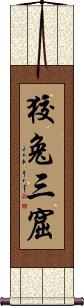
狡兔三窟 speaks to the cunning character of a sly rabbit. Such a rabbit will not have just one hole but rather a few entrances and exits from his liar.
About 2,250 years ago, a rich man told his assistant to go and buy something wonderful that he did not yet possess. He was a man that already had everything, so the assistant went to a local village that owed a great deal of money to the rich man. The assistant told the village elders that all debts were forgiven. All the villagers rejoiced and praised the rich man's name. The assistant returned to the rich man and told him he had purchased “benevolence” for him. The rich man was mildly amused but perhaps slightly confused by the action.
Sometime later, the rich man fell from the favor of the Emperor and was wiped out without a penny to his name. One day he was walking aimlessly and stumbled into the village where the debts had been forgiven. The villagers recognized the man and welcomed him with open arms, clothed, fed him, and gave him a place to live.
Without trying, the man had become like the sly and cunning rabbit. When his exit was blocked, he had another hole to emerge from - and was reborn. This story and idiom come from a book titled “The Amendment” - it's unclear whether this man actually existed or not. But the book did propel this idiom into common use in China.
Still today, this idiom about the rabbit is used in China when suggesting “backup plans,” alternate methods, and anyone with a good escape plan.
Daodejing / Tao Te Ching - Chapter 54
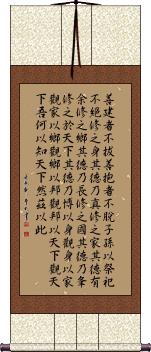
This is the Mawangdui version of Daodejing chapter 54.
By its virtue alone can one generation after another carry on the ancestral sacrifice.
Apply it to yourself, and by its power, you will be freed from dross.
Apply it to your household, and your household shall thereby have abundance.
Apply it to the village, and the village will be made secure.
Apply it to the kingdom, and the kingdom shall thereby be made to flourish.
Apply it to an empire, and the empire shall thereby be extended.
Therefore just as through oneself, one may contemplate Oneself;
So through the household one may contemplate the Household;
And through the village, one may contemplate the Village;
And through the kingdom, one may contemplate the Kingdom;
And through the empire, one may contemplate the Empire.
How do I know that the empire is so? By this.
What is firmly rooted cannot be pulled out;
What is tightly held in the arms will not slip loose;
Through this, the offering of sacrifice by descendants will never come to an end.
Cultivate it in your person, and its virtue will be genuine;
Cultivate it in the family, and its virtue will be more than sufficient;
Cultivate it in the hamlet, and its virtue will endure;
Cultivate it in the state, and its virtue will abound;
Cultivate it in the empire, and its virtue will be pervasive.
Hence look at the person through the person;
Look at the family through the family;
Look at the hamlet through the hamlet;
Look at the state through the state;
Look at the empire through the empire.
How do I know that the empire is like that?
By means of this.
The following table may be helpful for those studying Chinese or Japanese...
| Title | Characters | Romaji (Romanized Japanese) | Various forms of Romanized Chinese | |
| Arms | 阿姆斯 | ā mǔ sī / a1 mu3 si1 / a mu si / amusi | a mu ssu / amussu | |
| Arms | アームズ | aamuzu / amuzu | ||
| Realize Your Ambitions Embrace Your Ambition | 大志を抱く | taishi wo Idaku taishiwoIdaku | ||
| Army Military | 軍 军 | gun | jūn / jun1 / jun | chün |
| Soldiers | 兵 | hei | bīng / bing1 / bing | ping |
| Marine Corps | 海軍陸戰隊 海军陆战队 | hǎi jūn lù zhàn duì hai3 jun1 lu4 zhan4 dui4 hai jun lu zhan dui haijunluzhandui | hai chün lu chan tui haichünluchantui |
|
| Marine | 海軍陸戰隊員 海军陆战队员 | hǎi jūn lù zhàn duì yuán hai3 jun1 lu4 zhan4 dui4 yuan2 hai jun lu zhan dui yuan haijunluzhanduiyuan | hai chün lu chan tui yüan haichünluchantuiyüan |
|
| Soldiers Adapt Actions to the Situation | 兵來將擋水來土掩 兵来将挡水来土掩 | bīng lái jiàng dǎng shuǐ lái tǔ yǎn bing1 lai2 jiang4 dang3 shui3 lai2 tu3 yan3 bing lai jiang dang shui lai tu yan | ping lai chiang tang shui lai t`u yen ping lai chiang tang shui lai tu yen |
|
| 5. Right Living Right Livelihood Perfect Livelihood | 正命 | sei myou / seimyou / sei myo | zhèng mìng zheng4 ming4 zheng ming zhengming | cheng ming chengming |
| You are always a beauty in your lover’s eyes | 情人眼里出西施 | qíng rén yǎn lǐ chū xī shī qing2 ren2 yan3 li3 chu1 xi1 shi1 qing ren yan li chu xi shi qingrenyanlichuxishi | ch`ing jen yen li ch`u hsi shih chingjenyenlichuhsishih ching jen yen li chu hsi shih |
|
| Fundamental Principles of Tai Chi Chuan | 棚履擠按採列肘靠 棚履挤按采列肘靠 | péng lǚ jǐ àn cǎi liè zhǒu kào peng2 lv3 ji3 an4 cai3 lie4 zhou3 kao4 peng lv ji an cai lie zhou kao penglvjiancailiezhoukao | p`eng lü chi an ts`ai lieh chou k`ao peng lü chi an tsai lieh chou kao |
|
| A sly rabbit has three openings to its den | 狡兔三窟 | jiǎo tù sān kū jiao3 tu4 san1 ku1 jiao tu san ku jiaotusanku | chiao t`u san k`u chiaotusanku chiao tu san ku |
|
| Daodejing Tao Te Ching - Chapter 54 | 善建者不拔善抱者不脫子孫以祭祀不絕修之身其德乃真修之家其德有余修之鄉其德乃長修之國其德乃夆修之於天下其德乃博以身觀身以家觀家以鄉觀鄉以邦觀邦以天下觀天下吾何以知天下然茲以此 善建者不拔善抱者不脱子孙以祭祀不绝修之身其德乃真修之家其德有余修之乡其德乃长修之国其德乃夆修之于天下其德乃博以身观身以家观家以乡观乡以邦观邦以天下观天下吾何以知天下然兹以此 | shàn jiàn zhě bù bá shàn bào zhě bù tuō zǐ sūn yǐ jì sì bù jué xiū zhī shēn qí dé nǎi zhēn xiū zhī jiā qí dé yǒu yú xiū zhī xiāng qí dé nǎi zhǎng xiū zhī guó qí dé nǎi féng xiū zhī yú tiān xià qí dé nǎi bó yǐ shēn guān shēn yǐ jiā guān jiā yǐ xiāng guān xiāng yǐ bāng guān bāng yǐ tiān xià guān tiān xià wú hé yǐ zhī tiān xià rán zī yǐ cǐ shan4 jian4 zhe3 bu4 ba2 shan4 bao4 zhe3 bu4 tuo1 zi3 sun1 yi3 ji4 si4 bu4 jue2 xiu1 zhi1 shen1 qi2 de2 nai3 zhen1 xiu1 zhi1 jia1 qi2 de2 you3 yu2 xiu1 zhi1 xiang1 qi2 de2 nai3 zhang3 xiu1 zhi1 guo2 qi2 de2 nai3 feng2 xiu1 zhi1 yu2 tian1 xia4 qi2 de2 nai3 bo2 yi3 shen1 guan1 shen1 yi3 jia1 guan1 jia1 yi3 xiang1 guan1 xiang1 yi3 bang1 guan1 bang1 yi3 tian1 xia4 guan1 tian1 xia4 wu2 he2 yi3 zhi1 tian1 xia4 ran2 zi1 yi3 ci3 shan jian zhe bu ba shan bao zhe bu tuo zi sun yi ji si bu jue xiu zhi shen qi de nai zhen xiu zhi jia qi de you yu xiu zhi xiang qi de nai zhang xiu zhi guo qi de nai feng xiu zhi yu tian xia qi de nai bo yi shen guan shen yi jia guan jia yi xiang guan xiang yi bang guan bang yi tian xia guan tian xia wu he yi zhi tian xia ran zi yi ci | shan chien che pu pa shan pao che pu t`o tzu sun i chi ssu pu chüeh hsiu chih shen ch`i te nai chen hsiu chih chia ch`i te yu yü hsiu chih hsiang ch`i te nai chang hsiu chih kuo ch`i te nai feng hsiu chih yü t`ien hsia ch`i te nai po i shen kuan shen i chia kuan chia i hsiang kuan hsiang i pang kuan pang i t`ien hsia kuan t`ien hsia wu ho i chih t`ien hsia jan tzu i tz`u shan chien che pu pa shan pao che pu to tzu sun i chi ssu pu chüeh hsiu chih shen chi te nai chen hsiu chih chia chi te yu yü hsiu chih hsiang chi te nai chang hsiu chih kuo chi te nai feng hsiu chih yü tien hsia chi te nai po i shen kuan shen i chia kuan chia i hsiang kuan hsiang i pang kuan pang i tien hsia kuan tien hsia wu ho i chih tien hsia jan tzu i tzu |
|
| In some entries above you will see that characters have different versions above and below a line. In these cases, the characters above the line are Traditional Chinese, while the ones below are Simplified Chinese. | ||||

Successful Chinese Character and Japanese Kanji calligraphy searches within the last few hours...



