Adventures in Asian Art


Buy a Custom Woman Chinese or Japanese Calligraphy Wall Scroll

We have many options to create artwork with the Chinese characters / Asian symbols / Japanese Kanji for Woman on a wall scroll or portrait.
If you want to create a cool Woman Asian character tattoo, you can purchase that on our Chinese and Japanese Tattoo Image Service page and we'll help you select from many forms of ancient Asian symbols that express the idea of Woman.

Quick links to words on this page...

  1. Woman
  2. Beautiful Woman
  3. Whore / Mysterious Woman
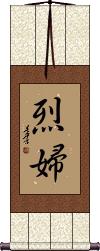
  4. Woman of Strong Character / Woman Hero
  5. Strong Woman
  6. Woman Hero / Heroine
  7. Active Duty Military
  8. Adoring Love
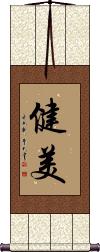
  9. Beauty / Beautiful
10. Beautiful Girl
11. You are always a beauty in your lover’s eyes
12. Benevolence
13. Dana
14. Daoism / Taoism
15. Emperor
16. Empress
17. Forgiveness
18. Gea
19. Geisha
20. The Geisha’s World
21. Geisha / Geigi
22. Geisha of Unequalled Talent
23. God Daughter
24. Goddess of Mercy and Compassion
25. I Love You
26. Islam
27. Lee
28. Love and Affection
29. Martial Arts Master
30. Phoenix
31. Purity
32. Queen
33. Queen / Empress
34. Holy Man / Saint
35. Sexy / Voluptuous
36. Soldier / Serviceman
37. Ox / Bull / Cow
38. Flowers / Blooming / Splendid / China

Woman

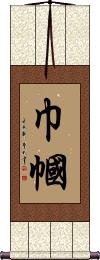
The ancient way to say Woman

jīn guó
巾
幗

This is the very old way to say woman in Chinese. A common title ancient China, this actually refers to the scarf or head wrapping worn by virtually all women at that time.

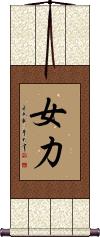
This is kind of a cool way to say Woman now. The actual gender character alone on a wall scroll would actually just look like a fancy sign for the woman's restroom (WC).

女If you are curious, the character to the right directly means female or woman. This is useful information if you are a woman in need of a toilet in China.

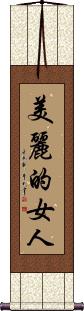
Beautiful Woman

měi lì de nǚ rén
美
麗
的
女
人

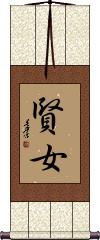
This is the best and most polite way to express "beautiful woman" in Chinese.

Note: Some people may like the simple 2-character way to express this, but there are some bad connotations with that, so better to stay with this longer and more respectful title.

See Also...  Beautiful Girl | Beauty

Whore / Mysterious Woman

Danger: Means prostitute in Japanese!
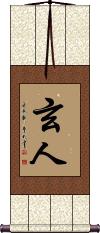
xuán rén
kurouto
현인
玄
人

This literally means "Mysterious Person/Woman". In Japanese this is associated with a "geisha", which matches this definition of "mysterious woman". However, this is the colloquial way to say "professional geisha" or "expert prostitute" in Japanese. It therefore might not be what you want on your wall.

Notes: This is a "Japanese only" term, though a Chinese person who sees these characters will think of a geisha or an alluring Japanese female musician.
While not often seen in Korean Hanja, this would mean a "dark woman", as in a woman that you cannot easily see through.

Woman of Strong Character / Woman Hero
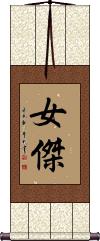
nǚ jiá
joketsu
女
傑

This can mean brave woman, heroine, lady of character, distinguished woman, outstanding woman, and sometimes prominent woman.

In modern usage, some people might use this to give a title to women like Oprah Winfrey, Hillary Clinton, or Sarah Palin. I would rather use it for a woman like Araceli Segarra (the first woman from Spain to climb Mt. Everest).

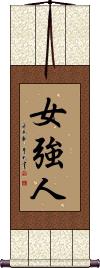
Strong Woman

nǚ qiáng rén
女
強
人

This is the best way to say "strong woman" or "strong and independent woman" in Chinese.

Grammar in China is a bit different, so these three characters literally read as "female strength person" or "woman strong person". This might sound funny in English, but this is a natural-sounding title in Chinese.

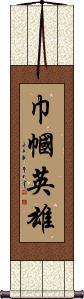
Woman Hero / Heroine

jīn guó yīng xióng
巾
幗
英
雄

This is a cool and somewhat ancient way to say woman hero in Chinese. This word is used in modern times to refer to an outstanding woman or a woman with great accomplishments.

In the old days, it was a title for a woman warrior (oh, did I mention that there were great female generals who led huge armies into battle in ancient China?)

Active Duty Military (person)

xiàn yì jūn rén
geneki gunjin
현역군인
現
役
軍
人

This means "Active Duty Soldier" or literally "Active Duty Military Person". It's a great way to show your pride in being an active duty member of the armed forces.

The first two characters mean "active duty" and the second two characters can be translated as "military personnel", "soldier", or "serviceman" (it is unisex, so male or female is not indicated).

If anyone is looking for "reservist" just post your request on our Asian calligraphy forum.

See Also...  Military | Warrior

Back to the top of this page

Adoring Love

ài mù
ai bou
애모
愛
慕

The best kind of love to have I suppose. This word has the well-know character for love. But the second character modifies and/or reinforces the meaning to become adore, adoring love, or to love and adore.

I say that I suppose this is the best kind of love because adoring someone is fine, until you are in the shoes of the Prince of the Kingdom of Wu. This Prince adored a certain beautiful woman (Xi Shi) so much that he neglected his duties, and soon let the kingdom fall into ruins.

Beauty / Beautiful

měi
bi
美

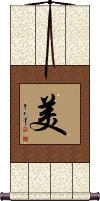
This word is often used to describe the beauty of a woman. It's also the first character in the word for "beauty salon" which you will see all over China.

For a bit of trivia: The title for the "USA" in Chinese is "Mei Guo" which literally means "Beautiful Country". This name was bestowed at a time before Chairman Mao came to power and decided that China didn't like the USA anymore (even though we fought together against the Japanese in WWII). But these days, Chinese people love Americans (but have distaste for American politics and policy). But I digress...

This is also how "Beautiful" is written in Japanese Kanji and Korean Hanja.

See Also...  Beautiful Woman | Beautiful Girl

Beautiful Girl
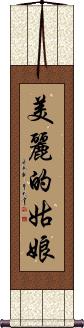
měi lì de gū niang
美
麗
的
姑
娘

This is the best way to express "beautiful girl" in Chinese.

See Also...  Beautiful Woman | Beauty

Back to the top of this page

You are always a beauty in your lover’s eyes

qíng rén yǎn lǐ chū xī shī
出
西
施
情
人
眼
裡

Characters shown
above are read
vertically, starting
from the right

Any woman with affection for Asian art and you will love a gift of this calligraphy on a wall scroll. She will melt in your arms as you tell her the meaning of these characters.

Contained in this phrase is a reference to the most beautiful woman in Chinese history. Her name was Xi Shi, and she was known to have good looks that need not fine robes or make up. Her charms were so powerful that she brought down an entire kingdom (in a successful effort to bring honor and pride back to her people).

Benevolence

rén
jin
仁

Beyond "benevolence" word can be also be defined as "charity" or "mercy" depending on context.

The meaning suggests that one should pay alms to the poor, care for those in trouble, and take care of his fellow man (or woman).

This is one of the five tenets of Confucius. In fact, it is a subject in which Confucius spent a great deal of time explaining to his disciples.

I have also seen this benevolent-related word translated as perfect virtue, selflessness, love for humanity, humaneness, goodness, good will, or simply "love" in the non-romantic form.

This word is so important to me that I named my second daughter with this character. Her name is "Renni" which means "Benevolent Girl".
-Gary.


This is also a virtue of the Samurai Warrior
See our page with just Code of the Samurai / Bushido here

See Also...  Love | Altruism | Kindness | Charity | Brotherhood | Confucius

Dana

dān nà
丹
娜

This is the transliteration to Mandarin Chinese for the female / feminine name Dana.

Back to the top of this page

Daoism / Taoism

Literally: The Way or Road

dào
michi / -do
道

This is the character "dao" which is sometimes written as "tao" but pronounced like "dow" in Mandarin.

This is the base of what is known as "Taoism". If you translate this literally, it can mean "the way" or "the path".

Dao is believed to be that which flows through all things, and keeps them in balance. It incorporates the ideas of yin and yang (e.g. there would be no love without hate, no light without dark, no male without female.)

The beginning of Taoism can be traced to a mystical man named
Lao Zi (604-531 BC), who followed, and added to the teachings of Confucius.

More about Taoism / Daoism here.

Note that this is pronounced "dou" and sometimes "michi" when written alone in Japanese, but pronounced "do" in word compounds such as Karate-do and Bushido. It's also "do" in Korean.

Alternate translations and meanings: road, way, path; truth, principle province.

Important Japanese note: In Japanese, this will generally be read with the road, way, or path meaning. Taoism is not as popular or well-known in Japan, so that Daoist/Taoist philosophy is not the first thing a Japanese person will think of then they read this character.

See our Taoism Page

Emperor

huáng
kou
皇

This is the simple, single-character way to write emperor in Chinese and Japanese.

See Also...  Empress | King | Queen

Emperor

huáng dì
koutei
황제
皇
帝

From times of old, the emperors of Asia ruled under the authority of God himself. In fact, one definition of an emperor is a ruler put in power by God. This definition separates emperors from the various kings in Chinese history (although defining who is a king versus an emperor gets vague sometimes).

Occasionally, the emperor's wife was widowed, and she took the role of empress until her death (see our entry for empress if that is what you are looking for).

See Also...  Empress | King | Queen

Back to the top of this page

Empress

huáng hòu
kou gou
황후
皇
后

This is the title of empress or emperess, the female form of emperor. This is used in Chinese, Japanese Kanji, and old Korean Hanja.

While the emperor's reign was for life, if he died, his wife would hold his power. In this case, a woman was the ultimate ruler of the greater part of East Asia (what is now China) until her death and the succession of the emperor's first born son to lead the empire. Numerous times in various Chinese dynasties, an empress took power in this way.

The first character means emperor by itself.

The second character alone can mean "wife of an emperor or king" (the first character clarifies that we are talking about an empress, and not a queen). It can also mean sovereign or last offspring, depending on context.

Note: In some books, this word is translated as queen. While only incorrect if you get technical (because an empress is theoretically a higher level than a queen), the meaning is very similar.

This is sometimes used for the title of queen, but more technically, this is the wife of the emperor (a higher level than a queen).

See Also...  Emperor | King | Queen | Phoenix

Forgiveness

shù
恕

This character means forgive, show mercy, absolve, or excuse in Chinese and Korean Hanja (though mostly used in compound words in Korean).

This character incorporates the pictogram of a heart at the bottom, and a woman and a mouth at the top. The heart portion has the most significance, as it is suggested that it is the heart's nature to forgive.
In Asian culture, as with most other cultures, forgiveness is an act of benevolence and altruism. In forgiving, you put yourself in someone else's shoes and show them the kindness that you would want them to show you. Confucius referred to this quality as "human-heartedness".

Gea

neutral / unisex

jí yǎ
吉
亞

This is the transliteration to Mandarin Chinese for the name Gea in a neutral or unisex version. Okay for a man or woman.

Back to the top of this page

Geisha

yún zhě
geisha
芸
者

This is the real basis for the way we spell geisha. However, there are many more ways to refer to a woman that fills the role that westerners think of when they hear the word geisha.

In Japanese, these characters literally mean "artful person". But in English it might be better translated as "a person (woman) highly trained/accomplished in the arts".

However, my Japanese dictionary says "a singing and dancing girl".

Many will argue as to whether "geisha" = "prostitute" or not. My Japanese friends seem to have the opinion that a geisha is so highly trained in the art playing musical instruments and dancing that the fact she might also be a prostitute is secondary to her performance on stage.

This is a "Japanese only" term, they use a slightly different first character to express "geisha" in Chinese. Since this is a Japanese term, I have not included the Chinese version.

The Geisha’s World

huā liǔ jiè
karyuukai
화류계
花
柳
界

This literally means "Flower Willow World/Kingdom". In Japanese, this means "The Realm of the Geisha" or "World of the Geisha". I suppose there is a presumption that the Geisha are surrounded by flowers in their residence. In Chinese and Korean, this pretty much has colloquially come to mean "The Red Light District" or to refer to pimps, prostitutes and johns as a group.

NOT APPROPRIATE FOR
CUSTOM CALLIGRAPHY

Geisha / Geigi

(Danger: Means prostitute in Japanese and Chinese!)

yún jì
geigi
芸
妓

This is how to refer to a geisha that offers "special services". Please don't order this, it's only here for reference. This is not appropriate for custom calligraphy!

Back to the top of this page

Geisha of Unequalled Talent

(Danger: Can mean prostitute!)

míng jì
mei gi
명기
名
妓

In Japanese this means "distinguished/talented/beautiful geisha". The meaning in Chinese (and the deeper meaning in Japanese) would be "distinguished/talented/beautiful prostitute".

I am not sure that our master calligrapher will even write this, so please note that fact if you decide to place the order. Of course we'll refund your money if he refuses.

God Daughter

jiào nǚ
教
女

This is the title for a female child in which you have a sworn duty to raise, should the girl's parents die. The second character specifically designates that we are talking about a female child, thus the title God Daughter.

See Also...  Family

Goddess of Mercy and Compassion

guān yīn
kwun yum
kan non
관음
觀
音

This is the Buddhist deity known as the Goddess of Mercy or Bodhisattva of Compassion. In Chinese, the proper name of this being is Guan Yin. There is some debate as to whether Guan Yin is female. The argument comes from some scripture that suggests Buddhist deities take on male form. Others say that Guan Yin has no sex. And still others are okay with the female representation of Guan Yin.

This bodhisattva is also known or Romanized in the following ways:
Mandarin Chinese: Guan Yin, Kuan Yin, Kwan Yin.
Japanese: Kannon, Kwannon.
Sanskrit: Bodhisattva Avalokitesvara.
Korean: Gwan-eum.
Vietnamese: Quan Âm.
Thai: Kuan Eim.
English: Bodhisattva of Mercy and Salvation, Goddess of Compassion, Buddha of Mercy, et al.

Note: The first character has a slight variation in Japanese. If your audience is specifically Japanese, you may want to select that version.

See Also...  Buddhism | Goddess | Namo Amitabha | Bodhisattva

Back to the top of this page

I Love You

wǒ ài nǐ
我
愛
你

This is exactly what the title suggests. The words directly translate from English to Chinese characters. This is a common phrase used between lovers in China.

Note: While the Japanese language uses the same characters, this phrase would not be spoken - it's kind of taboo in Japan. A man might tell a woman that he likes her with the phrase "Watashi wa anata ga suki-desu" (I regarding you have liking). If your audience is Japanese, avoid this "I love you" phrase. If you need something special, we have a Japanese translator on call.

Islam

(phonetic version)

yī sī lán jiào
伊
斯
蘭
教

This both means and sounds like "Islam" in Mandarin Chinese.

The first three characters sound like the word "Islam", and the last character means "religion" or "teaching". It's the more general term for "Islam" in China. The highest concentration of Muslims in China is Xinjiang (the vast region in northwest China that was known as East Turkistan Republic until 1949 and is sometimes called Chinese Turkistan, Uyghuristan or Uyghur Stan). Here you will find Uygurs, Kazakhs, and Kyrgyz and others that are descendants of Turkmen (possibly mixed with Persians and Arabs). Many of their ancestors were traders who traveled the silk road to buy and sell spices, silk, and exchange other goods from the Orient and Middle East.

I spent some time in Xinjiang and got to know this community. They are strong people who can endure much. They are friendly and love to have a good time. I was a stranger, but I was treated by villagers (near China's border with Afghanistan) as if I was a good friend.
But I have heard that it's best not to cross them, as in this land, the law is the blade, and everything is "eye for an eye". The Chinese government has little control in Xinjiang with almost no police officers except in the capital of Urumqi (so it's a 60-hour roundtrip train ride to seek the aid of law enforcement in most cases).

While few seem to be devout, there are at least small mosques in every village. And you will never see a man or woman outside without a head covering.

It should be noted that these people are all citizens of China but they are officially of the Caucasian race. A visit to Xinjiang will change your idea what it means to be Chinese.

Lee

feminine name


麗

This is the most common transliteration to Mandarin Chinese for the feminine western name Lee.

This character means "pretty" or "beautiful".

Note: This can sometimes be used as a female given name in China. It is not the only given name that sounds like Lee or Li in China. For instance, this is a completely different character than the one used for Bruce Lee's name.

Back to the top of this page

Lee

feminine name


莉

This is an alternate transliteration to Mandarin Chinese for the feminine western name Lee.

This character character means "jasmine".

Note: This can sometimes be used as a female given name in China. It is not the only given name that sounds like Lee or Li in China.

Love and Affection

ài qíng
aijou
애정
愛
情

This is a universal word in Japanese, Korean and Chinese which means love and affection. Some may translate this as "love between a man and a woman". Depending on context, it can mean utter devotion or favorite.

Martial Arts Master (Japanese Only)

wǔ yún zhě
bugeisha
무운자
武
芸
者

This is the Japanese Kanji title for "Martial Arts Master". It suggests that you have reached at least the level of black belt, and are probably to the level where you are ready to become an instructor.

Please consider carefully where you stand before ordering this phrase on a wall scroll. If you are not a master, this will make you look a bit foolish.

If you want to get this as a gift for your master at the dojo. Try to discreetly make sure this term is used in your school. Different schools and styles of Japanese martial arts use different terms. You may notice in the Romaji and the characters, this has the same characters as "geisha" which means "person skilled in arts" (what a geisha girl really is). The title here has the character for "martial", "warrior", and/or "military" in front of it. Therefore the literal translation is "martial art person".

These Kanji are valid Chinese characters and Korean Hanja, but this title does not really make sense in Chinese and not often used in Korean, though a Chinese or Korean would be able to guess the meaning by looking at the first and last characters.

Back to the top of this page

Phoenix (male)

fèng
ootori
鳳

This is the simplest way to write "Phoenix" in Chinese. Because dragon is usually expressed as a single character, when you see "dragon and phoenix" written in Chinese, you'll often see this single-character version.

Please note, this is also the male element of phoenix, so it also means "male phoenix bird". However some Chinese people may argue that the phoenix has a female characteristic, regardless of which character you use.

Phoenix (female)

huáng
ou
凰

This is another simple way to write "Phoenix" in Chinese. This is the specifically female element of phoenix, so this is how you write "female phoenix". This character is sometimes used to represent the female empress (many times in history, China was ruled by a woman, in much the same way queens came to power in Europe).

Note that the emperor is always represented as a dragon (not the male version of phoenix).

If you see yourself as a strong woman, this might be scroll for you to express "woman power" or "powerful woman" in a cool way.

Purity

Clean and Pure

jìng
jou
淨

This is the most simple way to express purity or cleanliness in Chinese, Japanese Kanji, and old Korean Hanja. As a single character, the concept is broad: This can be a verb (the act of cleaning, purifying, or to cleanse), but it can also be the state of being clean, pure, and chaste. In some context, it can be a place to clean (like a bathing room for the soul in Buddhist context). In Japanese, this can be a female given name "Jou" or "jō" (the Japanese equivalent of the English girl's name "Chastity").

Back to the top of this page

Queen

nǚ wáng
jo ou
여왕
女
王

This is one way to write queen in Chinese, Japanese Kanji, and old Korean Hanja.

This is not the same thing as an empress.

The first character means "woman" or "female", and the second means "king". So this is literally, "woman king".

See Also...  Empress | Goddess | King | Emperor

Queen / Empress

Wife of the King

wáng hòu
ou kou
왕후
王
后

This is another way to write queen in Chinese, Japanese Kanji, and old Korean Hanja.

This is sometimes used for the title of empress.

The first character means "king" and the second means "wife", or a short form to say "wife of the king / emperor". So this is literally, "king's wife" or "emperor's wife". Some will translate this as "queen consort".

See Also...  Queen | Goddess | King | Emperor

Holy Man / Saint

shèng rén
seijin
성인
聖
人

This can mean saint, sage, or holy man.

Note: There is more than one way to express this idea. This one really matches "Holy man" because the second character means "human" or "person" (therefore, this could equally mean "Holy woman").

Back to the top of this page

Sexy / Voluptuous

yāo yàn
you en
요염
妖
艶

This means sexy, fascinating, voluptuous, or bewitching in Japanese Kanji. This is specifically in regards to women.

This has a dictionary meaning of flirtatious or bewitchingly pretty in Chinese. However, in practice, this would refer to a sexy but bitchy woman in modern China. This is also a word in old Korean Hanja, however, I have not confirmed how it is perceived in Korean culture.

This may not be appropriate for a wall scroll unless your audience is Japanese only.

艷 Note: The second character can also be written in the alternate version shown to the right.

Soldier / Serviceman

jūn rén
gun jin
군인
軍
人

This means "Soldier" or literally "Military Person". This can also be translated as, "military personnel", "soldier", or "serviceman" (it is unisex, so male or female is not indicated).

See Also...  Military | Warrior

Ox / Bull / Cow

Year of the Ox / Bull - Zodiac Sign

niú
ushi
牛

This is the character for bull, cow, ox, or bovine creature in Chinese, old Korean, and Japanese.

If you were born in the year of the ox / bull / cow, you . . .


Are dedicated to your work.
Are discrete, careful and conscientious.
Value work and family.

Note that in this Chinese character, there is no distinction between bull and cow. All bovine creatures fit into the definition of this character. To distinguish between male and female, another sex-designating character is added in front of this character. Therefore, in China, the energy drink "Red Bull" (Hong Niu) is often translated in the minds of Chinese people as "Red Cow" or even "Red Ox".

See also our Chinese Zodiac page.

Back to the top of this page

Flowers / Blooming / Splendid / China

huá
ririka
華

This character is really open to interpretation. This character meant flowers or blooming in ancient China. It still has that meaning in Japanese, and Buddhist context.

In modern China, this means glorious, beautiful, splendid, magnificent, or the best part of something. It can also refer to the country of China or something Chinese (such as people - overseas Chinese are often called "hua ren"). This is also a surname in China.

In Japanese, this can be the female given name "Ririka". It's also the short name for a certain kind of playing cards in Japan.

In Korean, This can be the surname "Hwa". While it also means splendid, flowery, or the country of China in Korean.


You should look at these ready-to-ship pieces of artwork:

Beautiful Woman of China Wall Scroll

Beautiful Woman of China Wall Scroll

This wall scroll features a woman playing flute in the midst of a background of bamboo.


Compare: $88.00

Your Price: $48.88


More Info
Resting Woman Wall Scroll

Resting Woman Wall Scroll

This wall scroll features a woman resting in the midst of a flowering background.


Compare: $88.00

Your Price: $48.88


More Info
Antique-Style Chinese Woman Playing Lute Painting

Antique-Style Chinese Woman Playing Lute Painting

This painting features a Chinese woman playing a pipa (Ancient Chinese lute).


Compare: $214.00

Your Price: $118.88


More Info
Beautiful Woman Playing Flute - Contemporary Chinese Art Wall Scroll

Beautiful Woman Playing Flute
Contemporary Chinese Art Wall Scroll

This artwork features a beautiful Chinese woman playing a flute.


Compare: $250.00

Your Price: $138.88


More Info
Woman and Plum Blossoms - Large Wall Scroll

Woman and Plum Blossoms
Large Wall Scroll

This wall scroll features a beautiful Chinese woman strolling by the branches of a blooming plum tree.


Compare: $214.00

Your Price: $118.88


More Info
Woman and Palm Tree - Large Wall Scroll

Woman and Palm Tree
Large Wall Scroll

This wall scroll features a beautiful Chinese woman sitting amongst stones, and palm branches.


Compare: $268.00

Your Price: $148.88


More Info
Woman Combing Hair - Large Wall Scroll

Woman Combing Hair
Large Wall Scroll

This wall scroll features a beautiful Chinese woman combing her hair surrounded by lotus flowers at the edge of a pond.


Compare: $250.00

Your Price: $138.88


More Info
Xi Shi - Most Beautiful Woman in Chinese History - Wall Scroll

Xi Shi
Most Beautiful Woman in Chinese History
Wall Scroll

In 487BC Xi Shi was born to a tea trader from a mountain village in what today is known as the Zhejiang Province of China.
She was always known for her beauty from a young age...
PRICE REDUCED!


Compare: $106.00

Your Price: $58.88


More Info
Xi Shi - Most Beautiful Woman in Chinese History - Wall Scroll

Xi Shi
Most Beautiful Woman in Chinese History
Wall Scroll

In 487BC Xi Shi was born to a tea trader from a mountain village in what today is known as the Zhejiang Province of China.
She was always known for her beauty from a young age...


Compare: $150.00

Your Price: $88.88


More Info
Xi Shi - Most Beautiful Woman in Chinese History - Wall Scroll

Xi Shi
Most Beautiful Woman in Chinese History
Wall Scroll

In 487BC Xi Shi was born to a tea trader from a mountain village in what today is known as the Zhejiang Province of China.
She was always known for her beauty from a young age...


Compare: $150.00

Your Price: $68.88


More Info
Beautiful Woman - Contemporary Chinese Art Wall Scroll

Beautiful Woman
Contemporary Chinese Art Wall Scroll

This is a bit more contemporary that most of our artwork. The artist has been doing some experiments into the foray of contemporary Asian art, and this is one of the results.


Compare: $286.00

Your Price: $158.88


More Info
Beautiful Woman - Contemporary Chinese Art Wall Scroll

Beautiful Woman
Contemporary Chinese Art Wall Scroll

This is a bit more contemporary that most of our artwork. The artist has been doing some experiments into the foray of contemporary Asian art, and this is one of the results.


Compare: $250.00

Your Price: $138.88


More Info
Beautiful Woman - Contemporary Chinese Art Wall Scroll

Beautiful Woman
Contemporary Chinese Art Wall Scroll

This is a bit more contemporary that most of our artwork. The artist has been doing some experiments into the foray of contemporary Asian art, and this is one of the results.


Compare: $250.00

Your Price: $138.88


More Info
Traditional Japanese Woman - Japanese Oil Painting

Traditional Japanese Woman
Japanese Oil Painting

This painting features a pretty Japanese girl wearing traditional dress.


Compare: $1,059.00

Your Price: $588.00


More Info
Beautiful Woman - Contemporary Chinese Art Wall Scroll

Beautiful Woman
Contemporary Chinese Art Wall Scroll

This is a bit more contemporary that most of our artwork. The artist has been doing some experiments into the foray of contemporary Asian art, and this is one of the results.


Compare: $286.00

Your Price: $158.88


More Info

A nice Chinese calligraphy wall scroll

The scroll that I am holding in this picture is a "medium size"
4-character wall scroll.
As you can see, it is a great size to hang on your wall.
(We also offer custom wall scrolls in larger sizes)

A professional Chinese Calligrapher

Professional calligraphers are getting to be hard to find these days.
Instead of drawing characters by hand, the new generation in China merely type roman letters into their computer keyboards and pick the character that they want from a list that pops up.

There is some fear that true Chinese calligraphy may become a lost art in the coming years. Many art institutes in China are now promoting calligraphy programs in hopes of keeping this unique form of art alive.

Trying to learn Chinese calligrapher - a futile effort

Even with the teachings of a top-ranked calligrapher in China, my calligraphy will never be good enough to sell. I will leave that to the experts.


A high-ranked Chinese master calligrapher that I met in Zhongwei

The same calligrapher who gave me those lessons also attracted a crowd of thousands and a TV crew as he created characters over 6-feet high. He happens to be ranked as one of the top 100 calligraphers in all of China. He is also one of very few that would actually attempt such a feat.


See: Our list of specifically Japanese Kanji Calligraphy Wall Scrolls. And, check out Our list of specifically old Korean Hanja Calligraphy Wall Scrolls.

The following table is only helpful for those studying Chinese (or Japanese), and perhaps helps search engines to find this page when someone enters Romanized Chinese or Japanese

Title
Characters 
Simplified
Traditional
Japanese Romaji
(Romanized Japanese)
Various forms of Romanized Chinese
Woman巾帼
巾幗
n/ajīn guó
jin guo
chin kuo
jin1 guo2
jinguo
Beautiful Woman美丽的女人
美麗的女人
n/aměi lì de nǚ rén
mei li de nv ren
mei li te nü jen
mei3 li4 de nv3 ren2
meilidenvren
Whore / Mysterious Woman玄人
玄人
kurouto
kuroto
xuán rén
xuan ren
hsüan jen
xuan2 ren2
xuanren
Woman of Strong Character / Woman Hero女杰
女傑
joketsunǚ jiá
nv jia
nü chia
nv3 jia2
nvjia
Strong Woman女强人
女強人
n/anǚ qiáng rén
nv qiang ren
nü ch`iang jen
nv3 qiang2 ren2
nvqiangren
nüchiangjen
nü chiang jen
Woman Hero / Heroine巾帼英雄
巾幗英雄
n/ajīn guó yīng xióng
jin guo ying xiong
chin kuo ying hsiung
jin1 guo2 ying1 xiong2
jinguoyingxiong
Active Duty Military (person)现役军人
現役軍人
geneki gunjin
genekigunjin
xiàn yì jūn rén
xian yi jun ren
hsien i chün jen
xian4 yi4 jun1 ren2
xianyijunren
Adoring Love爱慕
愛慕
ai bou
aibou
ai bo
ài mù
ai mu
ai4 mu4
aimu
Beauty / Beautiful
biměi
mei
mei3
mei
Beautiful Girl美丽的姑娘
美麗的姑娘
n/aměi lì de gū niang
mei li de gu niang
mei li te ku niang
mei3 li4 de gu1 niang
meilideguniang
You are always a beauty in your lover’s eyes情人眼里出西施
情人眼裡出西施
n/aqíng rén yǎn lǐ chū xī shī
qing ren yan li chu xi shi
ch`ing jen yen li ch`u hsi shih
qing2 ren2 yan3 li3 chu1 xi1 shi1
qingrenyanlichuxishi
chingjenyenlichuhsishih
ching jen yen li chu hsi shih
Benevolence
jinrén
ren
jen
ren2
ren
Dana丹娜
丹娜
n/adān nà
dan na
tan na
dan1 na4
danna
Daoism / Taoism
michi / -do
michi/-do
dào
dao
tao
dao4
dao
Emperor
kou
ko
huáng
huang
huang2
huang
Emperor皇帝
皇帝
koutei
kotei
huáng dì
huang di
huang ti
huang2 di4
huangdi
Empress皇后
皇后
kou gou
kougou
ko go
huáng hòu
huang hou
huang2 hou4
huanghou
Forgiveness
n/ashù
shu
shu4
shu
Gea吉亚
吉亞
n/ají yǎ
ji ya
chi ya
ji2 ya3
jiya
Geisha芸者
芸者
geishayún zhě
yun zhe
yün che
yun2 zhe3
yunzhe
The Geisha’s World花柳界
花柳界
karyuukai
karyukai
huā liǔ jiè
hua liu jie
hua liu chieh
hua1 liu3 jie4
hualiujie
Geisha / Geigi芸妓
芸妓
geigiyún jì
yun ji
yün chi
yun2 ji4
yunji
Geisha of Unequalled Talent名妓
名妓
mei gi
meigi
míng jì
ming ji
ming chi
ming2 ji4
mingji
God Daughter教女
教女
n/ajiào nǚ
jiao nv
chiao nü
jiao4 nv3
jiaonv
Goddess of Mercy and Compassion观音
觀音 / 観音
kan non
kannon
guān yīn
guan yin
kuan yin
guan1 yin1
guanyin
I Love You我爱你
我愛你
n/awǒ ài nǐ
wo ai ni
wo3 ai4 ni3
woaini
Islam伊斯兰教
伊斯蘭教
n/ayī sī lán jiào
yi si lan jiao
i ssu lan chiao
yi1 si1 lan2 jiao4
yisilanjiao
Lee
n/a
li
li4
li
Lee
n/a
li
li4
li
Love and Affection爱情
愛情
aijou
aijo
ài qíng
ai qing
ai ch`ing
ai4 qing2
aiqing
aiching
ai ching
Martial Arts Master (Japanese Only)武芸者
武芸者
bugeishawǔ yún zhě
wu yun zhe
wu yün che
wu3 yun2 zhe3
wuyunzhe
Phoenix (male)
ootori
otori
fèng
feng
feng4
feng
Phoenix (female)
ou
o
huáng
huang
huang2
huang
Purity
jou
jo
jìng
jing
ching
jing4
jing
Queen女王
女王
jo ou
joou
jo o
nǚ wáng
nv wang
nü wang
nv3 wang2
nvwang
Queen / Empress王后
王后
ou kou
oukou
o ko
wáng hòu
wang hou
wang2 hou4
wanghou
Holy Man / Saint圣人
聖人
seijinshèng rén
sheng ren
sheng jen
sheng4 ren2
shengren
Sexy / Voluptuous妖艳
妖艶 / 妖艷
you en
youen
yo en
yāo yàn
yao yan
yao yen
yao1 yan4
yaoyan
Soldier / Serviceman军人
軍人
gun jin
gunjin
jūn rén
jun ren
chün jen
jun1 ren2
junren
Ox / Bull / Cow
ushiniú
niu
niu2
niu
Flowers / Blooming / Splendid / China
ririkahuá
hua
hua2
hua

If you have not set up your computer to display Chinese, the characters in this table probably look like empty boxes or random text garbage.
This is why I spent hundreds of hours making images so that you could view the characters in the "woman" listings above.
If you want your Windows computer to be able to display Chinese characters you can either head to your Regional and Language options in your Win XP control panel, select the [Languages] tab and click on [Install files for East Asian Languages]. This task will ask for your Win XP CD to complete in most cases. If you don't have your Windows XP CD, or are running Windows 98, you can also download/run the simplified Chinese font package installer from Microsoft which works independently with Win 98, ME, 2000, and XP. It's a 2.5MB download, so if you are on dial up, start the download and go make a sandwich.

Some people may refer to this entry as Kanji, Characters, in Mandarin Chinese, Characters, in Chinese Writing, in Japanese Writing, in Asian Writing, Ideograms, Chinese symbols, Hieroglyphics, Glyphs, in Chinese Letters, Hanzi, in Japanese Kanji, Pictograms, in the Chinese Written-Language, or in the Japanese Written-Language.

Did you like this? Share it:


Copyright Oriental Outpost 2002-2012   -   All Rights Reserved
Image Use Policy Privacy Policy