Justice / Rectitude / Right Decision
yì gi 의
This is about doing the right thing or making the right decision, not because it's easy, but because it's ethically and morally correct. No matter the outcome or result, one does not lose face if tempering proper justice.
This character can also be defined as righteousness, justice, morality, honor, or "right conduct". In more a more expanded definition, it can mean loyalty to friends, loyalty to the public good, or patriotism. This idea of loyalty and friendship comes from the fact that you will treat those you are loyal to with morality and justice.
This is also one of the five tenets of Confucius doctrine.
There's also an alternate version of this character sometimes seen in Bushido or Korean Taekwondo tenets. It's just the addition of a radical on the left side of the character. If you want this version, click on the image to the right instead of the button above.
This is also a virtue of the Samurai Warrior See our page with just Code of the Samurai / Bushido here
See Also... Judgement | Impartial | Confucius Tenets
Determination
jué xīn kesshin 결심
You focus your energy and efforts on a task and stick with it until it is finished. Determination is using your will power to do something when it isn't easy. You are determined to meet your goals even when it is hard or you are being tested. With determination we make our dreams come true.
The first characters means "to determine" or "determined". The second character means "heart" or "soul", so you can imagine that this form of "determination" partially means to put your heart into something. It can also be translated as resolve, resolution, or decision (as in a decision made and followed).
See Also... Devotion | Tenacious | Passion | Dedication | Will-Power
Fall Down Seven Times, Get Up EightAlways rising after a fall or repeated failures
shichi ten hakki 칠전팔기
This Japanese proverb relays the vicissitudes of life. Some would more naturally translate it into English as "Always rising after a fall or repeated failures".
The first Kanji is literally "7". The second means "fall down" (sometimes this Kanji means "turn around", "revolve" or "turn over", but in this case, it's holds the meaning of "fall"). The third is "8". And the last is "get up", "rouse", or "rise".
Basically if you fail 7 times, you should recover from those events and be prepared to rise an 8th time. This is also applies if it is the world or circumstances that knock you down seven times... ...just remember that you have the ability to bounce back from any kind of adversity.
Note: This can be pronounced two ways. One is "shichi ten hakki". The other is "nana korobi ya oki" also written, "nanakorobi-yaoki".
Special Note: The second character is a Kanji that is not used in China. Therefore, please only select our Japanese master calligrapher for this selection.
Free Will
zì yóu yì zhì jiyuu ishi 자유의지
This concept has existed for thousands of years that humans have the ability to understand right and wrong, then make a decision one way or the other (thus affecting their own fate).
Sources such as Confucius, Buddhist scriptures, the Qur'an and the Bible all address this idea.
As for the characters shown here, the first two mean free, freedom, or liberty. The last two simply mean "will".
See Also... Freedom | Strong Willed | Fate
Goddess of Mercy and CompassionThis is the long or more formal version of this title
guān shì yīn 관세음
This is the longer, and perhaps more formal title for the Buddhist deity known as the Goddess of Mercy or Bodhisattva of Compassion.
The longer title of this bodhisattva is Romanized in the following ways: Mandarin Chinese: Guanshi Yin, Kuan-shih Yin. Japanese: Kanzeon. Sanskrit: Bodhisattva Avalokitesvara. Korean: Gwan-se-eum. Vietnamese: Quan Thế Âm. Thai: Prah Mae Kuan Eim. English: Bodhisattva of Mercy and Salvation, Goddess of Compassion, Buddha of Mercy, et al.
Please view our more common and shorter version "Guan Yin" before you make a decision. Also note that the first character has a slight variation in Japanese. If your audience is specifically Japanese, you may want to select that version.
See Also... Buddhism | Goddess
Impartial & Fair to the Brotherhood & Sisterhood of the WorldAKA: Universal Benevolence
yí shì tóng rén isshidoujin 일시동인
This is how to write "universal benevolence". This is also how to express the idea that you see all people the same.
If you are kind and charitable to all people, this is the best way to state that virtue. It is the essence of being impartial to all mankind, regardless of social standing, background, race, sex, etc. You do not judge others, but rather you see them eye to eye on the same level with you.
See Also... Benevolence | Compassion | Equality | Justice | Right Decision | Selflessness | Work Unselfishly For The Common
A Deliberate Inaction Is Better Than A Blind Action
yí dòng bù rú yí jìng 일동불여일정
Characters shown above are read vertically, starting from the right
Sometimes this is translated by others as "Look before you leap", but the more accurate and direct translation is the one I used in the title.
While somewhat military in its origin, this phrase can apply to any situation where a decision needs to be made, but perhaps there are still some "unknowns".
This suggests that in our "action based" world, sometimes the "smarter move" is "no move at all".
Back to the top of this page
Integrity
zhèng zhí shoujiki 정직
Integrity is living by your highest values. It is being honest and sincere. Integrity helps you to listen to your conscience, to do the right thing, and to tell the truth. You act with integrity when your words and actions match. Integrity gives you self-respect and a peaceful heart.
Please note that the second Kanji sometimes has an alternate form in Japanese. Let us know if you want the alternate form shown to the right.
Note: This entry is cross-listed as "honesty" because it also fits that definition.
Beyond Integrity, this word also means "upright" and "honest" in Chinese. Means "integrity", "honesty" or "frankness" in Japanese.
See Also... Honor | Honesty | Truth | Trust
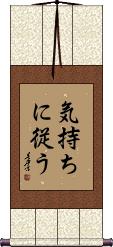
Listen to Your Heart / Follow Your Heart
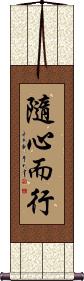
suí xīn ér xíng 수심이행
This is the closest way to express this idea in Chinese. Literally translated, this phrase means, "Allow your heart to dictate your behavior" or "Let your heart guide your conduct" in Chinese. You could also translate this as "follow your heart". Or, with a bit of imagination, it could mean: "let your spirit be your guide".
Note that in some cases, "heart" can mean "mind", "soul" or even "spirit" in Chinese. In ancient China, it was thought that the big pumping organ in your chest was where your thoughts came from, or where your soul resides. Ancient western thought followed a similar belief. Thus phrases like "I love you with all my heart" and "I give you my whole heart".
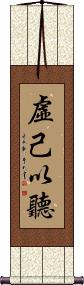
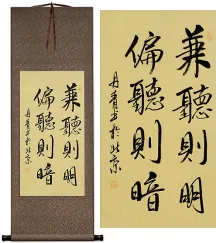
Listen to Both Sides and be Enlightened, Listen to One Side and be in the Dark
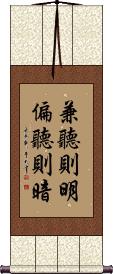
jiān tīng zé míng, piān tīng zé àn 겸청칙명편청칙암
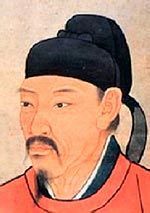
A man named Wei Zheng lived between 580-643 AD. He was a noble and wise historian and minister in the court of the early Tang Dynasty.
The emperor once asked him, "What should an emperor do to understand the real-world situation and what makes an emperor out-of-touch with reality?"
Wei Zheng replied, "Listen to both sides and you will be enlightened; listen to only one side and you will be left in the dark."
Then Wei Zheng went on to site examples of leaders in history that were victorious after heeding both sides of the story, and other leaders that met their doom because they believed one-sided stories which often came from flattering lips.
Please note that there is an unwritten rule when the same character appears twice in the same phrase, the calligrapher will alter the appearance so that no two characters are exactly alike in the same piece. This calligraphy has two repeating characters that will be written differently than they appear here.
Back to the top of this page
Undaunted After Repeated SetbacksPersistence to overcome all challenges
bǎi zhé bù náo hyaku setsu su tou 백절불요
This phrase means "Be undaunted in the face of repeated setbacks".
It comes from a long, and occasionally tragic story of a man that lived sometime around 25-220 AD. His name was Qiao Xuan and he never stooped to flattery, but remained an upright person at all times. He fought to expose corruption of higher-level government officials at great risk to himself.
Then when he was at a higher level in the Imperial Court, bandits were regularly capturing hostages and demanding ransoms. But when his own son was captured, he was so focused on his duty to the Emperor and common good that he sent a platoon of soldiers to raid the bandits' hideout, and stop them once and for all even at the risk of his own son's life. While all of the bandits were arrested in the raid, they killed Qiao Xuan's son at first sight of the raiding soldiers.
Near the end of his career a new Emperor came to power, and Qiao Xuan reported to him that one of his ministers was bullying the people and extorting money from them. The new Emperor refused to listen to Qiao Xuan and even promoted the corrupt Minister. Qiao Xuan was so disgusted that in protest he resigned his post as minister (something almost never done) and left for his home village.
His tombstone reads "Bai Zhe Bu Nao" which is now a phrase used in Chinese culture to describe a person of strong will who puts up stubborn resistance against great odds.
My Chinese-English dictionary defines these 4 characters as, "keep on fighting in spite of all setbacks", "be undaunted by repeated setbacks" and "be indomitable".
Our translator says it can mean, "never give up" in modern Chinese.
Although the first two characters are translated correctly as "repeated setbacks", the literal meaning is "100 setbacks" or "a rope that breaks 100 times". The last two characters can mean "do not yield" or "do not give up". Most Chinese, Japanese, and Korean people will not take this absolutely literal meaning, but will instead understand it as the title suggests above.
See Also... Tenacity | Fortitude | Strength | Perseverance
Push or KnockTo weigh one's words
fǎn fù tuī qiāo 반복추고
During the Tang Dynasty, a man named Jia Dao (born in the year 779), a well studied scholar and poet, went to the capital to take the imperial examination.
One day as he rides a donkey through the city streets, a poem begins to form in his mind. A portion of the poem comes into his head like this: "The bird sits on the tree branch near a pond, A monk approaches and knocks at the gate..." At the same time, he wondered if the word "push" would be better than "knock" in his poem.
As he rides down the street, he imagines the monk pushing or knocking. Soon he finds himself making motions of pushing, and shaking a fist in a knocking motion as he debates which word to use. He is quite a sight as he makes his way down the street on his donkey with hands and fists flying about as the internal debate continues.
As he amuses people along the street, he becomes completely lost in his thoughts and does not see the mayor's procession coming in the opposite direction. Jia Bao is blocking the way for the procession to continue down the road, and the mayor's guards immediately decide to remove Jia Bao by force. Jia Bao, not realizing that he was in the way, apologizes, explains his poetic dilemma, and awaits his punishment for blocking the mayor's way.
The mayor, Han Yu, a scholar and author of prose himself, finds himself intrigued by Jia Dao's poem and problem. Han Yu gets off his horse, and addresses Jia Bao, stating, "I think knock is better". The relieved Jia Bao raises his head, and is invited by the mayor to join the procession, and are seen riding off together down the street exchanging their ideas and love of poetry.
In modern Chinese, this idiom is used when someone is trying to decide which word to use in their writing or when struggling to decide between two things when neither seems to have a downside.
Unselfish: Perfectly Impartial
dà gōng wú sī 대공무사
This is comes from an old story from some time before 476 BC. About a man named Qi Huangyang, who was commissioned by the king to select the best person for a certain job in the Imperial Court.
Qi Huangyang selected his enemy for the job. The king was very confused by the selection, but Qi Huangyang explained that he was asked to find the best person for the job, not necessarily someone that he personally liked or had a friendship with.
Later, Confucius commented on how unselfish and impartial Qi Huangyang was by saying "Da Gong Wu Si" which if you look it up in a Chinese dictionary, is generally translated as "Unselfish" or "Just and Fair".
If you translate each character, you'd have something like, "Big/Deep Justice Without Self". Direct translations like this leave out a lot of what the Chinese characters really say. Use your imagination, and suddenly you realize that "without self" means "without thinking about yourself in the decision" - together, these two words mean "unselfish". The first two characters serve to really drive the point home that we are talking about a concept that is similar to "blind justice".
One of my Chinese-English dictionaries translates this simply as "just and fair". So that is the short and simple version.
Note: This can be pronounced in Korean, but it's not a commonly-used term.
See Also... Selflessness | Work Unselfishly For The Common Good | Altruism
Back to the top of this page |