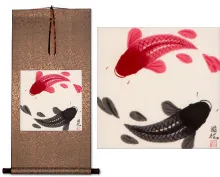
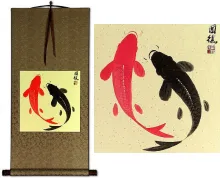
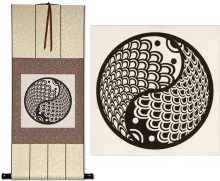
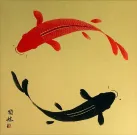
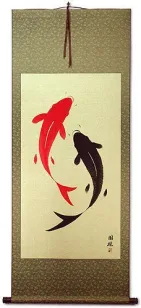
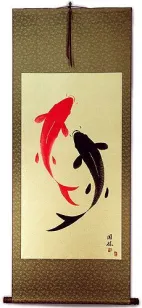
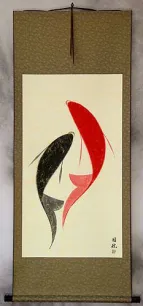
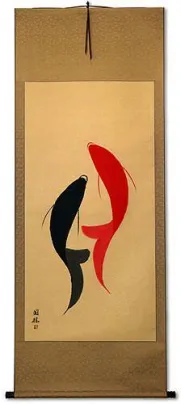
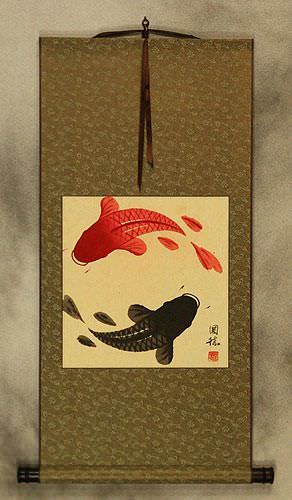
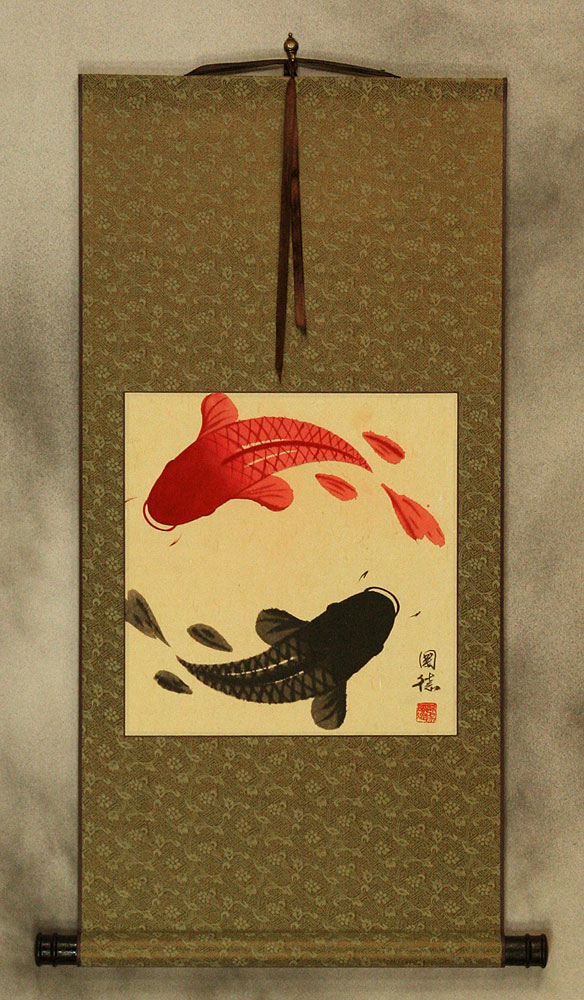
Antiqued Yin Yang Fish Silk Wall Scroll
34½"
20¼"
Typical Gallery Price: $90.00
$39.88Sold Out
Sorry you missed it.
• Hand-Painted Artwork.
• Handmade Wall Scroll.
• Money-Back Guarantee.
Approximate Measurements
Artwork Panel: 33.3cm x 34.2cm ≈ 13" x 13½"
Silk/Brocade: 42.5cm x 88cm ≈ 16¾" x 34½"
Width at Wooden Knobs: 51.5cm ≈ 20¼"
Information about caring for your wall scrollSee Larger Image
Yin Yang Fish Wall Scroll
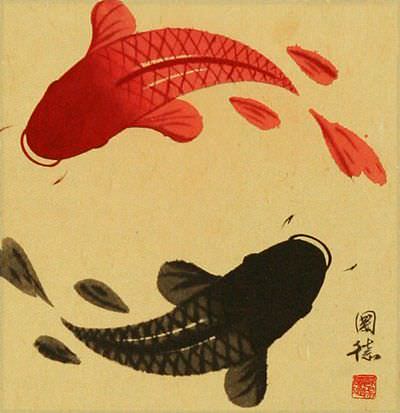
Close up view of the artwork mounted to this silk brocade wall scroll
This artwork features some antique-style xuan paper. The paper is handmade and has been stained with tea. There are some artifacts and irregularities in the paper, but this is the style of this paper. The artwork was mounted to a fresh golden-brown silk wall scroll by hand in our workshop. The whole wall scroll looks like an antique that is in excellent shape. Or perhaps just a traditional and classic look.
The painting in this wall scroll represents the balance in life known as "Yin Yang" in the Asian world.
In traditional Chinese culture, people believe that everything has balance...
| Male | Female |
| Good | Evil |
| Light | Dark |
| Sun | Moon |
| Heaven | Hell |
| Husband | Wife |
These fish are associated strongly with both Japanese and Chinese cultures. Beautiful garden parks in the cities around China are often graced with a pond full of these fish throughout the year. They are a very strong fish as they can be seen swimming slowly under thick sheets of ice in lakes during the brutal Winter of northern China.
Also, in Mandarin Chinese, "fish" is pronounced "Yu" which is the same pronunciation as the word meaning "wealth" or "being rich". So many Chinese people believe that having a painting of fish in your home will bring you wealth and riches.
About this wall scroll
The artwork was painted on xuan paper (often called "rice paper" in the west). The raw artwork was delivered to our Asian art mounting shop in Beijing. There it was built into a completely handmade silk wall scroll by a skilled craftsmen (one of the best in China). The result is a wall scroll that will last many years, and is leaps and bounds above the "tourist trash" wall scrolls that you find in the markets and gift shops around China.
About the amazing artist behind this great artwork:
If you have navigated much of our website, you already know this is a great all-around artist that does wonderful work in many categories. But of course, there is a story...
I was supposed to be on vacation, and I just wanted to see the karst mountain landscapes of the Li River near Guilin. As luck would have it, I stumbled across a very inspiring artist.
In fact, this man is probably the most courageous person that I have ever met. He certainly has my respect and admiration.
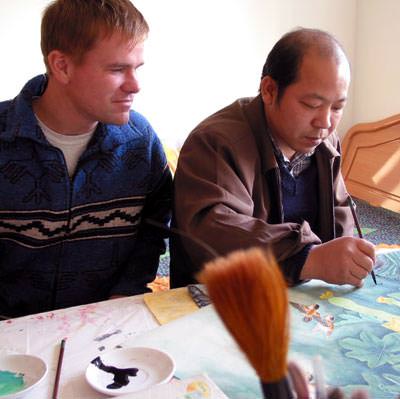
As I watch him finish one of his paintings, I find myself in awe of this man that can do amazing things with only one arm that most people can't do with two.
While he is a wonderful and talented artist, that is only part of his story
His full name is Ou-Yang Guo-De. He and his sister now live in Guilin. He keeps himself busy painting, while his sister sells his art at a small gallery not far from the center of the city.
When they were very young, their mother died. Their father didn't make much money, and with their mother gone, he had to remarry quickly for financial reasons (very common in Chinese culture under those circumstances and that time in history). Their father found a new wife in a village, and they all moved into the woman's family home.
Part of young Ou-Yang Guo-De's chores included collecting corn cobs that fell from the passing train cars at nearby railroad tracks. The corncobs are burned and used as fuel for cooking, and even heating homes in poorer villages where people cannot afford coal.
One day, when he was about 11 years old, Ou-Yang Guo-De came upon a train that had stopped on the tracks. Under the train he saw a bounty of corncobs. He climbed under the train to get the precious cobs when tragedy stuck. The train began to move, and literally cut him in half...
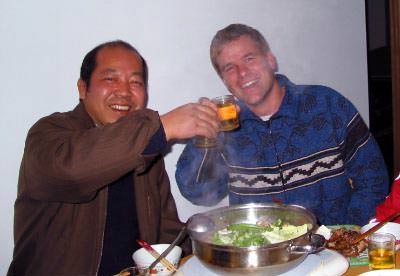
Every time I put my glass down, Mr. Ou-Yang would say, "Cheers!", and quickly our glasses go "bottoms up" again. Between drinks we eat from a steaming hot pot full of chicken, cabbage, and other vegetables.
The details he told me about this event were so vivid that they are a bit too graphic for a happy art listing. He still remembers everything that happened until he lost consciousness, expecting to die.
Though pieces of his story are missing from when he was unconscious, there must have been a miracle involved because somehow he survived. The nearest hospital was far away, and while he has no idea how he got there before bleeding to death, that's were he woke up. But both of his legs and his left arm were gone forever.
In China, the most likely occupation for a disabled person like him would be to become a beggar on the street, but not Ou-Yang Guo-De!
He continued to study and go to school, and went to work at an umbrella and parasol factory. He showed a lot of natural artistic talent, so the factory owner sent young Mr. Ou-Yang to art school for two years. After graduation, he went to work hand painting beautiful scenes on rice paper and silk parasols.
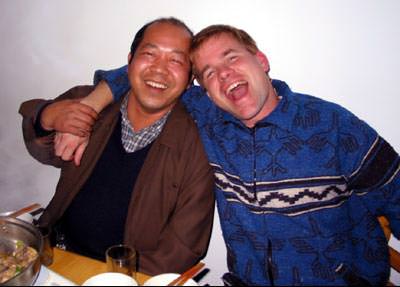
All of the cheers took their toll, if my flushed red face doesn't tell the story, the fact that I am singing a Neil Diamond song should tell you something.
After many years at the factory, working for low wages, he decided to make a change. He took a leap of faith and went out on his own as an artist. It was a little rough at first, but it turned out to be a good decision.
He has done well, and has quite a following. Also, he is a little famous for more than his art. You see, a few years ago, he was given an award by the government of China for being an example of what disabled people should aspire to.
But there is something about him that is different. This guy totally loves life. He is truly happy and good-natured. He laughs and tells jokes and is the life of the party. He is not a social outcast, but rather a social phenomenon. He is surrounded by a lot of friends because I think his friends feed off of his enthusiasm for life - I certainly felt it myself.
I spent several days with the artist, and I may be forever changed. Whenever I think I am in a tough spot, or difficult circumstance, all I have to do is think about Mr. Ou-Yang. If he can overcome what he did, then I can overcome my petty problems.
This item was listed or modified
Feb 6th, 2012
Typical Gallery Price: $90.00
$39.88Sold Out
Sorry you missed it.