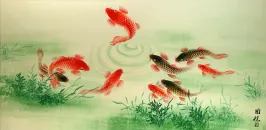
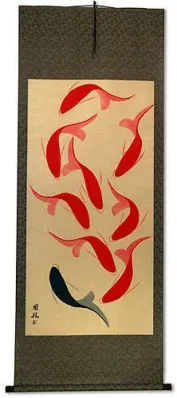
Year In, Year Out, Have Riches Chinese Koi Fish Wall Scroll
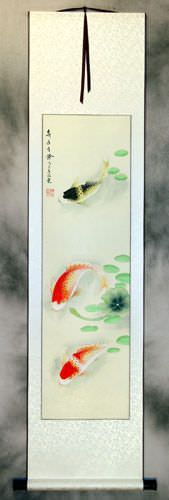
60¾"
18¼"
Typical Gallery Price: $200.00
$69.88Sold Out
Sorry you missed it.
• Hand-Painted Artwork.
• Handmade Wall Scroll.
• Money-Back Guarantee.
Approximate Measurements
Artwork Panel: 28.5cm x 98.6cm ≈ 11¼" x 38¾"
Silk/Brocade: 37.5cm x 154.1cm ≈ 14¾" x 60¾"
Width at Wooden Knobs: 46.5cm ≈ 18¼"
Information about caring for your wall scroll


Year In Year Out Have Abundance - Silk Wall Scroll
You simply can't appreciate the beauty of this piece in the small picture above.
The Chinese title is, "Nian Nian You Yu", which literally means, "Year [in] Year [out] Have Abundance". The word for "abundance" or "surplus" in Chinese has the exact same pronunciation as the word for "fish". Thus, this title is a play on words.
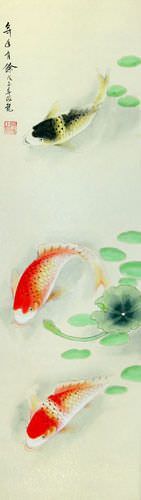
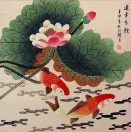
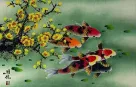
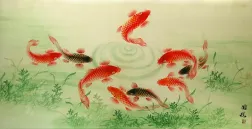
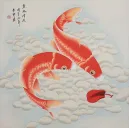
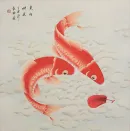
Close up view of the koi fish artwork mounted to this silk brocade wall scroll
This large koi fish scroll is part of a custom order of koi fish art that I commissioned from a talented artist (more about him below). Every scale of the koi fish has been carefully painted.
NOTE: It's always tough to get a picture that accurately represents the artwork that we sell. This koi fish wall scroll is so much more beautiful than this picture suggests - I guarantee your satisfaction or all of your money back.
The story of this Asian art...
Ready to leave Chengdu in the Sichuan Province of China. I walk down the hall toward the exit of a building that is home for many antique dealers and artist's studios.
On my way out, I see some nice art in a studio, but keep walking several steps past the door. I feel that I'm finished buying art, and am almost dizzy from the array of art that I'd viewed over the past week in Chengdu City.
But I have to go back and look. I peer in the studio to see an unassuming man holding his paint brush nearly vertical as he slowly works on a landscape painting.
I wait until he is ready to dip his brush into more paint before saying, "hello".
As in most cases, he's a bit startled to see a foreigner, and he mumbles something about how he seldom sees "white people" in the building. Although I doubt the comment is meant for me, I reply, "I look more like a pink person than white don't you think?" He is even more surprised that he can understand me when I speak Chinese to him than the fact that I could reply to his comment.
We both have a good laugh, and exchange pleasantries that are typical in Chinese culture. He hands me his name card (they don't call them business cards in China because the relationship between people is more important - business comes later). I try to read his card back to him, "Chen Zheng-Long", but I am better at oral Chinese than written, so he corrected me on the pronunciation of his name. (I got the tones wrong - there are 4 possible tones that can go with a sound in Mandarin Chinese - if you use the wrong tone, it completely changes the meaning).
Quick Mandarin Chinese Lesson:
Mandarin Chinese has 370 different sounds and an extended lexicon of over 30,000 characters. That's a lot compared to our 26 Roman letters used in English which have just a little over 26 sounds (in that some English letters can be pronounced with more than one sound - especially vowels).
But wait, there's more. Most of these 370 sounds have up to 4 different tones that can be associated with them, as well as a non-tone or zero-tone. These tones completely change the meaning of the sound just like vowels do in English.
Example...
The consonant sound of "n" and "t" can be:
"not, Nate, note, neat, net, gnat, knit or nut"
...just by changing the vowel sound.
When you change the tone in Chinese, the same thing happens (foreigners, like me, have a lot of trouble with these tones).
Here's an example using the "ma" sound with various tones:
horse eats hemp suffers mother's swearing
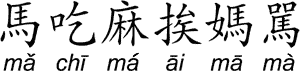
This sentence means
"The horse ate the hemp so it suffers mother's swearing"
...or a more proper translation and better English grammar,
"Mother is swearing at the horse because it ate the hemp".
If you heard this sentence in real life, you probably would not be able to figure out which "ma" is which, unless you'd studied a lot of Chinese. That's what makes this language one of the most difficult to learn on earth.
After he teaches me how to correctly say his name, he shows me several of his latest paintings.
They are all very good, and I know this art is just the kind that a lot of people are looking for from my customers around the world.
He tells me that he really likes to paint black ink horses, and koi fish, but everybody wants his landscape paintings more, so that is what he'd been painting lately.
I tell him that I would like to buy some koi fish and horses too, and he gets very excited, but apologizes that he has very few to show me now. After we talk about the price, I tell him that I'll just pay him in full for several more that he can mail to me in Beijing when he finishes them.
He looks at me with a puzzled face, and I can tell that he is wondering why I want to pay him in full rather than give him deposit. This is when I use the old Chinese Idiom, "If you drain the water from the pond, you will get all the fish in one day, but if you leave the water in the pond, you can catch fish forever". He clearly understood that I was trying to build a long-term relationship with him in a short time that I had left in Chengdu, by extending some trust.
He wraps up the paintings I bought on the spot, and actually paints me a receipt on a piece of rice paper for the money that I hand to him.
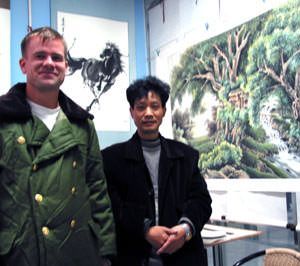
Meeting at Cheng Zheng-Long's Asian art studio in Chengdu
Before I leave, he tells me a little about himself in that he was once trained in civil engineering, but wanted to express more of his creative side. So he left that career behind and became a full time artist after studying at an art academy for a few years. I see some parallels in our lives, as I'd left a similar engineering career behind in the states to come to China originally.
More about this piece...
This artwork was created using special Chinese black ink and watercolor on xuan paper (rice paper).
In Beijing, I had this painting carefully mounted to a very high-quality silk scroll.
All you need to do is put a nail in your wall, and hang this great scroll for all to see.
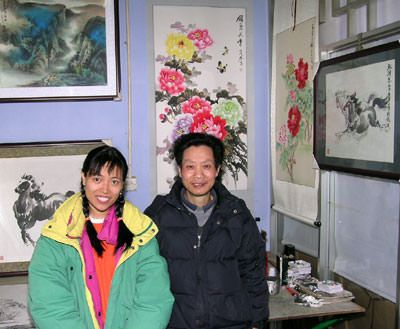
My wife, Ling Hua (aka Cat) and
Artist Chen Zheng-Long in Chengdu, 2006.
This item was listed or modified
Jan 1st, 2009
Typical Gallery Price: $200.00
$69.88Sold Out
Sorry you missed it.