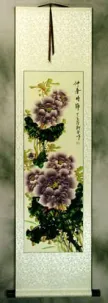
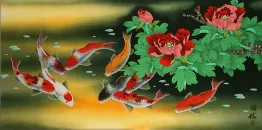
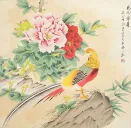
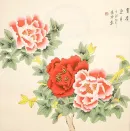
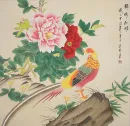
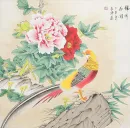
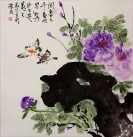
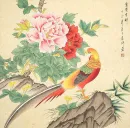
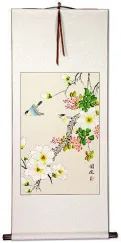
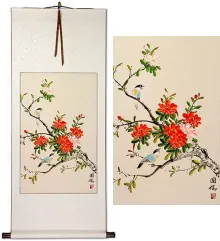
Extra-Long Green Peony Flower Wall Scroll

74"
19½"
Typical Gallery Price: $90.00
$39.00Sold Out
Sorry you missed it.
• Hand-Painted Artwork.
• Handmade Wall Scroll.
• Money-Back Guarantee.
Approximate Measurements
Artwork Panel: 31.2cm x 133cm ≈ 12¼" x 52¼"
Silk/Brocade: 40.5cm x 188cm ≈ 16" x 74"
Width at Wooden Knobs: 49.5cm ≈ 19½"
Information about caring for your wall scrollBeautiful Green Peony Flowers
DISCOUNTED: This one has been on our shelves for a while - nothing wrong with it, just time to move the inventory.

Close up view of the flower artwork mounted to this silk brocade wall scroll
Please note that you must hang this scroll on a nail first, and carefully unroll it down your wall. It's long length also makes it both extra beautiful and delicate.
The peony is the unofficial national flower of China. It dates back far into Chinese history. In fact if you were alive from the Tang Dynasty to the Song Dynasty (618-1279AD), you would see these flowers all around the Emperor's palace. It was the favorite flower many people from the Emperor down to the common peasants.
Legend has it that the emperor's concubines would often wear peonies in their hair vying for favor from the emperor.
In an interesting twist, the roots of this family of flower are often used in Chinese herbal medicine.
This piece was painted by Qing Yu-Dian. Besides the title, the Chinese Characters include his signature and year painted (according to the Chinese lunar calendar -Year of the Monkey, which ended in early 2005).
This artwork is by Liu Da-Lu of Chengdu (right in the middle of China near where all of the Panda bears live).
This flower artwork was first painted on special xuan paper (often known as rice paper in English, though there is not actually any rice involved in laying the paper). After it dried and was signed by the artist, I took it with me back to Beijing. Later, our expert mounter and his apprentices made a beautiful handmade wall scroll using silk, paper, wood, and a few nails and brass eyelets here and there.
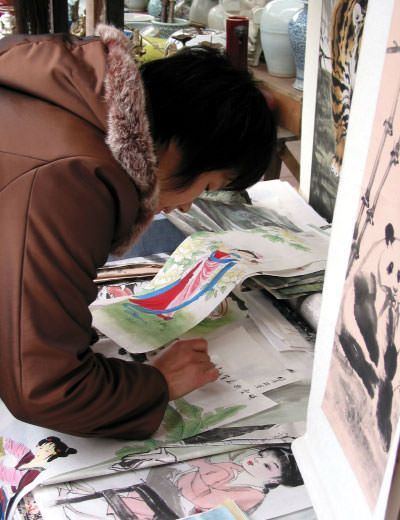
The artist places her "chop" (signature stamp) on one of the wonderful pieces of artwork that she created meticulously by hand.
How I found this art...
Visiting an old friend and artist in Chengdu, I notice a woman is politely waiting for me. Soon enough, I finish my business, and leave my friend to work on some art that I would pick up several days later. The polite woman greets me as I walk out. She quietly asks if I would just take a look at her artwork.
I walk over to her little booth and take a look. The work is good, and I am surprised that she doesn't have a studio-gallery like a lot of artists. She says that she likes to sell in the market, and put paintings in the hands of "the common man". It is then that I realize we have a similar philosophy.
I look through her whole collection, and pick out several pieces that I like. Her husband shows up, and I find out that he too is an artist.
I end up staying a few extra days with these two artists as they create a couple of custom paintings for me. The quality of their work is wonderful and I'm so glad I didn't miss the chance to meet them.
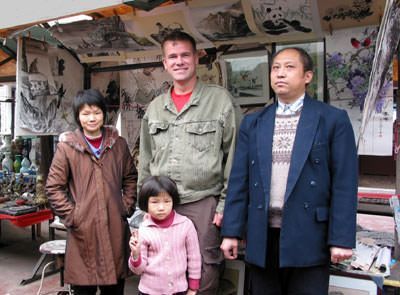
Liu Da-Lu with her husband and daughter.
As usual, I am the "non-Chinese-looking guy" in the picture.
About the artist:
The artist's name is Liu Da-Lu. She lives with her husband and young daughter near Chengdu, in the Sichuan province of China. As if fitting the stereotype, her husband loves to paint dragons and warriors, but she paints beautiful women, flowers, landscapes, and animals.
They both live the simple life of artists. Both of them have the attitude that the art itself is more important than money. The honor of knowing that their work will now be on the walls of homes throughout the world is the thing they feel strongest about.
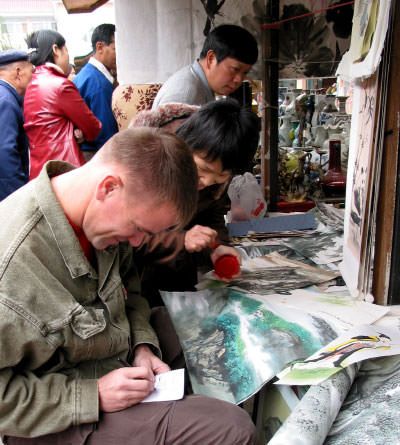
I take down many notes about the artist, and her paintings as I sit in her little shop in the arts & antiques market just outside Chengdu.
This item was listed or modified
Feb 9th, 2009
Typical Gallery Price: $90.00
$39.00Sold Out
Sorry you missed it.