Category: Beautiful Asian Women, Tough Chinese Warriors
...And other People of Asia Artwork

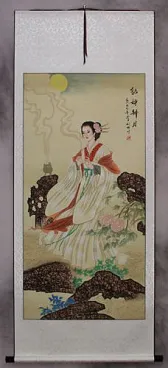
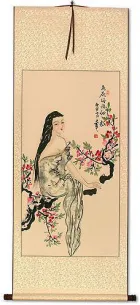
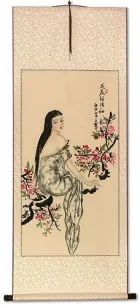
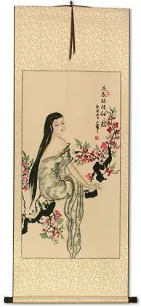
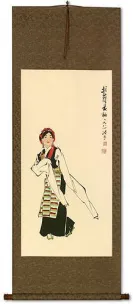
Diao Chan
Famous Beauty of China Wall Scroll

Diao Chan - Famous Beauty of China Wall Scroll
arrow
64¼"
(163.5cm)
arrow
line
arrow 20"
(50.7cm)
arrow


Typical Gallery Price: $170.00

Your Price:
US$49.00U.S. Dollars

GBP £29.74British Pounds
Euro €33.07Euro
Canadian $52.51Canadian Dollars
Australian $53.91Australian Dollars


Approximate Measurements:
Painting: 12½" x 42½"   (31.6cm x 108cm)
Silk Scroll: 16½" x 64¼"   (41.7cm x 163.5cm)
Width of Wooden Scroll Roller: 20"   (50.7cm)

Information about caring for your new Wall Scroll


Diao Chan

Deadliest of the Four Beauties of Ancient China.


DISCOUNTED: This one has been on our shelves for a while - nothing wrong with it, just time to move the inventory.

About the Four Beauties of China:

In Chinese culture, there are four famous beautiful woman of China.

They are thought to be the most beautiful and significant woman of China's ancient history.

Although the stories about these woman are based on fact, they are also steeped in legend.

These woman have remained famous through history because of the drastic effects on the emperors, kings, and kingdoms with whom they were bound.

Some of the beauties brought kingdoms and dynasties to their knees.

Most of the beauties had lives that ended in tragedy or mystery.

The legend and history of these woman has inspired Chinese artists for generations to create paintings that depict these four famous beauties of ancient China.


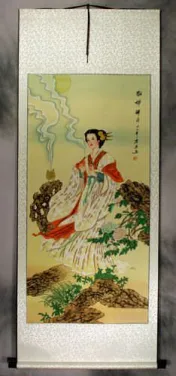
Diao Chan - Famous Beauty of China Wall Scroll close up view

Close up view of the artwork mounted to this silk brocade wall scroll

More about the beauty depicted on this scroll:

The woman in this painting is known as "Diao Chan Xi Hua"

She is usually just referred to as "Diao Chan", and she was a key player in the epic novel, "The Romance of the Three Kingdoms". Just like "Homer's Odyssey", nobody seems sure if the facts in the novel are truth, or fiction. But the legend of this woman is so strong that she lives on, regardless of whether she actually existed.


Her Story:

Diao Chan's legend is that she was so beautiful the she could cause men who were the closest of

During Three Kingdoms Period of China (220 A.D. - 280 A.D.), a man named Dong Zhuo was becoming the tyrant of the land; doing everything he could to gain more power.

After leveling false accusations against an official with whom he found displeasure, and then having that official beheaded on the spot, many were concerned for the future of the kingdom.

Diao Chan in an effort to have the evil Dong Zhuo removed from power, allowed herself to become betrothed to a warrior named Lu Bu. At the same time, she was offered as a concubine to Dong Zhuo. The plan was to infuriate the two men so much, that Lu Bu would finally kill Dong Zhuo. Every chance she had, she would fuel the fire between these two men. It is said that these men were so blinded by her beauty that they could not see the plot and trap that she had laid before them. With both men filled with rage, the warrior Lu Bu joined a plot to assassinate Dong Zhuo.

The plot was successful. Dong Zhuo was killed. His clan put into disarray, and taken from power.

For her part in manipulating the two men, Diao Chan was murdered by the surviving members of Dong Zhuo's clan.

You can draw your own conclusions about the lessons to be learned from this tale. If you want the whole story, you will have to read the book yourself.


The artist's name is Qing Ping. The artist lives near Chengdu and was introduced to my by one of our other artists from Chengdu, Huang Xin-An.

This is a elaborate style painting using special black Chinese ink and watercolor on rice paper. After buying this art from the artist, it was mounted to a hand-made silk scroll.


« Previous Artwork | Next Artwork »

Typical Gallery Price: $170.00

Your Price:
US$49.00U.S. Dollars

GBP £29.74British Pounds
Euro €33.07Euro
Canadian $52.51Canadian Dollars
Australian $53.91Australian Dollars


All orders billed in U.S. Dollars.
Other currencies shown for reference at approximate exchange rates.


Item Location: USA
details


Gary's random little facts about China:

Is "Oriental" politically correct?
Everyone is going to hate me for this, but here is the truth:

Some people who currently prefer to call themselves "Asian-Americans" woke up one morning and decided that "Oriental" is now a word to be used only for Oriental rugs, Oriental art and lamps, or any other inanimate object from Eastern Asia.

When I was teaching English in China, many of my students would refer to themselves as "Oriental", and I would correct them and say, It's better to say that you are Asian or Chinese rather than Oriental, but I was at a loss as to explain why.
My Chinese students were very smart, and came back at me with the fact that being from Asia was too broad a term, and asked if Persians and Saudi Arabians should also refer to themselves as "Asian".

I then had to make excuses for my geographically-challenged fellow Americans* who had long ago replaced the correct term of "Oriental" (meaning the bio-geographic region including southern Asia and the Malay Archipelago as far as the Philippines, Borneo and Java), and replaced it with "Asian" which in truth encompasses half the world's population - many of whom do not consider themselves to be of the same race as those from the Orient.
(For those Americans reading this and who've slept through their high school geography class: It's true, the whole Middle East, and half of Russia are located in the Asian continent)

But I admit I am not helping the problem. You see, almost half the people that find our website did so while searching for "Asian art" and I have done a lot to promote our business as "Purveyors of Asian art". So you can blame me too.
To truly be an Asian art gallery, we would have to offer artwork from beyond the Orient, from places like India, Persia (Iran), most Arab nations, and Russia.

Notes:
There are a lot of things that present problems in the English language.
Usually these problems are thanks to mistakes of the past.
That's why we have to say, "He's an Indian from India" versus "He's a Native-American Indian" (Thanks to Mr. Columbus).

Things to learn:
Do not refer to a Persian (Iranian) as Arab.
If you refer to an Arab-American as being Asian, they will look at you funny and possibly be offended.
If you refer to a person from India as Asian, you will mildly amuse them.
If you refer to a Russian as being Asian, they will pour borsch on you (my ex-wife is Russian, so I know this to be true from experience).
Using "Asian" to refer to a person from Singapore is okay, but they will later, as if by accident, mention that they are in fact from the most civilized country in Asia.

*We citizens of the USA call ourselves "Americans" which seems a bit arrogant to our neighbors who reside on the continents of North and South America. Keep in mind, Canadians and Mexicans are also from North America, but refer to themselves in more correct geographic terms.

Artwork
Search:

Exact
Phrase

Oriental Outpost LogoFlagTowerwatercolor
Chinese Calligraphy Search
ArtPaintingsAsian Art Gallery

Adventures in Asian Art