The Green of the Great Wall Scroll

16½"
19¾"
Typical Gallery Price: $60.00
$28.88Sold Out
Sorry you missed it.
• Hand-Painted Artwork.
• Handmade Wall Scroll.
• Money-Back Guarantee.
Approximate Measurements
Artwork Panel: 32cm x 32.5cm ≈ 12½" x 12¾"
Silk/Brocade: 41.5cm x 42cm ≈ 16¼" x 16½"
The Great Wall

The Great Wall is one of the greatest epic construction projects in Chinese history as well as the world.

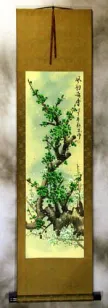
Close up view of the artwork mounted to this silk brocade wall scroll
The Great Wall stretches some 6,350 kilometers (about 4000 miles) across various parts of Northern China. But it's not just one wall, the Great Wall is actually many walls that are somewhat strung together (though much of the Great Wall isn't connected at all).
These are the only facts about the Great Wall that is not in dispute.
Archeologists and historians often argue about the following facts, but this is what I have found in my own research...
Originally, work on first sections of wall started in the 7th century B.C. During the Zhou Dynasty leading up to the Warring States period. During this period of history, China was far from unified, and none of the states trusted any of the other states, and therefore built walls to protect from attack.
Later, sometime after 221 B.C., the first emperor of the Qin Dynasty decided that after his great feat of unifying China for the first time, he ought to connect all of the walls together. The idea was to protect the northern border of the kingdom from attack and harassment from the Xiongnu tribe that didn't particularly like their new and powerful southern neighbors.
The struggle continued into the Han Dynasty (206 B.C. - 220 A.D.). After major battles in 127 B.C. and chasing their enemies into the Gobi Desert, Emperor Wu ordered a wall be built to keep the enemies of the Han Dynasty at bay.
Construction of various walls continued for another thousand years during several dynasties.
Just after 1210, the Mongols (remember Genghis Khan?) were taunted by a corrupt northern Chinese ruler who told the Mongols that they would need to submit to his rule. The Mongols were understandably put off by this, and promptly invaded and eventually took over almost all of what is now China. At that time, the Great Wall was in various conditions of decay, and provided little defense when the Mongols advanced.
In turn, the Chinese (Han) people were not really happy about being occupied by the Mongols, mostly because they felt that the Mongols smelled bad, had no manners, and acted like barbarians (no, I didn't just make that up).
Finally, the Chinese chased out the smelly Mongolians (although to this day, Chinese do not use deodorant, so the pot seems to be calling the kettle "black" here).
In 1368, hoping that the Mongols would never regroup and return to China, Emperor Tai Zu of the the Ming Dynasty (1368 - 1644 A.D.) ordered the largest construction project in history. The whole concept of "brick and mortar" was the new advanced technology of the time. The Chinese used this technology to build a wall that has stood the test of time for more than 630 years. If you go to China today, most of the Great Wall that you will see is from this period. Previous walls have either decayed to dust, or the new wall was built on top of the old.
Sadly, the wall was never put to the test, as the Manchurians, much as the Mongols before them conquered China by exploiting the weaknesses of corrupt officials and rampant poverty rather than any weakness in the Great Wall.
During Manchurian rule (known as the Qing Dynasty 1616 - 1911 A.D.) the wall was all but forgotten. The Republic of China was established in 1912, but soon found itself in a war with Japan, and after WWII, plunged into civil war with the Communists. When Chairman Mao took power, he shunned all things of tradition, history, and culture in China. This included the Great Wall, some of which was demolished for spite. Of course, ancient city walls, Buddhist and Taoism temples, and even the Forbidden City were razed, burned, or destroyed under his orders.
It's really been in more recent times that the Great Wall has found it's calling as a tourist attraction. No longer seen as "an embarrassing old relic" as it was during the Cultural Revolution, the Chinese people can now celebrate the marvel of the largest man made object on earth.
Oh, and It might just be an urban legend, but many believe The Great Wall is the only man made object on earth that is was visible in 1969 by American astronauts as they returned from the moon.
About the painting mounted to this wall scroll:
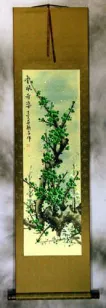
This was painted by Zi Shi of Beijing China. The season and place are noted in the Chinese script along with the year painted as well as the artist's signature and stamp.
The style and media of this painted is detailed freehand watercolor and special black Chinese ink on xuan paper (rice paper) and mounted to a traditional Asian silk scroll.
This item was listed or modified
Jul 25th, 2008
Typical Gallery Price: $60.00
$28.88Sold Out
Sorry you missed it.