Custom Kung Fu Chinese & Japanese Calligraphy Wall Scroll
We have many options to create artwork with Kung Fu characters on a wall scroll or portrait...
...We could also help you create an Kung Fu Asian Tattoo.
12. Bruce Lee
13. Five Elements
14. Fu Dog / Foo Dog
15. Fu Lu Shou
17. Hou De Zai Wu
18. Infinity / Infinite / Unlimited / Unbounded
20. Kung / Gong
21. Fatherly Master / Sifu / Shi Fu / Shifu
23. Wu Chi / Wuji
25. Wu Xing Fist
Kung Fu / Gong Fu
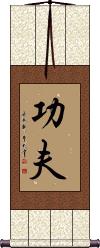
功夫 or Kung Fu is one of the most famous types of martial arts in the world - and not just because of Bruce Lee.
Some translate the meaning as “Accomplishment by Great Effort.” I think this is partially true, but directly translated, it literally means “Merit/Achievement/Accomplishment Man.” The word “fu” can sometimes mean “husband” or “porter,” but in this case, it can only mean “man.” However, few in China will think “man” when they hear the word “Gong Fu” spoken.
This term is also used for things other than martial arts. In fact, it's used to refer to a person with excellent skills in crafts that require a lot of effort to master, such as cooking, tea ceremonies, and calligraphy.
What a lot of people don't know is that the spelling of “Kung Fu” was actually taken from the old Wade Giles form of Romanization. Using this method, the sounds of the English “G” and “K” were both written as “K” and an apostrophe after the “K” told you it was supposed to sound like a “G.” Nobody in the west knew this rule, so most people pronounce it with a “K-sound.” And so, Gong Fu will always be Kung Fu for most westerners.
Also, just to educate you a little more, the “O” in “Gong” has a sound like the English word “oh.”
The popular Chinese dish “Kung Pao Chicken” suffers from the same problem. It should actually be “Gong Bao Chicken.”
Historical note: Many will claim that Kung Fu was invented by the monks of the Shaolin monastery. This fact is argued in both directions by scholars of Chinese history. Perhaps it is more accurate to say that the Shaolin Monks brought the original fame to Kung Fu many generations ago.
Japanese note: While most Japanese martial artists will recognize these characters, Katakana is more often used to approximate the pronunciation of "Kung Fu" with "カンフー." Some will argue as to whether this should be considered a Japanese word at all.
See Also: Bruce Lee
Kung Fu Panda
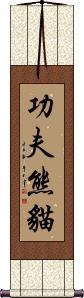
This is the title Kung Fu Panda in Chinese.
Kung Fu San Soo / San Shou
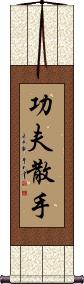
功夫散手 is a martial arts title.
Oddly, there are multiple ways two spell/romanize this in English, but in Chinese, it's written exactly the same.
Technically, the Mandarin romanizes as “gong fu san shou,” for which you'll sometimes see it written “kung fu san shou” (k'ung is an old romanization for a word that sounds like gong with a vowel sound like “oh”).
There is another martial arts style that spells this “Kung Fu San Soo.” I guess this was supposed to approximate Cantonese pronunciation for which the scholarly romanization is generally agreed to be “gung fu saan sau.”
Drunken Monkey Kung Fu
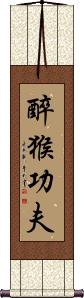
醉猴功夫 is the title for Drunken Monkey Kung Fu (Gong Fu).
The martial arts style was inspired by the novel, “Journey to the West.”
See Also: Monkey Fist
Lau Gar Kung Fu
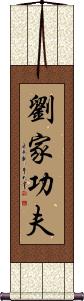
劉家功夫 are the characters for the Lau Gar Kung Fu style of martial arts.
The romanization of “Lau Gar” comes from Cantonese. “Kung Fu” is the common romanization for English from the Mandarin “Gōng Fu” or Cantonese “Gung Fu” pronunciations.
Lau gar = Lau family.
Laughing Dragon Kung Fu
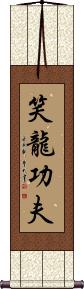
笑龍功夫 is the title for a Martial Arts studio (custom-made at by request of the owner of the studio).
San Soo Kung Fu
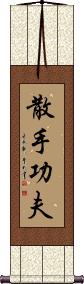
散手功夫 is San Soo Kung Fu.
Sometimes you will see this in the order 功夫散手 (Kung Fu San Soo). Either version is OK.
It's like “Kung Fu of San Soo” vs. “San Soo Kung Fu” if you put it in English terms. San Soo is the adjective either way in Chinese.
Shaolin Kung Fu
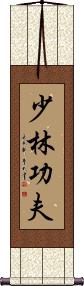
The Shaolin monks of China have been practicing the art of Kung Fu for thousands of years.
少林功夫 is the full title, “Shao Lin Kung Fu.”
Tai Chi Wing Chun Kung Fu
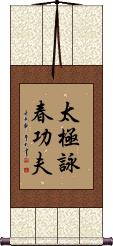
太極詠春功夫 is the title Tai Chi Wing Chun Kung Fu.
Please note that it can be romanized in a variety of ways such as:
Tai Chi Ving Tsun Kung Fu
Tai Qi Yong Chun Gong Fu
Taai Gik Wing Ceon Gung Fu
Be sure this is the right title for what you are looking for before you order.
Wing Chun Kung Fu
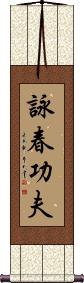
詠春功夫 is Wing Chun Kung Fu.
The first two characters literally mean “Singing Spring” (as in springtime).
The last two are “Kung Fu” (high skill).
Wu Ming / Anonymous
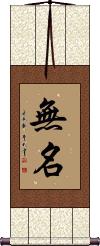
無名 is a Chinese, Japanese and Korean word that means nameless, obscure, unnamed, anonymous, unsigned, unknown, not famous, and sometimes unjustifiable.
The romanized title, Wu Ming, has been used for several different things such as a group of Italian writers, and even as the Chinese name of the infamous hackers.
Bruce Lee
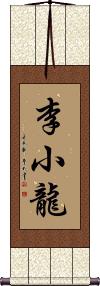
李小龍 is the real full name of Bruce Lee.
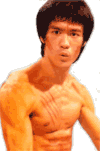 Many people have no idea that Bruce Lee had a “real” Chinese name. In Mandarin and Cantonese, he is known as “Lǐ XiǎoLóng” and “Léi SíuLùng” respectively.
He kept his family name pronunciation (Li = Lee). 李 is a common family name that also means “plum.”
His given name 小龍 (Xiao-Long), literally means “little dragon.” 李小龍 is why you often see the character for dragon associated with Bruce Lee on various posters etc.
For a pronunciation lesson, the “X” in Romanized Mandarin is pronounced like a “sh” sound but with your tongue at the bottom of your mouth. The vowel sound in “Long” is like the English “oh,” not like the “ah” sound in the English word “long.”
If you are a big Bruce Lee fan, you should know this information, and you should have this wall scroll hanging in your room or martial arts studio.
Note: Japanese use these same Chinese characters / Kanji to write Bruce Lee's real name (with different pronunciation - which is a bit like how the name “Bruce Lee” sounds in English).
See Also: Kung Fu | Martial Arts
Five Elements
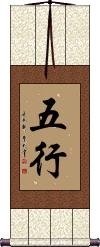
五行 is the title of the five elements: wood, fire, water, earth, and metal.
The first character means five, and the second character is simply element(s).
According to ancient Chinese science, all matter in the world is comprised of these elements. One idea presented with the five elements is that when energy is added, the matter is believed to expand. When energy is removed, matter contracts. Oddly, this concept is not far from Einstein's theories and modern science. Just a few thousand years before Einstein.
More info: Wikipedia - Five Elements (Wu Xing).
See Also: Wood | Fire | Water | Earth | Metal | Five Elements
Fu Dog / Foo Dog
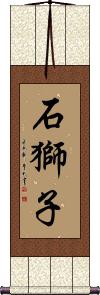
While known in the west as fu dogs or foo dogs, these are actually guardian lions.
These are the lion statues traditionally placed at the entrance of Chinese imperial palaces, imperial tombs, temples, and high-ranking officials' homes. These days, you are more likely to see them at the entrance to a fancy Chinese restaurant.
石獅子 means “stone lion(s).”
Fu Lu Shou
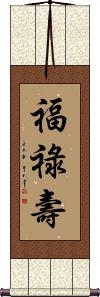
These are the short titles for Sanxing or 三星 (Three Stars).
福祿壽 are the gods of Jupiter, Ursa Major, and Sirius. Fu, Lu, and Shou represent fortune (福), presiding over the planet Jupiter, prosperity (祿), presiding over Ursa Major, and longevity (壽), presiding over Sirius.
In old Chinese folk religion, they are often represented as three old bearded wise men.
Kung / Gong / Mitsugi
Surname
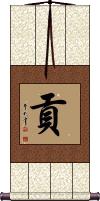
貢 is a Chinese surname that can romanize as Gong from Mandarin or Kung from Cantonese.
In Japan, this can be the surname or given name Mitsugi.
The meaning of this is tribute or gifts.
Hou De Zai Wu
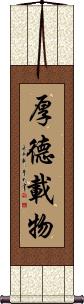
厚德載物 is a Chinese proverb that means “With great virtue, one can take charge of the world.”
Known sometimes by the romanization Hou De Zai Wu, this famous phrase suggests that being ethical is the bridge to leadership. I wish our world leaders followed this.
Infinity / Infinite / Unlimited / Unbounded
Japanese = Infinity / Chinese = No limits
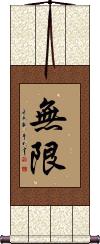
無限 is the Chinese and Japanese word meaning infinity, unlimited or unbounded.
無限 literally translates as “without limits” or “without [being] bound.”
The first character means “never” or “not,” like the prefix “un-.”
The second means “limited,” “restricted,” or “bound.”
Please note that the Japanese definition leans more toward “infinity” and the Chinese is more about being “boundless” or “without limits.”
In Korean, this means infinity, infinitude, or boundlessness. But in Korean, this term has many interpretations or contexts, so your intended meaning might be vague or ambiguous.
Jing Mo / Jing Wu
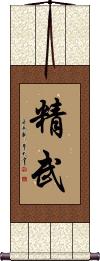
精武 is the title used for a certain type of martial arts. You can translate this roughly as “Excellent Martial Arts” or “Excellence in Martial Arts.” You will notice that the second character is “wu” as in wushu (martial arts) and wushi (warrior).
More information can be found at the Jing Mo website. You should probably only order this if you are a member of this association.
Note that “jing mo” is the Cantonese pronunciation of these characters. In Mandarin, they are “jing wu.”
Also used in Korean but only by those involved with martial arts who can also read Korean Hanja (a small percentage of the population).
Kung / Gong
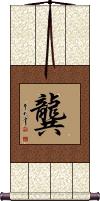
龔 is a Chinese surname that can be romanized as Gong or Kung.
From most of China, it would be Gong, but from Cantonese, it is often romanized as Kung.
In Korean, this could be a surname that romanizes as Gong or Kong and is now written as 공.
The original meaning of the character was something like, “to provide.”
Fatherly Master / Sifu / Shi Fu / Shifu
Martial Arts Teacher
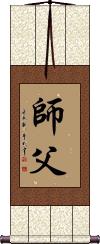
師父 means master in Chinese (occasionally used in Korean Hanja and Japanese). In the context of Martial Arts, this is the master and teacher who instructs students.
The second character by itself means father. Thus, you get the “Fatherly Master” translation. There's an old Chinese saying that goes something like, “One who is your teacher for one day is your father for life.”
Language notes: I've often seen this romanized as “sifu,” this is actually the Cantonese romanization. In Mandarin Chinese, it's “Shifu.” The pronunciation in Mandarin is actually like “sure foo” (using typical English pronunciation). There's an “R-sound” in there, which is not obvious from the romanization. Many martial arts studios incorrectly pronounce this like “she foo” (which is actually the Japanese pronunciation). In Cantonese, it sounds like “Sea foo” (almost like “seafood,” minus the “d” at the end).
師父 is kind of a weird selection for a calligraphy wall scroll; this entry is more for educational purposes. But you are welcome to buy it if it suits your circumstances.
Qi Gong / Chi Kung
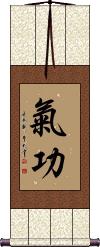
氣功 or Qigong is the title of a technique that is somewhere between medical practice, meditation, and in some cases, religion.
The definition is blurred depending on which school of Qigong you are following. In some cases, it is even incorporated with martial arts.
Some people (even Chinese people) mix this title with Tai Chi (Tai Qi) exercises.
Lately, in China, people will claim to practice Tai Chi rather than Qigong because the Qigong title was recently used as a cover for an illegal pseudo-religious movement in China with the initials F.G. or F.D. (I can not write those names here for fear of our website being banned in China).
You can learn those names and more here: Further info about Qigong
If you are wondering why I wrote “Qi Gong” and “Chi Kung” as the title of this calligraphy entry, I should teach you a little about the various ways in which Chinese can be Romanized. One form writes this as “Chi Kung” or “Chikung” (Taiwan). In the mainland and elsewhere, it is Romanized as “Qi Gong” or “Qigong.” The pronunciation is the same in Taiwan, mainland, and Singapore Mandarin. Neither Romanization is exactly like English. If you want to know how to say this with English rules, it would be something like “Chee Gong” (but the “gong” has a vowel sound like the “O” in “go”).
Romanization is a really confusing topic and has caused many Chinese words to be mispronounced in the west. One example is “Kung Pao Chicken,” which should actually be more like “Gong Bao” with the “O” sounding like “oh” for both characters. Neither the Romanization system in Taiwan nor the Mainland is perfect, in my opinion, and leads to many misunderstandings.
In modern Japan, you may see this written as 気功, but the original 氣功 is still recognized. If you need the Japanese version, please contact me.
Wu Chi / Wuji
Without Limit
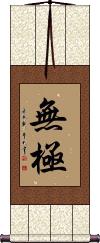
This is Wu Chi or Wuji in Chinese characters.
Wu Chi as a philosophy is often associated with Tai Chi (Taiji).
Wu Wei / Without Action
Daoist / Taoist Tenet
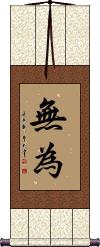
無為 or “Wu Wei” is a Daoist (Taoist) tenet that speaks to the idea of letting nature take its course.
Some will say it's about knowing when to take action and when not to. In reality, it's more about not going against the flow. What will happen is controlled by the Dao (Tao), for which one who follows the Dao will not resist or struggle against.
You can think of 無為 as the Chinese way to express “laissez-faire.”
There is a lot more to this concept, but if you are looking for this entry, you already know the expanded concept.
Warning: Outside of the Daoist context, this means idleness or inactivity (especially in Japanese, where not everyone knows this as a Daoist concept, though it does pair well with the Japanese concept of Wabi-Sabi).
Wu Xing Fist
Five Forms Fist of Kung Fu
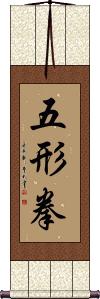
五形拳 is “Wu Xing Fist” or “Five Form Fist.”
The forms refer to Dragon, Snake, Tiger, Crane, and Leopard.
This term is used in Kung Fu, and is recognized by both Chinese and Japanese practitioners of martial arts.
Xuan Wu / Genbu / Black Tortoise God
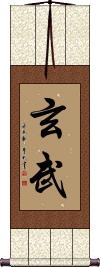
玄武 can refer to the Black Tortoise (an ancient Chinese constellation of stars- part of the seven mansions of the north sky).
In Daoism, this is the God of the North sky.
This also refers to a Black Tortoise god, said to rule over the northern heavens in Japanese. Can also be pronounced/romanized as genmu or when used as a personal name, Hirotake in Japanese.
This in-stock artwork might be what you are looking for, and ships right away...

The following table may be helpful for those studying Chinese or Japanese...
| Title | Characters | Romaji (Romanized Japanese) | Various forms of Romanized Chinese | |
| Kung Fu Gong Fu | 功夫 | kan fu / ku fu kanfu / kufu | gōng fu / gong1 fu / gong fu / gongfu | kung fu / kungfu |
| Kung Fu Panda | 功夫熊貓 功夫熊猫 | gōng fú xióng māo gong1 fu2 xiong2 mao1 gong fu xiong mao gongfuxiongmao | kung fu hsiung mao kungfuhsiungmao |
|
| Kung Fu San Soo San Shou | 功夫散手 | gōng fu sǎn shǒu gong1 fu san3 shou3 gong fu san shou gongfusanshou | kung fu san shou kungfusanshou |
|
| Drunken Monkey Kung Fu | 醉猴功夫 / 醉猴功伕 醉猴功夫 | zuì hóu gōng fu zui4 hou2 gong1 fu zui hou gong fu zuihougongfu | tsui hou kung fu tsuihoukungfu |
|
| Lau Gar Kung Fu | 劉家功夫 刘家功夫 | liú jiā gōng fu liu2 jia1 gong1 fu liu jia gong fu liujiagongfu | liu chia kung fu liuchiakungfu |
|
| Laughing Dragon Kung Fu | 笑龍功夫 笑龙功夫 | xiào lóng gōng fu xiao4 long2 gong1 fu xiao long gong fu xiaolonggongfu | hsiao lung kung fu hsiaolungkungfu |
|
| San Soo Kung Fu | 散手功夫 | sǎn shǒu gōng fu san3 shou3 gong1 fu san shou gong fu sanshougongfu | san shou kung fu sanshoukungfu |
|
| Shaolin Kung Fu | 少林功夫 | sho rin kan fu shorinkanfu | shǎo lín gōng fu shao3 lin2 gong1 fu shao lin gong fu shaolingongfu | shao lin kung fu shaolinkungfu |
| Tai Chi Wing Chun Kung Fu | 太極詠春功夫 太极咏春功夫 | tài jí yǒng chūn gōng fu tai4 ji2 yong3 chun1 gong1 fu tai ji yong chun gong fu taijiyongchungongfu | t`ai chi yung ch`un kung fu taichiyungchunkungfu tai chi yung chun kung fu |
|
| Wing Chun Kung Fu | 詠春功夫 咏春功夫 | yǒng chūn gōng fu yong3 chun1 gong1 fu yong chun gong fu yongchungongfu | yung ch`un kung fu yungchunkungfu yung chun kung fu |
|
| Wu Ming Anonymous | 無名 无名 | mu mei / mumei | wú míng / wu2 ming2 / wu ming / wuming | |
| Bruce Lee | 李小龍 李小龙 | bu ruu su ri buruusuri bu ru su ri | lǐ xiǎo lóng li3 xiao3 long2 li xiao long lixiaolong | li hsiao lung lihsiaolung |
| Five Elements | 五行 | gogyou / gogyo | wǔ xíng / wu3 xing2 / wu xing / wuxing | wu hsing / wuhsing |
| Fu Dog Foo Dog | 石獅子 石狮子 | shí shī zi shi2 shi1 zi5 shi shi zi shishizi | shih shih tzu shihshihtzu |
|
| Fu Lu Shou | 福祿壽 | fú lù shòu fu2 lu4 shou4 fu lu shou fulushou | ||
| Kung Gong Mitsugi | 貢 贡 | mitsugi | gòng / gong4 / gong | kung |
| Hou De Zai Wu | 厚德載物 厚德载物 | hòu dé zài wù hou4 de2 zai4 wu4 hou de zai wu houdezaiwu | hou te tsai wu houtetsaiwu |
|
| Infinity Infinite Unlimited Unbounded | 無限 无限 | mu gen / mugen | wú xiàn / wu2 xian4 / wu xian / wuxian | wu hsien / wuhsien |
| Jing Mo Jing Wu | 精武 | jīng wǔ / jing1 wu3 / jing wu / jingwu | ching wu / chingwu | |
| Kung Gong | 龔 龚 | gōng / gong1 / gong | kung | |
| Fatherly Master Sifu Shi Fu Shifu | 師父 师父 | shi fu / shifu | shī fù / shi1 fu4 / shi fu / shifu | shih fu / shihfu |
| Qi Gong Chi Kung | 氣功 气功 | ki kou / kikou / ki ko | qì gōng / qi4 gong1 / qi gong / qigong | ch`i kung / chikung / chi kung |
| Wu Chi Wuji | 無極 无极 | wú jí / wu2 ji2 / wu ji / wuji | wu chi / wuchi | |
| Wu Wei Without Action | 無為 无为 | mui | wú wéi / wu2 wei2 / wu wei / wuwei | |
| Wu Xing Fist | 五形拳 | gokeiken | wǔ xíng quán wu3 xing2 quan2 wu xing quan wuxingquan | wu hsing ch`üan wuhsingchüan wu hsing chüan |
| Xuan Wu Genbu Black Tortoise God | 玄武 | genbu | xuán wǔ / xuan2 wu3 / xuan wu / xuanwu | hsüan wu / hsüanwu |
| In some entries above you will see that characters have different versions above and below a line. In these cases, the characters above the line are Traditional Chinese, while the ones below are Simplified Chinese. | ||||



