Custom "Dear Grandfather" or "Loving Grandfather" Chinese Calligraphy
Before you see all of the listings below, you should note that there are several ways to say "Grandfather". And you might as well learn about some of the complexities of other family terms in Chinese...
Unlike English, in Chinese, there is a different name for every family member depending on if they are on your mother's side or father's side. For some family titles such as brothers, sisters, and cousins, the names vary depending on age differences. For instance, a male cousin on your mother's side who is older than you is your "biao ge". If this cousin was younger, female, or on your father's side, the title-name changes.
Luckily for grandparents, there is not an older or younger issue. However, there are northern and southern terms for grandparents in China. I guess this is like in America, you might say "sofa" or "couch" depending on where you are from, and if you are from a generation ago, a "sofa" is a "davenport".
For "Grandfather", there is paternal and maternal term which is set in stone. You would NEVER use a paternal term for your maternal grandfather, and vice versa.
Things in Northern China:
Beijing, The Great Wall, Inner-Mongolia,
Tsing Tao Beer, bad weather.
Things in Southern China:
Shanghai, Guilin's Li River, Pandas,
Szechuan (Sichuan) cooking, Hong Kong.
The northern and southern Chinese terms are more flexible - sometimes they are mixed depending on the family. And if there was a marriage between a northern family and southern family, all bets are off as to what someone is going to call their grandfather.
Neither the northern nor southern terms are incorrect - and no matter where they are from, north or south, everybody knows both terms. I will leave it to you if you feel more northern or sothern Chinese.
You'll also find one case of an informal grandfather term which is probably the English equivalent of saying "grandpa" or "pappy"
It would "feel strange" to just have "grandfather" on a wall scroll alone. To be a proper gift, and to "feel right", you need to say something about your grandfather. Therefore you will find the Chinese word for "dear" or "loving" in front of each grandfather term. If you really want just a plain "grandfather" without the adjective, or you want a different adjective, just email me - we'll be happy to help.
Please note that the characters in the boxes below are written in the traditional way, vertically from right to left - so it works out that the term for grandfather appears in the left column.
It's a little tough to correctly display and explain passages of Chinese characters for an English audience when we read English from left to right, and are not used to seeing something in written form that starts on the right.
Chan
Hokkien Surname
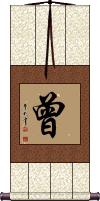
This is a Hokkien surname that is often romanized as Chan.
The meaning is great- (as in great-grandfather, grandmother, grandchild, etc.).
In some context, can mean already. In Japanese, this can be a surname that romanizes as Son.
Grandfather
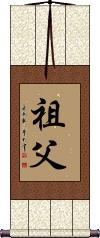
祖父 is a title for grandfather in Japanese.
In Chinese, this is specifically paternal grandfather.
This title alone is not normal for a calligraphy wall scroll.
Loving Grandfather
Maternal (Northern China)
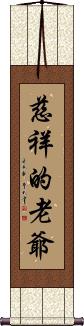
慈祥的老爺 is what you would call your maternal grandfather (mother's father) in Northern China with the adjective/title “Dear” on the front.
Dear Grandfather
Maternal (Northern China)
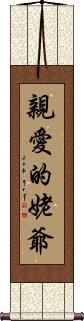
親愛的姥爺 is what you would call your maternal grandfather (mother's father) in Northern China with the adjective/title “Dear” on the front.
Loving Grandfather
Maternal (Southern China)
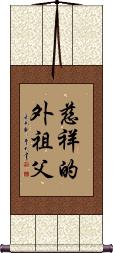
慈祥的外祖父 is “Loving Grandfather” in the formal way that people in Southern China usually call their mother's father (maternal grandfather).
Loving Grandfather
Maternal (Southern China - Informal)
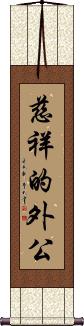
慈祥的外公 is “Loving Grandfather” using an informal way to call your maternal grandfather (mother's father) in Southern China.
Dear Grandfather
Maternal (Southern China)
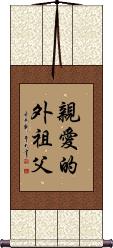
親愛的外祖父 is the formal way that people in Southern China usually call their mother's father (maternal grandfather) with the adjective/title “Dear” on the front.
Dear Grandfather
Maternal (Southern China - Informal)
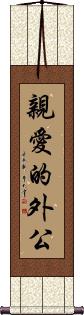
親愛的外公 is an informal way to call your maternal grandfather (mother's father) in Southern China with the adjective/title “Dear” on the front.
Loving Grandfather
Paternal (Northern China)
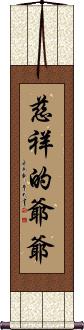
慈祥的爺爺 is “Loving Grandfather” using the most common way for people in Northern China to refer to their father's father (paternal grandfather).
Dear Grandfather
Paternal (Northern China)
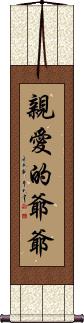
親愛的爺爺 is the most common way for people in Northern China to refer to their father's father (paternal grandfather) with the adjective/title “Dear” on the front.
Loving Grandfather
Paternal (Southern China)
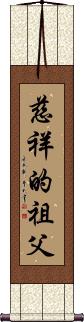
慈祥的祖父 is “Loving Grandfather” in the way people in Southern China call their father's father (paternal grandfather).
Dear Grandfather
Paternal (Southern China)
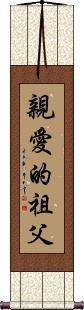
親愛的祖父 is how people in Southern China call their father's father (paternal grandfather) with the adjective/title “Dear” on the front.
Honor for Ancestors
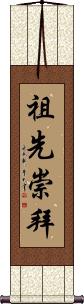
祖先崇拜 means “Appreciation and honor of your ancestors.”
This can refer to anyone from your grandparents and beyond.
The first two characters mean ancestors or forefathers.
The last two characters mean worship, adore/adoration, or admiration.
This is the kind of wall scroll that a filial son or daughter in China or Japan would hang to honor their ancestors who paved the way for the new generation.
 Japanese use a slight variation on the last Kanji. If you want this specifically Japanese version, just click on the Kanji image to the right (instead of the button above). Note that Japanese people would easily be able to identify the original Chinese form of that Kanji anyway.
They also have a similar phrase in old Korean but the first two characters are reversed - just let me know if you want that version when you place your order.
The following table may be helpful for those studying Chinese or Japanese...
| Title | Characters | Romaji (Romanized Japanese) | Various forms of Romanized Chinese | |
| Chan | 曾 | son | zēng / zeng1 / zeng | tseng |
| Grandfather | 祖父 | so fu / sofu | zǔ fù / zu3 fu4 / zu fu / zufu | tsu fu / tsufu |
| Loving Grandfather | 慈祥的老爺 慈祥的老爷 | cí xiáng de lǎo ye ci2 xiang2 de lao3 ye ci xiang de lao ye cixiangdelaoye | tz`u hsiang te lao yeh tzuhsiangtelaoyeh tzu hsiang te lao yeh |
|
| Dear Grandfather | 親愛的姥爺 亲爱的姥爷 | qín ài de lǎo ye qin2 ai4 de lao3 ye qin ai de lao ye qinaidelaoye | ch`in ai te lao yeh chinaitelaoyeh chin ai te lao yeh |
|
| Loving Grandfather | 慈祥的外祖父 | cí xiáng de wài zǔ fù ci2 xiang2 de wai4 zu3 fu4 ci xiang de wai zu fu cixiangdewaizufu | tz`u hsiang te wai tsu fu tzuhsiangtewaitsufu tzu hsiang te wai tsu fu |
|
| Loving Grandfather | 慈祥的外公 | cí xiáng de wài gōng ci2 xiang2 de wai4 gong1 ci xiang de wai gong cixiangdewaigong | tz`u hsiang te wai kung tzuhsiangtewaikung tzu hsiang te wai kung |
|
| Dear Grandfather | 親愛的外祖父 亲爱的外祖父 | qín ài de wài zǔ fù qin2 ai4 de wai4 zu3 fu4 qin ai de wai zu fu qinaidewaizufu | ch`in ai te wai tsu fu chinaitewaitsufu chin ai te wai tsu fu |
|
| Dear Grandfather | 親愛的外公 亲爱的外公 | qín ài de wài gōng qin2 ai4 de wai4 gong1 qin ai de wai gong qinaidewaigong | ch`in ai te wai kung chinaitewaikung chin ai te wai kung |
|
| Loving Grandfather | 慈祥的爺爺 慈祥的爷爷 | cí xiáng de yé ye ci2 xiang2 de ye2 ye ci xiang de ye ye cixiangdeyeye | tz`u hsiang te yeh yeh tzuhsiangteyehyeh tzu hsiang te yeh yeh |
|
| Dear Grandfather | 親愛的爺爺 亲爱的爷爷 | qín ài de yé ye qin2 ai4 de ye2 ye qin ai de ye ye qinaideyeye | ch`in ai te yeh yeh chinaiteyehyeh chin ai te yeh yeh |
|
| Loving Grandfather | 慈祥的祖父 | cí xiáng de zǔ fù ci2 xiang2 de zu3 fu4 ci xiang de zu fu cixiangdezufu | tz`u hsiang te tsu fu tzuhsiangtetsufu tzu hsiang te tsu fu |
|
| Dear Grandfather | 親愛的祖父 亲爱的祖父 | qín ài de zǔ fù qin2 ai4 de zu3 fu4 qin ai de zu fu qinaidezufu | ch`in ai te tsu fu chinaitetsufu chin ai te tsu fu |
|
| Honor for Ancestors | 祖先崇拜 祖先崇拜 / 祖先崇拝 | so sen suu hai sosensuuhai so sen su hai | zǔ xiān chóng bài zu3 xian1 chong2 bai4 zu xian chong bai zuxianchongbai | tsu hsien ch`ung pai tsuhsienchungpai tsu hsien chung pai |
| In some entries above you will see that characters have different versions above and below a line. In these cases, the characters above the line are Traditional Chinese, while the ones below are Simplified Chinese. | ||||



