Artwork
Search:

Exact
Phrase

Oriental Outpost LogoFlagTowerwatercolor
Chinese Calligraphy Search
ArtPaintingsAsian Art GalleryContact

Adventures in Asian Art


Custom Drunken Fist Chinese & Japanese Calligraphy Wall Scroll

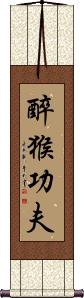
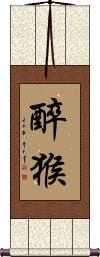
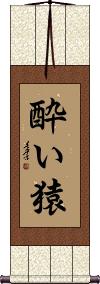
We have many options to create artwork with Drunken Fist characters on a wall scroll or portrait...
...We could also help you create an Drunken Fist Asian Tattoo.

Quick links to words on this page...


Select

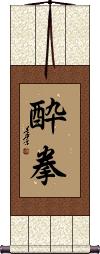
Drunken Fist

(A legitimate style of Kung Fu)
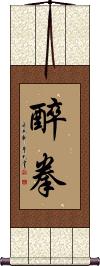
Mandarin: zuì quán
Japanese: suiken
Korean: 취권

醉
拳

Drunken Fist is a traditional Chinese martial art / technique of Kung Fu. It is a northern style of martial art that imitates a drunk person in its movements. Many staggering movements serve to deceive the opponent and keep them off-balance. Some consider it to be among the harder styles of martial arts due to the need for powerful joints and fingers.

Select

Five Elements Tai Chi Fist

Mandarin: wǔ xíng tài jí quán
Japanese: gogyou taikyokuken
Korean: 친애적야야?

五
行
太
極
拳

This is a certain school or style of Tai Chi (Taiji). The characters literally mean "Five Elements Tai Chi Fist".

Notes:
In Taiwan, it would be Romanized as "Wu Hsing Tai Chi Chuan" - see the standard Mandarin method above in the gray box (used in mainland China and the official Romanization used by the Library of Congress).

The last three characters are sometimes translated as "Grand Ultimate Fist", so the whole thing can be "Five Elements Grand Ultimate Fist" if you wish.

I have not confirmed use of this title in Korean, but if it is used, it's probably only by martial arts enthusiasts. The pronunciation is correct as shown above for Korean.

Select

Iron Fist

Tie Quan / Tieh Chuan

Mandarin: tiě quán
Japanese: tekken
Korean: 철권

鐵
拳

This is a common theme used by various schools of martial arts.

The first character means "iron", but in some cases, can mean "indisputable".
The second character is fist.

Some schools use the older/Taiwanese way to Romanize the iron fist, so you may have seen it spelled "Tieh Chuan" instead of "Tie Quan". Neither way is technically incorrect.

Note that in Mandarin, the first part of the first character actually sounds like the English word "tea" blending into a soft "-eh" sound. The second character sounds a lot like "chew on", but as if it is one syllable.

鉄After WWII in Japan, the Kanji for iron was simplified. This new Kanji form is shown to the right. If you want this modern Japanese version, please click on the Kanji to the right, instead of the button above. The characters shown to the left would still be considered the old or ancient Japanese version of this title.

Select

Law of the Fist Karate / Kempo Karate

Mandarin: quán fǎ táng shǒu
Japanese: ken pou kara te

拳
法
唐
手

The first two characters mean "fist law" which is Romanized from Japanese as "Kenpo" or "Kempo".

The last two are a secondary way to express "karate".

Notes:
The more common way to express "karate" is literally "empty hand" (meaning "without weapons in your hand"). This version would be translated literally as "Tang hand" (as in the Tang Dynasty) or "China hand" (sometimes "Tang" means "China" in Japanese). Even though the character for "Tang" is used instead of "empty", it's still pronounced "kara-te" in Japanese.

This is not commonly used in China - so please consider it to be a Japanese-only title.

Many Japanese people will say the last two Kanji are the old and antiquated way to say Karate. This fact does not stop this title from existing, as these four characters are often seen in Kenpo / Kempo Dojos around the western world.

Select

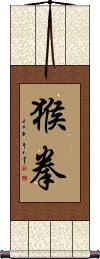
Monkey Fist

Mandarin: hóu quán
Korean: 후권

猴
拳

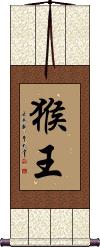
This literally means what you think, it's the "Monkey Fist" school of Kung Fu. A style that mimics the punches and movements of monkeys and apes.

Becoming popular during the Qing Dynasty, this style can trace its origins back to as early as the Song Dynasty. Some of the romance and popularity of this style comes from the novel "Journey to the West" which features the Monkey King and his fighting skills.

This novel and martial arts style has spawned a stream of Hong Kong movies featuring the Monkey King, and other Kung Fu style variations such as "Drunken Monkey" and "Monkey Stealing Peaches" (a technique of disabling your opponent by grabbing and yanking on his testicles).

Note: This kind of makes sense in Korean Hanja and Japanese Kanji, but probably unknown by all Koreans and Japanese except those who have an interest in this form of Kung Fu.

Select

Wing Chun Fist

Mandarin: yǒng chūn quán

詠
春
拳

This is the title for the "Wing Chun" school of martial arts, but with the addition of the character for "fist" on the end. So this is "Wing Chun Fist".


Wall scroll artwork shown on this page is priced as follows:

2-3 characters $39.88 each

4 characters $49.88 each

5-10 characters $59.88 each


We dispatch any size order to any country worldwide for a flat rate US$9.80 P&P

After you select your calligraphy, our website will take you through the process of customizing your artwork.

Options for other mounting such as portraits are available for $12 less.

We also offer the services of a famous master calligrapher for a $40 fee on any scroll if you are looking for investment-quality calligraphy.

If you chose our famous master-calligrapher, you also get more choices for silk and paper colors and the option for larger artwork.


All of our calligraphy is completely done by hand in the ancient way.

When the calligrapher finishes creating your artwork, it is taken to our art mounting workshop in Beijing where a wall scroll is made by hand from a combination of silk, rice paper, and wood.

After we create your wall scroll, it takes at least two weeks for air mail delivery from Beijing to you.

Therefore, allow at least 3 weeks for delivery from the time you place your order.

When you select your calligraphy, you'll be taken to another page where you can choose various custom options.

A nice Chinese calligraphy wall scroll

The scroll that I am holding in this picture is a "regular size"
4-character wall scroll.
As you can see, it is a great size to hang on your wall.
(We also offer custom wall scrolls in larger sizes)

A professional Chinese Calligrapher

Professional calligraphers are getting to be hard to find these days.
Instead of drawing characters by hand, the new generation in China merely type roman letters into their computer keyboards and pick the character that they want from a list that pops up.

There is some fear that true Chinese calligraphy may become a lost art in the coming years. Many art institutes in China are now promoting calligraphy programs in hopes of keeping this unique form of art alive.

Trying to learn Chinese calligrapher - a futile effort

Even with the teachings of a top-ranked calligrapher in China, my calligraphy will never be good enough to sell. I will leave that to the experts.


A high-ranked Chinese master calligrapher that I met in Zhongwei

The same calligrapher who gave me those lessons also attracted a crowd of thousands and a TV crew as he created characters over 6-feet high. He happens to be ranked as one of the top 100 calligraphers in all of China. He is also one of very few that would actually attempt such a feat.


See: Our list of specifically Japanese Kanji Calligraphy Wall Scrolls.


The following table is only helpful for those studying Chinese (or Japanese), and perhaps helps search engines to find this page when someone enters Romanized Chinese or Japanese

Title
 
Characters
Simplified
Traditional
Japanese Romaji
(Romanized Japanese)
Various forms of Hanyu-Pinyin
(Romanized Chinese)
Drunken Fist醉拳
醉拳
suikenzuì quán
zui4 quan2
Five Elements Tai Chi Fist五行太极拳
五行太極拳
gogyou taikyokukenwǔ xíng tài jí quán
wu3 xing2 tai4 ji2 quan2
Iron Fist铁拳 / 鉄拳
鐵拳
tekkentiě quán
tie3 quan2
Law of the Fist Karate / Kempo Karate拳法唐手
拳法唐手
ken pou kara tequán fǎ táng shǒu
quan2 fa3 tang2 shou3
Monkey Fist猴拳
猴拳
n/ahóu quán
hou2 quan2
Wing Chun Fist咏春拳
詠春拳
n/ayǒng chūn quán
yong3 chun1 quan2
If you have not set up your computer to display Chinese, the characters in this table probably look like empty boxes or random text garbage.
This is why we spent hundreds of hours making images so that you could view the characters in the "Drunken Fist" listings above.
If you want your Windows computer to be able to display Chinese characters you can either head to your Regional and Language options in your Win XP control panel, select the [Languages] tab and click on [Install files for East Asian Languages]. This task will ask for your Win XP CD to complete in most cases. If you don't have your Windows XP CD, or are running Windows 98, you can also download/run the simplified Chinese font package installer from Microsoft which works independently with Win 98, ME, 2000, and XP. It's a 2.5MB download, so if you are on dial up, start the download and go make a sandwich.


All custom calligraphy items are made-to-order in our little Beijing artwork-mounting workshop.
Normal delivery isjust over 3 weeksfor these handmade items.


Key / Important Pages

Information Pages

"How To" Pages

Search Engine Stuff

Home About Us Asian Art Questions & Answers How We Make Our Wall Scrolls & Portraits Site Map
Asian Art Gallery About China How Chinese Paintings are Mounted How To Care For Wall Scrolls Links
New Asian Art Arrivals F.A.Q. Asian Art Adventures Framing Suggestions for Chinese Art Characters
Contact Us Gary's Stories Japanese & Chinese Calligraphy Search How To Frame Asian Art Asian Art Index

Copyright Oriental Outpost 2002-2007   -   All Rights Reserved
Privacy Policy