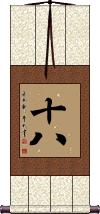
I am shipping orders on Thursday this week. News and More Info
Not what you want?
Try other similar-meaning words, fewer words, or just one word.
Feel free to email me with your request. If it's easy, I'll translate it for free and add it to this database of calligraphy for you.
Buy an Eighteen 18 calligraphy wall scroll here!
Personalize your custom “Eighteen 18” project by clicking the button next to your favorite “Eighteen 18” title below...
This means eighteen (18).
This can be pronounced seipai, toya, or jūhachi in Japanese. It can also be a Japanese personal name, Toya.
This would be the way to write the Buddhist Sanskrit word aṣṭādaśa (meaning 18) in Chinese, old Korean Hanja, and Japanese Kanji.
Below are some entries from our dictionary that may match your Eighteen 18 search...
| Characters If shown, 2nd row is Simp. Chinese |
Pronunciation Romanization |
Simple Dictionary Definition |
禪 禅 see styles |
shàn shan4 shan yuzuri ゆずり |
More info & calligraphy: Zen / Chan / Meditation(out-dated kanji) (1) (Buddhist term) dhyana (profound meditation); (2) (abbreviation) Zen (Buddhism); (surname) Yuzuri To level a place for an altar, to sacrifice to the hills and fountains; to abdicate. Adopted by Buddhists for dhyāna, 禪 or 禪那, i.e. meditation, abstraction, trance. dhyāna is 'meditation, thought, reflection, especially profound and abstract religious contemplation'. M.W. It was intp. as 'getting rid of evil', etc., later as 靜慮 quiet meditation. It is a form of 定, but that word is more closely allied with samādhi, cf. 禪定. The term also connotes Buddhism and Buddhist things in general, but has special application to the 禪宗 q.v. It is one of the six pāramitās, cf. 波. There are numerous methods and subjects of meditation. The eighteen brahmalokas are divided into four dhyāna regions 'corresponding to certain frames of mind where individuals might be reborn in strict accordance with their spiritual state'. The first three are the first dhyāna, the second three the second dhyāna, the third three the third dhyāna, and the remaining nine the fourth dhyāna. See Eitel. According to Childers' Pali Dictionary, 'The four jhānas are four stages of mystic meditation, whereby the believer's mind is purged from all earthly emotions, and detached as it were from his body, which remains plunged in a profound trance.' Seated cross-legged, the practiser 'concentrates his mind upon a single thought. Gradually his soul becomes filled with a supernatural ecstasy and serenity', his mind still reasoning: this is the first jhāna. Concentrating his mind on the same subject, he frees it from reasoning, the ecstasy and serenity remaining, which is the second jhāna. Then he divests himself of ecstasy, reaching the third stage of serenity. Lastly, in the fourth stage the mind becomes indifferent to all emotions, being exalted above them and purified. There are differences in the Mahāyāna methods, but similarity of aim. |
十八 see styles |
shí bā shi2 ba1 shih pa toya とや |
More info & calligraphy: Eighteen / 1818; eighteen; (personal name) Toya aṣṭādaśa, eighteen. |
地獄 地狱 see styles |
dì yù di4 yu4 ti yü jigoku じごく |
More info & calligraphy: Hell(1) {Buddh} hell realm; Naraka; (2) {Christn} Hell; (3) hell; misery; nightmare; inferno; (4) place where a volcano or hot springs constantly spew smoke or steam; (place-name) Jigoku naraka, 捺落迦 (or 那落迦) ; niraya 泥犂; explained by 不樂 joyless; 可厭 disgusting, hateful; 苦具, 苦器 means of suffering; if 地獄 earth-prison; 冥府 the shades, or departments of darkness. Earth-prison is generally intp. as hell or the hells; it may also be termed purgatory; one of the six gati or ways of transmigration. The hells are divided into three classes: I. Central, or radical, 根本地獄 consisting of (1) The eight hot hells. These were the original hells of primitive Buddhism, and are supposed to be located umder the southern continent Jambudvīpa 瞻部州, 500 yojanas below the surface. (a) 等活 or 更活 Saṃjīva, rebirth, where after many kinds of suffering a cold wind blows over the soul and returns it to this life as it was before, hence the name 等活. (b) 黑繩 Kaslasūtra, where the sufferer is bound with black chains and chopped or sawn asunder. (c) 線合; 衆合; 堆壓 Saṃghāta, where are multitudes of implements of torture, or the falling of mountains upon the sufferer. (d) 號呌; 呼呼; 叫喚 Raurava, hell of wailing. (e) 大呌; 大號呌; 大呼 Mahāraurava, hell of great wailing. (f) 炎熱; 燒炙 Tapana, hell of fames and burning. (g) 大熱; 大燒炙; 大炎熱 Pratāpana, hell of molten lead. (h) 無間; 河鼻旨; 阿惟越致; 阿毗至; 阿鼻; 阿毗 Avīci, unintermitted suffering, where sinners die and are reborn to suffer without interval. (2) The eight cold hells 八寒地獄. (a) 頞浮陀地獄 Arbuda, where the cold causes blisters. (b) 尼刺部陀 Nirarbuda, colder still causing the blisters to burst. (c) 頞哳吒; 阿吒吒 Atata, where this is the only possible sound from frozen lips. (d) 臛臛婆; 阿波波 Hahava or Apapa, where it is so cold that only this sound can be uttered. (e) 虎虎婆 Hāhādhara or Huhuva, where only this sound can be uttered. (f) 嗢鉢羅; 鬱鉢羅 (or 優鉢羅) Utpala, or 尼羅鳥 (or 漚) 鉢羅 Nīlotpala, where the skin is frozen like blue lotus buds. (g) 鉢特摩 Padma, where the skin is frozen and bursts open like red lotus buds. (h) 摩訶鉢特摩 Mahāpadma, ditto like great red lotus buds. Somewhat different names are also given. Cf. 倶舍論 8; 智度論 16; 涅槃經 11. II. The secondary hells are called 近邊地獄 adjacent hells or 十六遊增 each of its four sides, opening from each such door are four adjacent hells, in all sixteen; thus with the original eight there are 136. A list of eighteen hells is given in the 十八泥梨經. III. A third class is called the 孤地獄 (獨地獄) Lokāntarika, or isolated hells in mountains, deserts, below the earth and above it. Eitel says in regard to the eight hot hells that they range 'one beneath the other in tiers which begin at a depth of 11,900 yojanas and reach to a depth of 40,000 yojanas'. The cold hells are under 'the two Tchahavālas and range shaft-like one below the other, but so that this shaft is gradually widening to the fourth hell and then narrowing itself again so that the first and last hell have the shortest, those in the centre the longest diameter'. 'Every universe has the same number of hells, ' but 'the northern continent has no hell whatever, the two continents east and west of Meru have only small Lokāntarika hells... whilst all the other hells are required for the inhabitants of the southern continent '. It may be noted that the purpose of these hells is definitely punitive, as well as purgatorial. Yama is the judge and ruler, assisted by eighteen officers and a host of demons, who order or administer the various degrees of torture. 'His sister performs the same duties with regard to female criminals, ' and it may be mentioned that the Chinese have added the 血盆池 Lake of the bloody bath, or 'placenta tank' for women who die in childbirth. Release from the hells is in the power of the monks by tantric means. |
羅漢 罗汉 see styles |
luó hàn luo2 han4 lo han rakan らかん |
More info & calligraphy: Luohan / Lohan(abbreviation) {Buddh} (See 阿羅漢・あらかん) arhat; (place-name, surname) Rakan arhan, arhat; worthy, worshipful, an arhat, the saint, or perfect man of Hīnayāna; the sixteen, eighteen, or 500 famous disciples appointed to witness to buddha-truth and save the world; v. 阿. |
十八羅漢 十八罗汉 see styles |
shí bā luó hàn shi2 ba1 luo2 han4 shih pa lo han juuhachirakan / juhachirakan じゅうはちらかん |
More info & calligraphy: The Eighteen Arhatseighteen arhats |
樓 楼 see styles |
lóu lou2 lou rou / ro ろう |
house with more than 1 story; storied building; floor; CL:層|层[ceng2],座[zuo4],棟|栋[dong4] (surname) Rou An upper storey, stored building, tower; one of the eighteen hells. |
鷄 鸡 see styles |
jī ji1 chi |
variant of 雞|鸡[ji1] v. 雞 Eighteen Strokes. |
三六 see styles |
sān liù san1 liu4 san liu miroku みろく |
(f,p) Miroku Eighteen, especially referring to the eighteen sects of Hīnayāna. |
三科 see styles |
sān kē san1 ke1 san k`o san ko minashi みなし |
(surname) Minashi The three categories of 五蘊, 十二處 or 入, and eighteen 界. |
二九 see styles |
èr jiǔ er4 jiu3 erh chiu futaku ふたく |
(obsolete) eighteen; (surname) Futaku eighteen [years old] |
四禪 四禅 see styles |
sì chán si4 chan2 ssu ch`an ssu chan shizen |
(四禪天) The four dhyāna heavens, 四靜慮 (四靜慮天), i. e. the division of the eighteen brahmalokas into four dhyānas: the disciple attains to one of these heavens according to the dhyāna he observes: (1) 初禪天 The first region, 'as large as one whole universe' comprises the three heavens, Brahma-pāriṣadya, Brahma-purohita, and Mahābrahma, 梵輔, 梵衆, and 大梵天; the inhabitants are without gustatory or olfactory organs, not needing food, but possess the other four of the six organs. (2) 二禪天 The second region, equal to 'a small chiliocosmos' 小千界, comprises the three heavens, according to Eitel, 'Parīttābha, Apramāṇābha, and Ābhāsvara, ' i. e. 少光 minor light, 無量光 infinite light, and 極光淨 utmost light purity; the inhabitants have ceased to require the five physical organs, possessing only the organ of mind. (3) 三禪天 The third region, equal to 'a middling chiliocosmos '中千界, comprises three heavens; Eitel gives them as Parīttaśubha, Apramāṇaśubha, and Śubhakṛtsna, i. e. 少淨 minor purity, 無量淨 infinite purity, and 徧淨 universal purity; the inhabitants still have the organ of mind and are receptive of great joy. (4) 四禪天 The fourth region, equal to a great chiliocosmos, 大千界, comprises the remaining nine brahmalokas, namely, Puṇyaprasava, Anabhraka, Bṛhatphala, Asañjñisattva, Avṛha, Atapa, Sudṛśa, Sudarśana, and Akaniṣṭha (Eitel). The Chinese titles are 福生 felicitous birth, 無雲 cloudless, 廣果 large fruitage, 無煩 no vexations, atapa is 無熱 no heat, sudṛśa is 善見 beautiful to see, sudarśana is 善現 beautiful appearing, two others are 色究竟 the end of form, and 無想天 the heaven above thought, but it is difficult to trace avṛha and akaniṣṭha; the inhabitants of this fourth region still have mind. The number of the dhyāna heavens differs; the Sarvāstivādins say 16, the 經 or Sutra school 17, and the Sthavirāḥ school 18. Eitel points out that the first dhyāna has one world with one moon, one mem, four continents, and six devalokas; the second dhyāna has 1, 000 times the worlds of the first; the third has 1, 000 times the worlds of the second; the fourth dhyāna has 1, 000 times those of the third. Within a kalpa of destruction 壞劫 the first is destroyed fifty-six times by fire, the second seven by water, the third once by wind, the fourth 'corresponding to a state of absolute indifference' remains 'untouched' by all the other evolutions; when 'fate (天命) comes to an end then the fourth dhyāna may come to an end too, but not sooner'. |
天道 see styles |
tiān dào tian1 dao4 t`ien tao tien tao tendou / tendo てんどう |
natural law; heavenly law; weather (dialect) (1) (てんとう only) the sun; (2) god of heaven and the earth; (3) laws governing the heavens; (4) {astron} celestial path; celestial motion; (5) {Buddh} (See 六道) deva realm (svarga); (surname, given name) Tendō deva-gati, or devasopāna, 天趣. (1) The highest of the six paths 六道, the realm of devas, i. e. the eighteen heavens of form and four of formlessness. A place of enjoyment, where the meritorious enjoy the fruits of good karma, but not a place of progress toward bodhisattva perfection. (2) The Dao of Heaven, natural law, cosmic energy; according to the Daoists, the origin and law of all things. |
小乘 see styles |
xiǎo shèng xiao3 sheng4 hsiao sheng shōjō |
Hinayana, the Lesser Vehicle; Buddhism in India before the Mayahana sutras; also pr. [Xiao3 cheng2] Hīnayāna 希那衍. The small, or inferior wain, or vehicle; the form of Buddhism which developed after Śākyamuni's death to about the beginning of the Christian era, when Mahāyāna doctrines were introduced. It is the orthodox school and more in direct line with the Buddhist succession than Mahāyānism which developed on lines fundamentally different. The Buddha was a spiritual doctor, less interested in philosophy than in the remedy for human misery and perpetual transmigration. He "turned aside from idle metaphysical speculations; if he held views on such topics, he deemed them valueless for the purposes of salvation, which was his goal" (Keith). Metaphysical speculations arose after his death, and naturally developed into a variety of Hīnayāna schools before and after the separation of a distinct school of Mahāyāna. Hīnayāna remains the form in Ceylon, Burma, and Siam, hence is known as Southern Buddhism in contrast with Northern Buddhism or Mahāyāna, the form chiefly prevalent from Nepal to Japan. Another rough division is that of Pali and Sanskrit, Pali being the general literary language of the surviving form of Hīnayāna, Sanskrit of Mahāyāna. The term Hīnayāna is of Mahāyānist origination to emphasize the universalism and altruism of Mahāyāna over the narrower personal salvation of its rival. According to Mahāyāna teaching its own aim is universal Buddhahood, which means the utmost development of wisdom and the perfect transformation of all the living in the future state; it declares that Hīnayāna, aiming at arhatship and pratyekabuddhahood, seeks the destruction of body and mind and extinction in nirvāṇa. For arhatship the 四諦Four Noble Truths are the foundation teaching, for pratyekabuddhahood the 十二因緣 twelve-nidānas, and these two are therefore sometimes styled the two vehicles 二乘. Tiantai sometimes calls them the (Hīnayāna) Tripiṭaka school. Three of the eighteen Hīnayāna schools were transported to China: 倶舍 (Abhidharma) Kośa; 成實 Satya-siddhi; and the school of Harivarman, the律 Vinaya school. These are described by Mahāyānists as the Buddha's adaptable way of meeting the questions and capacity of his hearers, though his own mind is spoken of as always being in the absolute Mahāyāna all-embracing realm. Such is the Mahāyāna view of Hīnayāna, and if the Vaipulya sūtras and special scriptures of their school, which are repudiated by Hīnayāna, are apocryphal, of which there seems no doubt, then Mahāyāna in condemning Hīnayāna must find other support for its claim to orthodoxy. The sūtras on which it chiefly relies, as regards the Buddha, have no authenticity; while those of Hīnayāna cannot be accepted as his veritable teaching in the absence of fundamental research. Hīnayāna is said to have first been divided into minority and majority sections immediately after the death of Śākyamuni, when the sthāvira, or older disciples, remained in what is spoken of as "the cave", some place at Rājagṛha, to settle the future of the order, and the general body of disciples remained outside; these two are the first 上坐部 and 大衆部 q. v. The first doctrinal division is reported to have taken place under the leadership of the monk 大天 Mahādeva (q.v.) a hundred years after the Buddha's nirvāṇa and during the reign of Aśoka; his reign, however, has been placed later than this by historians. Mahādeva's sect became the Mahāsāṅghikā, the other the Sthāvira. In time the two are said to have divided into eighteen, which with the two originals are the so-called "twenty sects" of Hīnayāna. Another division of four sects, referred to by Yijing, is that of the 大衆部 (Arya) Mahāsaṅghanikāya, 上座部 Āryasthavirāḥ, 根本說一切有部 Mūlasarvāstivādaḥ, and 正量部 Saṃmatīyāḥ. There is still another division of five sects, 五部律. For the eighteen Hīnayāna sects see 小乘十八部. |
有學 有学 see styles |
yǒu xué you3 xue2 yu hsüeh ugaku |
śaikṣa; in Hīnayāna those in the first three stages of training as arhats, the fourth and last stage being 無學 those beyond the need of further teaching or study. There are eighteen grades of śaikṣa. |
本識 本识 see styles |
běn shì ben3 shi4 pen shih honjiki |
The fundamental vijñāna, one of the eighteen names of the ālaya-vijñāna, the root of all things. |
梵天 see styles |
fàn tiān fan4 tian1 fan t`ien fan tien bonten ぼんてん |
Nirvana (in Buddhist scripture); Lord Brahma (the Hindu Creator) (1) Brahma (Hindu creator god); (2) (See 御幣) large staff with plaited paper streamers (used at religious festivals or as a sign); (3) buoy (used in longline fishing, gillnetting, etc.); (4) down puff (on the end of an ear pick); (given name) Bonten Brahmadeva. Brahmā, the ruler of this world. India. brahmaloka, the eighteen heavens of the realm of form, divided into four dhyāna regions (sixteen heavens in Southern Buddhism). The first three contain the 梵衆天 assembly of brahmadevas, i.e. the brahmakāyika; the 梵輔天 brahmspurohitas, retinue of Brahmā; and 大梵天 Mahābrahman, Brahman himself. |
法界 see styles |
fǎ jiè fa3 jie4 fa chieh hokkai; houkai / hokkai; hokai ほっかい; ほうかい |
(1) {Buddh} universe; (2) {Buddh} realm of thought; (3) {Buddh} underlying principle of reality; manifestation of true thusness; (4) (ほうかい only) (abbreviation) (See 法界悋気) being jealous of things that have nothing to do with one; being jealous of others who are in love with each other dharmadhātu, 法性; 實相; 達磨馱都 Dharma-element, -factor, or-realm. (1) A name for "things" in general, noumenal or phenomenal; for the physical universe, or any portion or phase of it. (2) The unifying underlying spiritual reality regarded as the ground or cause of all things, the absolute from which all proceeds. It is one of the eighteen dhātus. These are categories of three, four, five, and ten dharmadhātus; the first three are combinations of 事 and 理 or active and passive, dynamic and static; the ten are: Buddha-realm, Bodhisattva-realm, pratyekabuddha-realm, śrāvaka, deva, Human, asura, Demon, Animal, and Hades realms-a Huayan category. Tiantai has ten for meditaton, i.e. the realms of the eighteen media of perception (the six organs, six objects, and six sense-data or sensations), of illusion, sickness, karma, māra, samādhi, (false) views, pride, the two lower Vehicles, and the Bodhisattva Vehicle. |
準提 准提 see styles |
zhǔn tí zhun3 ti2 chun t`i chun ti Juntei |
Candī, or Cundi; also 准胝; 尊提. (1) In Brahmanic mythology a vindictive form of Durgā, or Pārvatī, wife of Śiva. (2) In China identified with Marīci 摩里支 or 天后 Queen of Heaven. She is represented with three eyes and eighteen arms; also as a form of Guanyin, or in Guanyin's retinue. |
色界 see styles |
sè jiè se4 jie4 se chieh shikikai しきかい |
{Buddh} (See 三界・1) form realm rūpadhātu, or rūpāvacara, or rūpaloka, any material world, or world of form; it especially refers to the second of the Trailokya 三界, the brahmalokas above the devalokas, comprising sixteen or seventeen or eighteen 'Heavens of Form', divided into four dhyānas, in which life lasts from one-fourth of a mahākalpa to 16,000 mahākalpas, and the average stature is from one-half a yojana to 16,000 yojanas. The inhabitants are above the desire for sex or food. The rūpadhātu, with variants, are given as— 初禪天 The first dhyāna heavens: 梵衆天 Brahmapāriṣadya, 梵輔天 Brahmapurohita or Brahmakāyika, 大梵天 Mahābrahmā. 二禪天 The second dhyāna heavens: 少光天 Parīttābha, 無量光天 Apramāṇābha, 光音天 Ābhāsvara. 三禪天 The third dhyāna heavens: 少淨天 Parīttaśubha, 無量淨天 Apramāṇaśubha, 徧淨天 Śubhakṛtsna. 四禪天 The fourth dhyāna heavens: 無雲天 Anabhraka, 福生天 Puṇyaprasava, 廣果天 Bṛhatphala, 無想天 Asañjñisattva, 無煩天 Avṛha, 無熱天 Atapa, 善現天 Sudṛśa, 善見天 Sudarśana, 色究竟天 Akaniṣṭha, 和音天 ? Aghaniṣṭha, 大自在天 Mahāmaheśvara. |
蘊界 蕴界 see styles |
yùn jiè yun4 jie4 yün chieh unkai |
reference to the five skandhas 五蘊 and eighteen realms 十八界 |
裂裳 see styles |
liè cháng lie4 chang2 lieh ch`ang lieh chang resshō |
The torn robe (of Buddhism), i.e. split into eighteen pieces, like the Hīnayāna sects. |
金杖 see styles |
jīn zhàng jin1 zhang4 chin chang konjō |
The golden staff broken into eighteen pieces and the skirt similarly torn, seen in a dream by king Bimbisāra, prophetic of the eighteen divisions of Hīnayāna. |
閻魔 阎魔 see styles |
yán mó yan2 mo2 yen mo enma えんま |
(Buddhism) Yama, the King of Hell {Buddh} Yama (King of Hell who judges the dead); Enma; (dei) Yama (King of Hell who judges the dead); Enma 閻王 閻羅; (閻魔王); 閻摩羅; 閻老 Yama, also v. 夜; 閻羅王 Yama. (1) In the Vedas the god of the dead, with whom the spirits of the departed dwell. He was son of the Sun and had a twin sister Yamī or Yamuna. By some they were looked upon as the first human pair. (2) In later Brahmanic mythology, one of the eight Lokapālas, guardian of the South and ruler of the Yamadevaloka and judge of the dead. (3) In Buddhist mythology, the regent of the Nārakas, residing south of Jambudvīpa, outside of the Cakravālas, in a palace of copper and iron. Originally he is described as a king of Vaiśālī, who, when engaged in a bloody war, wished he were master of hell, and was accordingly reborn as Yama in hell together with his eighteen generals and his army of 80,000 men, who now serve him in purgatory. His sister Yamī deals with female culprits. Three times in every twenty-four hours demon pours into Yama's mouth boiling copper (by way of punishment), his subordinates receiving the same dose at the same time, until their sins are expiated, when he will be reborn as Samantarāja 普王. In China he rules the fifth court of purgatory. In some sources he is spoken of as ruling the eighteen judges of purgatory. |
陰界 阴界 see styles |
yīn jiè yin1 jie4 yin chieh on gai |
The five skandhas and the eighteen dhātu. |
駄都 see styles |
tuó dōu tuo2 dou1 t`o tou to tou |
dhātu, intp. by 界 field, area, sphere; 體 embodiment, body, corpus; 性nature, characteristic. It means that which is placed or laid; a deposit, foundation, constituent, ingredient, element; also a śarīra, or relic of Buddha The two dhātus are the conditioned and unconditioned, phenomenal and noumenal; the three are the realms of desire, of form, and of the formless; the four are earth, water, fire, and air; the six add space and intelligence; the eighteen are the twelve āyatanas, with six sensations added. |
一斗缶 see styles |
ittokan いっとかん |
eighteen litre drum |
上座部 see styles |
shàng zuò bù shang4 zuo4 bu4 shang tso pu jouzabu / jozabu じょうざぶ |
Theravada school of Buddhism Sthaviravada (early Buddhist movement) 他毘梨典部; 他鞞羅部 Sthavirāḥ; Sthaviranikāya; or Āryasthāvirāḥ. The school of the presiding elder, or elders. The two earliest sections of Buddhism were this (which developed into the Mahāsthavirāḥ) and the Mahāsānghikāḥ or 大衆部. At first they were not considered to be different schools, the 上座部 merely representing the intimate and older disciples of Śākyamuni and the 大衆 being the rest. It is said that a century later under Mahādeva 大天 a difference of opinion arose on certain doctrines. Three divisions are named as resulting, viz. Mahāvihāravāsinaḥ, Jetavanīyāḥ, and Abhayagiri-vāsinaḥ. These were in Ceylon. In course of time the eighteen Hīnayāna sects were developed. From the time of Aśoka four principal schools are counted as prevailing: Mahāsāṅghika, Sthavira, Mūlasarvāstivda, and Saṁmitīya. The following is a list of the eleven sects reckoned as of the 上座部: 說一切有部; 雪山; 犢子; 法上; 賢冑; 正量; 密林山; 化地; 法藏; 飮光; and 經量部. The Sthaviravādin is reputed as nearest to early Buddhism in its tenets, though it is said to have changed the basis of Buddhism from an agnostic system to a realistic philosophy. |
二九韻 二九韵 see styles |
èr jiǔ yùn er4 jiu3 yun4 erh chiu yün niku(no)un |
The eighteen 丁岸哆 tiṇanta, personal endings of the Sanskrit verb. |
二十部 see styles |
èr shí bù er4 shi2 bu4 erh shih pu nijū bu |
The eighteen Hīnayāna sects, together with the two original assemblies of elders. |
二福田 see styles |
èr fú tián er4 fu2 tian2 erh fu t`ien erh fu tien ni fukuden |
The two fields for the cultivation of happiness: (a) 學人田 the eighteen Hīnayāna classes of those under training in religion; (b) 無學人田 the nine divisions of those no longer in training, i.e. who have completed their course. Also (a) 悲田 the pitable or poor and needy, as the field or opportunity for charity; (b) 敬田the field of religion and reverence of the Buddhas, the saints, the priesthood. |
The following table may be helpful for those studying Chinese or Japanese...
| Title | Characters | Romaji (Romanized Japanese) | Various forms of Romanized Chinese | |
| The Eighteen Arhats | 十八羅漢 十八罗汉 | shí bā luó hàn shi2 ba1 luo2 han4 shi ba luo han shibaluohan | shih pa lo han shihpalohan |
|
| Eighteen 18 | 十八 | sei pai / to ya seipai / toya | shí bā / shi2 ba1 / shi ba / shiba | shih pa / shihpa |
| In some entries above you will see that characters have different versions above and below a line. In these cases, the characters above the line are Traditional Chinese, while the ones below are Simplified Chinese. | ||||
Successful Chinese Character and Japanese Kanji calligraphy searches within the last few hours...

All of our calligraphy wall scrolls are handmade.
When the calligrapher finishes creating your artwork, it is taken to my art mounting workshop in Beijing where a wall scroll is made by hand from a combination of silk, rice paper, and wood.
After we create your wall scroll, it takes at least two weeks for air mail delivery from Beijing to you.
Allow a few weeks for delivery. Rush service speeds it up by a week or two for $10!
When you select your calligraphy, you'll be taken to another page where you can choose various custom options.
The wall scroll that Sandy is holding in this picture is a "large size"
single-character wall scroll.
We also offer custom wall scrolls in small, medium, and an even-larger jumbo size.
Professional calligraphers are getting to be hard to find these days.
Instead of drawing characters by hand, the new generation in China merely type roman letters into their computer keyboards and pick the character that they want from a list that pops up.
There is some fear that true Chinese calligraphy may become a lost art in the coming years. Many art institutes in China are now promoting calligraphy programs in hopes of keeping this unique form
of art alive.
Even with the teachings of a top-ranked calligrapher in China, my calligraphy will never be good enough to sell. I will leave that to the experts.
The same calligrapher who gave me those lessons also attracted a crowd of thousands and a TV crew as he created characters over 6-feet high. He happens to be ranked as one of the top 100 calligraphers in all of China. He is also one of very few that would actually attempt such a feat.
Check out my lists of Japanese Kanji Calligraphy Wall Scrolls and Old Korean Hanja Calligraphy Wall Scrolls.
Some people may refer to this entry as Eighteen 18 Kanji, Eighteen 18 Characters, Eighteen 18 in Mandarin Chinese, Eighteen 18 Characters, Eighteen 18 in Chinese Writing, Eighteen 18 in Japanese Writing, Eighteen 18 in Asian Writing, Eighteen 18 Ideograms, Chinese Eighteen 18 symbols, Eighteen 18 Hieroglyphics, Eighteen 18 Glyphs, Eighteen 18 in Chinese Letters, Eighteen 18 Hanzi, Eighteen 18 in Japanese Kanji, Eighteen 18 Pictograms, Eighteen 18 in the Chinese Written-Language, or Eighteen 18 in the Japanese Written-Language.