Many custom options...


And formats...



Chiu in Chinese / Japanese...
Buy a Chiu calligraphy wall scroll here!
Personalize your custom “Chiu” project by clicking the button next to your favorite “Chiu” title below...
Chiu
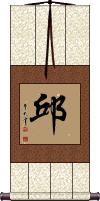
邱 is the most common Chinese character for a surname that romanizes as Chiu in Cantonese.
The surname Chiu (邱) is a common Chinese family name, especially prominent in Cantonese, Hokkien, and Taiwanese communities. However, this romanization can also come from several different Chinese surnames like Qiū (丘), Zhōu (周), Zhào (趙), and Jiāng (蔣), depending on original dialect and geography. Please confirm that this is the correct character before ordering.
Chiu

チウ is the name Chiu in Japanese Katakana.
Note: Because this title is entirely Japanese Katakana, it should be written by a Japanese calligrapher.
Not the results for Chiu that you were looking for?
Below are some entries from our dictionary that may match your Chiu search...
| Characters If shown, 2nd row is Simp. Chinese |
Pronunciation Romanization |
Simple Dictionary Definition |
ちう see styles |
chiu チウ |
(female given name) Chiu |
五時 五时 see styles |
wǔ shí wu3 shi2 wu shih goji |
(五時教) The five periods or divisions of Śākyamuni's teaching. According to Tiantai they are (1) 華嚴時 the Avataṃsaka or first period in three divisions each of seven days, after his enlightenment, when he preached the content, of this sutra; (2) 鹿苑時 the twelve years of his preaching the Āgamas 阿含 in the Deer Park; (3) 方等時 the eight years of preaching Mahāyāna-cum-Hīnayāna doctrines, the vaipulya period; (4) 般若時 the twenty-two years of his preaching the prajñā or wisdom sutras; (5) 法華涅槃時 the eight years of his preaching the Lotus Sutra and, in a day and a night, the Nirvana Sutra. According to the Nirvana School (now part of the Tiantai) they are (1) 三乘別教 the period when the differentiated teaching began and the distinction of the three vehicles, as represented by the 四諦 Four Noble Truths for śrāvakas, the 十二因緣 Twelve Nidānas for pratyekabuddhas, and the 六度 Six Pāramitās for bodhisattvas; (2) 三乘通教 the teaching common to all three vehicles, as seen in the 般若經; (3) 抑揚教 the teaching of the 維摩經, the 思益梵天所問經, and other sutras olling the bodhisattva teaching at the expense of that for śrāvakas; (4) 同歸教 the common objective teaching calling all three vehicles, through the Lotus, to union in the one vehicle; (5) 常住教 the teaehmg of eternal life i. e. the revelation through the Nirvana sutra of the eternity of Buddhahood; these five are also called 有相; 無相; 抑揚; 曾三歸—; and 圓常. According to 劉虬 Liu Chiu of the 晉 Chin dynasty, the teaching is divided into 頓 immediate and 漸 gradual attainment, the latter having five divisions called 五時教 similar to those of the Tiantai group. According to 法寶 Fabao of the Tang dynasty the five are (1) 小乘; (2) 般着 or 大乘; (3) 深密 or 三乘; (4) 法華 or 一乘; (5) 涅槃 or 佛性教. |
地藏 see styles |
dì zàng di4 zang4 ti tsang jizou / jizo じぞう |
Kṣitigarbha, the Bodhisattva of the Great Vow (to save all souls before accepting Bodhi); also translated Earth Treasury, Earth Womb, or Earth Store Bodhisattva (surname) Jizou Ti-tsang, J. Jizō, Kṣitigarbha, 乞叉底蘗沙; Earth-store, Earth-treasury, or Earthwomb. One of the group of eight Dhvani- Bodhisattvas. With hints of a feminine origin, he is now the guardian of the earth. Though associated with Yama as overlord, and with the dead and the hells, his role is that of saviour. Depicted with the alarum staff with its six rings, he is accredited with power over the hells and is devoted to the saving of all creatures between the nirvana of Śākyamuni and the advent of Maitreya the fifth century he has been especially considered as the deliverer from the hells. His central place in China is at Chiu-hua-shan, forty li south-west of Ch'ing-yang in Anhui. In Japan he is also the protector of travellers by land and his image accordingly appears on the roads; bereaved parents put stones by his images to seek his aid in relieving the labours of their dead in the task of piling stones on the banks of the Buddhist Styx; he also helps women in labour. He is described as holding a place between the gods and men on the one hand and the hells on the other for saving all in distress; some say he is an incarnation of Yama. At dawn he sits immobile on the earth 地 and meditates on the myriads of its beings 藏. When represented as a monk, it may be through the influence of a Korean monk who is considered to be his incarnation, and who came to China in 653 and died in 728 at the age of 99 after residing at Chiu-hua-shan for seventy-five years: his body, not decaying, is said to have been gilded over and became an object of worship. Many have confused 眞羅 part of Korea with 暹羅 Siam. There are other developments of Ti-tsang, such as the 六地藏 Six Ti-tsang, i. e. severally converting or transforming those in the hells, pretas, animals, asuras, men, and the devas; these six Ti-tsang have different images and symbols. Ti-tsang has also six messengers 六使者: Yama for transforming those in hell; the pearl-holder for pretas; the strong one or animals; the devīof mercy for asuras; the devī of the treasure for human beings; one who has charge of the heavens for the devas. There is also the 延命地藏 Yanming Ti-tsang, who controls length of days and who is approached, as also may be P'u-hsien, for that Purpose; his two assistants are the Supervisors of good and evil 掌善 and 掌惡. Under another form, as 勝軍地藏 Ti-tsang is chiefly associated with the esoteric cult. The benefits derived from his worship are many, some say ten, others say twenty-eight. His vows are contained in the 地藏菩薩本願經. There is also the 大乘大集地藏十電經 tr. by Xuanzang in 10 juan in the seventh century, which probably influenced the spread of the Ti-tsang cult. |
四大名山 see styles |
sì dà míng shān si4 da4 ming2 shan1 ssu ta ming shan shidai myōsan |
The four famous 'hills' or monasteries in China: 普陀 P'u-t'o, for Guanyin, element water; 五臺 Wu-tai, Wen-shu, wind; 峨眉 O-mei, P'uhsien, fire; and 九華 Chiu-hua, Tizang, earth. |
The following table may be helpful for those studying Chinese or Japanese...
| Title | Characters | Romaji (Romanized Japanese) | Various forms of Romanized Chinese | |
| Chiu | 邱 | qiū / qiu1 / qiu | ch`iu / chiu | |
| Chiu | チウ | chiu | ||

Successful Chinese Character and Japanese Kanji calligraphy searches within the last few hours...



