I am shipping orders on Thursday this week. News and More Info

The Name Ein in Japanese/Chinese on a Custom-Made Wall Scroll.

Click the "Customize" button next to your name below to start your personalized Ein calligraphy artwork...

Switched to secondary search mode due to lack of results using primary.
These secondary results may not be very accurate. Try a different but similar meaning word or phrase for better results. Or...

Look up Ein in my Japanese Kanji & Chinese Character Dictionary(My dictionary is a different system then the calligraphy search you just tried)

If you want a special phrase, word, title, name, or proverb, feel free to contact me, and I will translate your custom calligraphy idea for you.


  1. Brownstein

  2. Seeing one’s Nature and becoming a Buddha

  3. The Buddha is in Each Sentient Being

  4. Ein

  5. Finkelstein

  6. Hearing a Hundred Times is Not as Good as Seeing Once

  7. Hein

  8. Heine

  9. Heiner

10. Heinrich

11. Heinz

12. Hossein

13. Humility / Being Humble

14. Hussein

15. I Am Worthy of Being Loved

16. Inner Strength / Inner Well-Being and Health

17. Safety and Well-Being of the Family

18. Klein

19. Kongkreingkrai

20. Liechtenstein

21. Madeleine

22. Marie-Reine

23. Marjolein

24. Do not fear being slow, fear standing still

25. Rein

26. Reina

27. Reinaldo

28. Reincarnation

29. Reincarnation / Transmigration of Souls

30. Reincarnation / Life in Flux

31. Reine

32. Reiner

33. Reinert

34. Reinetta

35. Reinhard

36. Reinhardt

37. Reinhart

38. Reinhold

39. Reinke

40. Rothstein

41. Rubenstein

42. Schreiner

43. Seeing is Believing

44. Sheina

45. Silverstein

46. Stein

47. Steinbach

48. Steinberg

49. Steiner

50. Steinke

51. Steinman

52. Steinmetz

53. The Tao or Dao of Being Human / Humanity

54. Weinberg

55. Weinberger

56. Weiner

57. Weinstein

58. Weintraub


 bù lǎng sī tǎn
Brownstein Scroll

布朗斯坦 is the name Brownstein in Chinese (Mandarin).

 buraunsutain
Brownstein Scroll

ブラウンスタイン is the name Brownstein in Japanese Katakana.


Note: Because this title is entirely Japanese Katakana, it should be written by a Japanese calligrapher.

Seeing one’s Nature and becoming a Buddha

 jiàn xìng chéng fó
 ken shou jou butsu
Seeing one’s Nature and becoming a Buddha Scroll

見性成佛 is a universal phrase that suggests that one may see one's nature and accomplish Buddhahood.

見性 suggests penetrating deep inside oneself to see one's “Original finally Mind.”

成佛 refers to a sentient being who dispenses with illusions and delusions through ascetic practice, is enlightened to the truth, and becomes a Buddha.

This is used by Mahayana, Chan, and Zen Buddhists in China, Korea, and Japan.


You will also see this with the last character written as 仏 in Japanese. In the religious context, 佛 is commonly used to mean Buddha. If you want the other version, see Kenshō Jōbutsu 見性成仏

The Buddha is in Each Sentient Being

 butsu wa shujou no naka ni ari
The Buddha is in Each Sentient Being Scroll

佛は衆生の中に在り is “Butsu wa shujo no naka ni ari” and means that the Buddha (potential for Buddhahood) exists in all beings in the universe.

So yes, your dog has the potential to be a Buddha (but only in a future reincarnation as a human). But all things, from the tiny cricket to the humpback whale have Buddha nature within them. If one takes the time to look and contemplate, one will see the Buddha in all things.

In Japan, sometimes the Buddha character is written 仏 instead of 佛, so you might see the whole phrase written as 仏は衆生の中に在り.


Note: Because this selection contains some special Japanese Hiragana characters, it should be written by a Japanese calligrapher.

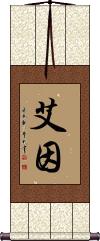
 ài yīn
Ein Scroll

艾因 is the name Ein in Chinese (Mandarin).

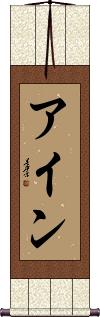
 ain
Ein Scroll

アイン is the name Ein in Japanese Katakana.


Note: Because this title is entirely Japanese Katakana, it should be written by a Japanese calligrapher.

 fēn kè ěr sī tǎn
Finkelstein Scroll

芬克爾斯坦 is the name Finkelstein in Chinese (Mandarin).

 finkerusutain
Finkelstein Scroll

フィンケルスタイン is the name Finkelstein in Japanese (Katakana).


Note: Because this title is entirely Japanese Katakana, it should be written by a Japanese calligrapher.

Hearing a Hundred Times is Not as Good as Seeing Once

 bǎi wén bù rú yī jiàn
Hearing a Hundred Times is Not as Good as Seeing Once Scroll

百聞不如一見 is a Chinese proverb that means “Seeing once is better than hearing one hundred times” which is similar to the idea of “Seeing is believing.”

You can also get the idea, “Seeing for oneself is better than hearing from many others.”

If you break it down directly, you get “100 hears/listens (is) not as-good (as) one sight.”

 hai en
Hein Scroll

海恩 is the name Hein in Chinese (Mandarin).

 hain
Hein Scroll

ハイン is the name Hein in Japanese.


Note: Because this title is entirely Japanese Katakana, it should be written by a Japanese calligrapher.

 hǎi niè
Heine Scroll

海涅 is the name Heine in Chinese (Mandarin).

 hain
Heine Scroll

ハイン is the name Heine in Japanese Katakana.


Note: Because this title is entirely Japanese Katakana, it should be written by a Japanese calligrapher.

 hǎi nuò ěr
Heiner Scroll

This is a common Mandarin Chinese transliteration for the male German name Heiner.

 hiinaa
Heiner Scroll

ヒーナー is the name Heiner in Japanese (Katakana).


Note: Because this title is entirely Japanese Katakana, it should be written by a Japanese calligrapher.

 hǎi yīn lǐ xī
Heinrich Scroll

海因里希 is the name Heinrich in Chinese (Mandarin).

 hainrikku
Heinrich Scroll

ハインリック is the name Heinrich in Japanese (Katakana).


Note: Because this title is entirely Japanese Katakana, it should be written by a Japanese calligrapher.

 hēng shì
Heinz Scroll

亨氏 is the name Heinz in Chinese (Mandarin).

 haintsu
Heinz Scroll

ハインツ is the name Heinz in Japanese Katakana.


Note: Because this title is entirely Japanese Katakana, it should be written by a Japanese calligrapher.

 hóu sài yīn
Hossein Scroll

侯賽因 is the name Hossein in Chinese (Mandarin).

 hosein
Hossein Scroll

ホセイン is the name Hossein in Japanese Katakana.


Note: Because this title is entirely Japanese Katakana, it should be written by a Japanese calligrapher.

Humility / Being Humble

 qiān xùn
 ken son
Humility / Being Humble Scroll

謙遜 can also be translated as being modest, humble, or unpretentious.

Being humble is considering others to be as important as yourself. You are thoughtful of their needs and willing to be of service. You don't expect others or yourself to be perfect. You learn from your mistakes. When you do great things, humility reminds you to be thankful instead of boastful.

This Humility title is also used as one of the 8 key concepts of Tang Soo Do. Often romanized as “Kyum Son.”

Also sometimes used in Japanese to express humility with an essence of modesty.


See Also:  Modesty | Humility

 hóu sài yīn
Hussein Scroll

侯賽因 is the name Hussein in Chinese (Mandarin).

 fusein
Hussein Scroll

フセイン is the name Hussein in Japanese Katakana.


Note: Because this title is entirely Japanese Katakana, it should be written by a Japanese calligrapher.

I Am Worthy of Being Loved

 wǒ zhí dé bèi ài
I Am Worthy of Being Loved Scroll

我值得被愛 means “I am worthy of being loved” in Chinese.

Inner Strength / Inner Well-Being and Health

 nèi jiàn
Inner Strength / Inner Well-Being and Health Scroll

內健 is an old Chinese word meaning inner strength or inner health.

It's the idea of health and well-being starting or residing inside yourself. Also defined as fortitude within the context of good health.

Safety and Well-Being of the Family

Kanai Anzen

 ka nai an zen
Safety and Well-Being of the Family Scroll

家內安全 is the Japanese way of saying “Family First.”

It's a Japanese proverb about the safety and well-being of your family and/or peace and prosperity in the household.

Some Japanese will hang an amulet in their home with these Kanji. The purpose is to keep your family safe from harm.

According to Shinto followers, hanging this in your home is seen as an invocation to God to always keep family members free from harm.

We were looking for a way to say “family first” in Japanese when this proverb came up in the conversation and research. While it doesn't say “family first,” it shows that the safety and well-being of your family is your first or most important priority. So, this proverb is the most natural way to express the idea that you put your family first.


See Also:  Peace and Prosperity

 kè lái ēn
Klein Scroll

克萊恩 is the name Klein in Chinese (Mandarin).

 kurain
Klein Scroll

クライン is the name Klein in Japanese Katakana.


Note: Because this title is entirely Japanese Katakana, it should be written by a Japanese calligrapher.

Kongkreingkrai

 kōng kè ruì kǎi
Kongkreingkrai Scroll

空克瑞凱 is the name Kongkreingkrai in Chinese (Mandarin).

Kongkreingkrai

 konkurainkurai
Kongkreingkrai Scroll

コンクラインクライ is the name Kongkreingkrai in Japanese Katakana.


Note: Because this title is entirely Japanese Katakana, it should be written by a Japanese calligrapher.

Liechtenstein

 liè zhī dūn shì dēng
Liechtenstein Scroll

This is the Chinese name for the country of Liechtenstein.


See Also:  Europe

 mǎ dé lín
Madeleine Scroll

瑪德琳 is the name Madeleine in Chinese (Mandarin).

 madoreenu
Madeleine Scroll

マドレーヌ is the name Madeleine in Japanese.


Note: Because this title is entirely Japanese Katakana, it should be written by a Japanese calligrapher.

 mǎ lì lěi nà
Marie-Reine Scroll

This is a common Mandarin Chinese transliteration for the female French name Marie-Reine.

 marii rein
Marie-Reine Scroll

マリーレーン is the name Marie-Reine or Mariereine in Japanese (Katakana).


Note: Because this title is entirely Japanese Katakana, it should be written by a Japanese calligrapher.

 mǎ qiáo lán
Marjolein Scroll

馬喬蘭 is the name Marjolein in Chinese (Mandarin).

 maajorin
Marjolein Scroll

マージョリン is the name Marjolein in Japanese Katakana.


Note: Because this title is entirely Japanese Katakana, it should be written by a Japanese calligrapher.

Do not fear being slow, fear standing still

 bú pà màn jiù pà zhàn
Do not fear being slow, fear standing still Scroll

不怕慢就怕站 is a Chinese proverb that translates as: Don't worry about being slow; only worry about standing still.

Figuratively, this means: A slow progress holds some promise but to stand still promises failure.

 léi ēn
Rein Scroll

雷恩 is the name Rein in Chinese (Mandarin).

 rein
Rein Scroll

レイン is the name Rein in Japanese Katakana.


Note: Because this title is entirely Japanese Katakana, it should be written by a Japanese calligrapher.

 léi nà
Reina Scroll

雷納 is the name Reina in Chinese (Mandarin).

 reina
Reina Scroll

レイナ is the name Reina in Japanese.


Note: Because this title is entirely Japanese Katakana, it should be written by a Japanese calligrapher.

 léi nà ěr duō
Reinaldo Scroll

雷納爾多 is the transliteration to Mandarin Chinese for the Latin / Spanish name Reinaldo.

 reinarudo
Reinaldo Scroll

レーナルド is the name Reinaldo in Japanese (Katakana).


Note: Because this title is entirely Japanese Katakana, it should be written by a Japanese calligrapher.

Reincarnation (Buddhism)

 zhuǎn shì
 ten sei
Reincarnation (Buddhism) Scroll

轉世 is the Buddhist idea of reincarnation or transmigration.

Other definitions of this term: “Attainer of Nirvana from within the desire realm,” “A practitioner who enters directly into Nirvana from the desire realm, without traversing the form and formless realms. One of the 27 kinds of Hinayana sages,” or simply, “to return again to this life.”

轉世 is also a Japanese title, but the first Kanji was slightly simplified after WWII. Just let us know if you want the modern Japanese version when you order.


See Also:  Buddhism | Rebirth

Reincarnation / Transmigration of Souls

 lún huí
 rin ne
Reincarnation / Transmigration of Souls Scroll

輪回 is a universal word in Japanese and Chinese that expresses the Buddhist idea of “reincarnation,” “transmigration of souls,” or “the eternal cycle of birth and death.”

In some contexts, this can also mean “karma,” and others will say it represents “samsara.”

The first character means wheel, ring, turn, circle, loop, or rotate.
The second character can be thought of as a suffix meaning “-times.” This second character can also refer to something that revolves, returns, goes back, or is a counter of the number of occurrences of some event.
Together the sum supersedes the parts, and it means reincarnation. But knowing the essence of each character may help you understand some of the meaning behind the word.


廻Shown to the right is the more common way to write the second character in Japanese. it’s an alternate form of this character in Chinese (so neither way is technically wrong in either language). If you select a Japanese calligrapher, expect that is will look like the Kanji to the right.


See Also:  Buddhism | Rebirth

Reincarnation / Life in Flux

 rinne tenshou
Reincarnation / Life in Flux Scroll

輪廻転生 is a Japanese Zen quote or proverb that expresses the idea of all things being in flux through the endless circle of birth, death, and rebirth or the circle of transmigration.

 lěi nà
Reine Scroll

This is a common Mandarin Chinese transliteration for the female French name Reine.

 rein
Reine Scroll

レーン is the name Reine in Japanese (Katakana).


Note: Because this title is entirely Japanese Katakana, it should be written by a Japanese calligrapher.

 lái nà
Reiner Scroll

萊納 is the name Reiner in Chinese (Mandarin).

 rainaa
Reiner Scroll

ライナー is the name Reiner in Japanese Katakana.


Note: Because this title is entirely Japanese Katakana, it should be written by a Japanese calligrapher.

 léi nà tè
Reinert Scroll

雷納特 is the name Reinert in Chinese (Mandarin).

 rainaato
Reinert Scroll

ライナート is the name Reinert in Japanese Katakana.


Note: Because this title is entirely Japanese Katakana, it should be written by a Japanese calligrapher.

 léi nèi tǎ
Reinetta Scroll

雷內塔 is the name Reinetta in Chinese (Mandarin).

 reinetta
Reinetta Scroll

レイネッタ is the name Reinetta in Japanese (Katakana).


Note: Because this title is entirely Japanese Katakana, it should be written by a Japanese calligrapher.

 lái yīn hā dé
Reinhard Scroll

萊因哈德 is the name Reinhard in Chinese (Mandarin).

 riinaado
Reinhard Scroll

リーナード is the name Reinhard in Japanese (Katakana).


Note: Because this title is entirely Japanese Katakana, it should be written by a Japanese calligrapher.

 lái yīn hā tè
Reinhardt Scroll

萊因哈特 is the name Reinhardt in Chinese (Mandarin).

 rainharuto
Reinhardt Scroll

ラインハルト is the name Reinhardt in Japanese Katakana.


Note: Because this title is entirely Japanese Katakana, it should be written by a Japanese calligrapher.

 lái yīn hā tè
Reinhart Scroll

萊因哈特 is the name Reinhart in Chinese (Mandarin).

 rainhaato
Reinhart Scroll

ラインハート is the name Reinhart in Japanese Katakana.


Note: Because this title is entirely Japanese Katakana, it should be written by a Japanese calligrapher.

 lái yīn huò ěr dé
Reinhold Scroll

萊因霍爾德 is the name Reinhold in Chinese (Mandarin).

 rainhoorudo
Reinhold Scroll

ラインホールド is the name Reinhold in Japanese Katakana.


Note: Because this title is entirely Japanese Katakana, it should be written by a Japanese calligrapher.

 léi ēn kè
Reinke Scroll

雷恩克 is the name Reinke in Chinese (Mandarin).

 rainke
Reinke Scroll

ラインケ is the name Reinke in Japanese Katakana.


Note: Because this title is entirely Japanese Katakana, it should be written by a Japanese calligrapher.

 luó sī tǎn
Rothstein Scroll

羅斯坦 is the name Rothstein in Chinese (Mandarin).

 rosusutain
Rothstein Scroll

ロススタイン is the name Rothstein in Japanese Katakana.


Note: Because this title is entirely Japanese Katakana, it should be written by a Japanese calligrapher.

 lǔ bīn sī tǎn
Rubenstein Scroll

魯賓斯坦 is the name Rubenstein in Chinese (Mandarin).

 ruubensutain
Rubenstein Scroll

ルーベンスタイン is the name Rubenstein in Japanese Katakana.


Note: Because this title is entirely Japanese Katakana, it should be written by a Japanese calligrapher.

 shī lài nà
Schreiner Scroll

施賴納 is the name Schreiner in Chinese (Mandarin).

 shurainaa
Schreiner Scroll

シュライナー is the name Schreiner in Japanese Katakana.


Note: Because this title is entirely Japanese Katakana, it should be written by a Japanese calligrapher.

Seeing is Believing

 bǎi wén bù rú yí jiàn
Seeing is Believing Scroll

百聞不如一見 is a proverb that means “Better to see something once rather than hear about it one hundred times” or “Telling me about something 100 times is not as good as seeing it once.”

In English, we have the similar proverb of “Seeing is believing” but this has a bit of the “A picture paints a thousand words” meaning too.

Sometimes it's simply more prudent to verify with your own eyes.

Seeing is Believing

 hyakubun wa ikken ni shikazu
Seeing is Believing Scroll

百聞は一見に如かず is the Japanese version of an ancient Chinese proverb that means “Seeing once is better than hearing one hundred times.”

It is the rough equivalent of “seeing is believing,” “one eye-witness is better than many hearsays,” or “a picture is worth a thousand words.”

Sometimes it's simply more prudent to verify with your own eyes.


Note: Because this selection contains some special Japanese Hiragana characters, it should be written by a Japanese calligrapher.


See Also:  Hearing a Hundred Times is Not as Good as Seeing Once

 xiè nà
Sheina Scroll

謝娜 is the name Sheina in Chinese (Mandarin).

 shiina
Sheina Scroll

シーナ is the name Sheina in Japanese (Katakana).


Note: Because this title is entirely Japanese Katakana, it should be written by a Japanese calligrapher.

 xī ěr fú sī tǎn
Silverstein Scroll

西爾弗斯坦 is the name Silverstein in Chinese (Mandarin).

 shirubaasutain
Silverstein Scroll

シルバースタイン is the name Silverstein in Japanese Katakana.


Note: Because this title is entirely Japanese Katakana, it should be written by a Japanese calligrapher.

 sī tǎn
Stein Scroll

斯坦 is the name Stein in Chinese (Mandarin).

 sutin
Stein Scroll

スティン is the name Stein in Japanese (Katakana).


Note: Because this title is entirely Japanese Katakana, it should be written by a Japanese calligrapher.

 sī tǎn bā hè
Steinbach Scroll

斯坦巴赫 is the name Steinbach in Chinese (Mandarin).

 sutainbahha
Steinbach Scroll

スタインバッハ is the name Steinbach in Japanese Katakana.


Note: Because this title is entirely Japanese Katakana, it should be written by a Japanese calligrapher.

 sī tǎn bó gé
Steinberg Scroll

斯坦伯格 is the name Steinberg in Chinese (Mandarin).

 sutainbaagu
Steinberg Scroll

スタインバーグ is the name Steinberg in Japanese Katakana.


Note: Because this title is entirely Japanese Katakana, it should be written by a Japanese calligrapher.

 shī tài nà
Steiner Scroll

施泰納 is the name Steiner in Chinese (Mandarin).

 shutainaa
Steiner Scroll

シュタイナー is the name Steiner in Japanese Katakana.


Note: Because this title is entirely Japanese Katakana, it should be written by a Japanese calligrapher.

 sī tǎn kè
Steinke Scroll

斯坦克 is the name Steinke in Chinese (Mandarin).

 sutainke
Steinke Scroll

スタインケ is the name Steinke in Japanese Katakana.


Note: Because this title is entirely Japanese Katakana, it should be written by a Japanese calligrapher.

 sī tǎn màn
Steinman Scroll

斯坦曼 is the name Steinman in Chinese (Mandarin).

 sutainman
Steinman Scroll

スタインマン is the name Steinman in Japanese Katakana.


Note: Because this title is entirely Japanese Katakana, it should be written by a Japanese calligrapher.

 sī tǎn méi cí
Steinmetz Scroll

斯坦梅茨 is the name Steinmetz in Chinese (Mandarin).

 sutainmettsu
Steinmetz Scroll

スタインメッツ is the name Steinmetz in Japanese Katakana.


Note: Because this title is entirely Japanese Katakana, it should be written by a Japanese calligrapher.

The Tao or Dao of Being Human / Humanity

 rén dào
 jindou
The Tao or Dao of Being Human / Humanity Scroll

人道 is literally the “The Way of Being Human,” or “The Human Way.” It can also be translated as “humanity.”

人道 has a secondary meaning of “sidewalk” as in “the way for people to walk” (in Japanese and Korean only). But as calligraphy artwork, nobody will read it with that translation.

Please note that there are two ways to Romanize Dao or Tao (Daoism = Taoism). It's the same word in Chinese.

 wēn bó gé
Weinberg Scroll

溫伯格 is the name Weinberg in Chinese (Mandarin).

 wainbaagu
Weinberg Scroll

ワインバーグ is the name Weinberg in Japanese Katakana.


Note: Because this title is entirely Japanese Katakana, it should be written by a Japanese calligrapher.

 wēn bó gé
Weinberger Scroll

溫伯格 is the name Weinberger in Chinese (Mandarin).

 wainbaagaa
Weinberger Scroll

ワインバーガー is the name Weinberger in Japanese Katakana.


Note: Because this title is entirely Japanese Katakana, it should be written by a Japanese calligrapher.

 wainaa
Weiner Scroll

ワイナー is the name Weiner in Japanese Katakana.


Note: Because this title is entirely Japanese Katakana, it should be written by a Japanese calligrapher.

 wéi ēn sī tǎn
Weinstein Scroll

韋恩斯坦 is the name Weinstein in Chinese (Mandarin).

 wainsutain
Weinstein Scroll

ワインスタイン is the name Weinstein in Japanese Katakana.


Note: Because this title is entirely Japanese Katakana, it should be written by a Japanese calligrapher.

 waintoraubu
Weintraub Scroll

ワイントラウブ is the name Weintraub in Japanese Katakana.


Note: Because this title is entirely Japanese Katakana, it should be written by a Japanese calligrapher.


Dictionary

Lookup Ein in my Japanese & Chinese Dictionary

All of our calligraphy wall scrolls are handmade.

When the calligrapher finishes creating your artwork, it is taken to my art mounting workshop in Beijing where a wall scroll is made by hand from a combination of silk, rice paper, and wood.
After we create your wall scroll, it takes at least two weeks for air mail delivery from Beijing to you.

Allow a few weeks for delivery. Rush service speeds it up by a week or two for $10!

When you select your calligraphy, you'll be taken to another page where you can choose various custom options.


A nice Chinese calligraphy wall scroll

The wall scroll that Sandy is holding in this picture is a "large size"
single-character wall scroll.
We also offer custom wall scrolls in small, medium, and an even-larger jumbo size.

A professional Chinese Calligrapher

Professional calligraphers are getting to be hard to find these days.
Instead of drawing characters by hand, the new generation in China merely type roman letters into their computer keyboards and pick the character that they want from a list that pops up.

There is some fear that true Chinese calligraphy may become a lost art in the coming years. Many art institutes in China are now promoting calligraphy programs in hopes of keeping this unique form of art alive.

Trying to learn Chinese calligrapher - a futile effort

Even with the teachings of a top-ranked calligrapher in China, my calligraphy will never be good enough to sell. I will leave that to the experts.

A high-ranked Chinese master calligrapher that I met in Zhongwei

The same calligrapher who gave me those lessons also attracted a crowd of thousands and a TV crew as he created characters over 6-feet high. He happens to be ranked as one of the top 100 calligraphers in all of China. He is also one of very few that would actually attempt such a feat.


Some people may refer to this entry as Ein Kanji, Ein Characters, Ein in Mandarin Chinese, Ein Characters, Ein in Chinese Writing, Ein in Japanese Writing, Ein in Asian Writing, Ein Ideograms, Chinese Ein symbols, Ein Hieroglyphics, Ein Glyphs, Ein in Chinese Letters, Ein Hanzi, Ein in Japanese Kanji, Ein Pictograms, Ein in the Chinese Written-Language, or Ein in the Japanese Written-Language.