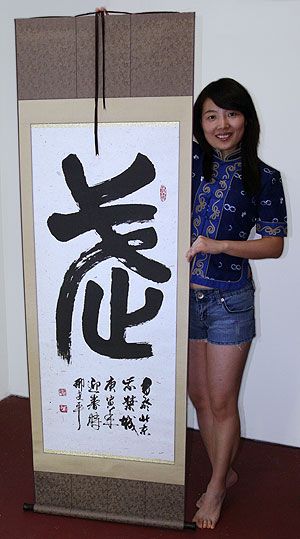
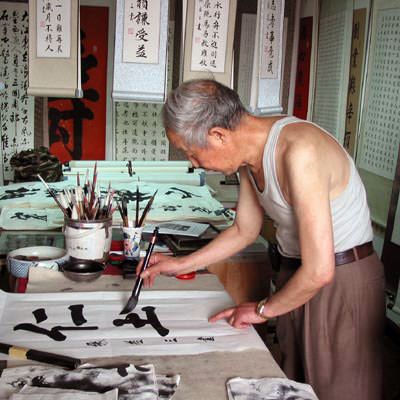
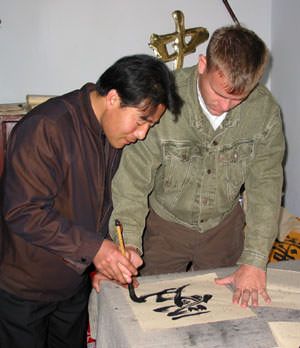
The Name Stone in Japanese/Chinese on a Custom-Made Wall Scroll.
Click the "Customize" button next to your name below to start your personalized Stone calligraphy artwork...
1. Stone
2. Dripping Water Penetrates Stone
3. Jade
4. Stone / Rock
5. Failure is a Stepping Stone to Success
6. Traveler / Wanderer / Vagabond / Rolling Stone
7. Adventure
8. Failure is the Origin of Success
10. Adventure
12. Smooth Sailing
Stone

斯通 is the name Stone in Chinese (Mandarin).
Stone

ストン is the name Stone in Japanese (Katakana).
Note: Because this title is entirely Japanese Katakana, it should be written by a Japanese calligrapher.
Dripping Water Penetrates Stone
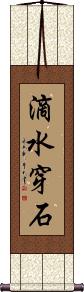
滴水穿石 is a Chinese proverb that means, dripping water penetrates stone.
The figurative meaning can mean:
Constant perseverance yields success.
You can achieve your aim if you try hard without giving up.
Persistent effort overcomes any difficulty.
While 滴水穿石 is the most common character order, you will likely see 水滴石穿, might see 滴水石穿, and will rarely see 小水穿石 in the wild.
Jade
(precious stone)
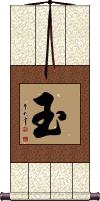
玉 is how to write jade in Chinese, Korean Hanja, and Japanese Kanji. This refers to the semi-precious stone that can be almost white or a vivid green.
Note: In Japanese, this character can mean jewel, ball, sphere or coin depending on context.
If your name is Jade, you may want to choose this to represent your name by meaning rather than pronunciation.
Stone / Rock
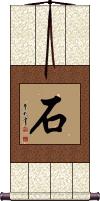
石 is the character that means rock or stone in both Chinese and Japanese.
Alone, this will be read as “stone” in Japanese but in some context, it is a unit of measure for the volume of about five bushels.
This can also refer to a gem or jewel.
This can also be the Japanese surnames that romanize as Ishi, Tsuruishi, Soku, Seki, Shi, Kazu, Iso, Ishizaki, Ishisaki, or Koku.
Failure is a Stepping Stone to Success
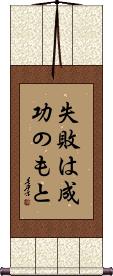
This Japanese proverb literally reads, “failures/mistakes/blunders are the yeast-starter/yeast-mash of success.”
it suggests that failures are a necessary part of success; Just as bread or beer requires yeast to successfully rise or brew/ferment.
Note: Because this selection contains some special Japanese Hiragana characters, it should be written by a Japanese calligrapher.
Traveler / Wanderer / Vagabond / Rolling Stone
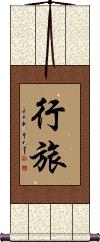
行旅 is a Chinese and Japanese title meaning traveler/traveller, wanderer, vagabond, rolling stone, or traveling/travelling.
Adventure
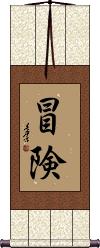
冒険 is a common Japanese way to say “Adventure.”
The first character can mean “to risk,” “to defy” or “to dare.” The second character means “inaccessible place” or “impregnable position.” Together, you get the idea of why these two characters mean adventure when put them together in Japanese.
Note: The second character is a morphed Japanese Kanji. The original Chinese version is also available and holds the same root meaning.
See Also: Bon Voyage | Traveler / Wanderer / Vagabond / Rolling Stone
Failure is the Origin of Success
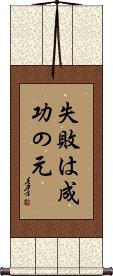
This Japanese proverb reads, “failure/mistake/blunder/defeat is the origin of success.”
It suggests that failures or defeats are a necessary part of success.
失敗は成功の元 is often translated as “Failure is a stepping stone to success.”
Note: There are a few similar variations of this idiom in Japanese.
Note: Because this selection contains some special Japanese Hiragana characters, it should be written by a Japanese calligrapher.
See Also: Failure is a Stepping Stone to Success
Smooth Sailing
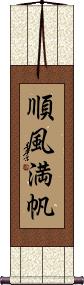
順風満帆 means “smooth sailing” in Japanese.
The Kanji literally means “Favorable wind, full sail.”
This title can also suggest having great ambitions.
See Also: Bon Voyage | Adventure | Traveler / Wanderer / Vagabond / Rolling Stone
Adventure
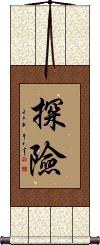
If you lead a life of adventure (like I do), a 探險 wall scroll is for you.
Alone, the first character can mean “to explore,” “to search out,” or “to scout.” The second character holds the meanings of “dangerous” and “rugged.” Together these two characters create the word that means “adventure” or “to explore.”
探険 is a modern Japanese Kanji version, but it more precisely means exploration or expedition rather than adventure. 探險 is the old/ancient Japanese version used before WWII. Let us know if you want the modern Japanese version instead.
See Also: Bon Voyage | Traveler / Wanderer / Vagabond / Rolling Stone
Adventure
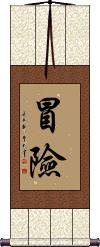
冒險 is another Chinese and Korean word for “Adventure.”
This is a more “risk-taking” sense of adventure.
The first character can mean “brave” and “bold.” The second character means “dangerous” and “rugged.” Together they can mean a word meaning “adventure” in Chinese and Korean.
Note: Some dictionaries translate these two characters as “take a risk.”
See Also: Bon Voyage | Traveler / Wanderer / Vagabond / Rolling Stone
Failure in Not an Option
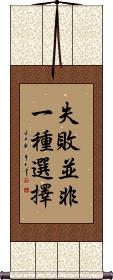
失敗並非一種選擇 is probably the best way to say, “Failure is not an option,” in Chinese.
Just don't forget that some ancient Chinese proverbs suggest that failure is a learning opportunity that leads to success or innovation. So don't plan to fail but failure is only a waste if nothing is learned from the failure.
See Also: Failure is a Stepping Stone to Success | Failure is the Mother of Success
Smooth Sailing
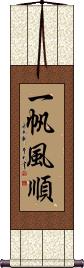
一帆風順 is just what you think it means. It suggests that you are on a trouble-free voyage through life, or literally on a sailing ship or sailboat. It is often used in China as a wish for good luck on a voyage or as you set out on a new quest or career in your life. Some may use this in place of “bon voyage.”
The literal meaning is “Once you raise your sail, you will get the wind you need, and it will take you where you want to go.” Another way to translate it is “Your sail and the wind follow your will.”
This is a great gift for a mariner, sailor, adventurer, or someone starting a new career.
Note: Can be understood in Korean Hanja but is rarely used.
See Also: Bon Voyage | Adventure | Traveler / Wanderer / Vagabond / Rolling Stone
This in-stock artwork might be what you are looking for, and ships right away...

The following table may be helpful for those studying Chinese or Japanese:
| Title | Characters | Romaji (Romanized Japanese) | Various forms of Romanized Chinese | |
| Stone | 斯通 | sī tōng / si1 tong1 / si tong / sitong | ssu t`ung / ssutung / ssu tung | |
| Stone | ストン | suton | ||
| Dripping Water Penetrates Stone | 滴水穿石 | dī shuǐ chuān shí di1 shui3 chuan1 shi2 di shui chuan shi dishuichuanshi | ti shui ch`uan shih tishuichuanshih ti shui chuan shih |
|
| Jade | 玉 | tama / gyoku | yù / yu4 / yu | yü |
| Stone Rock | 石 | ishi | shí / shi2 / shi | shih |
| Failure is a Stepping Stone to Success | 失敗は成功のもと | sittpai wa seikou no moto sittpaiwaseikounomoto sittpai wa seiko no moto | ||
| Traveler Wanderer Vagabond Rolling Stone | 行旅 | kou ryo / kouryo / ko ryo | xíng lǚ / xing2 lv3 / xing lv / xinglv | hsing lü / hsinglü |
| Adventure | 冒険 | bou ken / bo ken | ||
| Failure is the Origin of Success | 失敗は成功の元 | shippai wa seikou no moto shippaiwaseikounomoto shipai wa seiko no moto | ||
| Smooth Sailing | 順風満帆 | jun puu man pan junpuumanpan jun pu man pan | ||
| Adventure | 探險 探险 / 探険 | tanken | tàn xiǎn / tan4 xian3 / tan xian / tanxian | t`an hsien / tanhsien / tan hsien |
| Adventure | 冒險 冒险 | mào xiǎn / mao4 xian3 / mao xian / maoxian | mao hsien / maohsien | |
| Failure in Not an Option | 失敗並非一種選擇 失败并非一种选择 | shī bài bìng fēi yì zhǒng xuǎn zé shi1 bai4 bing4 fei1 yi4 zhong3 xuan3 ze2 shi bai bing fei yi zhong xuan ze | shih pai ping fei i chung hsüan tse | |
| Smooth Sailing | 一帆風順 一帆风顺 | yī fán fēng shùn yi1 fan2 feng1 shun4 yi fan feng shun yifanfengshun | i fan feng shun ifanfengshun |
|
| In some entries above you will see that characters have different versions above and below a line. In these cases, the characters above the line are Traditional Chinese, while the ones below are Simplified Chinese. | ||||