I am shipping orders on Thursday this week. News and More Info
Click the "Customize" button next to your name below to start your personalized Ou calligraphy artwork...
Switched to secondary search mode due to lack of results using primary.
These secondary results may not be very accurate. Try a different but similar meaning word or phrase for better results. Or...
Look up Ou in my Japanese Kanji & Chinese Character Dictionary(My dictionary is a different system then the calligraphy search you just tried)
If you want a special phrase, word, title, name, or proverb, feel free to contact me, and I will translate your custom calligraphy idea for you.
1. 2. Right Resolve / Right Thought / Right Intention / Perfect Resolve
2. Abdelmouiz
3. Abdou
4. Abou
5. Year-In Year-Out Have Abundance
7. Optimism / Happy With Your Fate
9. Skill Acquired Through Hard Training
10. Adonis / Handsome Young Man
11. Aijou-Ryu
12. Alone with only your shadow for company
13. Alou
14. Fix the roof before the rain; Dig the well before you are thirsty
15. You are Always in My Heart
16. Amadou
17. Ambitious / To Improve Oneself
18. Amour
20. Anouchka
21. Anouck
22. Anouk
23. Assetou
24. Aubouin
25. Ayoub
26. Baddour
28. Be Yourself
29. Beautiful Soul
30. You are always a beauty in your lover’s eyes
32. Without a big net, how can you catch fish?
33. If you cannot bite, do not show your teeth
34. Bless this House
35. Bouchlaghem
36. Bouchlaquem
37. Bouchra
38. Bouki
39. Boulder
40. Boule
41. Boumzil
42. Bounce Back / Stage a Comeback
43. Boutaina
45. Brahmavihara - The Four Immeasurables
47. You May Learn from Victory, You Will Learn from Failure
48. No Trouble / Freedom from Problems
49. Chill Out
51. Chou
52. Choudary
54. Chow / Zhou
55. You are who you hang out with
56. Cloud
57. Do not shed a tear until you see the coffin
58. The Foundation of Good Conduct
59. Learning leads to Knowledge, Study leads to Benevolence, Shame leads to Courage
60. Conquering Yourself is a Sign of Strength
61. Consideration / Meticulous Care
62. Coulson
63. Courage to do what is right
67. Court
68. Courteney
71. Courtland
Samyak Samkalpa / Samma Sankappa
正思唯 is one of the Noble Eightfold Paths of Buddhism. Right Thought, along with the Right View, constitute the path to Wisdom.
In Buddhism, Right Thought, in simple terms, means to free yourself from having ill will towards anyone or anything. It also suggests that you remain harmless to other living creatures.
This can also be defined as “Resolve in favor of renunciation, goodwill, and non-harming of sentient beings.”
There is an ancient/alternate version of the third character for this selection. You can see that alternation third character to the right. If you want your selection to use that older character, just click on the character to the right, instead of the button above.
Note: This term is exclusively used by devout Buddhists. It is not a common term, and is remains an unknown concept to most Japanese and Chinese people.
See Also: Buddhism | Enlightenment | Noble Eightfold Path
年年有餘 is a common proverb or wish of prosperity you'll hear around the time of Chinese New Year.
Directly translated character by character, it means “Year Year Have Surplus.” A more natural English translation including the deeper meaning would be “Every Year may you Have Abundance in your life.”
On a side note, this phrase often goes with a gift of something related to fish. This is because the last character, “yu” which means surplus or abundance, has exactly the same pronunciation in Mandarin as the word for “fish.”
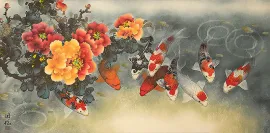
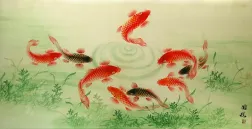
This is also one of the most common titles for traditional paintings that feature koi fish.
In China, this phrase might make an odd wall scroll - a customer asked especially for this common phrase which is why it appears here. See my other abundance-related words if you want a wall scroll that will seem more comfortable in Chinese culture.
Note: This can be pronounced in Korean, but it's not a commonly used term.
See Also: Prosperity | Good Fortune
富裕 means prosperous, having an abundance, well-to-do, or well-off.
It's a simple word that suggests “you have made it” in Chinese, Japanese Kanji, and Korean Hanja.
See Also: Good Fortune
樂天 is about being optimistic and also making the best of whatever life throws at you.
This is hard to define. One dictionary defines this as “acceptance of fate and happy about it.” There is one English word equivalent, which is sanguinity or sanguinary.
You can also say that this means “Be happy with whatever Heaven provides,” or “Find happiness in whatever fate Heaven bestows upon you.” 樂天 suggests being an optimist in life.
Note: This is sometimes a given name in China.
Please note that Japanese tend to write the first character in a slightly-different form (as seen to the right). Let us know if you have a preference when you place your order.
會計師 is the occupational or legal title of an accountant in Chinese and Korean.
In Asia, particular studies and certifications are needed to obtain this title. Therefore, this is the closest match to the English term for Certified Public Accountant. Such a professional might have a sign on his desk or a name badge that has his/her name on it and this title in Chinese characters. It's not too common to see this on a wall scroll in Asia, but you can take such liberties in the west.
煢煢孑立形影相吊 is a Chinese proverb about the state of being as alone as you possibly can be.
It can be translated as “Alone with only your shadow for comfort/company.”
See Also: I Miss You
补漏趁天晴未渴先掘井 is a Chinese proverb that literally translates as: Mend the roof while the weather is fine, [and when you are] not yet thirsty, dig the well beforehand.
In simple terms, this means: Always being prepared in advance.
See Also: Have a Walking Stick at the Ready Before You Stumble
Advance and Progress
上進 is a Chinese and Japanese Kanji word that means to advance, to make progress, to do better, to be ambitious, to improve oneself, or to move forward.
This can refer to a single person, general things (such as a work project), or a whole country.
In Japanese, this is sometimes used as the given name Joushin.
無名 is a Chinese, Japanese and Korean word that means nameless, obscure, unnamed, anonymous, unsigned, unknown, not famous, and sometimes unjustifiable.
The romanized title, Wu Ming, has been used for several different things such as a group of Italian writers, and even as the Chinese name of the infamous hackers.
Any woman with affection for Asian art will love a gift of this Chinese proverb calligraphy on a wall scroll.
She will melt in your arms as you tell her the meaning of these characters.
Contained in this phrase is a reference to the most beautiful woman in Chinese history. Her name was Xi Shi, and she was known to have good looks that need not have fine robes or makeup. Her charms were so powerful that she brought down an entire kingdom (in a successful effort to bring honor and pride back to her people).
情人眼里出西施 is a great way to express that the woman in your life is your one love.
自分を信じる means “believe in yourself,” “have faith in yourself,” or “believe in myself” (can be myself or yourself depending on if you're saying it to yourself or someone else).
Note: Because this selection contains some special Japanese Hiragana characters, it should be written by a Japanese calligrapher.
不撒大網不得大魚 is a Chinese proverb that literally translates as: [if one does] not cast a big net, [one can] not get big fish.
Figuratively, this means: One cannot make great accomplishments without making great efforts or taking great pains.
This is sort of the fishing version of, “No pain, no gain.”
If you cannot fight, don't start one
不能咬人就别龇牙 is a Chinese proverb that literally translates as: [if you] can't bite people, don't bare [your] teeth.
Figuratively, this means: Don't show your anger if you can't do anything about the situation.
Some will also say this means “Don't start a fight that you cannot win.” Others will say it means that you must be willing to back up your words (perhaps with your fists).
This means “Bless this house” or “Bless this home,” in Japanese.
Some may also translate this as “Bless this family,” since the Kanji for home can also mean family.
Note: Because this selection contains some special Japanese Hiragana characters, it should be written by a Japanese calligrapher.
東山再起 is a Chinese proverb that means “make a comeback” or “resuming after a failure.”
It's sometimes used in terms of losing a job and then getting it back. However, it applies to any kind of comeback after difficulty.
The literal meaning of this Chinese idiom is, “[The] Eastern Mountain Again [will] Rise.”
Quote from William S. Clark in Japan
少年よ大志を抱け was a sort of motto or proverb invoked by William Clark after being hired by the Emperor of Japan in 1876 to establish a university in Hokkaido, Japan.
This phrase has been famous across all generations of Japan since that time.
More about William S. Clark's adventures in Japan.
Note: Because this selection contains some special Japanese Hiragana characters, it should be written by a Japanese calligrapher.
四無量心 is the cattāri brahmavihārā or catvāri apramāṇāni.
The four immeasurables, or infinite Buddha-states of mind. These four dhyānas include:
1. 慈無量心 boundless kindness, maitrī, or bestowing of joy or happiness.
2. 悲無量心 boundless pity, karuṇā, to save from suffering.
3. 喜無量心 boundless joy, muditā, on seeing others rescued from suffering.
4. 捨無量心 limitless indifference, upekṣā, i.e., rising above these emotions or giving up all things.
Courage in the face of Fear
勇敢 is about courage or bravery in the face of fear.
You do the right thing even when it is hard or scary. When you are courageous, you don't give up. You try new things. You admit mistakes. This kind of courage is the willingness to take action in the face of danger and peril.
勇敢 can also be translated as braveness, valor, heroic, fearless, boldness, prowess, gallantry, audacity, daring, dauntless, and/or courage in Japanese, Chinese, and Korean. This version of bravery/courage can be an adjective or a noun. The first character means bravery and courage by itself. The second character means “daring” by itself. The second character emphasizes the meaning of the first but adds the idea that you are not afraid of taking a dare, and you are not afraid of danger.
勇敢 is more about brave behavior and not so much the mental state of being brave. You'd more likely use this to say, “He fought courageously in the battle,” rather than “He is very courageous.”
Single Character for Courage
勇 can be translated as bravery, courage, valor, or fearless in Chinese, Japanese and Korean.
勇 is the simplest form to express courage or bravery, as there is also a two-character form that starts with this same character.
勇 can also be translated as brave, daring, fearless, plucky, or heroic.
This is also a virtue of the Samurai Warrior
See our page with just Code of the Samurai / Bushido here
百胜难虑敌三折乃良医 is a Chinese proverb that literally translates as: [Even a general who has won a] hundred victories [may be] hard put to see through the enemy's [strategy], [but one who has] broken [his] arm three [times] [will] be a good doctor.
Figuratively, this means: One cannot always depend on past successes to guarantee future success but one can always learn from lessons drawn from failure.
See Also: Failure - Mother of Success | Experience - Mother of Success | Fall Down 7 Times Get Up 8 | Hard Knocks
無事 is a Zen Buddhist term meaning no problem and no trouble.
無事 is the Zen state of perfect freedom from troubles and leaving secular affairs behind.
Sometimes this is used to describe the state of satori and complete tranquility of mind.
Written as 無事に with an extra Hiragana at the end, this becomes an adverb to describe something in the condition of safety, peace, quietness, and without troubles.
無事 (Buji) can also be a given name in Japan.
This has more meaning in the Japanese Zen Buddhist community than in China or Korea, where it can mean “be free” or “nothing to do or worry about.”
丑 can refer to the astrological time of the ox, or a Chinese surname, Chou.
丑 represents the 2nd earthly branch. In daily time, 1:00-3:00 AM, or the 12th/last month in the Chinese calendar.
In an ancient year-naming scheme, this can represent the year of the Ox (one of twelve animals paired with one of five element characters yielding a 60-year cycle).
戳腳 is the title for Choujiao, Chuōjiǎo, or Chou Jiao.
This means poking or stabbing foot. This is a Chinese martial art that falls under the Northern School.
There are many jumps, kicks, and lightning-fist actions in this style.
You'll find Chou Jiao practiced in Liaoning Province, Hebei Province, and Beijing.
Surname
周 originally represents the Zhou Dynasty (1046-256 BC) of ancient China.
It has become a surname in China that romanizes as Zhou from Mandarin, Chou in Taiwan, and often written as Chow from Cantonese.
The actual meaning is circle, circumference, lap, cycle, all, thorough, or perimeter. It is used in Japanese Kanji and old Korean Hanja with that meaning - though it can also be used as a name in those languages as well.
金似金挨玉似玉 is a Chinese proverb that literally translates as: [One who is] close to gold [is] like gold [and one who is] close to jade [is] like jade.
Figuratively, this means:
A good environment produces good people.
People are influenced by the company they keep.
Basically, if you hang out with good people, you are likely to become or stay good yourself. The opposite also is true. 挨This is like the moral version of “You are what you eat.”
Note: In Japanese, they have a similar phrase, 類は友を呼ぶ (rui wa tomo o yobu) Birds of a feather flock together. However, this is not a good meaning, so we’re not offering it for wall scrolls.
不見棺材不落淚 is a cautionary tale that suggests you are unknowingly (though it should be obvious)on a bad course.
It further suggests that you will not realize your folly until the worst has happened.
This can also be a warning of inaction until it's too late to take action. Again, not realizing your error until it's too late.
In an alternate interpretation, some will suggest this means doing something bad and not looking back - Then the worst happens.
It should be noted that this is one of the oddest selections for a wall scroll in our whole Asian calligraphy database. All of our translators are convinced that no Chinese person would ever hang this on their wall.
Quote from Confucius
This proverb, 志于道据于德依于仁游于艺, from the Analects of Confucius translates as:
Resolve yourself in the Dao/Tao/Way.
Rely on Virtue.
Reside in benevolence.
Revel in the arts.
According to Confucius, these are the tenets of good and proper conduct.
This was written over 2500 years ago. The composition is in ancient Chinese grammar and phrasing. A modern Chinese person would need a background in Chinese literature to understand this without the aid of a reference.
見義勇為 means the courage to do what is right in Chinese.
This could also be translated as “Never hesitate to do what is right.”
This comes from Confucian thought:
Your courage should head in an honorable direction. For example, you should take action when the goal is to attain a just result as, without honorable intent, a person’s gutsy fervor can easily lead them astray.
One who flaunts courage but disregards justice is bound to do wrong; someone who possesses courage and morality is destined to become a hero.
Some text above paraphrased from The World of Chinese - The Character of 勇
See Also: Work Unselfishly for the Common Good | Justice | Bravery
Courageous Energy
勇氣 is one of several ways to express bravery and courage in Chinese, Japanese, and Korean.
This version is the most spiritual. This is the essence of bravery from deep within your being. This is the mental state of being brave versus actual brave behavior. You'd more likely use this to say, “He is very courageous,” rather than “He fought courageously in the battle.”
The first character also means bravery or courage when it's seen alone. With the second character added, an element of energy or spirit is added. The second character is the same “chi” or “qi” energy that Kung Fu masters focus on when they strike. For this reason, you could say this means “spirit of courage” or “brave spirit.”
This is certainly a stronger word than just the first character alone.
Beyond bravery or courage, dictionaries also translate this word as valor/valour, nerve, audacity, daring, pluck, plucky, gallantry, guts, gutsy, and boldness.
This is also one of the 8 key concepts of tang soo do.
While the version shown to the left is commonly used in Chinese and Korean Hanja (and ancient Japanese Kanji), please note that the second character is written with slightly fewer strokes in modern Japanese. If you want the modern Japanese version, please click on the character to the right. Both styles would be understood by native Chinese, Japanese, and many (but not all) Korean people. You should make your selection based on the intended audience for your calligraphy artwork. Or pick the single-character form of bravery/courage which is universal.
In Chinese, old Korean Hanja, and old Japanese Kanji, 禮儀 means “etiquette” or “courtesy.”
You'll also find a Japanese entry on our website, which uses a modern/simplified first Kanji. The characters shown here compose the best choice if your audience is Chinese or Korean - but also acceptable if you want an ancient-style Japanese scroll (in modern Japanese, it has the same pronunciation, but is written 礼儀).
Note: This can also be translated as propriety, decorum, or formality.
In Japanese, 礼儀 means “manners,” “courtesy,” or “etiquette.”
This also clearly means etiquette in Chinese, though the first Japanese Kanji has been “modernized” and happens to be the same as the modern Simplified Chinese version. Therefore, this word will be understood by both Japanese and Chinese people but best if your audience is mostly Japanese (Chinese people would generally prefer the ancient Traditional Chinese version).
禮貌 is a Chinese and old Korean word that means courtesy or politeness.
Courtesy is being polite and having good manners. When you speak and act courteously, you give others a feeling of being valued and respected. Greet people pleasantly. Bring courtesy home. Your family needs it most of all. Courtesy helps life to go smoothly.
If you put the words "fēi cháng bù" in front of this, it is like adding "very much not." it’s a great insult in China, as nobody wants to be called "extremely discourteous" or "very much impolite."
All of our calligraphy wall scrolls are handmade.
When the calligrapher finishes creating your artwork, it is taken to my art mounting workshop in Beijing where a wall scroll is made by hand from a combination of silk, rice paper, and wood.
After we create your wall scroll, it takes at least two weeks for air mail delivery from Beijing to you.
Allow a few weeks for delivery. Rush service speeds it up by a week or two for $10!
When you select your calligraphy, you'll be taken to another page where you can choose various custom options.
The wall scroll that Sandy is holding in this picture is a "large size"
single-character wall scroll.
We also offer custom wall scrolls in small, medium, and an even-larger jumbo size.
Professional calligraphers are getting to be hard to find these days.
Instead of drawing characters by hand, the new generation in China merely type roman letters into their computer keyboards and pick the character that they want from a list that pops up.
There is some fear that true Chinese calligraphy may become a lost art in the coming years. Many art institutes in China are now promoting calligraphy programs in hopes of keeping this unique form
of art alive.
Even with the teachings of a top-ranked calligrapher in China, my calligraphy will never be good enough to sell. I will leave that to the experts.
The same calligrapher who gave me those lessons also attracted a crowd of thousands and a TV crew as he created characters over 6-feet high. He happens to be ranked as one of the top 100 calligraphers in all of China. He is also one of very few that would actually attempt such a feat.
Some people may refer to this entry as Ou Kanji, Ou Characters, Ou in Mandarin Chinese, Ou Characters, Ou in Chinese Writing, Ou in Japanese Writing, Ou in Asian Writing, Ou Ideograms, Chinese Ou symbols, Ou Hieroglyphics, Ou Glyphs, Ou in Chinese Letters, Ou Hanzi, Ou in Japanese Kanji, Ou Pictograms, Ou in the Chinese Written-Language, or Ou in the Japanese Written-Language.