Many custom options


And formats



2 Birds in Chinese / Japanese
Buy a 2 Birds calligraphy wall scroll here!
Personalize your custom “2 Birds” project by clicking the button next to your favorite “2 Birds” title below.
Men Die for Wealth, Birds Die for Food
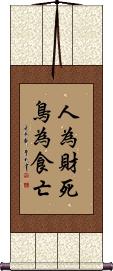
人為財死鳥為食亡 is a Chinese proverb that literally states that human beings will die for riches, just as birds will for food.
Figuratively it means that man will do anything in his means to become rich. Personally, I think dying for food is a more noble cause.
Often translated as “Men die in pursuit of wealth, birds die in pursuit of food. The 人 in this proverb just means human, so “men” is a placeholder for human with that translation - an English language problem that we have no easy gender-neutral nouns.
This proverb is meant to serve as a warning about the follies of greed.
Eagle / Falcon / Hawk
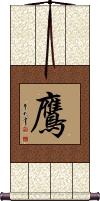
鷹 is the way to write eagle, falcon, or hawk in Chinese.
It means hawk or falcon in Japanese Kanji, and simply “eagle” in old Korean Hanja. Though we have different words for them in English, eagles, falcons, and hawks are all seen as the same general type of bird in Asian languages.
If you are looking for the Dutch surname Valk, or the German surname Falco by meaning, this would be a good character for you.
There are other multi-character words (most of them contain this character) which express different specific species of birds of prey (bald eagle, osprey, golden eagle, etc). If you need a more specific title, just contact me.
Swallow
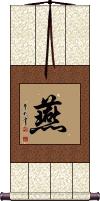
燕 is the single character for the swallow (bird).
If you are a zoologist, this can refer to birds of the family Hirundinidae. Sometimes used to refer to Hirundo rustica (the barn swallow).
燕 is also a surname in China that is romanized as Yan. In fact, there were also several different Yan kingdoms in the ancient history of China (which is the origin of the surname).
Black Eagle / Condor
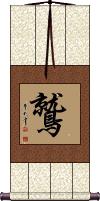
鷲 is the way to write black eagle or condor in Chinese.
It means eagle (sometimes vulture) in Japanese Kanji. 鷲 hasn't been in common use in Korean for hundreds of years, so it's hard to say what bird it represented in old Korean Hanja.
There are other multi-character words that express different specific species of birds of prey (bald eagle, osprey, golden eagle, etc).
If you need a more specific title, just contact me.
Tengu
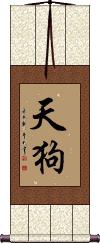
天狗 is the Japanese title for Tengu, which roughly translates as “heavenly dog.”
Tengu is a type of legendary creature found in Japanese folk religion and is also considered a type of Shinto god (kami) or yōkai (supernatural being).
The origin is Chinese, though this term is seldom used in Chinese anymore. It was a dog-like Chinese demon (Tiangou)
Although the title contains the word “dog,” the tengu are often depicted with human and bird-like characteristics. Sometimes they have large noses or beaks like birds.
Beautiful Woman Proverb
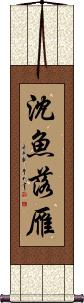
沈魚落雁 is an old proverb that literally means “fish sink, goose alights.”
...But this takes some explaining. This is a proverb from Zhuangzi (莊子), who lived in the late 4th century BC.
This figuratively refers to female beauty that is so captivating that even the birds and beasts take notice.
Perhaps a better and more accurate way to describe this is to say that it speaks of the charms of a uniquely beautiful woman who is so beautiful that fish stay on the bottom of the water and flying wild geese fall from the sky in shame.
This proverb is so famous that it is also known and used in Japan (same characters, different pronunciation).
Note: This can also be written 沉魚落雁 instead of 沈魚落雁 (just the first character varies slightly).
This in-stock artwork might be what you are looking for, and ships right away...
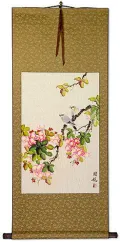
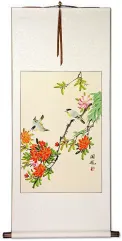
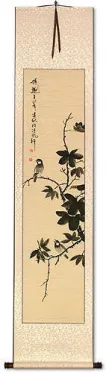
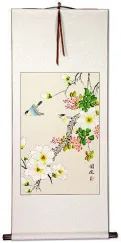
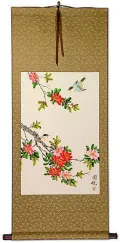

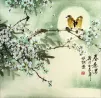

Not the results for 2 Birds that you were looking for?
Below are some entries from our dictionary that may match your 2 Birds search:
| Characters If shown, 2nd row is Simp. Chinese |
Pronunciation Romanization |
Simple Dictionary Definition |
羅 罗 see styles |
luó luo2 lo rou / ro ろう |
More info & calligraphy: Lo(abbreviation) (See 羅甸語) Latin (language); (surname) Rou A net (for catching birds), gauze, open work; sieve; to arrange in order; translit. la and ra sounds, e.g. 南羅 S. Lāra; Lāḍa; Lāṭa, in Gujarāt; 北羅 N. Lāra, Valabhī, on the western coast of Gujarāt. |
翼 see styles |
yì yi4 i yoku よく |
More info & calligraphy: Wings(1) wing; (2) (よく only) {astron} (See 二十八宿,朱雀・すざく・2) Chinese "Wings" constellation (one of the 28 mansions); (suf,ctr) (3) (よく only) (archaism) counter for birds or bird wings; (female given name) Yoku assist |
草 see styles |
cào cao4 ts`ao tsao hajime はじめ |
More info & calligraphy: Cao / Kusa / Grass(1) draft; rough copy; (2) (abbreviation) (See 草書) highly cursive style (of writing Chinese characters); grass style; (female given name) Hajime Grass, herbs, plants; rough; female (of animals, birds, etc. ). |
レック see styles |
reggu レッグ |
More info & calligraphy: Lec |
ぴーぴー see styles |
piipii / pipi ぴーぴー |
(n,adv) (1) (onomatopoeic or mimetic word) peep; chirp; beep; whistling, chirping, piping, etc. sound made by birds, insects, pipes, children, etc.; (noun/participle) (2) poor; hard up; pinched; (3) the runs; diarrhea; diarrhoea; (4) flute; pipe; (5) beginner; novice |
哢 see styles |
lòng long4 lung |
to sing or chirp (of birds); music sound |
啁 see styles |
zhōu zhou1 chou |
twittering of birds |
喞 see styles |
jī ji1 chi soku |
chirp of insects, birds, etc. |
喿 see styles |
sào sao4 sao |
chirping of birds |
嘯 啸 see styles |
xiào xiao4 hsiao |
(of people) to whistle; (of birds and animals) to screech; to howl; to roar |
噪 see styles |
zào zao4 tsao |
(literary) (of birds or insects) to chirp; (bound form) to make a cacophonous noise |
嚶 嘤 see styles |
yīng ying1 ying |
calling of birds |
囀 啭 see styles |
zhuàn zhuan4 chuan ten |
to sing (of birds or insects); to warble; to chirp; to twitter Translit. vā. |
嬎 see styles |
fàn fan4 fan |
(dialect) (of birds) to lay eggs; (archaic) to reproduce; to bear offspring |
獝 see styles |
xù xu4 hsü |
(literary) (of birds) to scatter in fear; (literary) wild; unrestrained |
磔 see styles |
zhé zhe2 che taku たく |
old term for the right-falling stroke in Chinese characters (e.g. the last stroke of 大[da4]), now called 捺[na4]; sound made by birds (onom.); (literary) to dismember (form of punishment); to spread (See 永字八法) eighth principle of the Eight Principles of Yong; stroke that falls rightwards and fattens at the bottom |
禽 see styles |
qín qin2 ch`in chin kin とり |
(bound form) birds; fowl; (literary) birds and animals; old variant of 擒[qin2] (1) bird; (2) bird meat (esp. chicken meat); fowl; poultry bird |
罟 see styles |
gǔ gu3 ku |
to implicate; net for birds or fish |
罦 see styles |
fú fu2 fu |
net for catching birds |
羽 see styles |
yǔ yu3 yü hano はの |
feather; 5th note in pentatonic scale (counter) counter for birds or rabbits; (female given name) Hano wing |
翯 see styles |
hè he4 ho |
glistening plumage of birds |
胑 see styles |
zhī zhi1 chih |
wings of birds; legs of animals |
裘 see styles |
qiú qiu2 ch`iu chiu kiyuu / kiyu きゆう |
fur; fur coat (1) fur coat (to protect against the cold); (2) clothes made with the down of birds; fur coat; (surname) Kiyū |
距 see styles |
jù ju4 chü kyo きょ |
to be at a distance of ... from; to be apart from; (bound form) distance; spur (on the leg of certain birds: gamecock, pheasant etc) {bot} tubular nectary; spur |
隻 只 see styles |
zhī zhi1 chih sumihiko すみひこ |
classifier for birds and certain animals, one of a pair, some utensils, vessels etc (counter) (1) counter for ships; (counter) (2) counter for half of a pair (e.g. half of a folding screen); (counter) (3) (archaism) counter for items carried in a bundle (e.g. fish, birds, arrows); (personal name) Sumihiko |
鳴 鸣 see styles |
míng ming2 ming mei / me めい |
to cry (of birds, animals and insects); to make a sound; to voice (one's gratitude, grievance etc) (female given name) Mei Cry, sound, note of a bird, etc.; Oh ! alas ! to wail. |
鵯 鹎 see styles |
bēi bei1 pei hiyodori ひよどり |
the Pycnonotidae or bulbul family of birds (kana only) brown-eared bulbul (Hypsipetes amaurotis); (place-name) Hiyodori |
鶯 莺 see styles |
yīng ying1 ying uguisu うぐいす |
oriole or various birds of the Sylvidae family including warblers (1) (kana only) Japanese bush warbler (Horornis diphone); Japanese nightingale; (2) (abbreviation) greenish brown; (prefix noun) (3) having a beautiful voice; (surname) Uguisu |
鶱 𬸣 see styles |
xiān xian1 hsien |
(literary) (adjective) (of birds) flying; soaring |
九想 see styles |
jiǔ xiǎng jiu3 xiang3 chiu hsiang kusō |
(九想觀) or 九相 navasaṃjñā. Meditation on a corpse in order to curb desire; one of the meditations on the unclean: vyādhmātakasaṃjñā, its tumefaction; vinīlakas., its blue, mottled colour; vipadumakas., its decay; vilohitakas., its mess of blood,etc.; vipūyakas., its discharges and rotten flesh; vikhāditakas., its being devoured by birds and beasts; vikṣiptakas., its dismembering; asthis., its bones; vidagdhakas., their being burnt and returning to dust. |
Click here for more 2 Birds results from our dictionary
The following table may be helpful for those studying Chinese or Japanese:
| Title | Characters | Romaji (Romanized Japanese) | Various forms of Romanized Chinese | |
| Men Die for Wealth, Birds Die for Food | 人為財死鳥為食亡 人为财死鸟为食亡 | rén wèi cái sǐ niǎo wèi shí wáng ren2 wei4 cai2 si3 niao3 wei4 shi2 wang2 ren wei cai si niao wei shi wang | jen wei ts`ai ssu niao wei shih wang jen wei tsai ssu niao wei shih wang |
|
| Eagle Falcon Hawk | 鷹 鹰 | taka | yīng / ying1 / ying | |
| Swallow | 燕 | yasushi | yàn / yan4 / yan | yen |
| Black Eagle Condor | 鷲 鹫 | washi | jiù / jiu4 / jiu | chiu |
| Tengu | 天狗 | ten gu / tengu | tiān gǒu / tian1 gou3 / tian gou / tiangou | t`ien kou / tienkou / tien kou |
| Beautiful Woman Proverb | 沈魚落雁 沈鱼落雁 | chin gyo raku gan chingyorakugan | chén yú luò yàn chen2 yu2 luo4 yan4 chen yu luo yan chenyuluoyan | ch`en yü lo yen chenyüloyen chen yü lo yen |
| In some entries above you will see that characters have different versions above and below a line. In these cases, the characters above the line are Traditional Chinese, while the ones below are Simplified Chinese. | ||||

Successful Chinese Character and Japanese Kanji calligraphy searches within the last few hours...



