Many custom options...


And formats...



Not what you want?
Try other similar-meaning words, fewer words, or just one word.
United States in Chinese / Japanese...
Buy an United States calligraphy wall scroll here!
Personalize your custom “United States” project by clicking the button next to your favorite “United States” title below...
United States of America (USA)
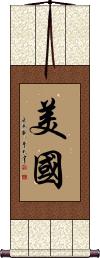
United States of America (USA)
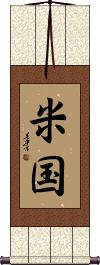
This is the United States of America (USA) written in Japanese.
United States Marine Corps
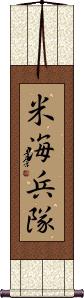
米海兵隊 is the Japanese way to write “United States Marine Corps” or simply “U.S. Marines.”
Breaking down each Kanji, this means:
“rice (American) ocean/sea soldiers/army/military corps/regiment/group.”
This title will only make sense in Japanese, it is not the same in Chinese! Make sure you know your audience before ordering a custom wall scroll.
If you are wondering about rice, America is known as “rice country” or “rice kingdom” when literally translated. The Kanji for rice is often used as an abbreviation in front of words (like a sub-adjective) to make something “American.” Americans say “rice burner” for a Japanese car and “rice rocket” for a Japanese motorcycle. If you did the same in Japanese, it would have the opposite meaning.
Note: I have not verified this but I’ve found this title used for U.S. Marines in Korean articles, so it’s most likely a normal Korean term as well (but only in Korean Hanja).
See Also: Marine Corps | Navy | Army | Art of War | Warrior | Military
Marine Corps
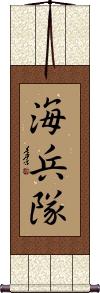
海兵隊 is the Japanese and Korean way to express “Marine Corps” or simply “Marines.” It is not specific, so this can be the Marine Corps of any country, such as the British Royal Marines to the U.S. Marines.
Breaking down each character, this means:
“ocean/sea soldiers/army corps/regiment/group.”
See Also: Military
Marine Corps
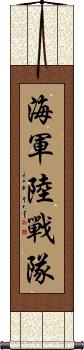
海軍陸戰隊 is the Chinese way to express “Marine Corps.” This could be the Marine Corps of virtually any country that has an amphibious military force.
Let me know if you want a more specific title, such as British Royal Marines or U.S. Marine Corps.
The Chinese title for Marines is very verbose...
Breaking down each character this means:
“ocean/sea military/arms shore/land fighting/war/battle corps/team/group.”
See Also: Military
Puerto Rico
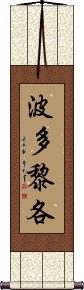
This is the Chinese name for Puerto Rico (overseas territory of the United States) .
See Also: North America
British Virgin Islands
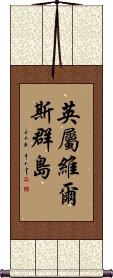
英屬維爾斯群島 is the Chinese name for the British Virgin Islands (overseas territory of the United Kingdom).
See Also: North America
Mexico
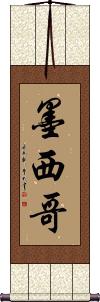
Canada
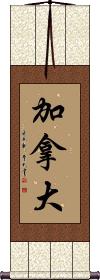
U.S. Virgin Islands
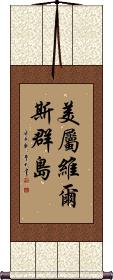
This is the Chinese name for the United States Virgin Islands (overseas territory of the United States).
See Also: North America | British Virgin Islands
Guam
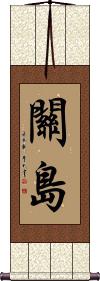
關島 is the Chinese name for the island of Guam (overseas territory of the United States).
See Also: North America
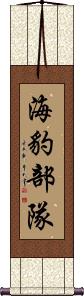
海豹部隊 is the title for United States Navy SEALs in Chinese. The U.S. part is implied, as few, if any, other nations claim to have sailors with the title “navy seals.”
Sometimes the term 海豹突击队 (Simplified) or 海豹突擊隊 (Traditional) is also used in Chinese. It means “Seal Commando Team.”
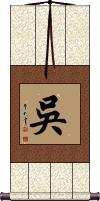
This is the surname Ng in Chinese.
吳 is sometimes romanized as Ang, Eng, Ing and Ong in the United States and Ung in Australia. In Mandarin, 吳 is usually romanized as Wu, but sometimes Woo. In Vietnamese, 吳 can be the Ngô surname.
Be careful, as 黃/黄 is another surname character that also romanizes as Ng and other variants noted above.
Asian Pride / Oriental Pride / AZN Pryde
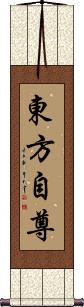
東方自尊 is the universal way to write “Asian Pride.”
We worked on this one for a long time. The effort involved both Chinese and Japanese translators and lengthy discussions. If you have been searching for this term, there is a reason that it's hard to find the way to write “Asian Pride” in Chinese and Japanese - it's because of the inherent difficulties in figuring out a universal combination of characters that can be read in all languages that use forms of Chinese characters.
This final solution that you see to the left creates a reasonable title in Chinese and an exotic (perhaps unusual) title in Japanese (This could be read as “Eastern Self-Respect” in Japanese”).
Although not as natural, it does have the same meaning as Korean Hanja, and the older generation of Vietnamese people will be able to read it.
The first two characters literally mean “Oriental” and the second two mean “pride,” “self-esteem,” or “self-respect” (we chose the most non-arrogant way to say “pride”). If you have “Asian Pride” (sometimes spelled Asian Pryde) these are the characters for you.
Note: For those who wonder, there is nothing technically wrong with the word “Oriental.” It is a correct word, and any bad meanings were created by so-called “Asian Americans” and Caucasians in the United States. To say “Asian” would not completely correct the intended meaning since that would include people from Saudi Arabia, Iraq, Iran, India, and portions of Russia.
For further proof, if you were of East Asian ancestry and born in England, you would be known as a “British Oriental” (The “Oriental stigma” is basically an American creation and, therefore, applies mainly to the American English language - where they get a bit overzealous with political correctness).
Further, since the Chinese and Japanese word for Oriental is not English, they can not be construed as having ill meaning. On one trip to China or Japan, you will find many things titled with these two characters, such as malls, buildings, and business names. These places also use “Oriental” as their English title (much as we do since our Chinese business name starts with these same two characters).
In short, the first two characters have the meaning that Americans attach to “Asian” but is more technically correct.
The following table may be helpful for those studying Chinese or Japanese...
| Title | Characters | Romaji (Romanized Japanese) | Various forms of Romanized Chinese | |
| United States of America (USA) | 美國 美国 | měi guó / mei3 guo2 / mei guo / meiguo | mei kuo / meikuo | |
| United States of America (USA) | 米國 米国 | bei koku / beikoku | ||
| United States Marine Corps | 米海兵隊 | bei kai hei tai beikaiheitai | ||
| Marine Corps | 海兵隊 海兵队 | kaiheitai | ||
| Marine Corps | 海軍陸戰隊 海军陆战队 | hǎi jūn lù zhàn duì hai3 jun1 lu4 zhan4 dui4 hai jun lu zhan dui haijunluzhandui | hai chün lu chan tui haichünluchantui |
|
| Puerto Rico | 波多黎各 | bō duō lí gè bo1 duo1 li2 ge4 bo duo li ge boduolige | po to li ko potoliko |
|
| British Virgin Islands | 英屬維爾斯群島 英属维尔斯群岛 | yīng shǔ wéi ěr sī qún dǎo ying1 shu3 wei2 er3 si1 qun2 dao3 ying shu wei er si qun dao yingshuweiersiqundao | ying shu wei erh ssu ch`ün tao yingshuweierhssuchüntao ying shu wei erh ssu chün tao |
|
| Mexico | 墨西哥 | mò xī gē mo4 xi1 ge1 mo xi ge moxige | mo hsi ko mohsiko |
|
| Canada | 加拿大 | jiā ná dà jia1 na2 da4 jia na da jianada | chia na ta chianata |
|
| U.S. Virgin Islands | 美屬維爾斯群島 美属维尔斯群岛 | měi shǔ wéi ěr sī qún dǎo mei3 shu3 wei2 er3 si1 qun2 dao3 mei shu wei er si qun dao meishuweiersiqundao | mei shu wei erh ssu ch`ün tao meishuweierhssuchüntao mei shu wei erh ssu chün tao |
|
| Guam | 關島 关岛 | guān dǎo / guan1 dao3 / guan dao / guandao | kuan tao / kuantao | |
| Navy SEALS | 海豹部隊 海豹部队 | hǎi bào bù duì hai3 bao4 bu4 dui4 hai bao bu dui haibaobudui | hai pao pu tui haipaoputui |
|
| Ng | 吳 吴 | wú / wu2 / wu | ||
| Asian Pride Oriental Pride AZN Pryde | 東方自尊 东方自尊 | tou hou zi son touhouzison to ho zi son | dōng fāng zì zūn dong1 fang1 zi4 zun1 dong fang zi zun dongfangzizun | tung fang tzu tsun tungfangtzutsun |
| In some entries above you will see that characters have different versions above and below a line. In these cases, the characters above the line are Traditional Chinese, while the ones below are Simplified Chinese. | ||||

Successful Chinese Character and Japanese Kanji calligraphy searches within the last few hours...



