Many custom options...


And formats...



Need in Chinese / Japanese...
Buy a Need calligraphy wall scroll here!
Personalize your custom “Need” project by clicking the button next to your favorite “Need” title below...
I Need You
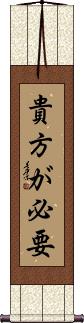
Some people like to say, “I love you” but others might want to say “I need you.” 貴方が必要 is “I need you” in Japanese.
The first two characters mean “You.”
The middle character is a connecting particle. In this case, it more or less means “are.”
The last two characters mean necessary, needed, essential, indispensable, or necessity.
The “I” in the title is implied. Effectively this means “I need you.”
I Need You
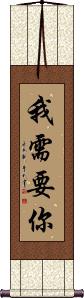
Some people like to say, “I love you” but others might want to say “I need you.” That is what this 我需要你 phrase is all about.
The first character means “I.” The second and third create a compound word that means “need” and “want” at the same time. The last character means “you.”
These search terms might be related to Need:
Do Not Fear Poverty; Fear Low Ambitions
Drinking the Water of a Well: One Should Never Forget Who Dug It
I Want You
To Know Hardship, One Must Experience It
You Must Endure a Harsh Winter to Appreciate the Warmth of Springtime
Not the results for need that you were looking for?
Below are some entries from our dictionary that may match your need search...
| Characters If shown, 2nd row is Simp. Chinese |
Pronunciation Romanization |
Simple Dictionary Definition |
待 see styles |
dài dai4 tai dai |
to wait; to treat; to deal with; to need; going to (do something); about to; intending to To wait, treat, behave to. |
得 see styles |
dei dei3 tei toku とく |
to have to; must; ought to; to need to (noun or adjectival noun) (1) (also written as 徳) profit; advantage; benefit; gain; (noun or adjectival noun) (2) {Buddh} rebirth in paradise, entering nirvana; (surname) Toku prāp; prāpta. To get, obtain, attain to; got, obtained, etc. |
摘 see styles |
zhāi zhai1 chai |
to take; to pick (flowers, fruit etc); to pluck; to remove; to take off (glasses, hat etc); to select; to pick out; to borrow money at a time of urgent need |
消 see styles |
xiāo xiao1 hsiao masao まさお |
to diminish; to subside; to consume; to reduce; to idle away (the time); (after 不[bu4] or 只[zhi3] or 何[he2] etc) to need; to require; to take (personal name) Masao Melt, disperse, expend, digest, dispose of. |
用 see styles |
yòng yong4 yung you / yo よう |
to use; to make use of; to employ; (coverb) with; using; to need; to have to (usu. used in the negative or in questions); usefulness; utility; (bound form) expense; outlay; (courteous) to eat; to drink; (literary) hence; therefore (1) business; task; errand; engagement; (2) use; purpose; (suffix noun) (3) for the use of ...; used for ...; made for ...; (4) (See 用を足す・2) call of nature; excretion; (place-name) Yō To use, to employ; use, function. |
甮 see styles |
fèng feng4 feng |
(dialect) need not; please don't (contracted form of 勿用[wu4 yong4]) |
要 see styles |
yào yao4 yao yoshi よし |
to want; to need; to ask for; will; shall; about to; need to; should; if (same as 要是[yao4 shi5]); (bound form) important (1) main point; essential point; important thing; (n,adj-f) (2) necessity; need; requirement; (surname) Yoshi Important, essential, necessary, strategic; want, need; about to; intercept; coerce; agree, etc. |
貧 贫 see styles |
pín pin2 p`in pin hanawa はなわ |
poor; inadequate; deficient; garrulous (1) poverty; penury; want; need; (2) (archaism) insufficiency; shortage; deficiency; (personal name) Hanawa Poor, in poverty.; The two kinds of poverty: of goods, and of the religion. |
需 see styles |
xū xu1 hsü motome もとめ |
to require; to need; to want; necessity; need (given name) Motome |
三身 see styles |
sān shēn san1 shen1 san shen sanmi さんみ |
{Buddh} trikaya (three bodies of the Buddha); (surname) Sanmi trikāya. 三寶身 The threefold body or nature of a Buddha, i.e. the 法, 報, and 化身, or dharmakāya, sambhogakāya, and nirmāṇakāya. The three are defined as 自性, 受用, and 變化, the Buddha-body per se, or in its essential nature; his body of bliss, which he "receives" for his own "use" and enjoyment; and his body of transformation, by which he can appear in any form; i.e. spiritual, or essential; glorified; revealed. While the doctrine of the trikāya is a Mahāyāna concept, it partly results from the Hīnayāna idealization of the earthly Buddha with his thirty-two signs, eighty physical marks, clairvoyance, clairaudience, holiness, purity, wisdom, pity, etc. Mahāyāna, however, proceeded to conceive of Buddha as the Universal, the All, with infinity of forms, yet above all our concepts of unity or diversity. To every Buddha Mahāyāna attributed a three-fold body: that of essential Buddha; that of joy or enjoyment of the fruits of his past saving labours; that of power to transform himself at will to any shape for omnipresent salvation of those who need him. The trinity finds different methods of expression, e.g. Vairocana is entitled 法身, the embodiment of the Law, shining everywhere, enlightening all; Locana is 報身; c.f. 三賓, the embodiment of purity and bliss; Śākyamuni is 化身 or Buddha revealed. In the esoteric sect they are 法 Vairocana, 報 Amitābha, and 化 Śākyamuni. The 三賓 are also 法 dharma, 報 saṅgha, 化 buddha. Nevertheless, the three are considered as a trinity, the three being essentially one, each in the other. (1) 法身 Dharmakāya in its earliest conception was that of the body of the dharma, or truth, as preached by Śākyamuni; later it became his mind or soul in contrast with his material body. In Mādhyamika, the dharmakāya was the only reality, i.e. the void, or the immateria1, the ground of all phenomena; in other words, the 眞如 the tathāgatagarbha, the bhūtatathatā. According to the Huayan (Kegon) School it is the 理or noumenon, while the other two are氣or phenomenal aspects. "For the Vijñānavāda... the body of the law as highest reality is the void intelligence, whose infection (saṃkleҫa) results in the process of birth and death, whilst its purification brings about Nirvāṇa, or its restoration to its primitive transparence" (Keith). The "body of the law is the true reality of everything". Nevertheless, in Mahāyāna every Buddha has his own 法身; e.g. in the dharmakāya aspect we have the designation Amitābha, who in his saṃbhogakāya aspect is styled Amitāyus. (2) 報身Sambhogakāya, a Buddha's reward body, or body of enjoyment of the merits he attained as a bodhisattva; in other words, a Buddha in glory in his heaven. This is the form of Buddha as an object of worship. It is defined in two aspects, (a) 自受用身 for his own bliss, and (b) 他受用身 for the sake of others, revealing himself in his glory to bodhisattvas, enlightening and inspiring them. By wisdom a Buddha's dharmakāya is attained, by bodhisattva-merits his saṃbhogakāya. Not only has every Buddha all the three bodies or aspects, but as all men are of the same essence, or nature, as Buddhas, they are therefore potential Buddhas and are in and of the trikāya. Moreover, trikāya is not divided, for a Buddha in his 化身 is still one with his 法身 and 報身, all three bodies being co-existent. (3) 化身; 應身; 應化身 nirmāṇakāya, a Buddha's transformation, or miraculous body, in which he appears at will and in any form outside his heaven, e.g. as Śākyamuni among men. |
不必 see styles |
bù bì bu4 bi4 pu pi fuhitsu |
need not; does not have to; not necessarily unnecessary |
不消 see styles |
bù xiāo bu4 xiao1 pu hsiao |
to not need; needless (to say) |
不用 see styles |
bù yòng bu4 yong4 pu yung fuyou / fuyo ふよう |
need not (adj-na,adj-no,n) (1) (See 不要) disused; unused; (adj-na,n,adj-no) (2) useless; wasteful; of no use not using |
不著 不着 see styles |
bù zháo bu4 zhao2 pu chao fujaku |
no need; need not to doe not stick |
五生 see styles |
wǔ shēng wu3 sheng1 wu sheng takai たかい |
(female given name) Takai Five rebirths, i. e. five states, or conditions of a bodhisattva's rebirth: (1) to stay calamities, e. g. by sacrificing himself; (2) in any class that may need him; (3) in superior condition, handsome, wealthy, or noble; (4) in various grades of kingship; (5) final rebirth before Buddhahood; v. 瑜伽論 4. |
五轉 五转 see styles |
wǔ zhuǎn wu3 zhuan3 wu chuan goten |
The five evolutions, or developments; (1) resolve on Buddhahood; (2) observance of the rules; (3) attainment of enlightenment; (4) of nirvana; (5) of power to aid others according to need. |
亟待 see styles |
jí dài ji2 dai4 chi tai |
to need urgently; to need doing without delay |
亟需 see styles |
jí xū ji2 xu1 chi hsü |
to urgently need; urgent need |
伐柯 see styles |
fá kē fa2 ke1 fa k`o fa ko |
(cf Book of Songs) How to fashion an ax handle? You need an ax; fig. to follow a principle; fig. to act as matchmaker |
何必 see styles |
hé bì he2 bi4 ho pi kahitsu |
there is no need; why should why? |
何須 何须 see styles |
hé xū he2 xu1 ho hsü kashu |
there is no need; why should why is it necessary... |
便急 see styles |
biàn jí bian4 ji2 pien chi |
to need the toilet; urinary or defecatory urgency |
俟つ see styles |
matsu まつ |
(v5t,vt,vi) (1) to await; to look forward to; to anticipate; (2) to depend on; to need |
入用 see styles |
nyuuyou / nyuyo にゅうよう |
(noun or adjectival noun) (1) need; want; necessity; requirement; (2) expenses; cost |
內急 内急 see styles |
nèi jí nei4 ji2 nei chi |
to need to answer the call of nature |
務必 务必 see styles |
wù bì wu4 bi4 wu pi |
must; to need to; to be sure to |
只消 see styles |
zhǐ xiāo zhi3 xiao1 chih hsiao |
to only need; it only takes |
只管 see styles |
zhǐ guǎn zhi3 guan3 chih kuan koreuchi これうち |
solely engrossed in one thing; just (one thing, no need to worry about the rest); simply; by all means; please feel free; do not hesitate (to ask for something) (adj-na,adv) (kana only) nothing but; earnest; intent; determined; set on (something); (personal name) Koreuchi |
合用 see styles |
hé yòng he2 yong4 ho yung gōyō |
to share; to use in common; suitable; fit for purpose; useable In accordance with need; suitable. |
四馬 四马 see styles |
sì mǎ si4 ma3 ssu ma shime |
Four kinds of horses, likened to four classes of monks: those that respond to the shadow of the whip, its lightest touch, its mild application, and those who need the spur to bite the bone. |
Click here for more need results from our dictionary
The following table may be helpful for those studying Chinese or Japanese...
| Title | Characters | Romaji (Romanized Japanese) | Various forms of Romanized Chinese | |
| I Need You | 貴方が必要 | ana ta ga hitsu you anatagahitsuyou ana ta ga hitsu yo | ||
| I Need You | 我需要你 | wǒ xū yào nǐ wo3 xu1 yao4 ni3 wo xu yao ni woxuyaoni | wo hsü yao ni wohsüyaoni |
|

Successful Chinese Character and Japanese Kanji calligraphy searches within the last few hours...



