Many custom options...


And formats...



Might in Chinese / Japanese...
Buy a Might calligraphy wall scroll here!
A House Might be Worth 1 Million Dollars, But Good Neighbors are Worth 10 Million
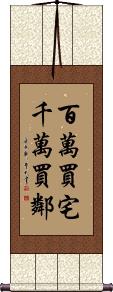
百万买宅千万买邻 is a Chinese proverb that literally translates as:
[It may cost a] million to buy a house, [but] ten million to find [good] neighbors.
Figuratively, this means:
Good neighbors are hard to find.
Good neighbors are even more important than the quality of one's house.
This in-stock artwork might be what you are looking for, and ships right away...

Gallery Price: $400.00
Your Price: $158.88
Gallery Price: $240.00
Your Price: $148.88
Gallery Price: $200.00
Your Price: $88.88
These search terms might be related to Might:
Air Force
Always Striving for Inner Strength
Conquering Yourself is a Sign of Strength
Control of Power
Courage and Strength
Determination to Achieve / Will-Power
Flexibility Overcomes Strength
Fortitude / Strength of Character
Girl Power / Woman Power
God Give Me Strength
Great Power
Herculean Strength
Inner Strength
Inner Strength / Inner Well-Being and Health
Inner Strength / Self-Improvement
Inner Strength is Better Than Outward Appearance
Juggernaut / Absolute Power
Life Force
Love Faith Strength
Perseverance / Will-Power
Physical Strength
Power / Strength
Power of Oneself / Self-Sufficient
Power of Understanding and Wisdom
Psychic Power
Self-Discipline / Will-Power
Spiritual Strength / Strength of Spirit
Strength / Ability
Strength / Vigor / Energy
Strength and Courage
Strength and Honor
Strength and Love
Strength and Love in Unity
Strength Love Honor
Strength: Strong and Solid
Strong / Powerful / Force
The Force
The Spirit of the Dragon Horse and Power of a Tiger
Will-Power / Self-Control
With All the Strength of Your Heart
Not the results for might that you were looking for?
Below are some entries from our dictionary that may match your might search...
| Characters If shown, 2nd row is Simp. Chinese |
Pronunciation Romanization |
Simple Dictionary Definition |
禪 禅 see styles |
shàn shan4 shan yuzuri ゆずり |
More info & calligraphy: Zen / Chan / Meditation(out-dated kanji) (1) (Buddhist term) dhyana (profound meditation); (2) (abbreviation) Zen (Buddhism); (surname) Yuzuri To level a place for an altar, to sacrifice to the hills and fountains; to abdicate. Adopted by Buddhists for dhyāna, 禪 or 禪那, i.e. meditation, abstraction, trance. dhyāna is 'meditation, thought, reflection, especially profound and abstract religious contemplation'. M.W. It was intp. as 'getting rid of evil', etc., later as 靜慮 quiet meditation. It is a form of 定, but that word is more closely allied with samādhi, cf. 禪定. The term also connotes Buddhism and Buddhist things in general, but has special application to the 禪宗 q.v. It is one of the six pāramitās, cf. 波. There are numerous methods and subjects of meditation. The eighteen brahmalokas are divided into four dhyāna regions 'corresponding to certain frames of mind where individuals might be reborn in strict accordance with their spiritual state'. The first three are the first dhyāna, the second three the second dhyāna, the third three the third dhyāna, and the remaining nine the fourth dhyāna. See Eitel. According to Childers' Pali Dictionary, 'The four jhānas are four stages of mystic meditation, whereby the believer's mind is purged from all earthly emotions, and detached as it were from his body, which remains plunged in a profound trance.' Seated cross-legged, the practiser 'concentrates his mind upon a single thought. Gradually his soul becomes filled with a supernatural ecstasy and serenity', his mind still reasoning: this is the first jhāna. Concentrating his mind on the same subject, he frees it from reasoning, the ecstasy and serenity remaining, which is the second jhāna. Then he divests himself of ecstasy, reaching the third stage of serenity. Lastly, in the fourth stage the mind becomes indifferent to all emotions, being exalted above them and purified. There are differences in the Mahāyāna methods, but similarity of aim. |
能 see styles |
néng neng2 neng nozaki のざき |
More info & calligraphy: Neng(1) talent; gift; function; (2) noh (theatre); (surname) Nozaki śak. Able to, can; capability, power. |
かも see styles |
kamo かも |
(particle) (abbreviation) (See かもしれない) may; might; perhaps; may be; possibly |
一所懸命 see styles |
isshokenmei / isshokenme いっしょけんめい |
More info & calligraphy: Life Of A Samurai |
倒 see styles |
dào dao4 tao dō さかしま |
to invert; to place upside down or frontside back; to pour out; to tip out; to dump; inverted; upside down; reversed; to go backward; contrary to what one might expect; but; yet (noun or adjectival noun) (1) reverse; inversion; upside down; (2) unreasonable; absurd; wrong; (n-pref,n) inverse; reverse To fall, lie down; to pour; upside down, inverted, perverted; on the contrary. |
威 see styles |
wēi wei1 wei tsuyoshi つよし |
power; might; prestige power; authority; might; influence; dignity; majesty; (personal name) Tsuyoshi prabhāva. Awe-inspiring majesty; also 威力 and 威神力. |
或 see styles |
huò huo4 huo ami あみ |
maybe; perhaps; might; possibly; or (pre-noun adjective) (kana only) a certain ...; some ...; (personal name) Ami somebody |
PU see styles |
p u p u p u |
the degree of suspicion that a woman might, after she marries, cheat on her husband (abbr. for "paternity uncertainty") |
にも see styles |
nimo ニモ |
(expression) (1) also; too; not ... either; as well; even; (expression) (2) (after the volitional or dictionary form of verb) (it's not possible) no matter what; although one might wish otherwise; (female given name) Nimo |
まあ see styles |
maa / ma まあ |
(adverb) (1) just (e.g. "just wait here"); come now; now, now; (2) tolerably; passably; moderately; reasonably; fairly; rather; somewhat; (3) well...; I think...; it would seem...; you might say...; Hmmm, I guess so...; (interjection) (4) (feminine speech) oh!; oh dear!; oh, my!; wow!; goodness gracious!; good heavens! |
よう see styles |
you / yo ヨウ |
(auxiliary verb) (1) (on non-五段 stem, e.g. 食べる→食べよう; indicates intention) (I) will; (I) shall; (auxiliary verb) (2) (on non-五段 stem; indicates suggestion or invitation) let's; (auxiliary verb) (3) (on non-五段 stem; indicates speculation) (I) wonder (if); might it be (that); maybe; perhaps; perchance; (personal name) Yaw |
丈に see styles |
dakeni だけに |
(exp,conj) (1) (kana only) given that ... it is only natural that ...; ... being the case, it is unavoidable that ...; (precisely) because ...; as might be expected (from ...); (exp,conj) (2) (kana only) (when used with negatives) contrary to expectations ... |
不妨 see styles |
bù fáng bu4 fang2 pu fang fubō |
there is no harm in; might as well unobstructed |
並未 并未 see styles |
bìng wèi bing4 wei4 ping wei |
(used to stress that something did not turn out as one might have expected) did not actually ...; has not actually ... |
乾脆 干脆 see styles |
gān cuì gan1 cui4 kan ts`ui kan tsui |
candid; direct and to the point; simply; just; might as well |
倒是 see styles |
dào shi dao4 shi5 tao shih |
contrary to what one might expect; actually; contrariwise; why don't you |
偉力 伟力 see styles |
wěi lì wei3 li4 wei li iryoku いりょく |
mighty force power; might; authority; influence |
力尽 see styles |
chikarazuku ちからづく |
(irregular okurigana usage) (noun - becomes adjective with の) (brute) force; using all one's might |
力戰 力战 see styles |
lì zhàn li4 zhan4 li chan |
to fight with all one's might |
勢い see styles |
ikioi いきおい |
(adv,n) (1) force; vigor; vigour; energy; spirit; life; (2) influence; authority; power; might; (3) impetus; momentum; course (of events); (adverbial noun) (4) naturally; necessarily; (surname) Ikioi |
勢力 势力 see styles |
shì li shi4 li5 shih li seiriki / seriki せいりき |
power; influence; a force (military, political etc) (1) influence; power; might; strength; potency; force; energy; (2) {go} (See 外勢) influence (of stones); (place-name, surname) Seiriki momentum |
可能 see styles |
kě néng ke3 neng2 k`o neng ko neng kanou / kano かのう |
might (happen); possible; probable; possibility; probability; maybe; perhaps; CL:個|个[ge4] (noun or adjectival noun) possible; potential; practicable; feasible; (surname) Kanou able |
和尚 see styles |
hé shang he2 shang5 ho shang wajou / wajo わじょう |
Buddhist monk (1) (honorific or respectful language) preceptor or high priest (in Shingon, Hosso, Ritsu or Shin Buddhism); (2) second highest priestly rank in Buddhism; (3) master (of one's art, trade, etc.); (1) (honorific or respectful language) preceptor or high priest (in Tendai or Kegon Buddhism); (2) second highest priestly rank in Buddhism; (3) monk (esp. the head monk of a temple); (4) master (of one's art, trade, etc.); (1) (honorific or respectful language) preceptor or high priest (esp. in Zen or Pure Land Buddhism); (2) second highest priestly rank in Buddhism; (3) monk (esp. the head monk of a temple); (4) master (of one's art, trade, etc.); (personal name) Wajō A general term for a monk. It is said to be derived from Khotan in the form of 和闍 or 和社 (or 烏社) which might be a translit. of vandya (Tibetan and Khotani ban-de), 'reverend.' Later it took the form of 和尚 or 和上. The 律宗 use 和上, others generally 和尚. The Sanskrit term used in its interpretation is 鳥波陀耶 upādhyāya, a 'sub-teacher' of the Vedas, inferior to an ācārya; this is intp. as 力生 strong in producing (knowledge), or in begetting strength in his disciples; also by 知有罪知無罪 a discerner of sin from not-sin, or the sinful from the not-sinful. It has been used as a synonym for 法師 a teacher of doctrine, in distinction from 律師 a teacher of the vinaya, also from 禪師 a teacher of the Intuitive school. |
威力 see styles |
wēi lì wei1 li4 wei li takeo たけお |
might; formidable power power; might; authority; influence; (given name) Takeo power |
威勢 威势 see styles |
wēi shì wei1 shi4 wei shih isei / ise いせい |
might; power and influence (1) power; might; authority; influence; (2) spirits; vigor; vigour; energy; boldness power |
威武 see styles |
wēi wǔ wei1 wu3 wei wu takemu たけむ |
might; formidable authority and force; (personal name) Takemu |
強權 强权 see styles |
qiáng quán qiang2 quan2 ch`iang ch`üan chiang chüan |
power; might |
強盛 强盛 see styles |
qiáng shèng qiang2 sheng4 ch`iang sheng chiang sheng kyousei; goujou / kyose; gojo きょうせい; ごうじょう |
rich and powerful (noun or adjectival noun) (archaism) might; mighty powerful |
拼命 see styles |
pīn mìng pin1 ming4 p`in ming pin ming |
to do one's utmost; with all one's might; at all costs; (to work or fight) as if one's life depends on it |
本覺 本觉 see styles |
běn jué ben3 jue2 pen chüeh hongaku |
Original bodhi, i. e. 'enlightenment', awareness, knowledge, or wisdom, as contrasted with 始覺 initial knowledge, that is 'enlightenment a priori is contrasted with enlightenment a posteriori'. Suzuki, Awakening of Faith, P. 62. The reference is to universal mind 衆生之心體, which is conceived as pure and intelligent, with 始覺 as active intelligence. It is considered as the Buddha-dharmakāya, or as it might perhaps be termed, the fundamental mind. Nevertheless in action from the first it was influenced by its antithesis 無明 ignorance, the opposite of awareness, or true knowledge. See 起信論 and 仁王經,中. There are two kinds of 本覺, one which is unconditioned, and never sullied by ignorance and delusion, the other which is conditioned and subject to ignorance. In original enlightenment is implied potential enlightenment in each being. |
Click here for more might results from our dictionary
The following table may be helpful for those studying Chinese or Japanese...
| Title | Characters | Romaji (Romanized Japanese) | Various forms of Romanized Chinese | |
| A House Might be Worth 1 Million Dollars, But Good Neighbors are Worth 10 Million | 百萬買宅千萬買鄰 百万买宅千万买邻 | bǎi wàn mǎi zhái qiān wàn mǎi lín bai3 wan4 mai3 zhai2 qian1 wan4 mai3 lin2 bai wan mai zhai qian wan mai lin | pai wan mai chai ch`ien wan mai lin pai wan mai chai chien wan mai lin |
|
| In some entries above you will see that characters have different versions above and below a line. In these cases, the characters above the line are Traditional Chinese, while the ones below are Simplified Chinese. | ||||

Successful Chinese Character and Japanese Kanji calligraphy searches within the last few hours...



