Many custom options...


And formats...



Fight to the End in Chinese / Japanese...
Buy a Fight to the End calligraphy wall scroll here!
Personalize your custom “Fight to the End” project by clicking the button next to your favorite “Fight to the End” title below...
See also: Bushido - Code of the Samurai Warrior
1. Fight to the End / Fight Until the Bitter End
2. Undaunted After Repeated Setbacks
3. Diligence
4. Perseverance
6. Indomitable / Persistence / Fortitude
7. No Fear
11. Never Give Up
Fight to the End / Fight Until the Bitter End
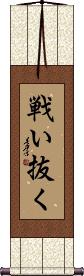
戦い抜く means “To fight to the bitter end” in Japanese.
Note: Because this selection contains some special Japanese Hiragana characters, it should be written by a Japanese calligrapher.
Undaunted After Repeated Setbacks
Persistence to overcome all challenges
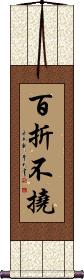
百折不撓 is a Chinese proverb that means “Be undaunted in the face of repeated setbacks.”
More directly translated, it reads, “[Overcome] a hundred setbacks, without flinching.” 百折不撓 is of Chinese origin but is commonly used in Japanese and somewhat in Korean (same characters, different pronunciation).
This proverb comes from a long, and occasionally tragic story of a man that lived sometime around 25-220 AD. His name was Qiao Xuan, and he never stooped to flattery but remained an upright person at all times. He fought to expose the corruption of higher-level government officials at great risk to himself.
Then when he was at a higher level in the Imperial Court, bandits were regularly capturing hostages and demanding ransoms. But when his own son was captured, he was so focused on his duty to the Emperor and the common good that he sent a platoon of soldiers to raid the bandits' hideout, and stop them once and for all even at the risk of his own son's life. While all of the bandits were arrested in the raid, they killed Qiao Xuan's son at first sight of the raiding soldiers.
Near the end of his career, a new Emperor came to power, and Qiao Xuan reported to him that one of his ministers was bullying the people and extorting money from them. The new Emperor refused to listen to Qiao Xuan and even promoted the corrupt Minister. Qiao Xuan was so disgusted that in protest, he resigned from his post as minister (something almost never done) and left for his home village.
His tombstone reads “Bai Zhe Bu Nao” which is now a proverb used in Chinese culture to describe a person of strong will who puts up stubborn resistance against great odds.
My Chinese-English dictionary defines these 4 characters as “keep on fighting despite all setbacks,” “be undaunted by repeated setbacks,” and “be indomitable.”
Our translator says it can mean “never give up” in modern Chinese.
Although the first two characters are translated correctly as “repeated setbacks,” the literal meaning is “100 setbacks” or “a rope that breaks 100 times.” The last two characters can mean “do not yield” or “do not give up.”
Most Chinese, Japanese, and Korean people will not take this absolutely literal meaning but will instead understand it as the title suggests above. If you want a single big word definition, it would be indefatigability, indomitableness, persistence, or unyielding.
See Also: Tenacity | Fortitude | Strength | Perseverance | Persistence
Diligence
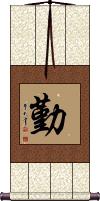
勤 is a single character that means diligence or “sense of duty” in Chinese and Korean (also understood in Japanese but not commonly seen as a stand-alone Kanji).
As a single character on a wall scroll, this will only be seen with this meaning. However, it can also mean industrious, hardworking, frequent, regular, constant, energy, zeal, fortitude, or virility.
In Buddhism, this can represent vīrya (viriya), the idea of energy, diligence, enthusiasm, or effort. It can be defined as an attitude of gladly engaging in wholesome activities, and it functions to cause one to accomplish wholesome or virtuous actions. Some Buddhists may even define this as “manliness” (a definition from a hundred years ago, before equality).
If you or someone you know is a hard worker (or needs a reminder to be diligent), then this is the wall scroll to have in your/their office.
Perseverance
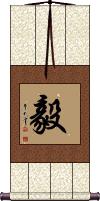
毅 is the simplest way to express perseverance in Chinese and Korean Hanja.
This single-character version leaves a bit of mystery about what kind of perseverance you might want to convey.
In Korean, this is usually associated with “strength of character.”
In Japanese, this character can be pronounced in a dozen different ways (so we have left out the Japanese pronunciation guide that normally appears above). In Japanese, this Kanji would usually be translated as “strong” (perhaps strong-willed).
Perseverance / Fortitude
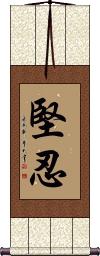
堅忍 means persistent, steadfast, fortitude, and/or perseverance.
The first character means strong, solid, firm, unyielding, or resolute.
The second character means to beat, endure, or tolerate.
Together they speak of the strength from within yourself. Some may also translate this as long-suffering in a more Biblical sense.
堅忍 is a common term in Chinese and Korean Hanja but a little less commonly used in modern Japanese Kanji. For that reason, this selection is best if your audience is Chinese or Korean.

 Note that when writing this as Kanji, Japanese will tend to write the second Kanji a little differently. If you select our Japanese master calligrapher, please expect the form where the little horizontal stroke crosses the vertical stroke. See differences in the images to the right. Technically, they are both the same character, and will be read the same in either language.
Indomitable / Persistence / Fortitude
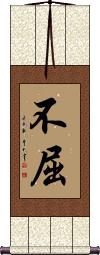
不屈 is the short form of a longer Chinese word and also a word used in Korean and Japanese to express the idea of being indomitable. It literally means “will not bend,” “will not crouch,” “will not yield,” “will not flinch,” or “will not submit.”
Note: Some will translate this as “indomitable spirit”; however, technically, there is no character to suggest the idea of “spirit” in this word.
No Fear
(2 characters)
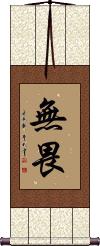
無畏 literally means “No Fear.” But perhaps not the most natural Chinese phrase (see our other “No Fear” phrase for a complete thought). However, this two-character version of “No Fear” seems to be a very popular way to translate this into Chinese when we checked Chinese Google.
Note: This also means “No Fear” in Japanese and Korean, but this character pair is not often used in Japan or Korea.
This term appears in various Chinese dictionaries with definitions like “without fear,” intrepidity, fearless, dauntless, and bold.
In the Buddhist context, this is a word derived from the word Abhaya, meaning: Fearless, dauntless, secure, nothing, and nobody to fear. Also, from vīra meaning: courageous, bold.
See Also: Never Give Up | No Worries | Undaunted | Bravery | Courage | Fear No Man
Tenacious / Tenacity
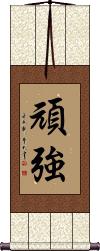
頑強 means “Tenacious,” “Hard to Defeat,” or “Dogged.”
Alone, the first character means mischievous, obstinate, or stubborn. But it loses some of the mischievous meaning when the second character is added.
The second character means strength, force, power, or better.
See Also: Determination | Dedication | Devotion | Never Give Up
Fear No Man / Fear Nothing
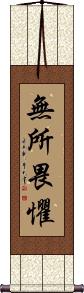
無所畏懼 means “fear nothing,” but it's the closest thing in Chinese to the phrase “fear no man” which many of you have requested.
This would also be the way to say “fear nobody” and can be translated simply as “undaunted.”
Indomitable / Unyielding
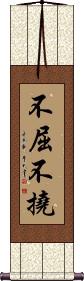
不屈不撓 means “Indomitable” or “Unyielding.”
不屈不撓 is a long word by Chinese standards. At least, it is often translated as a single word into English. It's actually a proverb in Chinese.
If you want to break it down, you can see that the first and third characters are the same. Both mean “not” (they work as a suffix to make a negative or opposite meaning to whatever character follows).
The second character means “bendable.”
The last means “scratched” or “bothered.”
So this really means “Won't be bent, can't be bothered.” I have also seen it written as “Will not crouch, will not submit.” This comes from the fact that the second character can mean “to crouch” and the last can mean “to submit” (as in “to give in” such as “submitting to the rule of someone else”). This may explain better why these four characters mean “indomitable.”
Notes:
Some will translate this as “indomitable spirit”; however, technically, there is no character to suggest the idea of “spirit” in this word.
Other translations include indefatigability, indomitableness, or unremitting tenacity.
The first two characters can be stand-alone words in Chinese.
In Japanese, this is considered two words (with very similar meanings). It's more common to see the word order flipped to 不撓不屈 in Japanese.
The same characters are used in old Korean Hanja. Just like in Japanese, the words are swapped to 不撓不屈 creating a word pronounced “불요불굴” in Korean.
See 不撓不屈
Never Give Up
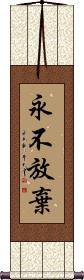
The first character means “eternal” or “forever,” and the second means “not” (together, they mean “never”). The last two characters mean “give up” or “abandon.” Altogether, you can translate this proverb as “never give up” or “never abandon.”
Depending on how you want to read this, 永不放棄 is also a statement that you will never abandon your hopes, dreams, family, or friends.
Indomitable Spirit
Korean Only
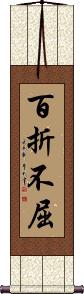
百折不屈 is a Korean proverb that means “indomitable spirit,” at least, that is the way it is commonly translated in martial arts circles (Taekwondo, Hapkido, etc.).
The literal translation is “[one] hundred [times] broken [still] don't succumb.”
Or more naturally translated, “Even if attacked/beaten one hundred times, still be undaunted/indomitable.”
Notes:
Some will say this is one long word rather than a proverb.
This is also a proverb/word in Chinese though rarely used in modern times.
Carry On, Undaunted
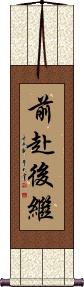
前赴後繼 is a Chinese proverb that figuratively means “to advance dauntlessly in wave upon wave.”
It suggests that you should or can carry on and have the strength to keep going.
While this proverb is a little bit militaristic, it suggests that despite a fallen comrade (or perhaps a loved one), you should keep going and work towards the goal they intended.
There is always a way out
Never say die
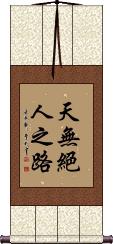
天無絕人之路 is a proverb that means “Heaven never bars one's way,” “Don't despair and you will find a way through,” and “Never give up hope,” and is the Chinese way to say “Never say die.”
Always Try to do Better
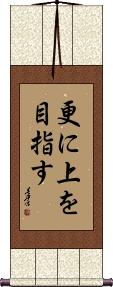
This Japanese proverb literally translates as: [After having achieved a fair degree of success,] one should still try to do better.
Others may translate this as “Always try to improve,” or “Always try to be better.”
Note: Because this selection contains some special Japanese Hiragana characters, it should be written by a Japanese calligrapher.
See Also: Never Give Up
Never Give In / Never Succumb / Never Lose
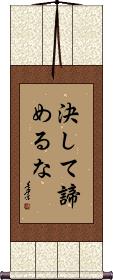
決して諦めるな is a Japanese term that informally means “never give up.”
It's also a Japanese way to say “never surrender.”
Note: Because this selection contains some special Japanese Hiragana characters, it should be written by a Japanese calligrapher.
See Also: Tenacity | Perseverance | Hope
Taekwondo Tenets / Spirit of Taekwon-do
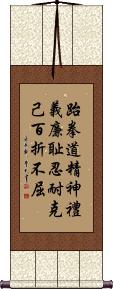
跆拳道精神禮義廉耻忍耐克己百折不屈 is General Choi's writing that is often called “The Tenets of Taekwon-do.”
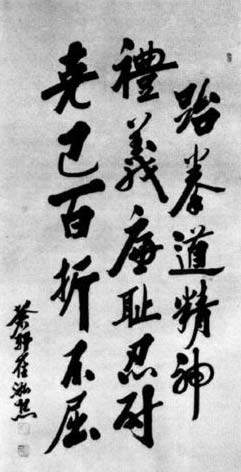
The actual title would be translated as “Taekwondo Spirit” or “The Spirit of Taekwondo.” It was originally written in Korean Hanja (Chinese characters used in Korea for about 1600 years).
General Choi's original calligraphy is shown to the right. Your custom calligraphy will be unique, and not an exact match, as each calligrapher has their own style.In modern times, the common form of written Korean is Hangul (a phonetic character set). The table below shows the text in Hangul and Hanja along with a pronunciation guide and a brief English translation:
| Traditional Korean Hanja | Modern Korean Hangul | Pronunciation | English |
| 跆拳道精神 | 태권도정신 | tae gweon do jeong sin | Taekwondo Spirit |
| 禮儀 | 예의 | ye yi | Courtesy / Etiquette / Propriety / Decorum / Formality |
| 廉耻 | 염치 | yeom ci | Integrity / Sense of Honor |
| 忍耐 | 인내 | in nae | Patience / Perseverance / Endurance |
| 克己 | 극기 | geug gi | Self-Control / Self-Denial / Self-Abnegation |
| 百折不屈 | 백절불굴 | baeg jeor bur gur | Indomitable Spirit (Undaunted even after repeated attacks from the opponent) |
| Note that the pronunciation is the official version now used in South Korea. However, it is different than what you may be used to. For instance, “Taekwon-do” is “tae gweon do.” This new romanization is supposed to be closer to actual Korean pronunciation. | |||
This in-stock artwork might be what you are looking for, and ships right away...

Gallery Price: $61.00
Your Price: $33.88
Gallery Price: $52.00
Your Price: $28.88
The following table may be helpful for those studying Chinese or Japanese...
| Title | Characters | Romaji (Romanized Japanese) | Various forms of Romanized Chinese | |
| Fight to the End Fight Until the Bitter End | 戦い抜く | tataka-i nu-ku tataka-inu-ku | ||
| Undaunted After Repeated Setbacks | 百折不撓 百折不挠 | hyaku setsu su tou hyakusetsusutou hyaku setsu su to | bǎi zhé bù náo bai3 zhe2 bu4 nao2 bai zhe bu nao baizhebunao | pai che pu nao paichepunao |
| Diligence | 勤 | kin | qín / qin2 / qin | ch`in / chin |
| Perseverance | 毅 | see note / seenote / se note | yì / yi4 / yi | i |
| Perseverance Fortitude | 堅忍 坚忍 | ken nin / kennin | jiǎn rěn / jian3 ren3 / jian ren / jianren | chien jen / chienjen |
| Indomitable Persistence Fortitude | 不屈 | fukutsu | bù qū / bu4 qu1 / bu qu / buqu | pu ch`ü / puchü / pu chü |
| No Fear | 無畏 无畏 | mui | wú wèi / wu2 wei4 / wu wei / wuwei | |
| Tenacious Tenacity | 頑強 顽强 | gan kyou / gankyou / gan kyo | wán qiáng wan2 qiang2 wan qiang wanqiang | wan ch`iang wanchiang wan chiang |
| Fear No Man Fear Nothing | 無所畏懼 无所畏惧 | wú suǒ wèi jù wu2 suo3 wei4 ju4 wu suo wei ju wusuoweiju | wu so wei chü wusoweichü |
|
| Indomitable Unyielding | 不屈不撓 不屈不挠 | fu kutsu fu tou fukutsufutou fu kutsu fu to | bù qū bù náo bu4 qu1 bu4 nao2 bu qu bu nao buqubunao | pu ch`ü pu nao puchüpunao pu chü pu nao |
| Never Give Up | 永不放棄 永不放弃 | yǒng bù fàng qì yong3 bu4 fang4 qi4 yong bu fang qi yongbufangqi | yung pu fang ch`i yungpufangchi yung pu fang chi |
|
| Indomitable Spirit | 百折不屈 | bǎi shé bù qū bai3 she2 bu4 qu1 bai she bu qu baishebuqu | pai she pu ch`ü paishepuchü pai she pu chü |
|
| Carry On, Undaunted | 前赴後繼 前赴后继 | qián fù hòu jì qian2 fu4 hou4 ji4 qian fu hou ji qianfuhouji | ch`ien fu hou chi chienfuhouchi chien fu hou chi |
|
| There is always a way out | 天無絕人之路 天无绝人之路 | tiān wú jué rén zhī lù tian1 wu2 jue2 ren2 zhi1 lu4 tian wu jue ren zhi lu tianwujuerenzhilu | t`ien wu chüeh jen chih lu tienwuchüehjenchihlu tien wu chüeh jen chih lu |
|
| Always Try to do Better | 更に上を目指す | sara ni ue o me za su saraniueomezasu | ||
| Never Give In Never Succumb Never Lose | 決して諦めるな | kesshite akirameruna kesshiteakirameruna keshite akirameruna | ||
| Taekwondo Tenets Spirit of Taekwon-do | 跆拳道精神禮義廉耻忍耐克己百折不屈 跆拳道精神礼义廉耻忍耐克己百折不屈 | tái quán dào jīng shén lǐ yì lián chǐ rěn nài kè jǐ bǎi zhé bù qū tai2 quan2 dao4 jing1 shen2 li3 yi4 lian2 chi3 ren3 nai4 ke4 ji3 bai3 zhe2 bu4 qu1 tai quan dao jing shen li yi lian chi ren nai ke ji bai zhe bu qu | t`ai ch`üan tao ching shen li i lien ch`ih jen nai k`o chi pai che pu ch`ü tai chüan tao ching shen li i lien chih jen nai ko chi pai che pu chü |
|
| In some entries above you will see that characters have different versions above and below a line. In these cases, the characters above the line are Traditional Chinese, while the ones below are Simplified Chinese. | ||||

Successful Chinese Character and Japanese Kanji calligraphy searches within the last few hours...



