Many custom options...


And formats...



Fall Down in Chinese / Japanese...
Buy a Fall Down calligraphy wall scroll here!
Personalize your custom “Fall Down” project by clicking the button next to your favorite “Fall Down” title below...
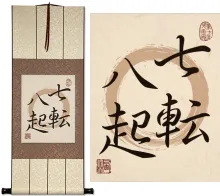
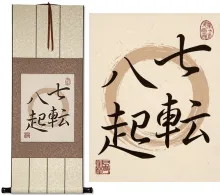
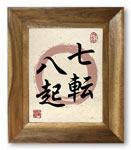
Fall Down Seven Times, Get Up Eight
Always rising after a fall or repeated failures
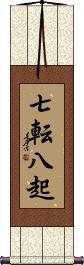
七転八起 is a Japanese proverb that relays the vicissitudes of life, with the meaning “seven times down eight times up.”
Some would more naturally translate it into English as “Always rising after a fall or repeated failures” or compare it to the English, “If at first, you don't succeed, try, try again.”
The first Kanji is literally “7.” The second means “fall down” (sometimes this Kanji means “turn around,” “revolve” or “turn over” but in this case, it holds the meaning of “fall”). The third is “8.” And the last is “get up,” “rouse,” or “rise.”
Basically, if you fail 7 times, you should recover from those events and be prepared to rise an 8th time. This also applies if it is the world or circumstances that knock you down seven times...
...just remember that you have the ability to bounce back from any kind of adversity.
Note: This can be pronounced in two ways. One is “shichi ten hakki” or “shichitenhakki.” The other is “nana korobi ya oki” also written, “nanakorobi-yaoki.”
Special Note: The second character is a Kanji that is not used in China. Therefore, please select a Japanese calligrapher for this title.
Rise and Fall / Ups and Downs
Eiko-Seisui
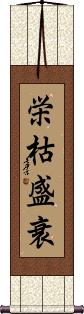
This Japanese proverb can be translated as “flourish and wither, prosper and perish,” “life is full of fortune and misfortune,” or simply “vicissitudes of life.”
栄枯盛衰 / 榮枯盛衰 is about the rise and fall of human affairs or the ups and downs of life. Prosperity comes and goes, everything is fleeting and temporary, but like waves, another swell of prosperity may come.
Here's how the Kanji break down in this proverb:
栄 = prosper; thrive; flourish; boom.
枯 = wither; die.
盛 = prosperous; flourishing; thriving; successful; energetic; vigorous; enthusiastic.
衰 = become weaker; decline; get weak; die down; subside; abate; fail.
 Notes: The original version of the first character looks like the image to the right. In modern Japan, they simplified that Kanji a bit into the version shown above. If you have a preference for which style is used for your calligraphy, please let me know when you place your order.
Apparently, with that original version of the first character, this is also used in Korean Hanja. However, I have not confirmed that
it’s
used in the same way or is widely-known in Korean.
You May Learn from Victory, You Will Learn from Failure
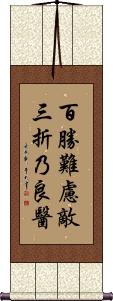
百胜难虑敌三折乃良医 is a Chinese proverb that literally translates as: [Even a general who has won a] hundred victories [may be] hard put to see through the enemy's [strategy], [but one who has] broken [his] arm three [times] [will] be a good doctor.
Figuratively, this means: One cannot always depend on past successes to guarantee future success but one can always learn from lessons drawn from failure.
See Also: Failure - Mother of Success | Experience - Mother of Success | Hard Knocks
This in-stock artwork might be what you are looking for, and ships right away...
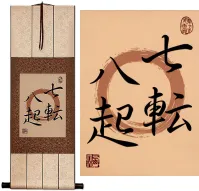
Gallery Price: $100.00
Your Price: $49.88
Gallery Price: $100.00
Your Price: $58.88
Gallery Price: $100.00
Your Price: $58.88

Gallery Price: $162.00
Your Price: $89.88

Gallery Price: $162.00
Your Price: $89.88
Gallery Price: $100.00
Your Price: $39.88
Gallery Price: $100.00
Your Price: $39.88

Gallery Price: $100.00
Your Price: $49.88

Gallery Price: $222.00
Your Price: $122.88

Gallery Price: $220.00
Your Price: $138.88

Not the results for fall down that you were looking for?
Below are some entries from our dictionary that may match your fall down search...
| Characters If shown, 2nd row is Simp. Chinese |
Pronunciation Romanization |
Simple Dictionary Definition |
タウン see styles |
daun ダウン |
More info & calligraphy: Towne |
伏 see styles |
fú fu2 fu fuse ふせ |
to lean over; to fall (go down); to hide (in ambush); to conceal oneself; to lie low; hottest days of summer; to submit; to concede defeat; to overcome; to subdue; volt (surname) Fuse Prostrate; humble; suffer, bear; ambush; dog-days; hatch; it is used for control, under control, e. g. as delusion; 斷 is contrasted with it as complete extirpation, so that no delusive thought arises. |
倒 see styles |
dào dao4 tao dō さかしま |
to invert; to place upside down or frontside back; to pour out; to tip out; to dump; inverted; upside down; reversed; to go backward; contrary to what one might expect; but; yet (noun or adjectival noun) (1) reverse; inversion; upside down; (2) unreasonable; absurd; wrong; (n-pref,n) inverse; reverse To fall, lie down; to pour; upside down, inverted, perverted; on the contrary. |
偃 see styles |
yǎn yan3 yen |
to lie supine; to stop; to fall down |
墜 坠 see styles |
zhuì zhui4 chui tsui |
to fall; to drop; to weigh down To fall, sink, settle, slide. |
摔 see styles |
shuāi shuai1 shuai |
to throw down; to fall; to drop and break |
栽 see styles |
zāi zai1 tsai sai さい |
to plant; to grow; to insert; to erect (e.g. a bus stop sign); to impose something on sb; to stumble; to fall down (surname) Sai |
落 see styles |
luò luo4 lo raku らく |
to fall or drop; (of the sun) to set; (of a tide) to go out; to lower; to decline or sink; to lag or fall behind; to fall onto; to rest with; to get or receive; to write down; whereabouts; settlement (irregular okurigana usage) (1) slip; omission; (2) outcome; final result; the end; (3) (kana only) punch line (of a joke); (surname) Raku Falling leaves: to fall, drop, descend, settle; translit. la, na. |
踣 see styles |
bó bo2 po |
(literary) to tumble; to fall down; (literary) to fall dead |
下げ see styles |
sage さげ |
(1) lowering; sinking; bringing down; letting down; (2) depreciation; price fall; (3) punch line (of a rakugo story); (4) (abbreviation) (archaism) sword strap |
下る see styles |
sagaru さがる |
(irregular okurigana usage) (v5r,vi) (1) to come down; to go down; to fall; to drop; to sink; to get lower; (2) to hang; to dangle; (3) to move back; to step back; to withdraw; to retire; (4) to deteriorate; to fall off; to be downgraded; (5) to get closer to the present day; (6) to go south; (v5r,vi) (1) to descend; to go down; to come down; (2) to be handed down (of an order, judgment, etc.); (3) to pass (of time); (4) to surrender; to capitulate; (5) (often in neg. form) to be less than; to be inferior to; (6) to have the runs; to have diarrhea; (place-name) Sagaru |
下臺 下台 see styles |
xià tái xia4 tai2 hsia t`ai hsia tai |
to go off the stage; to fall from position of prestige; to step down (from office etc); to disentangle oneself; to get off the hook See: 下台 |
下降 see styles |
xià jiàng xia4 jiang4 hsia chiang kakou / kako かこう |
to decline; to drop; to fall; to go down; to decrease (n,vs,vi) descent; fall; drop; decline; downturn; subsidence |
中招 see styles |
zhòng zhāo zhong4 zhao1 chung chao |
(martial arts) to get hit; to get taken down; (fig.) to get infected (disease or computer virus); (fig.) to fall for sb's trap; to be taken in |
伏す see styles |
fusu ふす |
(v5s,vi) (1) (See 伏せる・3) to lie face down; to lie flat (on one's stomach); to fall prostrate; (v5s,vi) (2) (See 伏して) to bend down (in submission); to bow down; to prostrate oneself; (v5s,vi) (3) to (crouch) and hide (behind); to conceal oneself; (v5s,vi) (4) (usu. as 臥す) (See 臥せる) to lie down (and sleep); to go to bed (with an illness); (transitive verb) (5) (See 伏せる・1) to lay (something) face down; to place upside down; to turn over (face down); (transitive verb) (6) (See 伏せる・4) to conceal; to hide; to keep secret |
低昂 see styles |
dī áng di1 ang2 ti ang |
ups and down; rise and fall |
僵仆 see styles |
jiāng fù jiang1 fu4 chiang fu kyōfu |
to fall down |
垂げ see styles |
sage さげ |
(out-dated kanji) (1) lowering; sinking; bringing down; letting down; (2) depreciation; price fall; (3) punch line (of a rakugo story); (4) (abbreviation) (archaism) sword strap |
堕つ see styles |
otsu おつ |
(v2t-k,vi) (1) (archaism) to fall down; to drop; to fall (e.g. rain); to sink (e.g. sun or moon); to fall onto (e.g. light or one's gaze); (2) (archaism) to be omitted; to be missing; (3) (archaism) to crash; to degenerate; to degrade; to fall behind; (4) (archaism) to be removed (e.g. illness, possessing spirit, name on a list); (5) (archaism) to fall (into someone's hands); to become someone's possession; (6) (archaism) to fall; to be defeated; to surrender |
墜つ see styles |
otsu おつ |
(v2t-k,vi) (1) (archaism) to fall down; to drop; to fall (e.g. rain); to sink (e.g. sun or moon); to fall onto (e.g. light or one's gaze); (2) (archaism) to be omitted; to be missing; (3) (archaism) to crash; to degenerate; to degrade; to fall behind; (4) (archaism) to be removed (e.g. illness, possessing spirit, name on a list); (5) (archaism) to fall (into someone's hands); to become someone's possession; (6) (archaism) to fall; to be defeated; to surrender |
崩倒 see styles |
bēng dǎo beng1 dao3 peng tao hōtō |
to collapse; to crash down; to fall down in a heap to collapse |
崩潰 崩溃 see styles |
bēng kuì beng1 kui4 peng k`uei peng kuei houkai / hokai ほうかい |
to collapse; to crumble; to fall apart (noun/participle) (1) collapse; crumbling; breaking down; caving in; (2) (physics) decay |
掉下 see styles |
diào xià diao4 xia4 tiao hsia |
to drop down; to fall |
掉落 see styles |
diào luò diao4 luo4 tiao lo |
to fall down |
提げ see styles |
sage さげ |
(out-dated kanji) (1) lowering; sinking; bringing down; letting down; (2) depreciation; price fall; (3) punch line (of a rakugo story); (4) (abbreviation) (archaism) sword strap |
摔倒 see styles |
shuāi dǎo shuai1 dao3 shuai tao |
to fall down; to slip and fall; to throw sb to the ground |
撲倒 扑倒 see styles |
pū dǎo pu1 dao3 p`u tao pu tao |
to fall down |
昇降 升降 see styles |
shēng jiàng sheng1 jiang4 sheng chiang shoukou / shoko しょうこう |
rising and falling (n,vs,vi) ascending and descending; going up and down rise and fall |
沉浮 see styles |
chén fú chen2 fu2 ch`en fu chen fu |
lit. sinking and floating; to bob up and down on water; ebb and flow; fig. rise and fall; ups and downs of fortune; vicissitudes |
滑落 see styles |
huá luò hua2 luo4 hua lo katsuraku かつらく |
to slip and fall; to slide down; to roll down; (fig.) (of sales, popularity etc) to decline; to fall (n,vs,vi) sliding down (a slope, mountainside); slipping down |
Click here for more fall down results from our dictionary
The following table may be helpful for those studying Chinese or Japanese...
| Title | Characters | Romaji (Romanized Japanese) | Various forms of Romanized Chinese | |
| Fall Down Seven Times, Get Up Eight | 七転八起 | shichi ten hakki / nana korobi ya oki shichi ten haki / nana korobi ya oki | ||
| Rise and Fall Ups and Downs | 栄枯盛衰 / 榮枯盛衰 荣枯盛衰 | ei ko sei sui eikoseisui | ||
| You May Learn from Victory, You Will Learn from Failure | 百勝難慮敵三折乃良醫 百胜难虑敌三折乃良医 | bǎi shèng nán lǜ dí sān zhé nǎi liáng yī bai3 sheng4 nan2 lv4 di2 san1 zhe2 nai3 liang2 yi1 bai sheng nan lv di san zhe nai liang yi | pai sheng nan lü ti san che nai liang i | |
| In some entries above you will see that characters have different versions above and below a line. In these cases, the characters above the line are Traditional Chinese, while the ones below are Simplified Chinese. | ||||

Successful Chinese Character and Japanese Kanji calligraphy searches within the last few hours...



