Many custom options...


And formats...



Fail in Chinese / Japanese...
Buy a Fail calligraphy wall scroll here!
Personalize your custom “Fail” project by clicking the button next to your favorite “Fail” title below...
1. Keep Calm in Face of Adversity
3. Courage To Do What Is Right
4. Let Us Try
Keep Calm in Face of Adversity
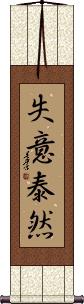
失意泰然 is a very old Japanese proverb that suggests “keeping calm and collected at times of disappointment,” or “maintaining a serene state of mind when faced with adversity.”
It's hard to relate individual character meanings to the overall meaning unless you also understand Japanese grammar. The word order is very different than English. That being said, here's the character meaning breakdown:
失 To miss, lose or fail.
意 Feelings, thoughts, meaning.
泰 Safe, peaceful.
然 Like that, in that way, however, although.
Using these definitions in English, we might say, “Although you may fail or lose, have a feeling of peace and calm.”
Failure in Not an Option
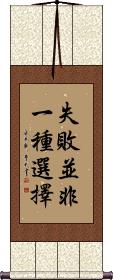
失敗並非一種選擇 is probably the best way to say, “Failure is not an option,” in Chinese.
Just don't forget that some ancient Chinese proverbs suggest that failure is a learning opportunity that leads to success or innovation. So don't plan to fail but failure is only a waste if nothing is learned from the failure.
Courage To Do What Is Right
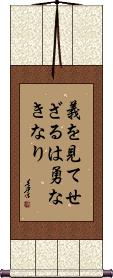
義を見てせざるは勇なきなり is a Japanese proverb that means “Knowing what is right and not doing is a want of courage.”
I've also seen it translated as:
To see what is right, yet fail to do so, is a lack of courage.
To know righteousness, but take no action is cowardice.
You are a coward if you knew what was the right thing to do, but you did not take action.
Knowing what is right without practicing it betrays one's cowardice.
Note: Because this selection contains some special Japanese Hiragana characters, it should be written by a Japanese calligrapher.
Let Us Try
Essayons
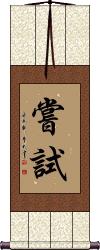
嘗試 is a close match for the English phrase “let us try” or the French word “Essayons.”
 Essayons the motto of Combat Engineers in the U.S. Army.
This word can also be translated as “to try” or “to attempt.”
Even if you're not a Combat Engineer, this word should inspire you to attempt to accomplish difficult things. If you don't try, you are certain to fail; if you do try, at least there is a chance of success.
The worst thing is not failure, the worst thing is not trying at all.
Rise and Fall / Ups and Downs
Eiko-Seisui
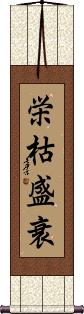
This Japanese proverb can be translated as “flourish and wither, prosper and perish,” “life is full of fortune and misfortune,” or simply “vicissitudes of life.”
栄枯盛衰 / 榮枯盛衰 is about the rise and fall of human affairs or the ups and downs of life. Prosperity comes and goes, everything is fleeting and temporary, but like waves, another swell of prosperity may come.
Here's how the Kanji break down in this proverb:
栄 = prosper; thrive; flourish; boom.
枯 = wither; die.
盛 = prosperous; flourishing; thriving; successful; energetic; vigorous; enthusiastic.
衰 = become weaker; decline; get weak; die down; subside; abate; fail.
 Notes: The original version of the first character looks like the image to the right. In modern Japan, they simplified that Kanji a bit into the version shown above. If you have a preference for which style is used for your calligraphy, please let me know when you place your order.
Apparently, with that original version of the first character, this is also used in Korean Hanja. However, I have not confirmed that
it’s
used in the same way or is widely-known in Korean.
Fall Down Seven Times, Get Up Eight
Always rising after a fall or repeated failures
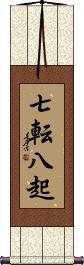
七転八起 is a Japanese proverb that relays the vicissitudes of life, with the meaning “seven times down eight times up.”
Some would more naturally translate it into English as “Always rising after a fall or repeated failures” or compare it to the English, “If at first, you don't succeed, try, try again.”
The first Kanji is literally “7.” The second means “fall down” (sometimes this Kanji means “turn around,” “revolve” or “turn over” but in this case, it holds the meaning of “fall”). The third is “8.” And the last is “get up,” “rouse,” or “rise.”
Basically, if you fail 7 times, you should recover from those events and be prepared to rise an 8th time. This also applies if it is the world or circumstances that knock you down seven times...
...just remember that you have the ability to bounce back from any kind of adversity.
Note: This can be pronounced in two ways. One is “shichi ten hakki” or “shichitenhakki.” The other is “nana korobi ya oki” also written, “nanakorobi-yaoki.”
Special Note: The second character is a Kanji that is not used in China. Therefore, please select a Japanese calligrapher for this title.
Not the results for fail that you were looking for?
Below are some entries from our dictionary that may match your fail search...
| Characters If shown, 2nd row is Simp. Chinese |
Pronunciation Romanization |
Simple Dictionary Definition |
空軍 空军 see styles |
kōng jun kong1 jun1 k`ung chün kung chün kuugun / kugun くうぐん |
More info & calligraphy: Air Forceair force |
失 see styles |
shī shi1 shih shitsu しつ |
to lose; to miss; to fail (1) loss (of something); disadvantage; (2) mistake; error; failure; (3) flaw; defect; (4) (abbreviation) {baseb} (See 失策・2) error To lose, opp. of 得; to err. |
挫 see styles |
cuò cuo4 ts`o tso |
obstructed; to fail; to oppress; to repress; to lower the tone; to bend back; to dampen |
掛 挂 see styles |
guà gua4 kua kake かけ |
to hang; to suspend (from a hook etc); to hang up (the phone); (of a line) to be dead; to be worried; to be concerned; (dialect) to make a phone call; to register (at a hospital); to make an appointment (with a doctor); (slang) to kill; to die; to be finished; to fail (an exam); classifier for sets or clusters of objects (suf,adj-no) (1) -clad; (2) (kana only) in the midst of; (3) tenths (e.g. wholesale price, as tenths of retail price); (4) times (i.e. multiplied by); (5) able-to-seat (of a chair, etc.); (suffix) charge; duty; person in charge; official; clerk; (1) (abbreviation) credit; (2) money owed on an account; bill; (3) (abbreviation) (kana only) hot noodles in broth; (n,n-suf) (4) proportion (of wholesale price, as tenths of list price); (suffix) (5) in the midst of; (6) rest; rack; hanger; (surname) Kake To hang, suspend. |
敗 败 see styles |
bài bai4 pai hai はい |
to defeat; to damage; to lose (to an opponent); to fail; to wither (1) loss; defeat; (suf,ctr) (2) (ant: 勝・しょう・3) counter for losses Subvert, defeat, ruin, spoil, destroy. |
當 当 see styles |
dàng dang4 tang atari あたり |
at or in the very same...; suitable; adequate; fitting; proper; to replace; to regard as; to think; to pawn; (coll.) to fail (a student) (surname) Atari Suitable, adequate, equal to; to bear, undertake; ought; proper; to regard as, as; to pawn, put in place of; at, in the future. |
砸 see styles |
zá za2 tsa |
to smash; to pound; to fail; to muck up; to bungle |
蹉 see styles |
cuō cuo1 ts`o tso sa |
to error; to slip; to miss; to err to fail |
不明 see styles |
bù míng bu4 ming2 pu ming fumi ふみ |
not clear; unknown; to fail to understand (noun or adjectival noun) (1) unclear; obscure; indistinct; uncertain; ambiguous; (adj-no,suf) (2) unknown; unidentified; (3) ignorance; lack of wisdom; lack of insight; (female given name) Fumi unclear |
不第 see styles |
bù dì bu4 di4 pu ti |
to fail the civil service examination (in imperial China) |
不遂 see styles |
bù suì bu4 sui4 pu sui fuzui |
to fail; to fail to materialize; not to get one's way not done |
何卒 see styles |
nanitozo なにとぞ nanisotsu なにそつ |
(adverb) (1) (humble language) please; kindly; I beg of you; if it pleases you; (2) by all means; without fail; (ik) (adverb) (1) (humble language) please; kindly; I beg of you; if it pleases you; (2) by all means; without fail |
冠る see styles |
kamuru かむる kaburu かぶる |
(transitive verb) (1) (kana only) to put on (one's head); to wear; to have on; to pull over (one's head); to crown (oneself); (2) (kana only) to be covered with (dust, snow, etc.); to pour (water, etc.) on oneself; to dash on oneself; to ship water; (3) (kana only) to bear (e.g. someone's debts, faults, etc.); to take (blame); to assume (responsibility); to shoulder (burden); (4) to overlap (e.g. sound or color); (5) to be similar; to be redundant; (v5r,vi) (6) to be fogged (due to overexposure, etc.); (7) to close; to come to an end; (8) to get a full house; to sell out; (9) (archaism) to blunder; to bungle; to fail; (10) (archaism) to be deceived |
失察 see styles |
shī chá shi1 cha2 shih ch`a shih cha |
to fail in observing or supervising; to miss; to let something slip through |
失效 see styles |
shī xiào shi1 xiao4 shih hsiao |
to fail; to lose effectiveness |
失敗 失败 see styles |
shī bài shi1 bai4 shih pai shippai しっぱい |
to be defeated; to lose; to fail (e.g. experiments); failure; defeat; CL:次[ci4] (n,vs,vt,vi) failure; mistake; blunder |
失瞻 see styles |
shī zhān shi1 zhan1 shih chan |
to fail to greet in timely manner |
弄混 see styles |
nòng hún nong4 hun2 nung hun |
to confuse (fail to differentiate) |
必ず see styles |
kanarazu かならず |
(adverb) always; without exception; necessarily; certainly; without fail; positively; invariably |
必達 see styles |
hittatsu ひったつ |
(noun, transitive verb) (abbreviation) (from 必ず達成する) certain fulfilment; reaching a goal without fail |
怠る see styles |
okotaru おこたる |
(transitive verb) (1) to neglect; to be negligent in; to be neglectful of; to fail to do; to leave undone; to avoid (doing); to shirk; to be unmindful of; (v5r,vi) (2) (dated) to improve (of an illness); to get better |
愆期 see styles |
qiān qī qian1 qi1 ch`ien ch`i chien chi |
(formal) to delay; to miss a deadline; to fail to do something at the appointed time |
打嘴 see styles |
dǎ zuǐ da3 zui3 ta tsui |
to slap sb's face; to slap one's own face; fig. to fail to live up to a boast |
掛科 挂科 see styles |
guà kē gua4 ke1 kua k`o kua ko |
to fail (a course) |
損う see styles |
sokonau そこなう |
(irregular okurigana usage) (Godan verb with "u" ending) (1) to harm; to hurt; to injure; to damage; (auxiliary verb) (2) to fail in doing |
是非 see styles |
shì fēi shi4 fei1 shih fei zehi ぜひ |
right and wrong; quarrel (adverb) (1) certainly; without fail; (2) right and wrong; pros and cons; (surname) Zehi yes and no |
曠職 旷职 see styles |
kuàng zhí kuang4 zhi2 k`uang chih kuang chih koushoku / koshoku こうしょく |
to fail to show up for work neglect of official duty |
未果 see styles |
wèi guǒ wei4 guo3 wei kuo mika みか |
to fail to eventuate; (verb suffix) to be unsuccessful in ...ing (female given name) Mika |
未能 see styles |
wèi néng wei4 neng2 wei neng minō |
cannot; to fail to; unable to not yet capable of |
未遂 see styles |
wèi suì wei4 sui4 wei sui misui みすい |
to fail to accomplish; unsuccessful (attempt); abortive (coup d'état); attempted (murder, suicide); unfulfilled (wish) (n,n-suf,adj-no) (See 既遂・2) failed attempt (at a crime, suicide, etc.) not yet finished |
Click here for more fail results from our dictionary
The following table may be helpful for those studying Chinese or Japanese...
| Title | Characters | Romaji (Romanized Japanese) | Various forms of Romanized Chinese | |
| Keep Calm in Face of Adversity | 失意泰然 | shitsuitaizen | ||
| Failure in Not an Option | 失敗並非一種選擇 失败并非一种选择 | shī bài bìng fēi yì zhǒng xuǎn zé shi1 bai4 bing4 fei1 yi4 zhong3 xuan3 ze2 shi bai bing fei yi zhong xuan ze | shih pai ping fei i chung hsüan tse | |
| Courage To Do What Is Right | 義を見てせざるは勇なきなり | giomitesezaruhayuunakinari giomitesezaruhayunakinari | ||
| Let Us Try | 嘗試 尝试 | cháng shì chang2 shi4 chang shi changshi | ch`ang shih changshih chang shih |
|
| Rise and Fall Ups and Downs | 栄枯盛衰 / 榮枯盛衰 荣枯盛衰 | ei ko sei sui eikoseisui | ||
| Fall Down Seven Times, Get Up Eight | 七転八起 | shichi ten hakki / nana korobi ya oki shichi ten haki / nana korobi ya oki | ||
| In some entries above you will see that characters have different versions above and below a line. In these cases, the characters above the line are Traditional Chinese, while the ones below are Simplified Chinese. | ||||

Successful Chinese Character and Japanese Kanji calligraphy searches within the last few hours...



