Many custom options...


And formats...



Dangerous in Chinese / Japanese...
Buy a Dangerous calligraphy wall scroll here!
Personalize your custom “Dangerous” project by clicking the button next to your favorite “Dangerous” title below...
Danger
A dangerous character in every way
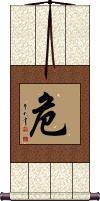
危 means danger, peril, or “to endanger” in Chinese, Japanese, and old Korean.
If you live a dangerous life or want to subtly warn others that you are a dangerous person, this may be the selection for you.
This also means “danger” and sometimes “fear” in Japanese and Korean but is seldom seen outside of compound words in those languages (as a single character, it's kind of like an abbreviation for danger in Japanese and Korean). 危 is also a rather odd selection for a wall scroll anyway. It's only here because people search for danger on our website.
Adventure
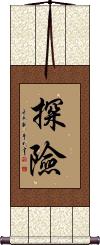
If you lead a life of adventure (like I do), a 探險 wall scroll is for you.
Alone, the first character can mean “to explore,” “to search out,” or “to scout.” The second character holds the meanings of “dangerous” and “rugged.” Together these two characters create the word that means “adventure” or “to explore.”
探険 is a modern Japanese Kanji version, but it more precisely means exploration or expedition rather than adventure. 探險 is the old/ancient Japanese version used before WWII. Let us know if you want the modern Japanese version instead.
See Also: Bon Voyage | Travel
Adventure
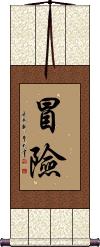
冒險 is another Chinese and Korean word for “Adventure.”
This is more of a “risk-taking” version of adventure.
The first character can mean “brave” and “bold.” The second character means “dangerous” and “rugged.” Together they can be defined as a word meaning “adventure” in Chinese and Korean.
Note: Some dictionaries translate these two characters as “take a risk.”
Adventure
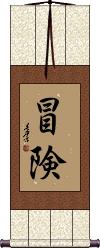
冒険 is a common Japanese way to say “Adventure.”
The first character can mean “to risk,” “to defy” or “to dare.” The second character means “inaccessible place” or “impregnable position.” Together, you get the idea of why these two characters mean adventure when put them together in Japanese.
Note: The second character is a morphed Japanese Kanji. The original Chinese version is also available and holds the same root meaning.
Crisis equals Danger plus Opportunity?
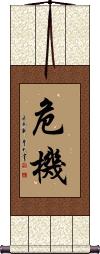
危機 means crisis in Chinese and Japanese.
Separately, the first character here does mean “danger” or “to endanger,” and the second character can mean “opportunity.”
However, I want to debunk a myth that was propagated by some westerners who did not have a clear understanding of Asian languages...
While often, Chinese/Japanese/Korean compound words (words of two or more characters) are the sum of their parts, this is not always the case. The compound is often understood with a completely different meaning than the two characters individually.
Many have said that the Chinese/Japanese/Korean word for Crisis is made up of the characters for “danger” and “opportunity.” 危機 is true when phrased this way.
However, it's not absolutely correct to say that “danger + opportunity = crisis” in Asian cultures.
English example:
If I tell you that...
Bovine creature + Guy behind the plate in baseball = Locomotive train protection

...you would think I was mad. But consider that “cow + catcher = cowcatcher,” which is the device that used to be found on steam engines to protect them if they hit an animal on the tracks. When we hear the word “cowcatcher,” we don't separate the words into their individual meanings (necessarily).
The same is true with the word for crisis in Chinese/Japanese/Korean. While you can separate the characters, few Asian people would automatically do so in their minds.
The final answer:
It is a half-truth to say, “danger plus opportunity equals crisis” in Chinese/Japanese/Korean. Use this statement and concept with caution.
Also, the second character can mean “secret” or “machine,” depending on context so I guess you have to say “a dangerous machine = crisis” or “danger + a secret = crisis.” Both of these are only slightly more ridiculous than the first premise.
PS: 危機 is probably not a great word for a scroll unless you have a special use for it.
Not the results for dangerous that you were looking for?
Below are some entries from our dictionary that may match your dangerous search...
| Characters If shown, 2nd row is Simp. Chinese |
Pronunciation Romanization |
Simple Dictionary Definition |
崒 see styles |
zú zu2 tsu |
rocky peaks; lofty and dangerous |
崖 see styles |
yá ya2 ya hake はけ |
precipice; cliff; Taiwan pr. [yai2] (1) cliff; precipice; (2) precipice; brink of a dangerous situation; (personal name) Hake a steep bank |
嶮 崄 see styles |
xiǎn xian3 hsien ken けん |
precipitous; rugged (noun or adjectival noun) (1) steepness; steep place; (2) harsh (look); sharp (tongue) dangerous |
殆 see styles |
dài dai4 tai tai ほとほと |
(literary) dangerous; perilous; (literary) almost; well-nigh (adverb) (kana only) quite (usu. negative connotation); utterly; really dangerous |
碥 see styles |
biǎn bian3 pien |
dangerous rocks jutting out over rapids |
磡 see styles |
kàn kan4 k`an kan |
dangerous sea-cliff |
阽 see styles |
diàn dian4 tien |
dangerous; also pr. [yan2] |
隉 陧 see styles |
niè nie4 nieh |
dangerous |
險 险 see styles |
xiǎn xian3 hsien ken |
danger; dangerous; rugged misfortune |
三K see styles |
sankee さんケー |
(1) difficult, dirty, and dangerous (work); (2) three bedrooms and a kitchen (in real estate); (3) three kilograms (or kilometers, etc.) |
兇具 see styles |
kyougu / kyogu きょうぐ |
(out-dated kanji) dangerous weapon |
兇器 凶器 see styles |
xiōng qì xiong1 qi4 hsiung ch`i hsiung chi kyouki / kyoki きょうき |
lethal weapon; murder weapon (out-dated kanji) dangerous weapon; lethal weapon; deadly weapon; murder weapon |
兇險 凶险 see styles |
xiōng xiǎn xiong1 xian3 hsiung hsien kyōken |
dangerous; ruthless; treacherous fierce |
六齋 六斋 see styles |
liù zhāi liu4 zhai1 liu chai rokusai |
The six monthly poṣadha, or fast days: the 8th, 14th, 15th, 23rd, 29th, and 30th. They are the days on which the Four Mahārājas 四天王 take note of human conduct and when evil demons are busy, so that great care is required and consequently nothing should be eaten after noon, hence the 'fast', v. 梵王經 30th command. The 智度論 13 describes them as 惡日 evil or dangerous days, and says they arose from an ancient custom of cutting of the flesh and casting it into the fire. |
凶具 see styles |
kyougu / kyogu きょうぐ |
dangerous weapon |
凶器 see styles |
kyouki / kyoki きょうき |
dangerous weapon; lethal weapon; deadly weapon; murder weapon |
凶戲 凶戏 see styles |
xiōng xì xiong1 xi4 hsiung hsi kuki |
dangerous amusements |
剣呑 see styles |
kennon けんのん |
(noun or adjectival noun) risky; dangerous; insecure |
危地 see styles |
kichi きち |
dangerous position; peril |
危境 see styles |
wēi jìng wei1 jing4 wei ching |
dangerous situation; venerable old age |
危樓 危楼 see styles |
wēi lóu wei1 lou2 wei lou |
(literary) tall building; dangerous building; one that is at risk of collapse |
危途 see styles |
wēi tú wei1 tu2 wei t`u wei tu |
dangerous road |
危道 see styles |
kidou / kido きどう |
(rare) dangerous road |
危險 危险 see styles |
wēi xiǎn wei1 xian3 wei hsien |
danger; dangerous |
大病 see styles |
dà bìng da4 bing4 ta ping taibyou / taibyo たいびょう |
serious illness (n,vs,vi) serious illness; dangerous disease |
婦人 妇人 see styles |
fù rén fu4 ren2 fu jen fujin ふじん |
married woman (sensitive word) (dated) (See 紳士) woman; lady; adult female "Nothing is so dangerous to monastic chastity as woman"; she is the root of all misery, hindrance, destruction, bondage, sorrow, hatred, blindness, etc. |
小口 see styles |
koguchi こぐち |
(1) cut end; edge (of a page, etc.); (noun - becomes adjective with の) (2) (ant: 大口・おおぐち・3) small amount; small quantity; small sum; (3) beginning; clue; (4) (See 虎口) tiger's den; jaws of death; dangerous place; (place-name, surname) Koguchi |
岌々 see styles |
kyuukyuu / kyukyu きゅうきゅう |
(adj-t,adv-to) (1) tall (as a mountain, etc.); (2) exceedingly dangerous |
岌岌 see styles |
kyuukyuu / kyukyu きゅうきゅう |
(adj-t,adv-to) (1) tall (as a mountain, etc.); (2) exceedingly dangerous |
嶮難 崄难 see styles |
xiǎn nán xian3 nan2 hsien nan kennan けんなん |
(noun or adjectival noun) steep; dangerous difficulty |
Click here for more dangerous results from our dictionary
The following table may be helpful for those studying Chinese or Japanese...
| Title | Characters | Romaji (Romanized Japanese) | Various forms of Romanized Chinese | |
| Danger | 危 | ki | wēi / wei1 / wei | |
| Adventure | 探險 探险 / 探険 | tanken | tàn xiǎn / tan4 xian3 / tan xian / tanxian | t`an hsien / tanhsien / tan hsien |
| Adventure | 冒險 冒险 | mào xiǎn / mao4 xian3 / mao xian / maoxian | mao hsien / maohsien | |
| Adventure | 冒険 | bou ken / bo ken | ||
| Crisis equals Danger plus Opportunity? | 危機 危机 | kiki | wēi jī / wei1 ji1 / wei ji / weiji | wei chi / weichi |
| In some entries above you will see that characters have different versions above and below a line. In these cases, the characters above the line are Traditional Chinese, while the ones below are Simplified Chinese. | ||||

Successful Chinese Character and Japanese Kanji calligraphy searches within the last few hours...



