Many custom options...


And formats...



Not what you want?
Try other similar-meaning words, fewer words, or just one word.
You Are Important to Me in Chinese / Japanese...
Buy a You Are Important to Me calligraphy wall scroll here!
Personalize your custom “You Are Important to Me” project by clicking the button next to your favorite “You Are Important to Me” title below...
1. Remember What Is Important To You
2. The two most important days in your life...
4. Honesty
6. Storm
8. Failure is the Mother of Success
9. Flying / Flight / Rising Upward
10. Eye for an eye, tooth for a tooth
12. Zero
13. Eight
14. Five
15. Ten
16. Nine
17. Three
18. Sincere Heart
19. Safe / Secure
20. Failure is the Mother of Success
21. Karma
22. Hard Work
23. Training / Drill
24. Daodejing / Tao Te Ching - Excerpt
25. Mercy / Compassion / Buddhist Loving Kindness
26. Ken Zen Ichi Nyo
27. Safety and Well-Being of the Family
28. Kai Zen / Kaizen
29. Daoism / Taoism
Remember What Is Important To You
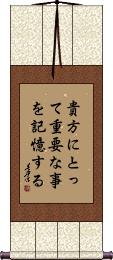
貴方にとって重要な事を記憶する means “Remember What Is Important To You” in Japanese.
Note: Because this selection contains some special Japanese Hiragana characters, it should be written by a Japanese calligrapher.
Remember What Is Important To You
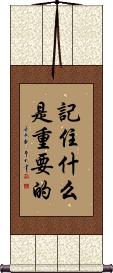
记住什么是重要的 means “Remember What Is Important To You” in Mandarin Chinese.
The two most important days in your life...

人生で一番大事な日は二日ある。生まれた日と、なぜ生まれたかを分かった日 is Mark Twain's quote, “The two most important days in your life are the day you are born and the day you find out why” in Japanese.
Note: Because this selection contains some special Japanese Hiragana characters, it should be written by a Japanese calligrapher.
Mother and Son
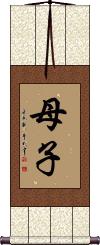
母子 simply means “mother and son,” or the essence of the relationship and bond between mother and son.
母子 is really a single word that expresses this idea (showing how important or significant this bond is).
This is not the most common choice for a wall scroll, it is acceptable if you feel this term is important to you.
See Also: Mother and Daughter
Honesty
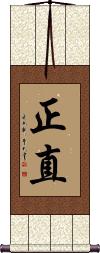
正直 or honesty is being truthful and sincere. It is important because it builds trust. When people are honest, they can be relied on not to lie, cheat or steal. Being honest means that you accept yourself as you are. When you are open and trustworthy, others can believe in you.
正直 is one of the 8 key concepts of Tang Soo Do.
Note: This entry is cross-listed as "integrity" because it also fits that definition.
 Please note that the second Kanji sometimes has an alternate form in Japanese. Let us know if you want the alternate form shown to the right.
Humility / Being Humble
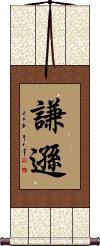
謙遜 can also be translated as being modest, humble, or unpretentious.
Being humble is considering others to be as important as yourself. You are thoughtful of their needs and willing to be of service. You don't expect others or yourself to be perfect. You learn from your mistakes. When you do great things, humility reminds you to be thankful instead of boastful.
This Humility title is also used as one of the 8 key concepts of Tang Soo Do. Often romanized as “Kyum Son.”
Also sometimes used in Japanese to express humility with an essence of modesty.
Storm
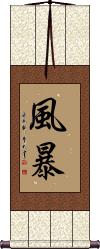
風暴 is the Chinese word for storm.
If the meaning of storm is somehow important or significant to you, these are the characters you want.
The first character means wind, and the second means violent or sudden.
Note: This would be understood in Korean Hanja, however, Koreans would generally use these characters in reverse order.
Strength and Courage
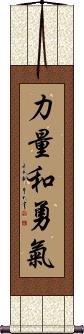
While 力量和勇氣 is not a typical Chinese phrase, this is how to write “strength and courage.”
If this is an important idea for you, we can make a great custom Chinese “strength and courage” wall scroll for you.
Failure is the Mother of Success
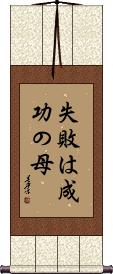
失敗は成功の母 is a Japanese proverb that means exactly what you think.
Every failure that you experience is a chance to learn from it and find success.
Knowing what does not work is just as important as finding out what does work.
Note: This is the Japanese version of an ancient Chinese proverb.
Note: Because this selection contains some special Japanese Hiragana characters, it should be written by a Japanese calligrapher.
See Also: Experience is the Mother of Wisdom
Flying / Flight / Rising Upward
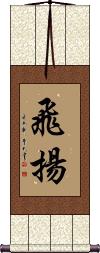
飛揚 means flight, flying, or to rise upwards in Chinese and Japanese Kanji.
飛揚 is not the most common title for a wall scroll but if you have a personal reason or this idea is important to you, then go for it.
This can also be the personal name “Hiyou” in Japanese.
Eye for an eye, tooth for a tooth
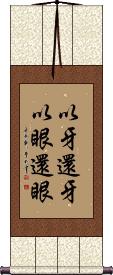
Here's the full proverb, 以牙还牙以眼还眼, with the first and second parts.
However, in Chinese, it's more natural to put the “tooth” part first, so this more accurately reads “Tooth for a tooth, eye for an eye.”
If revenge is important to you, I suppose this is the phase you want on your wall.
Military Discipline
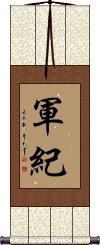
軍紀 means military discipline or military principles.
If maintaining your military discipline is important to you personally or important to your military unit, this is the wall scroll to have up behind your desk. In fact, it's the kind of thing I expect to see behind the desk of a First Sergeant or maybe a hardcore NCO.
Note: In some rare contexts, it could be extended to mean “morale,” but “discipline” is much closer to the commonly-held definition.
Note: This term is not well-known outside the military services in Asia (not used by the common person).
See Also: Self-Discipline
Zero
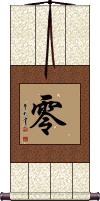
零 is the number zero in Chinese, Japanese Kanji, and old Korean Hanja.
零 is a strange selection for a wall scroll, so it's here mostly for reference. I guess it's OK if zero is important to you.
Note: In modern Japan and China, they will often just write a circle to represent zero in lieu of this character.
Eight
The number eight
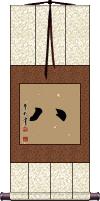
八 is the number eight in Chinese, Japanese Kanji, and old Korean Hanja.
八 is a strange selection for a wall scroll, so it's here mostly for reference. I guess it's OK if the number eight is important to you.
Because this character is rather simple (just two strokes), 捌 instead of 八 is an anti-fraud way to write eight on bank documents.
Five
The number five
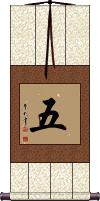
五 is the number five in Chinese, Japanese Kanji, and old Korean Hanja.
This is a strange selection for a wall scroll, so it's here mostly for reference. I guess it's OK if the number five is important to you.
 Because this character is rather simple (just four strokes), there is an anti-fraud way to write three on bank documents. These variants are shown to the right. This version can also refer to a squad of five soldiers, or in Korean, refer to rank.
Ten
The number ten
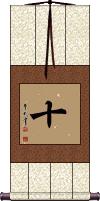
十 is the number ten in Chinese, Japanese Kanji, and old Korean Hanja.
This is a strange selection for a wall scroll, so it's here mostly for reference. I guess it's OK if the number ten is important to you.
 Because this character is rather simple (just two strokes), there is an anti-fraud way to write ten on bank documents. This variant is shown to the right.
Nine
The number nine
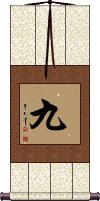
九 is the number nine in Chinese, Japanese Kanji, and old Korean Hanja.
九 is a strange selection for a wall scroll, so it's here mostly for reference. I guess it's OK if the number nine is important to you.
 Because this character is rather simple (just two strokes), there is an anti-fraud way to write nine on bank documents. This version is shown to the right.
Three
The number three
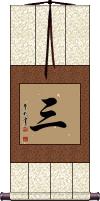
三 is the number three in Chinese, Japanese Kanji, and old Korean Hanja.
This is a strange selection for a wall scroll, so it's here mostly for reference. I guess it's OK if the number three is important to you.

 Because this character is rather simple (just three lines), there is an anti-fraud way to write three on bank documents. These variants are shown to the right.
Sincere Heart
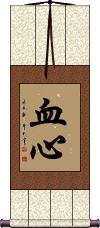
When you take 血心 apart, you find the sum is slightly different than the parts. The first character means blood, and the second means heart. It is important to note that for thousands of years, it was believed that your heart was both your soul and your mind in Asian culture. When you add blood to the heart, it is your whole being - the pure and clean dedication of your whole soul.
Most Chinese dictionaries define this as the sincerity of heart or a MEDICAL TERM!!!
Please think carefully before ordering this selection - it was only added as others have used this for coffee cups and other novelties (though perhaps naively).
Safe / Secure
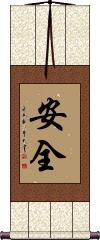
安全 is the word that represents the idea of safety and security in Chinese, Japanese Kanji, and old Korean Hanja.
Everyone wants to have some form of safety in their lives. This conveys how important the feeling of safety and security is to you.
Failure is the Mother of Success
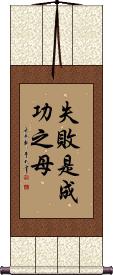
失败是成功之母 is a Chinese and Korean proverb that means “Every failure that you experience is a chance to learn from it and find success.”
Knowing what does not work is just as important as finding out what does work.
See Also: Experience is the Mother of Wisdom
Karma
Transliterated personal name
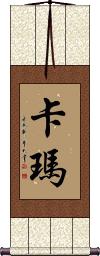
卡瑪 is the most common transliteration to Mandarin Chinese for the name Karma.
Note: This sounds like Karma but does not have the meaning of Karma in Chinese. See our other entry if you are looking for the Buddhist idea of Karma.
In fact, if your name is Karma, I strongly suggest that you use a word that means Karma, rather than this one that sounds like Karma (meaning is more important and universal in Chinese/Japanese/Korean).
Hard Work
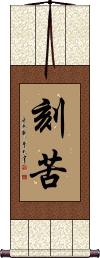
刻苦 is “hard work” in Chinese characters, Japanese Kanji, and old Korean Hanja.
If working hard is important to you, maybe this word will state your belief on your wall (this is not a common title to see on a wall scroll in Asia).
Training / Drill
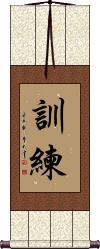
If training or drill is important to you (especially for military drill and training), 訓練 might be just the thing for a drill master to hang behind his/her desk.
This term is universal in Chinese, Japanese Kanji, and old Korean Hanja. It can also mean practice or exercise, depending on context.
Daodejing / Tao Te Ching - Excerpt
Excerpt from Chapter 67
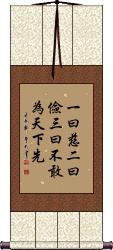
一曰慈二曰儉三曰不敢為天下先 is an excerpt from the 67th Chapter of Lao Tzu's (Lao Zi's) Te-Tao Ching (Dao De Jing).
This is the part where the three treasures are discussed. In English, we'd say these three treasures are compassion, frugality, and humility. Some may translate these as love, moderation, and lack of arrogance. I have also seen them translated as benevolence, modesty, and “Not presuming to be at the forefront in the world.” You can mix them up the way you want, as translation is not really a science but rather an art.
I should also explain that the first two treasures are single-character ideas, yet the third treasure was written out in six characters (there are also some auxiliary characters to number the treasures).
If Lao Tzu's words are important to you, then a wall scroll with this passage might make a great addition to your home.
Mercy / Compassion / Buddhist Loving Kindness
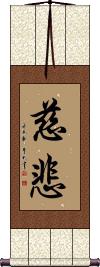
Besides the title above, 慈悲 can also be defined as clemency or lenience and sometimes the act of giving charity.
In the Buddhist context, it can be defined as “benevolence,” “loving-kindness and compassion,” or “mercy and compassion.”
This Buddhist virtue is perhaps the most important to employ in your life. All sentient beings that you encounter should be given your loving kindness. And trust me, however much you can give, it comes back. Make your life and the world a better place!
This Chinese/Japanese Buddhist term is the equivalent of Metta Karuna from Pali or Maitri Karuna from Sanskrit.
慈 can mean loving-kindness by itself.
悲 adds a component of sorrow, empathy, compassion, and sympathy for others.
See Also: Benevolence
Ken Zen Ichi Nyo
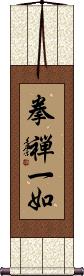
拳禪一如 is a Japanese phrase that is often translated as “train both body and spirit.”
Here's the breakdown of the words in this phrase:
拳 means fist.
禅 is zen, which means meditation.
一如 is a word that means “to be just like,” “oneness,” “true nature,” or “true character.”
So to get to the translation of “train both body and spirit,” you must understand that “fist” is representing “body” and the idea of meditation is representing “mind.”
I have to say, this is not how I would translate this. To me, it's really about training with your mind and remembering that meditation is a huge part of training, not just your fist. As the Shaolin Buddhist monks show us, meditation is just as important as physical training in martial arts.
Safety and Well-Being of the Family
Kanai Anzen
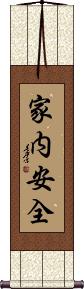
家內安全 is the Japanese way of saying “Family First.”
It's a Japanese proverb about the safety and well-being of your family and/or peace and prosperity in the household.
Some Japanese will hang an amulet in their home with these Kanji. The purpose is to keep your family safe from harm.
According to Shinto followers, hanging this in your home is seen as an invocation to God to always keep family members free from harm.
We were looking for a way to say “family first” in Japanese when this proverb came up in the conversation and research. While it doesn't say “family first,” it shows that the safety and well-being of your family is your first or most important priority. So, this proverb is the most natural way to express the idea that you put your family first.
See Also: Peace and Prosperity
Kai Zen / Kaizen
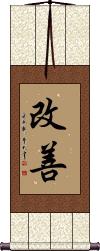
改善 means betterment, improvement, to make better, or to improve - specifically incremental and continuous improvement.
改善 became very important in post-war Japan when Edwards Deming came to Japan to teach concepts of incremental and continuous improvement (for which the big 3 auto-makers did not want to hear about at the time - even kicking Deming out of their offices). The Japanese workforce absorbed this concept when their culture was in flux and primed for change.
This kaizen term is closely associated with the western title “Total Quality Management.” Perhaps dear to my heart since I spent years studying this at university before I moved to China where TQM did not seem to exist. Slowly, this concept has entered China as well (I've actually given lectures on the subject in Beijing).
If you are trying to improve processes at your business or need to remind yourself of your continuous TQM goals, this would be a great wall scroll to hang behind your desk or in your workplace.
See Also: Kansei
Daoism / Taoism
Literally: The Way or Road
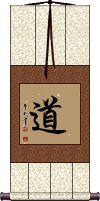
道 is the character “dao” which is sometimes written as “tao” but pronounced like “dow” in Mandarin.
道 is the base of what is known as “Taoism.” If you translate this literally, it can mean “the way” or “the path.”
Dao is believed to be that which flows through all things and keeps them in balance. It incorporates the ideas of yin and yang (e.g. there would be no love without hate, no light without dark, no male without female.)
The beginning of Taoism can be traced to a mystical man named
Lao Zi (604-531 BC), who followed, and added to the teachings of Confucius.
More about Taoism / Daoism here.
Note that this is pronounced “dou” and sometimes “michi” when written alone in Japanese but pronounced “do” in word compounds such as Karate-do and Bushido. It's also “do” in Korean.
Alternate translations and meanings: road, way, path; truth, principle province.
Important Japanese note: In Japanese, this will generally be read with the road, way, or path meaning. Taoism is not as popular or well-known in Japan so Daoist/Taoist philosophy is not the first thing a Japanese person will think of when they read this character.
See our Taoism Page
Tai Chi Chuan / Tai Ji Quan
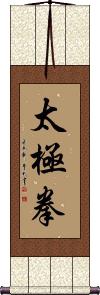
太極拳 is the famous Taoist meditation and martial art exercise. The direct translation of these characters would be something like “grand ultimate fist,” but that does not quite hit the mark for what this title really means.
An early-morning walk through any city in China near a park or an open area will yield a view of Chinese people practicing this ancient technique.
A typical scene is an old man of no less than 80 years on this earth, with a wispy white beard and perhaps a sword in one hand. He makes slow moves that are impossibly smooth. He is steady-footed and always in balance. For him, time is meaningless and proper form, and technique is far more important than speed.
For the younger generation, faster moves may look impressive and seem smooth to the casual observer. But more discipline and mental strength are needed to create perfectly smooth moves in virtual slow motion.
Note: There are two ways to Romanize these Chinese characters, as seen in the title above. The pronunciation and actual characters are the same in Chinese. If you really used English sounds/words to pronounce this, it would be something like “tie jee chew-on” (make the “chew-on” one flowing syllable).
Better Late Than Never
It's Never Too Late Too Mend
Long ago in what is now China, there were many kingdoms throughout the land. This time period is known as “The Warring States Period” by historians because these kingdoms often did not get along with each other.
Sometime around 279 B.C. the Kingdom of Chu was a large but not particularly powerful kingdom. Part of the reason it lacked power was the fact that the King was surrounded by “yes men” who told him only what he wanted to hear. Many of the King's court officials were corrupt and incompetent which did not help the situation.
The King was not blameless himself, as he started spending much of his time being entertained by his many concubines.
One of the King's ministers, Zhuang Xin, saw problems on the horizon for the Kingdom, and warned the King, “Your Majesty, you are surrounded by people who tell you what you want to hear. They tell you things to make you happy and cause you to ignore important state affairs. If this is allowed to continue, the Kingdom of Chu will surely perish, and fall into ruins.”
This enraged the King who scolded Zhuang Xin for insulting the country and accused him of trying to create resentment among the people. Zhuang Xin explained, “I dare not curse the Kingdom of Chu but I feel that we face great danger in the future because of the current situation.” The King was simply not impressed with Zhuang Xin's words.
Seeing the King's displeasure with him and the King's fondness for his court of corrupt officials, Zhuang Xin asked permission from the King that he may take leave of the Kingdom of Chu, and travel to the State of Zhao to live. The King agreed, and Zhuang Xin left the Kingdom of Chu, perhaps forever.
Five months later, troops from the neighboring Kingdom of Qin invaded Chu, taking a huge tract of land. The King of Chu went into exile, and it appeared that soon, the Kingdom of Chu would no longer exist.
The King of Chu remembered the words of Zhuang Xin and sent some of his men to find him. Immediately, Zhuang Xin returned to meet the King. The first question asked by the King was “What can I do now?”
Zhuang Xin told the King this story:
A shepherd woke one morning to find a sheep missing. Looking at the pen saw a hole in the fence where a wolf had come through to steal one of his sheep. His friends told him that he had best fix the hole at once. But the Shepherd thought since the sheep is already gone, there is no use fixing the hole.
The next morning, another sheep was missing. And the Shepherd realized that he must mend the fence at once. Zhuang Xin then went on to make suggestions about what could be done to reclaim the land lost to the Kingdom of Qin, and reclaim the former glory and integrity of the Kingdom of Chu.
The Chinese idiom shown above came from this reply from Zhuang Xin to the King of Chu almost 2,300 years ago.
It translates roughly into English as...
“Even if you have lost some sheep, it's never too late to mend the fence.”
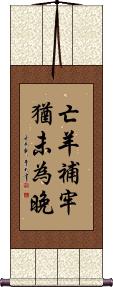
This proverb, 亡羊补牢犹未为晚, is often used in modern China when suggesting in a hopeful way that someone change their ways, or fix something in their life. It might be used to suggest fixing a marriage, quitting smoking, or getting back on track after taking an unfortunate path in life among other things one might fix in their life.
I suppose in the same way that we might say, “Today is the first day of the rest of your life” in our western cultures to suggest that you can always start anew.
Note: This does have Korean pronunciation but is not a well-known proverb in Korean (only Koreans familiar with ancient Chinese history would know it). Best if your audience is Chinese.
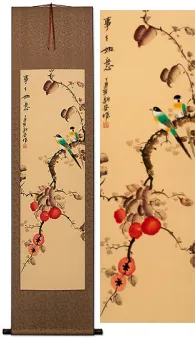
This in-stock artwork might be what you are looking for, and ships right away...

Gallery Price: $61.00
Your Price: $33.88
Gallery Price: $108.00
Your Price: $59.88

Gallery Price: $61.00
Your Price: $33.88

Gallery Price: $61.00
Your Price: $33.88

Gallery Price: $61.00
Your Price: $33.88


Gallery Price: $120.00
Your Price: $49.88
Gallery Price: $304.00
Your Price: $168.88
Gallery Price: $90.00
Your Price: $49.88
The following table may be helpful for those studying Chinese or Japanese...
| Title | Characters | Romaji (Romanized Japanese) | Various forms of Romanized Chinese | |
| Remember What Is Important To You | 貴方にとって重要な事を記憶する | anata ni totte jyuyou na koto wo kioku suru anata ni totte jyuyo na koto wo kioku suru | ||
| Remember What Is Important To You | 記住什么是重要的 记住什么是重要的 | jì zhù shén shì zhòng yào de ji4 zhu4 shen2 me shi4 zhong4 yao4 de ji zhu shen me shi zhong yao de jizhushenmeshizhongyaode | chi chu shen me shih chung yao te | |
| The two most important days in your life... | 人生で一番大事な日は二日ある生まれた日となぜ生まれたかを分かった日 | Jinsei de ichiban daijina hi wa futsuka aru. Umaretahi to, naze umareta ka o wakatta hi | ||
| Mother and Son | 母子 | bo shi / boshi | mǔ zǐ / mu3 zi3 / mu zi / muzi | mu tzu / mutzu |
| Honesty | 正直 | shoujiki / shojiki | zhèng zhí zheng4 zhi2 zheng zhi zhengzhi | cheng chih chengchih |
| Humility Being Humble | 謙遜 谦逊 | ken son / kenson | qiān xùn / qian1 xun4 / qian xun / qianxun | ch`ien hsün / chienhsün / chien hsün |
| Storm | 風暴 风暴 | fēng bào / feng1 bao4 / feng bao / fengbao | feng pao / fengpao | |
| Strength and Courage | 力量和勇氣 力量和勇气 | lì liàng hé yǒng qì li4 liang4 he2 yong3 qi4 li liang he yong qi liliangheyongqi | li liang ho yung ch`i lilianghoyungchi li liang ho yung chi |
|
| Failure is the Mother of Success | 失敗は成功の母 | shippai wa seikou no haha shippaiwaseikounohaha shipai wa seiko no haha | ||
| Flying Flight Rising Upward | 飛揚 飞扬 | hi you / hiyou / hi yo | fēi yáng / fei1 yang2 / fei yang / feiyang | |
| Eye for an eye, tooth for a tooth | 以牙還牙以眼還眼 以牙还牙以眼还眼 | yǐ yá huán yá yǐ yǎn huán yǎn yi3 ya2 huan2 ya2 yi3 yan3 huan2 yan3 yi ya huan ya yi yan huan yan yiyahuanyayiyanhuanyan | i ya huan ya i yen huan yen iyahuanyaiyenhuanyen |
|
| Military Discipline | 軍紀 军纪 | gun ki / gunki | jūn jì / jun1 ji4 / jun ji / junji | chün chi / chünchi |
| Zero | 零 零 / 〇 | rei / zero | líng / ling2 / ling | |
| Eight | 八 | hachi | bā / ba1 / ba | pa |
| Five | 五 / 伍 五 | go | wǔ / wu3 / wu | |
| Ten | 十 / 拾 十 | juu / ju | shí / shi2 / shi | shih |
| Nine | 九 / 玖 | kyuu / kyu | jiǔ / jiu3 / jiu | chiu |
| Three | 三 / 參 三 / 参 | san | sān / san1 / san | |
| Sincere Heart | 血心 | xuě xīn / xue3 xin1 / xue xin / xuexin | hsüeh hsin / hsüehhsin | |
| Safe Secure | 安全 | an zen / anzen | ān quán / an1 quan2 / an quan / anquan | an ch`üan / anchüan / an chüan |
| Failure is the Mother of Success | 失敗是成功之母 失败是成功之母 | shī bài shì chéng gōng zhī mǔ shi1 bai4 shi4 cheng2 gong1 zhi1 mu3 shi bai shi cheng gong zhi mu shibaishichenggongzhimu | shih pai shih ch`eng kung chih mu shih pai shih cheng kung chih mu |
|
| Karma | 卡瑪 卡玛 | kǎ mǎ / ka3 ma3 / ka ma / kama | k`a ma / kama / ka ma | |
| Hard Work | 刻苦 | kokku / koku | kè kǔ / ke4 ku3 / ke ku / keku | k`o k`u / koku / ko ku |
| Training Drill | 訓練 训练 | kunren | xùn liàn / xun4 lian4 / xun lian / xunlian | hsün lien / hsünlien |
| Daodejing Tao Te Ching - Excerpt | 一曰慈二曰儉三曰不敢為天下先 一曰慈二曰俭三曰不敢为天下先 | yī yuē cí èr yuē jiǎn sān yuē bù gǎn wéi tiān xià xiān yi1 yue1 ci2 er4 yue1 jian3 san1 yue1 bu4 gan3 wei2 tian1 xia4 xian1 yi yue ci er yue jian san yue bu gan wei tian xia xian | i yüeh tz`u erh yüeh chien san yüeh pu kan wei t`ien hsia hsien i yüeh tzu erh yüeh chien san yüeh pu kan wei tien hsia hsien |
|
| Mercy Compassion Buddhist Loving Kindness | 慈悲 | ji hi / jihi | cí bēi / ci2 bei1 / ci bei / cibei | tz`u pei / tzupei / tzu pei |
| Ken Zen Ichi Nyo | 拳禪一如 拳禅一如 | ken zen ichi nyo kenzenichinyo | ||
| Safety and Well-Being of the Family | 家內安全 家内安全 | ka nai an zen kanaianzen | ||
| Kai Zen Kaizen | 改善 | kai zen / kaizen | gǎi shàn / gai3 shan4 / gai shan / gaishan | kai shan / kaishan |
| Daoism Taoism | 道 | michi / -do | dào / dao4 / dao | tao |
| Tai Chi Chuan Tai Ji Quan | 太極拳 太极拳 | tai kyoku ken taikyokuken | tài jí quán tai4 ji2 quan2 tai ji quan taijiquan | t`ai chi ch`üan taichichüan tai chi chüan |
| Better Late Than Never | 亡羊補牢猶未為晚 亡羊补牢犹未为晚 | wáng yáng bǔ láo yóu wèi wéi wǎn wang2 yang2 bu3 lao2 you2 wei4 wei2 wan3 wang yang bu lao you wei wei wan | wang yang pu lao yu wei wei wan wangyangpulaoyuweiweiwan |
|
| In some entries above you will see that characters have different versions above and below a line. In these cases, the characters above the line are Traditional Chinese, while the ones below are Simplified Chinese. | ||||

Successful Chinese Character and Japanese Kanji calligraphy searches within the last few hours...



