Many custom options...


And formats...



Women in Chinese / Japanese...
Buy a Women calligraphy wall scroll here!
Personalize your custom “Women” project by clicking the button next to your favorite “Women” title below...
1. Sisterhood / Association of Women
2. Woman
5. Chastity
6. Fire Horse
9. Polo
11. Woman of Strong Character / Woman Hero
Sisterhood / Association of Women
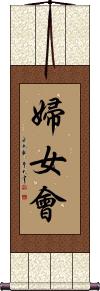
婦女會 is an expression that means “sisterhood” as in a women's association, club, or group.
The first two characters mean “women.”
The last character means to assemble, to meet, to gather, to see, union, group, or association.
Woman
The ancient way to say Woman
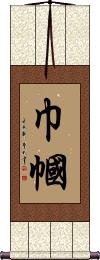
巾幗 is the very old way to say woman in Chinese.
A common title in ancient China, this actually refers to the scarf or head wrapping worn by virtually all women at that time.
巾幗 is kind of a cool way to say Woman now. The actual gender character alone on a wall scroll would actually look like a fancy sign for the woman's restroom (WC).
 If you are curious, the character to the right means female or woman. Knowing 女 is useful information if you are a woman searching for a toilet in China or Japan.
Girl Power / Woman Power
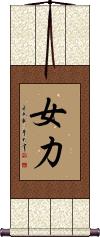
This can be read as “girl power,” “woman power,” “women empowerment” or “female strength.”
女力 is kind of a strange or unofficial title in Chinese and Japanese. At least, it's not common for a wall scroll.
This should be “onna ryoku” in Japanese but I found some who suggest it should be “me riki.”
Woman’s Association
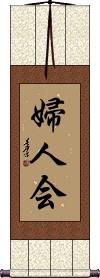
婦人會 is a Japanese title for women's group or association.
Chastity
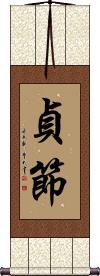
In Chinese, 貞節 would be defined as “The state of being sexually pure” or “chaste.”
Culturally, this especially applies to young women. 貞節 is not actually far off from our western view on this subject. In Japanese and Korean, this could also be used to express virtue, faithfulness, and fidelity.
See Also: Modesty
Fire Horse
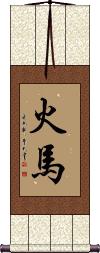
火馬 is the title, “Fire Horse.”
火馬 is not a common title for calligraphy. You might be looking for 丙午, the 43rd year of the sexagenary cycle (the year of the Fire Horse, renowned for disasters and the birth of women destined to kill their husbands).
Beautiful Princess
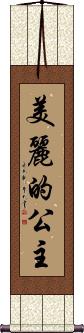
美麗的公主 is how to write beautiful princess in Chinese.
The first two characters mean feminine beauty or rather a way to say beautiful that only applies to women. The middle character is just a connecting character. The last two characters mean princess.
See Also: Queen
Sisters at Heart
The love between sisters
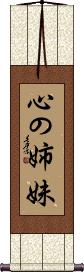
心の姉妹 is “heart of sisters,” “soul sisters,” or “sisters of the heart.”
This can be used for actual sisters to celebrate the heartfelt love they feel.
It can even be used by two women who feel a connection as if they are sisters.
Polo
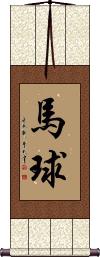
馬球 is the Chinese title for the ancient game of polo.
During the Tang Dynasty (618-907 AD), the elite and rich would mount their horses and engage in this rigorous sport. It was the only sport of that period that women were also known to play.
The original polo came from Persia and may have been played in China hundreds of years before the Tang popularized it.
The characters “馬球” literally mean “horse ball.”
Sexy / Voluptuous
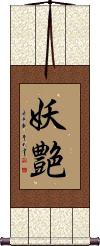
妖艶 means sexy, fascinating, voluptuous, or bewitching in Japanese Kanji. 妖艶 / 妖艷 is specifically in regards to women.
This has a dictionary meaning of flirtatious or bewitchingly pretty in Chinese. However, in practice, this would refer to a sexy but bitchy woman in modern China.
This is also a word in old Korean Hanja; however, I have not confirmed how it is perceived in Korean culture.
This may not be appropriate for a wall scroll unless your audience is Japanese only.
 Note: The second character can also be written in the alternate version shown to the right.
Woman of Strong Character / Woman Hero
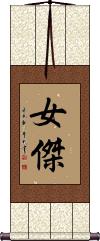
女傑 can mean brave woman, heroine, lady of character, distinguished woman, outstanding woman, and sometimes prominent woman.
Some people might use this to give a title to women like Amelia Earhart, Rosa Parks, Queen Elizabeth the First, Joan of Arc, Mulan Fa, Yevdokiya Nikolayevna Zavaliy, Harriet Tubman, Anne Frank, Clara Barton, and Jane Eyre.
I use it for a woman like Araceli Segarra (the first woman from Spain to climb Mt. Everest) and gave one of my daughters the middle name of Araceli.
Homosexual Male / Gay Male
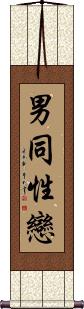
You need the male character in front of the word for homosexual in Chinese to create this word.
It's a much nicer way to say “Gay Male” than English words like Fag, Fairy, Sissy, Puff, Poof, Poofster, Swish, or Pansy. Although I suppose it could be used as a substitute for Nancy Boy, Queer, or Queen (for which, last time I checked, my gay friends said were OK in the right context).
For those of you who think China is a restrictive society - there are at least two gay discos in Beijing, the capital of China. It's at least somewhat socially acceptable to be a gay male in China. However, lesbians seem to be shunned a bit.
I think the Chinese government has realized that the 60% male population means not everybody is going to find a wife (every gay male couple that exists means two more women in the population are available for the straight guys), and the fact that it is biologically impossible for men to give birth, may be seen as helping to decrease the over-population in China.
Flying Tigers AVG
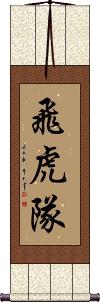
飛虎隊 is the full Chinese title of the “Flying Tigers Group.”
These were the American pilots that volunteered to go to China and fight the Japanese before the entry of the USA into World War Two. These fighter pilots were so esteemed in China that fallen American pilots could always find refuge in villages and safe passage and escape to areas of China that were not occupied by Japan at that time. Chinese villagers helped such fallen pilots with full knowledge that when the Japanese occupation forces found out, all the men, women, and children in the village would be massacred by Japanese troops (there are more than a few known cases of such massacres).
The Flying Tigers successfully kept supply lines to the Chinese resistance open and divided Japanese forces at a crucial time while America prepared to join WWII officially.
A wall scroll like this honors the men who risked or gave their lives as noble volunteers and is a reminder of the best moment in the history of Sino-American relations.
These three characters literally mean “flying tiger(s) group/team/squad.”
Note: Hanging these characters on your wall will not make you any friends with Japanese people who are aware or this history (most Japanese have no idea, as Japan’s involvement in WWII has all but been erased from school textbooks in Japan).
A Traditional Warm Welcome
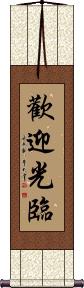
歡迎光臨 would be the ultimate Chinese “welcome mat.” Except it will be on your wall, and people will not step on it.
In a somewhat literal translation, you could say it means “I feel happy as I welcome you, as you have brought a shining light to this place with your arrival,” or more simply, “I am happy you've come as your presents brightens up the place.”
It has become common for this greeting to be announced by the staff upon the arrival of any customer into a fancy store in China. You will also see these characters on the “welcome mats” in front of 4 and 5-star hotels in China.
Having this on a wall scroll is an extra nice touch. I have seen a few horizontal scrolls with this phrase on the wall behind the reception desk of better hotels or near the front door of fine shops. At the fanciest department stores and restaurants in China, several greeters (almost always young women) will stand by the front door, all wearing sashes with this phrase embroidered. As you walk in, they will bow and say “huan ying guang lin” to welcome you to the establishment.
Note: The first two and last two characters do make words in Korean Hanja but are seldom used as a sentence like this in Korean.
This in-stock artwork might be what you are looking for, and ships right away...


Gallery Price: $60.00
Your Price: $36.88

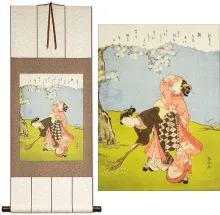
Gallery Price: $115.00
Your Price: $63.88
The following table may be helpful for those studying Chinese or Japanese...
| Title | Characters | Romaji (Romanized Japanese) | Various forms of Romanized Chinese | |
| Sisterhood Association of Women | 婦女會 妇女会 | fu jo kai / fujokai | fù nǚ huì fu4 nv3 hui4 fu nv hui funvhui | fu nü hui funühui |
| Woman | 巾幗 巾帼 | jīn guó / jin1 guo2 / jin guo / jinguo | chin kuo / chinkuo | |
| Girl Power Woman Power | 女力 | onna ryoku / onnaryoku | nǚ lì / nv3 li4 / nv li / nvli | nü li / nüli |
| Woman’s Association | 婦人會 婦人会 | fujinkai | ||
| Chastity | 貞節 贞节 | teisetsu | zhēn jié / zhen1 jie2 / zhen jie / zhenjie | chen chieh / chenchieh |
| Fire Horse | 火馬 火马 | oma hi / omahi | huǒ mǎ / huo3 ma3 / huo ma / huoma | |
| Beautiful Princess | 美麗的公主 美丽的公主 | měi lì de gōng zhǔ mei3 li4 de gong1 zhu3 mei li de gong zhu meilidegongzhu | mei li te kung chu meilitekungchu |
|
| Sisters at Heart | 心の姉妹 | kokoro no shi mai kokoronoshimai | ||
| Polo | 馬球 马球 | mǎ qiú / ma3 qiu2 / ma qiu / maqiu | ma ch`iu / machiu / ma chiu | |
| Sexy Voluptuous | 妖艶 / 妖艷 妖艳 | you en / youen / yo en | yāo yàn / yao1 yan4 / yao yan / yaoyan | yao yen / yaoyen |
| Woman of Strong Character Woman Hero | 女傑 女杰 | joketsu | nǚ jié / nv3 jie2 / nv jie / nvjie | nü chieh / nüchieh |
| Homosexual Male Gay Male | 男同性戀 男同性恋 | nán tóng xìng liàn nan2 tong2 xing4 lian4 nan tong xing lian nantongxinglian | nan t`ung hsing lien nantunghsinglien nan tung hsing lien |
|
| Flying Tigers AVG | 飛虎隊 飞虎队 | fēi hǔ duì fei1 hu3 dui4 fei hu dui feihudui | fei hu tui feihutui |
|
| A Traditional Warm Welcome | 歡迎光臨 欢迎光临 | huān yíng guāng lín huan1 ying2 guang1 lin2 huan ying guang lin huanyingguanglin | huan ying kuang lin huanyingkuanglin |
|
| In some entries above you will see that characters have different versions above and below a line. In these cases, the characters above the line are Traditional Chinese, while the ones below are Simplified Chinese. | ||||

Successful Chinese Character and Japanese Kanji calligraphy searches within the last few hours...



