Many custom options...


And formats...



Winds in Chinese / Japanese...
Buy a Winds calligraphy wall scroll here!
Personalize your custom “Winds” project by clicking the button next to your favorite “Winds” title below...
Unmoved by the Eight Winds

八風吹不動 is an ancient Buddhist phrase from about 1000 years ago.
Literal meaning: “The Eight Winds cannot move [me].”
The original famous anecdote is from Song Dynasty China, involving the poet-official 蘇東坡 (Su Dongpo / Su Shi, 1037–1101) and Zen master 佛印 (Foyin).
Su Dongpo wrote 八風吹不動,一屁打過江
“The Eight Winds cannot move me; Yet one fart blows me across the river.”
Foyin’s irreverent reply exposed Su Dongpo’s ego, which is kind of a classic Zen/Chan teaching story.
利 gain
衰 loss
毀 disgrace
譽 praise
稱 honor
譏 ridicule
苦 suffering
樂 pleasure
“The Eight Winds cannot move [him / the mind].”
“Unmoved by the Eight Winds.”
“The Eight Winds do not move me.”
“Not moved by the Eight Winds.”
“Unshaken by the Eight Winds.”
“Unaffected by the Eight Winds.”
“Unmoved by worldly forces.”
“Steadfast against the Eight Winds.”
“Remaining unmoved amid the Eight Winds.”
There is a shorter Japanese Zen version, 八風不動, which drops the middle character. Often romanized as happū fudō. The romanization of 八風吹不動 is arguably happū fukedomo ugokazu or happū sui fudō.
Happu Fudo
Unmoved by the Eight Winds

八風不動 is the short version, popularized in Japanese Zen Buddhism, of the original Chinese phrase 八風吹不動.
Literal meaning: “Unmoved by the Eight Winds”
The origin is Chinese, but it was later adopted into Japanese Zen. Here’s a little backstory:
The original famous anecdote is from Song Dynasty China, involving the poet-official 蘇東坡 (Su Dongpo / Su Shi, 1037–1101) and Zen master 佛印 (Foyin).
Su Dongpo wrote 八風吹不動,一屁打過江
“The Eight Winds cannot move me; Yet one fart blows me across the river.”
Foyin’s irreverent reply exposed Su Dongpo’s ego, which is kind of a classic Zen teaching story.
Do not fear the task: Cooperation will lead to success
Do not fear strong winds waves; just be sure to row in unison
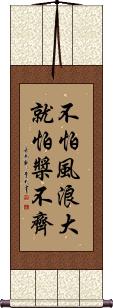
不怕风浪大就怕桨不齐 is a Chinese proverb that literally translates as: Do not fear strong winds [and] high waves; what [one should] worry about whether or not you're rowing in unison.
Figuratively, this means: However difficult the task, the key to success lies in making collective efforts.
I like to translate this as “Don't sweat the details, just get together and get it done.”
Wind of Change
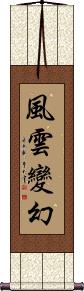
風雲變幻 is a Chinese proverb that means “wind of change” or “changeable situation.”
The first character, 風, means wind, but when combined with the second character, 風雲, you have weather, winds and clouds, nature, or the elements. Colloquially, this can refer to an unstable situation or state of affairs.
The last two characters, 變幻, mean change or fluctuate.
Not the results for Winds that you were looking for?
Below are some entries from our dictionary that may match your Winds search...
| Characters If shown, 2nd row is Simp. Chinese |
Pronunciation Romanization |
Simple Dictionary Definition |
嵐 岚 see styles |
lán lan2 lan ranran らんらん |
(bound form) mountain mist (1) storm; tempest; (2) (idiom) uproar; hullabaloo; storm (e.g. of protest); winds (e.g. of change); (3) (kana only) {cards} (usu. as アラシ) (See おいちょかぶ) pile of 3 cards of the same value in oicho-kabu; (personal name) Ranran Mountain mist; vapour. |
五風 五风 see styles |
wǔ fēng wu3 feng1 wu feng gofuu / gofu ごふう |
(personal name) Gofū five pathogenic winds |
八風 八风 see styles |
bā fēng ba1 feng1 pa feng happuu / happu はっぷう |
see 八風穴|八风穴[ba1 feng1 xue2] (1) {Buddh} eight winds; eight things that hinder enlightenment; prosperity, decline, disgrace, honor, praise, censure, suffering, and pleasure; (2) eight winds (e.g. in eight directions); (given name) Happuu The eight winds, or influences which fan the passions, i.e. gain, loss; defamation, eulogy; praise, ridicule; sorrow, joy. Also 八法. |
塵風 尘风 see styles |
chén fēng chen2 feng1 ch`en feng chen feng jin fū |
defiling winds |
妄風 妄风 see styles |
wàng fēng wang4 feng1 wang feng mōfu |
winds of ignorance |
悪風 see styles |
akufuu / akufu あくふう |
(1) vice; bad manners; evil customs; (2) storm; raging winds |
風雲 风云 see styles |
fēng yún feng1 yun2 feng yün houun / houn ほううん |
weather; unstable situation (1) winds and clouds; nature; the elements; (2) situation; state of affairs; (given name) Houun |
上層風 see styles |
jousoufuu / josofu じょうそうふう |
winds aloft |
吹上げ see styles |
fukiage ふきあげ |
(1) place exposed to winds which blow up from below (usu. a beach); beach exposed to sea winds; (2) fountain |
噴上げ see styles |
fukiage ふきあげ |
(1) place exposed to winds which blow up from below (usu. a beach); beach exposed to sea winds; (2) fountain |
境界風 境界风 see styles |
jìng jiè fēng jing4 jie4 feng1 ching chieh feng kyōkai fū |
winds of the objective realms |
大四喜 see styles |
taasuushii; daisuushii / tasushi; daisushi タースーシー; だいスーシー |
{mahj} big four winds (chi: dà sì xǐ); winning hand containing four kongs or pungs of winds |
大風災 大风灾 see styles |
dà fēng zāi da4 feng1 zai1 ta feng tsai dai fūsai |
Great Storms, the third of the three destructive calamities to end the world. |
季節風 see styles |
kisetsufuu / kisetsufu きせつふう |
seasonal winds |
小四喜 see styles |
shaosuushii; shousuushii / shaosushi; shosushi シャオスーシー; しょうスーシー |
{mahj} little four winds (chi: xiǎo sì xǐ); winning hand consisting of three kongs or pungs of winds and a pair of the fourth wind |
山谷風 see styles |
yamatanikaze やまたにかぜ |
mountain-valley winds; mountain and valley breeze |
春一番 see styles |
haruichiban はるいちばん |
first storm of spring; strong winds during the change from winter to spring; (person) Haruichiban (1966.8.13-) |
暴風圈 暴风圈 see styles |
bào fēng quān bao4 feng1 quan1 pao feng ch`üan pao feng chüan |
(meteorology) storm area (area exposed to winds of force 7 or higher during a typhoon); (fig.) area particularly badly affected by a crisis |
暴風域 see styles |
boufuuiki / bofuiki ぼうふういき |
storm area (winds of 25mps or more) |
避風塘 避风塘 see styles |
bì fēng táng bi4 feng1 tang2 pi feng t`ang pi feng tang |
typhoon shelter (a cove where boats shelter from strong winds and rough seas, esp. in Hong Kong); (attributive) typhoon shelter-style, a cooking method associated with those who lived on boats in the coves, where crab, prawn or other meat is fried and flavored with spices and black beans |
風の神 see styles |
kazenokami かぜのかみ |
(n,exp) god of winds |
五風十雨 see styles |
gofuujuuu / gofujuu ごふうじゅうう |
(yoji) seasonable rains and winds; halcyon weather; halcyon times of peace |
八種淸風 八种淸风 see styles |
bā zhǒng qīng fēng ba1 zhong3 qing1 feng1 pa chung ch`ing feng pa chung ching feng hasshu shōfū |
eight kinds of fresh winds |
台風並み see styles |
taifuunami / taifunami たいふうなみ |
(noun - becomes adjective with の) typhoon-strength (winds, etc.) |
吹き上げ see styles |
fukiage ふきあげ |
(1) place exposed to winds which blow up from below (usu. a beach); beach exposed to sea winds; (2) fountain |
噴き上げ see styles |
fukiage ふきあげ |
(1) place exposed to winds which blow up from below (usu. a beach); beach exposed to sea winds; (2) fountain |
埃奧羅斯 埃奥罗斯 see styles |
āi ào luó sī ai1 ao4 luo2 si1 ai ao lo ssu |
Aeolus, Greek God of winds |
歪風邪氣 歪风邪气 see styles |
wāi fēng xié qì wai1 feng1 xie2 qi4 wai feng hsieh ch`i wai feng hsieh chi |
noxious winds, evil influences (idiom); malignant social trends |
疾風勁草 疾风劲草 see styles |
jí fēng jìng cǎo ji2 feng1 jing4 cao3 chi feng ching ts`ao chi feng ching tsao |
lit. sturdy grass withstands high winds (idiom); fig. strength of character is revealed in a crisis |
風に乗る see styles |
kazeninoru かぜにのる |
(exp,v5r) to ride upon the winds |
Click here for more Winds results from our dictionary
The following table may be helpful for those studying Chinese or Japanese...
| Title | Characters | Romaji (Romanized Japanese) | Various forms of Romanized Chinese | |
| Unmoved by the Eight Winds | 八風吹不動 八风吹不动 | happuu sui fudou happuusuifudou hapu sui fudo | bā fēng chuī bù dòng ba1 feng1 chui1 bu4 dong4 ba feng chui bu dong bafengchuibudong | pa feng ch`ui pu tung pafengchuiputung pa feng chui pu tung |
| Happu Fudo | 八風不動 八风不动 | happuu fudou happuufudou hapu fudo | bā fēng bù dòng ba1 feng1 bu4 dong4 ba feng bu dong bafengbudong | pa feng pu tung pafengputung |
| Do not fear the task: Cooperation will lead to success | 不怕風浪大就怕槳不齊 不怕风浪大就怕桨不齐 | bù pà fēng làng dà jiù pà jiǎng bù qí bu4 pa4 feng1 lang4 da4 jiu4 pa4 jiang3 bu4 qi2 bu pa feng lang da jiu pa jiang bu qi | pu p`a feng lang ta chiu p`a chiang pu ch`i pu pa feng lang ta chiu pa chiang pu chi |
|
| Wind of Change | 風雲變幻 风云变幻 | fēng yún biàn huàn feng1 yun2 bian4 huan4 feng yun bian huan fengyunbianhuan | feng yün pien huan fengyünpienhuan |
|
| In some entries above you will see that characters have different versions above and below a line. In these cases, the characters above the line are Traditional Chinese, while the ones below are Simplified Chinese. | ||||

Successful Chinese Character and Japanese Kanji calligraphy searches within the last few hours...



