Many custom options...


And formats...



Wealth in Chinese / Japanese...
Buy a Wealth calligraphy wall scroll here!
Personalize your custom “Wealth” project by clicking the button next to your favorite “Wealth” title below...
3. Wealth / Fortune / Riches / Abundance
4. Men Die for Wealth, Birds Die for Food
5. Treasure
9. Benzaiten
10. Dark Sister
11. Five Red Bats
Wealth / Riches / Fortune
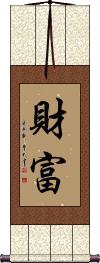
財富 means wealth or riches in Chinese.
Hanging this on your wall will label you as a “lover of money” or a “greedy person.” Order this only if you don't mind being seen in this light.
Money / Wealth
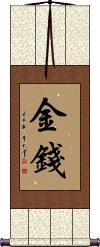
金錢/金銭 means money, cash, currency, or wealth in Chinese, Japanese Kanji, and old Korean Hanja.
Literally, it means “gold coins” but has come to be used to mean money in general, as well as the idea of wealth.
 The second character of this word is written in a variant form in Japan. The more common version in Japan is shown to the right. Click on the Kanji to the right instead of the button above if you want this Japanese variant in your calligraphy.
Wealth / Fortune / Riches / Abundance
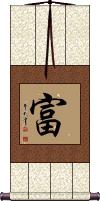
The title says it all; this word is clearly understood in Chinese and Japanese as well as Korean Hanja.
Men Die for Wealth, Birds Die for Food
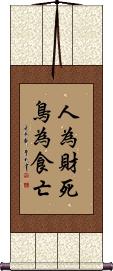
人為財死鳥為食亡 is a Chinese proverb that literally states that human beings will die for riches, just as birds will for food.
Figuratively it means that man will do anything in his means to become rich. Personally, I think dying for food is a more noble cause.
Often translated as “Men die in pursuit of wealth, birds die in pursuit of food. The 人 in this proverb just means human, so “men” is a placeholder for human with that translation - an English language problem that we have no easy gender-neutral nouns.
This proverb is meant to serve as a warning about the follies of greed.
Treasure
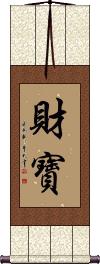
財寶 is the Japanese word meaning “treasure” or “money and valuables.”
The first character means “property,” “money,” “wealth,” or “assets.” The second character means “treasure,” “wealth,” or “valuables” in Japanese. Together these two characters reinforce each other into a word that clearly means treasure in Japanese.
財寶 is also a word meaning “money and valuables” in Chinese but more of a daily use word - not as appropriate for a wall scroll if your audience is Chinese.
 The second character shown to the left is the ancient/traditional Japanese version. In modern Japan, this character has been simplified. This simplified version is shown to the right. If you want this modern Japanese/simplified version, just click the Kanji on the right, instead of the button above.
Shili / Shiri / Sri
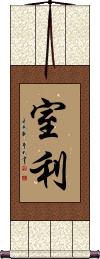
室利 is a Buddhist term or title that comes from the Sanskrit śrī.
The meaning is fortunate, lucky, prosperous, wealth, or beauty. This can be a sort of suffix for certain deities or respected people in Buddhism.
The Five Fortunes

This is the title of “The Five Fortunes” in Chinese.
The implied five fortunes are as follows:
Longevity (壽)
Wealth (富)
Health & Composure (康寧)
Love of Virtue (攸好德)
A Peaceful Death (考終命)
Blessings on this Home
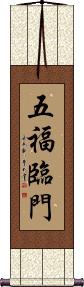
五福臨門 means “five good fortunes arrive [at the] door.”
It is understood to mean “may the five blessings descend upon this home.”
These blessings are known in ancient China to be: longevity, wealth, health, virtue, and natural death (living to old age). This is one of several auspicious sayings you might hear during the Chinese New Year.
Benzaiten
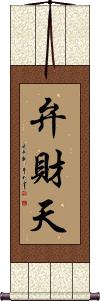
弁財天 is a Buddhist term that can be translated or transliterated as Benzaiten or Saraswati.
弁財天 is the Buddhist goddess of music, eloquence, wealth, and water.
This goddess of eloquence came into Buddhism from the Hindu goddess Saraswati. Benzaiten and Saraswati are considered by most to be one and the same. However, in Japanese culture, Benzaiten has been conflated with several other deities.
Dark Sister
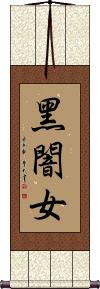
黑闇女 is a Buddhist title that means “dark sister,” “dark one,” or “dark woman.”
There are two sisters:
One is the deva, 功德女 (“merit” or “achieving”), who causes people to acquire wealth.
The other is the “dark one,” 黑闇女, which causes people to spend and waste.
These sisters always accompany each other.
Five Red Bats
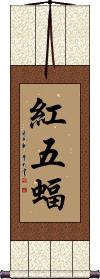
紅五蝠 is a play on words in Chinese because of some homophones.
The first thing you need to know is that the word for bat, 蝠, sounds exactly like the word for good fortune, 福. Thus, bats are often associated with good luck and good fortune in Chinese culture.
Five bats (五福 / 五蝠) means “five fortunes,” referring to luck, prosperity, wealth, happiness, and longevity.
The word red, 红, has the same sound as 宏 meaning vast, great, or magnificent. Therefore, a red bat means “vast fortune.”
Altogether, five red bats represent vast reaches of the five fortunes.
Daodejing / Tao Te Ching - Chapter 9
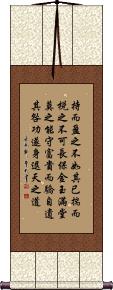
This text is the ninth chapter of the Daodejing / Tao Te Ching.
To hold until full is not as good as stopping.
An oversharpened sword cannot last long.
A room filled with gold and jewels cannot be protected.
Boasting of wealth and virtue brings your demise.
After finishing the work, withdraw.
持而盈之不如其已揣而梲之不可長保金玉滿堂莫之能守富貴而驕自遺其咎功遂身退天之道 is the Way of Heaven.
Dr. Muller's translation of all 81 Daodejing chapters
The text reads:
持而盈之、不如其已。揣而梲之、不可長保。 金玉滿堂、莫之能守。 富貴而驕、自遺其咎。 功遂身退、天之道。
This classical Chinese passage comes from the Mawangdui (馬王堆帛書) text.
Daodejing / Tao Te Ching - Chapter 33
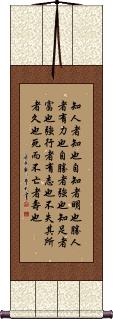
This is referred to as passage or chapter 33 of the Dao De Jing (often Romanized as “Tao Te Ching”).
These are the words of the philosopher Laozi (Lao Tzu).
To know others is wisdom;
To know oneself is acuity/intelligence.
To conquer others is power,
To conquer oneself is strength.
To know contentment is to have wealth.
To act resolutely is to have purpose.
To stay one's ground is to be enduring.
To die and yet not be forgotten is to be long-lived.
To understand others is to be knowledgeable;
To understand yourself is to be wise.
To conquer others is to have strength;
To conquer yourself is to be strong.
To know when you have enough is to be rich.
To go forward with strength is to have ambition.
To not lose your place is to be long-lasting.
To die but not be forgotten -- that's true long life.
He who is content is rich;
He who acts with persistence has will;
He who does not lose his roots will endure;
He who dies physically but preserves the Dao
will enjoy a long after-life.
Notes:
During our research, the Chinese characters shown here are probably the most accurate to the original text of Laozi. These were taken for the most part from the Mawangdui 1973 and Guodan 1993 manuscripts which pre-date other Daodejing texts by about 1000 years.
Grammar was a little different in Laozi’s time. So you should consider this to be the ancient Chinese version. Some have modernized this passage by adding, removing, or swapping articles and changing the grammar (we felt the oldest and most original version would be more desirable). You may find other versions printed in books or online - sometimes these modern texts are simply used to explain to Chinese people what the original text really means.
This language issue can be compared in English by thinking how the King James (known as the Authorized version in Great Britain) Bible from 1611 was written, and comparing it to modern English. Now imagine that the Daodejing was probably written around 403 BCE (2000 years before the King James Version of the Bible). To a Chinese person, the original Daodejing reads like text that is 3 times more detached compared to Shakespeare’s English is to our modern-day speech.
Extended notes:
While on this Biblical text comparison, it should be noted, that just like the Bible, all the original texts of the Daodejing were lost or destroyed long ago. Just as with the scripture used to create the Bible, various manuscripts exist, many with variations or copyist errors. Just as the earliest New Testament scripture (incomplete) is from 170 years after Christ, the earliest Daodejing manuscript (incomplete) is from 100-200 years after the death of Laozi.
The reason that the originals were lost probably has a lot to do with the first Qin Emperor. Upon taking power and unifying China, he ordered the burning and destruction of all books (scrolls/rolls) except those pertaining to Chinese medicine and a few other subjects. The surviving Daodejing manuscripts were either hidden on purpose or simply forgotten about. Some were not unearthed until as late as 1993.
We compared a lot of research by various archeologists and historians before deciding on this as the most accurate and correct version. But one must allow that it may not be perfect, or the actual and original as from the hand of Laozi himself.
This in-stock artwork might be what you are looking for, and ships right away...
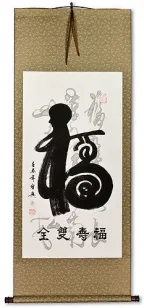
Gallery Price: $31.00
Your Price: $17.00
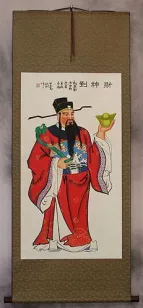
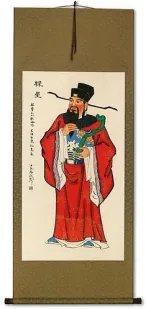
Gallery Price: $120.00
Your Price: $69.88
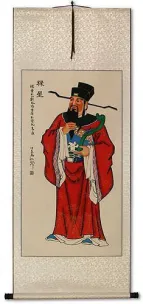
Gallery Price: $120.00
Your Price: $59.88

Gallery Price: $108.00
Your Price: $59.88
Gallery Price: $108.00
Your Price: $59.88
Gallery Price: $120.00
Your Price: $59.88
The following table may be helpful for those studying Chinese or Japanese...
| Title | Characters | Romaji (Romanized Japanese) | Various forms of Romanized Chinese | |
| Wealth Riches Fortune | 財富 财富 | cái fù / cai2 fu4 / cai fu / caifu | ts`ai fu / tsaifu / tsai fu | |
| Money Wealth | 金錢 / 金銭 金钱 | kin sen / kinsen | jīn qián / jin1 qian2 / jin qian / jinqian | chin ch`ien / chinchien / chin chien |
| Wealth Fortune Riches Abundance | 富 | tomi | fù / fu4 / fu | |
| Men Die for Wealth, Birds Die for Food | 人為財死鳥為食亡 人为财死鸟为食亡 | rén wèi cái sǐ niǎo wèi shí wáng ren2 wei4 cai2 si3 niao3 wei4 shi2 wang2 ren wei cai si niao wei shi wang | jen wei ts`ai ssu niao wei shih wang jen wei tsai ssu niao wei shih wang |
|
| Treasure | 財寶 财宝 | zaihou / zaiho | cái bǎo / cai2 bao3 / cai bao / caibao | ts`ai pao / tsaipao / tsai pao |
| Shili Shiri Sri | 室利 | shiri | shì lì / shi4 li4 / shi li / shili | shih li / shihli |
| The Five Fortunes | 五福 | wǔ fú / wu3 fu2 / wu fu / wufu | ||
| Blessings on this Home | 五福臨門 五福临门 | wǔ fú lín mén wu3 fu2 lin2 men2 wu fu lin men wufulinmen | ||
| Benzaiten | 弁財天 弁财天 | ben zai ten benzaiten | biàn cái tiān bian4 cai2 tian1 bian cai tian biancaitian | pien ts`ai t`ien pientsaitien pien tsai tien |
| Dark Sister | 黑闇女 | koku an nyo kokuannyo | hēi àn nǚ hei1 an4 nv3 hei an nv heiannv | hei an nü heiannü |
| Five Red Bats | 紅五蝠 红五蝠 | hóng wǔ fú hong2 wu3 fu2 hong wu fu hongwufu | hung wu fu hungwufu |
|
| Daodejing Tao Te Ching - Chapter 9 | 持而盈之不如其已揣而梲之不可長保金玉滿堂莫之能守富貴而驕自遺其咎功遂身退天之道 持而盈之不如其已揣而梲之不可长保金玉满堂莫之能守富贵而骄自遗其咎功遂身退天之道 | chí ér yíng zhī bù rú qí yǐ chuǎi ér zhī bù kě cháng bǎo jīn yù mǎn táng mò zhī néng shǒu fù guì ér jiāo zì yí qí jiù gōng suì shēn tuì tiān zhī dào chi2 er2 ying2 zhi1 bu4 ru2 qi2 yi3 chuai3 er2 棁 zhi1 bu4 ke3 chang2 bao3 jin1 yu4 man3 tang2 mo4 zhi1 neng2 shou3 fu4 gui4 er2 jiao1 zi4 yi2 qi2 jiu4 gong1 sui4 shen1 tui4 tian1 zhi1 dao4 chi er ying zhi bu ru qi yi chuai er 棁 zhi bu ke chang bao jin yu man tang mo zhi neng shou fu gui er jiao zi yi qi jiu gong sui shen tui tian zhi dao | ch`ih erh ying chih pu ju ch`i i ch`uai erh chih pu k`o ch`ang pao chin yü man t`ang mo chih neng shou fu kuei erh chiao tzu i ch`i chiu kung sui shen t`ui t`ien chih tao chih erh ying chih pu ju chi i chuai erh chih pu ko chang pao chin yü man tang mo chih neng shou fu kuei erh chiao tzu i chi chiu kung sui shen tui tien chih tao |
|
| Daodejing Tao Te Ching - Chapter 33 | 知人者知也自知者明也勝人者有力也自勝者強也知足者富也強行者有志也不失其所者久也死而不亡者壽也 知人者知也自知者明也胜人者有力也自胜者强也知足者富也强行者有志也不失其所者久也死而不亡者寿也 | zhī rén zhě zhī yě zì zhī zhě míng yě shèng rén zhě yǒu lì yě zì shèng zhě qiáng yě zhī zú zhě fù yě qiáng xíng zhě yǒu zhì yě bù zhī qí suǒ zhě jiǔ yě sǐ ér bù wáng zhě shòu yě zhi1 ren2 zhe3 zhi1 ye3 zi4 zhi1 zhe3 ming2 ye3 sheng4 ren2 zhe3 you3 li4 ye3 zi4 sheng4 zhe3 qiang2 ye3 zhi1 zu2 zhe3 fu4 ye3 qiang2 xing2 zhe3 you3 zhi4 ye3 bu4 zhi1 qi2 suo3 zhe3 jiu3 ye3 si3 er2 bu4 wang2 zhe3 shou4 ye3 zhi ren zhe zhi ye zi zhi zhe ming ye sheng ren zhe you li ye zi sheng zhe qiang ye zhi zu zhe fu ye qiang xing zhe you zhi ye bu zhi qi suo zhe jiu ye si er bu wang zhe shou ye | chih jen che chih yeh tzu chih che ming yeh sheng jen che yu li yeh tzu sheng che ch`iang yeh chih tsu che fu yeh ch`iang hsing che yu chih yeh pu chih ch`i so che chiu yeh ssu erh pu wang che shou yeh chih jen che chih yeh tzu chih che ming yeh sheng jen che yu li yeh tzu sheng che chiang yeh chih tsu che fu yeh chiang hsing che yu chih yeh pu chih chi so che chiu yeh ssu erh pu wang che shou yeh |
|
| In some entries above you will see that characters have different versions above and below a line. In these cases, the characters above the line are Traditional Chinese, while the ones below are Simplified Chinese. | ||||

Successful Chinese Character and Japanese Kanji calligraphy searches within the last few hours...



