Many custom options...


And formats...



Warriors in Chinese / Japanese...
Buy a Warriors calligraphy wall scroll here!
Personalize your custom “Warriors” project by clicking the button next to your favorite “Warriors” title below...
See also: Bushido - Code of the Samurai Warrior
2. Warriors: Quality Over Quantity
3. Warriors Adapt and Overcome
4. The Value of Warriors Lies in Their Quality
5. The Warrior’s Word, Dependable as Gold and Steel
6. Warrior
7. Bushi Kai
10. Paladin
11. Samurai
13. In Flowers the Cherry Blossom, In Men the Samurai
15. Hua Mulan
16. Bushido / The Way of the Samurai
17. Katana
18. Musashi
Warriors of Light
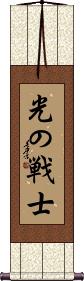
光の戦士 is the Japanese title for Warrior(s) of Light.
This usually refers to the Four Warriors of Light theme from the Final Fantasy series.
Also called Light Warriors, Warriors of the Light, Knights of Light, or Heroes of Light, depending on who is translating.
There are no direct plural forms in Japanese, so warrior or warriors is the same word, 戦士 (which can also be soldier, fighter, combatant, etc.).
Warriors: Quality Over Quantity
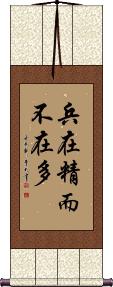
兵在精而不在多 is a Chinese proverb that means: [The value of] soldiers/warriors lies in [their] quality, not [just] in [their] quantity.
In simple terms, this says that regarding warriors, quality is better than quantity.
Most tacticians will agree that this can aid in the factor known as “force multiplication.” Having good troops of high morale, excellent training, and good discipline is like having a force that is three times larger.
See Also: 兵在精
Warriors Adapt and Overcome
Soldiers need a fluid plan
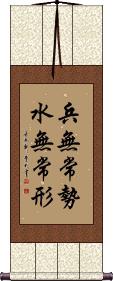
This literally translates as: Troops/soldiers/warriors have no fixed [battlefield] strategy [just as] water has no constant shape [but adapts itself to whatever container it is in].
Figuratively, this means: One should seek to find whatever strategy or method is best suited to resolving each individual problem.
This proverb is about as close as you can get to the military idea of “adapt improvise overcome.” 兵無常勢水無常形 is the best way to express that idea in both an ancient way, and a very natural way in Chinese.
The Value of Warriors Lies in Their Quality
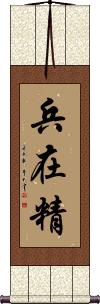
This literally means: [The value of] soldiers/warriors lies in [their] quality.
兵在精 is part of a longer phrase that ends with “not [just] in [their] quantity.”
兵在精 is a well-known phrase in military circles, so the second part is suggested when one hears or reads these three characters.
See Also: 兵在精而不在多
The Warrior’s Word, Dependable as Gold and Steel
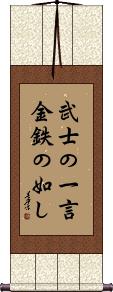
武士の一言金鉄の如し is an old Japanese proverb about the value of the word of a warrior.
Here are a couple of versions of how this can be translated:
A warrior's single word is as unchanging and reliable as gold and steel.
A warrior's promise is as dependable as gold, and his [scabbard contains] untarnished steel (a sword).
Note: Sometimes this phrase is written as 男子の一言、金鉄の如し (danshi no ichigon kintetsu no gotoshi)
Note: Because this selection contains some special Japanese Hiragana characters, it should be written by a Japanese calligrapher.
Warrior
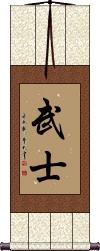
The first character, 武, is the spirit or essence of a warrior. The second character, 士, means soldier, officer, or official. 武士 is also used appropriately enough to describe a piece of a chess game. 武士 can also be translated as a soldier, cavalier, palace guard, or samurai, and sometimes as a knight. I've occasionally seen this translated as strong man or tough man (gender not necessarily implied).
By far, 武士 is the most common way to write warrior in Chinese characters, Japanese Kanji, and old Korean Hanja.
Note: In Japanese, this is Bushi, as in Bushido.
Bushi Kai
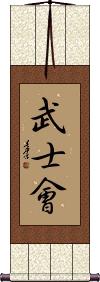
Value of Warrior Generals
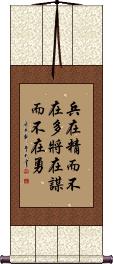
兵在精而不在多將在謀而不在勇 is a proverb that informs how it is better to have warriors of quality, rather than just a large quantity of warriors in your army/force.
This literally means: [Just as] warriors [are valued for their] quality and not [just] for quantity, [so] generals [are valued] for their tactics, not [just] for [their] bravery.
See Also: 兵在精而不在多
Mighty / Powerful / Strong
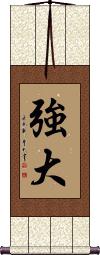
強大 can mean mighty, powerful, large, formidable, or strong.
This term is often used to describe soldiers/troops/warriors and whole armies.
Paladin
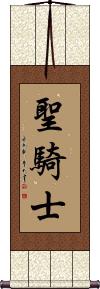
聖騎士 is how Paladin is written in Chinese.
This title originates from the warriors of Charlemagne's court.
The literal translation of this Chinese title is something like “Saintly Knight.”
Samurai
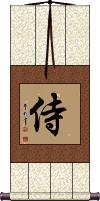
In Japanese, 侍 represents the warriors that attempted to hold peace when there was no Emperor in Japan.
Be cautious though, as it is an old way to express “servant” or “waiter” in Chinese and Korean. Of course, if you are a samurai, you are a servant to your Shogun-ate, Lord, or the people (which is the root meaning).
See Also: Warrior
Naginata / Halberd
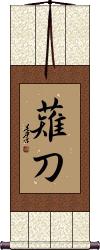
薙刀 is the Japanese word naginata.
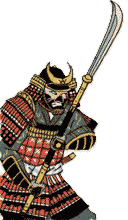 A naginata is a special kind of halberd or long sword carried by some Samurai and other warriors. It is still used ceremonially in some schools of martial arts.
In Flowers the Cherry Blossom, In Men the Samurai
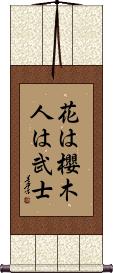
This Japanese proverb simply reads, “[In] Flowers it's Cherry Blossoms, [In] Men it's Warriors.”
花は櫻木人は武士 is meant to say that of all the flowers in the world, the cherry blossom is the best. And of all men in the world, the Samurai or Warrior is the best
This proverb has been around for a long time. It's believed to have been composed sometime before the Edo Period in Japan (which started in 1603).
Some will drop one syllable and pronounce this, “hana wa sakura hito wa bushi.” That's “sakura” instead of “sakuragi,” which is like saying “cherry blossom” instead of “cherry tree.”
The third character was traditionally written as 櫻. But in modern Japan, that became 桜. You may still see 櫻 used from time to time on older pieces of calligraphy. We can do either one, so just make a special request if you want 櫻.
Note: Because this selection contains some special Japanese Hiragana characters, it should be written by a Japanese calligrapher.
Harmony / Balance
Cho Wa
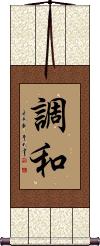
調和 is one of the several ways to express harmony in Chinese and Japanese.
Note: The first character means harmony but also suggests a musical meaning. It can also describe warriors marching in perfect cadence (in step) or to regulate something.
The second character carries the meaning of harmony and peace by itself.
Together, these characters create a word that can be defined as harmonious, to mediate, to reconcile, to compromise; mediation, temper, to mix, blend, blended, season, seasoning (getting the flavors of the food in balance), to placate, or be in harmonious proportion.
The meaning varies depending on the context. However, when hanging as a wall scroll, this will refer to the person (you) being balanced and in harmony while rational and under control simultaneously.
Hua Mulan
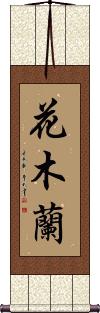
花木蘭 is the name of the famous Chinese woman warrior Hua Mulan.
She was made famous in the west by Disney's animated movie, “Mulan.”
Most of the historical information about her comes from an ancient poem. It starts with a concerned Mulan, as she is told a man from each family is to serve conscription in the army. Her father is too old, and her brother is too young. Mulan decides to take the place of her father. After twelve years of war, the army returns, and the best warriors are awarded great posts in the government and riches. Mulan turns down all offers and asks only for a good horse for the long trip home. When Mulan greets visiting comrades wearing her old clothes, they are shocked to find the warrior they rode into battle with for years is actually a woman.
Bushido / The Way of the Samurai
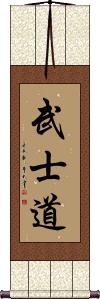
武士道 is the title for “The Code of the Samurai.”
Sometimes called “The Seven Virtues of the Samurai,” “The Bushido Code,” or “The Samurai Code of Chivalry.”
This would be read in Chinese characters, Japanese Kanji, and old Korean Hanja as “The Way of the Warrior,” “The Warrior's Way,” or “The Warrior's Code.”
It's a set of virtues that the Samurai of Japan and ancient warriors of China and Korea had to live and die by. However, while known throughout Asia, this title is mostly used in Japan and thought of as being of Japanese origin.
The seven commonly-accepted tenets or virtues of Bushido are Rectitude 義, Courage 勇, Benevolence 仁, Respect 礼(禮), Honour 名誉, Honesty 誠, and Loyalty 忠実. These tenets were part of oral history for generations, thus, you will see variations in the list of Bushido tenets depending on who you talk to.
See our page with just Code of the Samurai / Bushido here
Katana
Japanese Samurai Sword
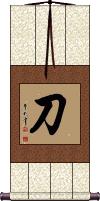
刀 is the Japanese Kanji for “sword.” This refers to the style of sword carried by warriors, samurai, and shogun of ancient Japan.
With the pacification of Japan, such swords are now only used for ceremony and decoration. The true art of sword-smithing is all but lost in Japan with new sword production dedicated to making inexpensive replicas for the tourist and foreign market.
For those of you that want to ask whether I can get you a real antique sword. Let me tell you that most real Asian swords were melted down after WWII in Japan, and during the Great Leap Forward in China. Any remaining swords are family heirlooms that nobody will part with.
Please carefully note that the Japanese kanji character shown above is only for a Japanese audience. In China, this character means “knife.” See our other entry for “sword” in Chinese.
Note: 刀 can mean knife, sword, or blade in Korean, depending on context.
See Also: Sword
Musashi
The most famous Samurai
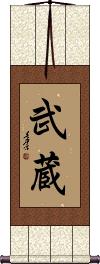
Miyamoto Musashi is probably the most famous Samurai in all of Japanese history.
武蔵 is the short title for a man long in legend. While coming from a lower class, his new sword and fighting techniques put him on par with the best that feudal Japan had to offer. His long career started with his first duel at age 13!
He is credited with using two swords at once and never losing a single battle in his career. After becoming a Buddhist, and getting older, like many old warriors, he took up a peaceful and solitary life until his death around 1645 A.D.
Note: Technically, Musashi is his given name, and Miyamoto is his surname. However, it's suggested that he assumed both of these names and had a few other names in childhood, as well as being given a Buddhist name. It's hard to know what to call him, as with most Kanji, there are multiple pronunciations. The characters for Musashi can also be pronounced Takezō. But everyone in modern times seems to know him by the name Musashi.
Shogun / Japanese General
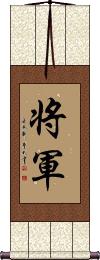
将軍 or Shogun, in the simplest definition, is a General, but you could also use words such as commander, lord, overlord, highest ranking, or commanding officer.
The title “Shogun” has held some slightly ambiguous meanings at times in Japanese history.
In the west, when someone mentions “Shogun,” we may be filled with thoughts of gallant warriors. Some might even think of the TV mini-series with Richard Chamberlain. Often westerners use the words, Samurai and Shogun interchangeably, but that's really not technically correct. In the case of the Samurai, the Shogun was a designated (by the emperor) leader of a gild of Samurai. In this context, the Shogun was a Samurai lord. Or effectively, a commanding officer of a company of Samurai - to put it in modern military terms.
Sometimes a Shogun was a general; other times, he was the leader of a military government in Japan - but not a front-line warrior like a Samurai.
Variants of the same characters are used in China for the rank and title of a General of the People's Liberation Army (and the same term and characters have been used for the last 2200 years since the Qin Dynasty).
This in-stock artwork might be what you are looking for, and ships right away...

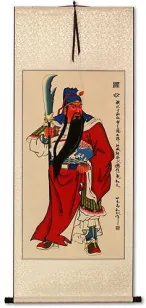
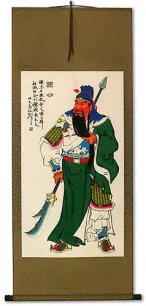
Gallery Price: $200.00
Your Price: $79.88
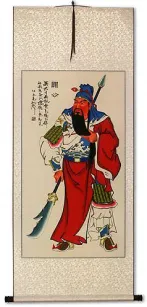
Gallery Price: $200.00
Your Price: $79.88
The following table may be helpful for those studying Chinese or Japanese...
| Title | Characters | Romaji (Romanized Japanese) | Various forms of Romanized Chinese | |
| Warriors of Light | 光の戦士 | hikari no senshi hikarinosenshi | ||
| Warriors: Quality Over Quantity | 兵在精而不在多 | bīng zài jīng ér bú zài duō bing1 zai4 jing1 er2 bu2 zai4 duo1 bing zai jing er bu zai duo bingzaijingerbuzaiduo | ping tsai ching erh pu tsai to pingtsaichingerhputsaito |
|
| Warriors Adapt and Overcome | 兵無常勢水無常形 兵无常势水无常形 | bīng wú cháng shì shuǐ wú cháng xíng bing1 wu2 chang2 shi4 shui3 wu2 chang2 xing2 bing wu chang shi shui wu chang xing | ping wu ch`ang shih shui wu ch`ang hsing ping wu chang shih shui wu chang hsing |
|
| The Value of Warriors Lies in Their Quality | 兵在精 | bīng zài jīng bing1 zai4 jing1 bing zai jing bingzaijing | ping tsai ching pingtsaiching |
|
| The Warrior’s Word, Dependable as Gold and Steel | 武士の一言、金鉄の如し | bushi no ichigon kintetsu no gotoshi | ||
| Warrior | 武士 | bu shi / bushi | wǔ shì / wu3 shi4 / wu shi / wushi | wu shih / wushih |
| Bushi Kai | 武士會 武士会 | bu shi kai / bushikai | ||
| Value of Warrior Generals | 兵在精而不在多將在謀而不在勇 兵在精而不在多将在谋而不在勇 | bīng zài jīng ér bú zài duō jiàng zài móu ér bú zài yǒng bing1 zai4 jing1 er2 bu2 zai4 duo1 jiang4 zai4 mou2 er2 bu2 zai4 yong3 bing zai jing er bu zai duo jiang zai mou er bu zai yong | ping tsai ching erh pu tsai to chiang tsai mou erh pu tsai yung | |
| Mighty Powerful Strong | 強大 强大 | kyoudai / kyodai | qiáng dà / qiang2 da4 / qiang da / qiangda | ch`iang ta / chiangta / chiang ta |
| Paladin | 聖騎士 圣骑士 | shèng qí shì sheng4 qi2 shi4 sheng qi shi shengqishi | sheng ch`i shih shengchishih sheng chi shih |
|
| Samurai | 侍 | samurai | shì / shi4 / shi | shih |
| Naginata Halberd | 薙刀 | naginata | ||
| In Flowers the Cherry Blossom, In Men the Samurai | 花は櫻木人は武士 花は桜木人は武士 | hana wa sakuragi hito wa bushi | ||
| Harmony Balance | 調和 调和 | chou wa / chouwa / cho wa | tiáo hé / tiao2 he2 / tiao he / tiaohe | t`iao ho / tiaoho / tiao ho |
| Hua Mulan | 花木蘭 花木兰 | huā mù lán hua1 mu4 lan2 hua mu lan huamulan | ||
| Bushido The Way of the Samurai | 武士道 | bu shi do / bushido | wǔ shì dào wu3 shi4 dao4 wu shi dao wushidao | wu shih tao wushihtao |
| Katana | 刀 | katana | dāo / dao1 / dao | tao |
| Musashi | 武蔵 | mu sashi / musashi | ||
| Shogun Japanese General | 將軍 将军 | shougun / shogun | jiāng jūn jiang1 jun1 jiang jun jiangjun | chiang chün chiangchün |
| In some entries above you will see that characters have different versions above and below a line. In these cases, the characters above the line are Traditional Chinese, while the ones below are Simplified Chinese. | ||||

Successful Chinese Character and Japanese Kanji calligraphy searches within the last few hours...



