Many custom options...


And formats...



Voice in Chinese / Japanese...
Buy a Voice calligraphy wall scroll here!
Personalize your custom “Voice” project by clicking the button next to your favorite “Voice” title below...
Voice of Heaven / Voices from Heaven
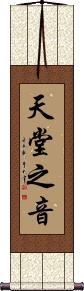
天堂之音 is a title that can be translated as either “voice of heaven” or “voices from heaven.”
The first two characters mean heaven.
The third character is a possessive article (kind of like making heaven into heaven's).
The last character means voice but can also mean sound.
Note: This can be pronounced in Korean, but it's not a commonly used term.
Word of God / The Gospel
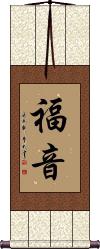
福音 is the Chinese, Korean and Japanese word for “Gospel” or “Word of God.”
福音 is a specifically Christian word in Asia (not used for any other religion).
The first character means blessing, good fortune, or good luck. This first character is a special character used throughout China to bring good tidings and fortune - especially during Chinese New Year. The second character means sound, noise, or news.
Together, these characters create a word that means “The Good News” or “The Sound of Good Fortune.”
When read by a Chinese or Japanese person, this word is always perceived as “The Christian Gospel,” “Word of God,” or even “The Voice of God.”
See Also: Christianity | Jesus Christ | God of Abraham
These search terms might be related to Voice:
3. Right Speech / Right Talk / Perfect Speech
State of Anarchy
Utter
Not the results for Voice that you were looking for?
Below are some entries from our dictionary that may match your Voice search...
| Characters If shown, 2nd row is Simp. Chinese |
Pronunciation Romanization |
Simple Dictionary Definition |
れる see styles |
reru れる |
(aux-v,v1) (1) indicates passive voice (incl. the "suffering passive"); (2) indicates the potential form; (3) indicates spontaneous occurrence; (4) (honorific or respectful language) used as an honorific for others' actions |
呺 see styles |
xiāo xiao1 hsiao |
voice of anger; vast; spacious |
咽 see styles |
yè ye4 yeh nondo のんど nomido のみど nomito のみと nodo のど |
to choke (in crying) (1) (kana only) throat; (2) singing voice |
啞 哑 see styles |
yǎ ya3 ya a |
mute; dumb; incapable of speech; (of a voice) hoarse; husky; (bound form) (of a bullet, bomb etc) dud eḍa, dumb; eḍamūka, deaf and dumb, unable to express oneself; translit. a, v. 阿. |
嗓 see styles |
sǎng sang3 sang |
throat; voice |
声 see styles |
chika ちか |
(1) {Buddh} (See 六境) voice; sound; (2) {ling} (also read せい) (See 四声,声点) tone (of Chinese character); tone mark; (3) stress (in pronunciation); intonation; accent; (female given name) Chika |
尖 see styles |
jiān jian1 chien togari とがり |
pointed; tapering; sharp; (of a sound) shrill; piercing; (of one's hearing, sight etc) sharp; acute; keen; to make (one's voice) shrill; sharp point; tip; the best of something; the cream of the crop (irregular okurigana usage) (kana only) diagonal move (in the game of go); (surname) Togari to be pointed |
態 态 see styles |
tài tai4 t`ai tai tai たい |
(bound form); appearance; shape; form; state; attitude; (grammar) voice (n,n-suf) (1) condition; figure; appearance; (n,n-suf) (2) {gramm} (See ボイス) voice attitude |
粗 see styles |
cū cu1 ts`u tsu hobo ほぼ |
(of something long) wide; thick; (of something granular) coarse; (of a voice) gruff; (of sb's manner etc) rough; crude; careless; rude (adverb) (kana only) almost; roughly; approximately; (1) leftovers (after filleting a fish); (2) rice chaff; (3) (kana only) flaw (esp. of a person); (prefix) (4) rough; roughly; (5) crude; raw; natural; wild; (surname) Hobo rough |
聲 声 see styles |
shēng sheng1 sheng shō こえ |
sound; voice; tone; noise; reputation; classifier for sounds (out-dated kanji) voice śabda. Sound, tone, voice, repute; one of the five physical senses or sensations, i.e. sound, the聲入, 聲根, or聲塵, cf. 六 and 十二入. |
脆 see styles |
cuì cui4 ts`ui tsui sumitomo すみとも |
brittle; fragile; crisp; crunchy; clear and loud voice; neat (personal name) Sumitomo weak |
艶 艳 see styles |
yàn yan4 yen yoshi よし |
variant of 豔|艳[yan4] (1) gloss; luster; lustre; shine; sheen; polish; (2) mellowness (of a voice); youthfulness (e.g. of skin); (3) interest; appeal; charm; color; colour; feeling; (4) romance; love; sexiness; (given name) Yoshi |
被 see styles |
bèi bei4 pei hi ひ |
quilt; to cover (with); (literary) to suffer (a misfortune); used to indicate passive voice (placed before the doer of the action like "by" in English passive-voice sentences, or, if the doer is not mentioned, before the verb); (since c. 2009) (sarcastic or jocular) used to indicate that the following word should be regarded as being in air quotes (as in 被旅遊|被旅游[bei4 lu : 3 you2] to "go on a trip") (prefix noun) indicates being the subject or receiver of an action, decision, etc.; -ee (e.g. employee, examinee, trustee) A quilt, coverlet; to cover; to suffer; sign of the passive. |
響 响 see styles |
xiǎng xiang3 hsiang rizumu りずむ |
echo; sound; noise; to make a sound; to sound; to ring; loud; classifier for noises (irregular okurigana usage) (1) echo; reverberation; (2) sound (esp. the distinctive sound of an object or activity, e.g. rain, gun, gallop, drum); noise; (3) quality of a sound (e.g. a fine phrase, clear voice, resonant bell); feeling of a sound; emotion or feeling inspired by something heard or read; (female given name) Rizumu pratiśrut. Echo, resonance. |
鳴 鸣 see styles |
míng ming2 ming mei / me めい |
to cry (of birds, animals and insects); to make a sound; to voice (one's gratitude, grievance etc) (female given name) Mei Cry, sound, note of a bird, etc.; Oh ! alas ! to wail. |
鴬 see styles |
ou / o おう |
(1) (kana only) Japanese bush warbler (Horornis diphone); Japanese nightingale; (2) (abbreviation) greenish brown; (prefix noun) (3) having a beautiful voice; (personal name) Ou |
鶯 莺 see styles |
yīng ying1 ying uguisu うぐいす |
oriole or various birds of the Sylvidae family including warblers (1) (kana only) Japanese bush warbler (Horornis diphone); Japanese nightingale; (2) (abbreviation) greenish brown; (prefix noun) (3) having a beautiful voice; (surname) Uguisu |
齆 see styles |
wèng weng4 weng |
stuffy (nose); nasal (voice) |
齉 see styles |
nàng nang4 nang |
stuffy (nose); nasal (voice) |
CV see styles |
shii bui; shiibui(sk) / shi bui; shibui(sk) シー・ブイ; シーブイ(sk) |
(See キャラクターボイス) voice actor |
OS see styles |
o s o s o s oo esu; ooesu(sk) オー・エス; オーエス(sk) |
(in a soap opera or movie) voice-over that makes a character's unspoken thoughts audible to the audience {comp} operating system; OS |
〆る see styles |
shimeru しめる |
(aux-v,v1) (1) (form) auxiliary verb indicating the causative voice; (aux-v,v1) (2) (form) auxiliary verb indicating the permissive voice; (aux-v,v1) (3) (honorific or respectful language) (form) (when used together with other honorific auxiliaries) auxiliary verb strengthening the honorific notion |
一声 see styles |
issei / isse いっせい |
voice; cry; shout; (given name) Issei |
三密 see styles |
sān mì san1 mi4 san mi sanmitsu さんみつ |
{Buddh} three mysteries (Buddha's body, speech and mind) The three mystic things: the body, mouth (i.e. voice), and mind of the Tathāgata, which are universal, all things being this mystic body, all sound this mystic voice, and all thought this mystic mind. All creatures in body, voice, and mind are only individualized parts of the Tathāgata, but illusion hides their Tathāgata nature from them. The esoterics seek to realize their Tathāgata nature by physical signs and postures, by voicing of 眞言 dhāraṇī and by meditations, so that 入我我入 He may enter me and I Him, which is the perfection of siddhi 悉地; v. 大日經疏 1. 菩提心論. |
三醫 三医 see styles |
sān yī san1 yi1 san i san'i |
The three modes of diagnosis: the superior, 聽聲 listening to the voice; the medium, 相色 observing the external appearance; the inferior 診脈 testing the pulse. |
乙張 see styles |
merihari めりはり |
(noun - becomes adjective with の) (1) (kana only) modulation (of voice); (2) variation; variety; (3) liveliness; full-bodied |
乾澀 干涩 see styles |
gān sè gan1 se4 kan se |
dry and rough (skin); hoarse (voice); dry and heavy (style) |
人声 see styles |
jinsei / jinse じんせい |
human voice; cry; (given name) Jinsei |
仙音 see styles |
xiān yīn xian1 yin1 hsien yin sen'on |
The voice of Buddha. |
低い see styles |
hikui(p); hikkui(sk) ひくい(P); ひっくい(sk) |
(adjective) (1) (ant: 高い・1) low (rank, degree, value, content, quality, etc.); (adjective) (2) low (position); close to the ground; (adjective) (3) short (height); (adjective) (4) deep (voice); in a low key; low (volume) |
Click here for more Voice results from our dictionary
The following table may be helpful for those studying Chinese or Japanese...
| Title | Characters | Romaji (Romanized Japanese) | Various forms of Romanized Chinese | |
| Voice of Heaven Voices from Heaven | 天堂之音 | tiān táng zhī yīn tian1 tang2 zhi1 yin1 tian tang zhi yin tiantangzhiyin | t`ien t`ang chih yin tientangchihyin tien tang chih yin |
|
| Word of God The Gospel | 福音 | fukuin | fú yīn / fu2 yin1 / fu yin / fuyin | |

Successful Chinese Character and Japanese Kanji calligraphy searches within the last few hours...



