Many custom options...


And formats...



Vast in Chinese / Japanese...
Buy a Vast calligraphy wall scroll here!
Personalize your custom “Vast” project by clicking the button next to your favorite “Vast” title below...
2. Hao
4. Oasis
5. Ocean
6. Kodokan
7. Longevity / Long Life Wishes
8. Dragon
9. Achieve Inner Peace; Find Deep Understanding
10. Tibet
11. Sangha
12. A Life of Serenity Yields Understanding
13. Islam
A Vast Sky Full of Stars
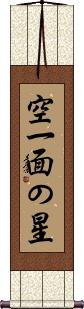
空一面の星 is a Japanese phrase that refers to the sky being like a vast page or face full of stars.
A Vast Sky Full of Stars
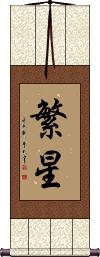
繁星 is a title that literally means a cluster or huge number of stars in the sky.
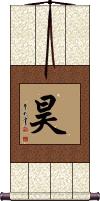
This means vast and limitless or the vast sky.
昊 is also a Chinese surname that romanizes as Hao.
In Japanese, this can be the given names Hiroshi, Takashi, Sora, or Atsushi.
Five Red Bats
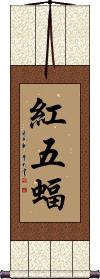
紅五蝠 is a play on words in Chinese because of some homophones.
The first thing you need to know is that the word for bat, 蝠, sounds exactly like the word for good fortune, 福. Thus, bats are often associated with good luck and good fortune in Chinese culture.
Five bats (五福 / 五蝠) means “five fortunes,” referring to luck, prosperity, wealth, happiness, and longevity.
The word red, 红, has the same sound as 宏 meaning vast, great, or magnificent. Therefore, a red bat means “vast fortune.”
Altogether, five red bats represent vast reaches of the five fortunes.
Oasis
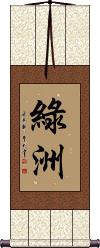
綠洲 is the Chinese word for an oasis, as in refuge with water amid a vast desert.
Ocean
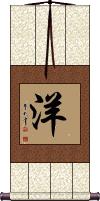
This is the Chinese and old Korean Hanja word for ocean. This can be pronounced in Japanese, and has the same meaning but is rarely seen alone in Japanese.
Besides ocean or sea, this character can also mean foreign, wide, or vast.
It's more common for Chinese people to use a different word “hai” for ocean or sea.
Kodokan
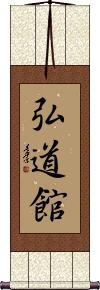
弘道館 is a Japanese title that romanizes as Kodokan.
There are a few martial arts titles that are romanized as Kodokan, so be careful to choose the correct one. This one kind of means “Great Way Hall.”
In the old Buddhist context, the 弘 Kanji can mean vast, great, to enlarge, spread abroad, or widely to proclaim.
The 道 part is the “Way,” as seen in many martial arts titles. It is the root character of Taoism/Daoism (romanized as Tao or Dao from Chinese, but Do in Japanese).
The 館 or hall part is implied to be a dojo or place of learning.
Longevity / Long Life Wishes
A wish for a long and prosperous life
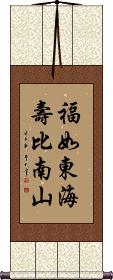
福如東海壽比南山 is a phrase that means “May you have good fortune as great as the eastern oceans, and may your life last as long as the southern mountains.”
In ancient Chinese mythology, the eastern oceans and southern mountains are where God resides (basically it is the same as saying “heaven”). So it's like saying, “May your good fortune and life be as vast as the heavens.”
There is also a longer, 14-character version of this phrase. Also, this can be cut into two scrolls (with half the phrase on each side - great for hanging on either side of a doorway). Just let me know if you'd like a special version (there is an additional cost).
Dragon
Year of the Dragon / Zodiac Sign
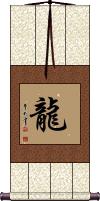
龍 is the character for dragon in Chinese, old Korean Hanja, and Japanese Kanji.
The dragon is a creature of myth and legend that dominates Chinese, Japanese, and even European folklore. In China, the dragon is the symbol of the Emperor, strength, and power, and the Chinese dragon is known as the god of water.
From the Chinese Zodiac, if you were born in the year of the Dragon, you . . .
Have a strong body and spirit.
Are full of energy.
Have vast goals.
Have a deep level of self-awareness.
Will do whatever you can to “save face.”
See also our Chinese Zodiac or Dragon Calligraphy pages.
Achieve Inner Peace; Find Deep Understanding
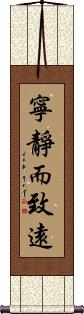
寧靜而致遠 is five characters from a longer ten-character proverb composed by Zhuge Liang about 1800 years ago.
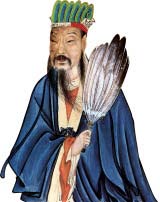
诸葛亮 Zhuge Liang
The proverb means “Your inner peace/tranquility/serenity will help you see or reach far (into the world).”
The last word means “far” but the deeper meaning is that you will surpass what you can currently see or understand. Perhaps even opening up vast knowledge and understanding of complex ideas.
Tibet
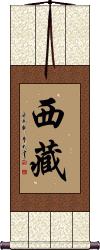
西藏 is the Chinese and Japanese name for Tibet.
It is a vast area in southwest China for which the Chinese government has little control (except in the capital of Llasa). During your travels in Tibet (outside of Llasa) you will find it is rough country full of ruthless bandits and honorable and upright Living Buddhas. There are about 2000 Living Buddhas in Tibet, and at least 10 times more bandits ready to ambush you on the road or trail.
On the eastern frontier of Tibet, you will find the place designated to be Shangri-la. It's a friendly village of Tibetans and is the gateway to greater Tibet.
The full official Chinese name is Tibet Autonomous Region or 西藏自治區|西藏自治区. The name here, 西藏 is quite old - from several dynasties ago.
Sangha
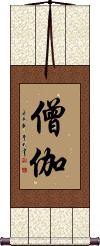
In Buddhism, 僧伽 refers to a community of monks and/or nuns (one of the “Three Jewels”). In general terms, it can simply mean “all followers of the Buddha.”
Notes: Though there are not vast numbers of Chinese Hindus, in the Hindu faith, this term means “community together.”
The original Sanskrit word is also Romanized as samgha.
The first character means “monk.” The second character means Buddha or Shakyamuni.
僧伽 is a transliteration of the original Sanskrit, but it uses two very profound Chinese characters related to Buddhism.
Some may pronounce this as “seng qie” or “seng jia” in Mandarin (two possible pronunciations for the second character). Note that “qie” sounds like “chee-ah” using typical English pronunciation. Chinese Romanization is not actually designed to match English sounds.

 Note that when writing this as Kanji, Japanese will tend to write the first character in the form shown to the right. If you select our Japanese master calligrapher, please expect this special Kanji form. However, it should also be noted that this is not a common term in Japanese (except by certain sects of Buddhism or perhaps devout Buddhists in Japan).
A Life of Serenity Yields Understanding
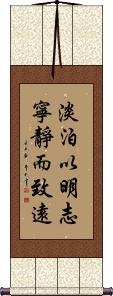
淡泊以明志寧靜而致遠 is a kind of complex ten-character proverb composed by Zhuge Liang about 1800 years ago.
淡泊以明志寧靜而致遠 is a Chinese proverb that means “Leading a simple life will yield a clear mind, and having inner peace will help you see far (into the world).”
What I have translated as “simple life” means NOT being materialistic and NOT competing in the rat race.
The last word means “far” but the deeper meaning is that you will surpass what you can currently see or understand. Perhaps even the idea of opening up vast knowledge and understanding of complex ideas.
The whole phrase has a theme that suggests that if you are NOT an aggressive, cut-throat person who fights their way to the top, no matter how many people they crush along the way, and instead seek inner peace, you will have a happier existence and be more likely to understand the meaning of life.
See Also: Serenity
Islam
(phonetic version)
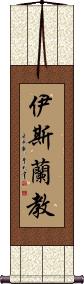
伊斯蘭教 both means and sounds like “Islam” in Mandarin Chinese.
The first three characters sound like the word “Islam,” and the last character means “religion” or “teaching.” It's the most general term for “Islam” in China. The highest concentration of Muslims in China is Xinjiang (the vast region in northwest China that was called The East Turkistan Republic until 1949 and is sometimes called Chinese Turkistan, Uyghuristan). Here you will find Uygurs, Kazakhs, Kyrgyz, and others that are descendants of Turkmen (possibly mixed with Persians and Arabs). Many of their ancestors were traders who traveled the silk road to buy and sell spices and silk and exchange other goods from the Orient and the Middle East.
I spent some time in Xinjiang and got to know this community. They are strong people who can endure much. They are friendly and love to have a good time. I was a stranger but was treated by villagers (near China's border with Afghanistan) as if I was a good friend.
However, I have heard that it's best not to cross them, as in this land, the law is the blade, and everything is “eye for an eye.” The Chinese government has little control in Xinjiang, with almost no police officers except in the capital of Urumqi (so it's a 60-hour roundtrip train ride to seek the aid of law enforcement in most cases).
While few seem devout, there are at least small mosques in every village. And you will never see a man or woman outside without a head covering.
It should be noted that these people are all citizens of China, but they are officially of the Caucasian race. A visit to Xinjiang will change your idea of what it means to be Chinese.
Wing Chun Fist Maxims
Wing Chun Kuen Kuit
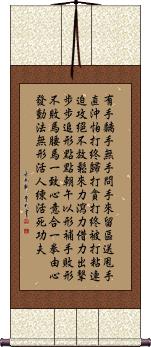
This text is the chant or poem of Wing Chun.
I call it a “chant” because it was meant to be a somewhat rhythmic poem to help practitioners memorize many aspects of Wing Chun.
1 有手黐手,無手問手
2 來留區送, 甩手直沖
3 怕打終歸打, 貪打終被打
4 粘連迫攻, 絕不放鬆
5 來力瀉力, 借力出擊
6 步步追形, 點點朝午
7 以形補手, 敗形不敗馬
8 腰馬一致, 心意合一
9 拳由心發, 動法無形
10 活人練活死功夫
You will see this referred to as “Wing Chun Kuem Kuit.” This Cantonese romanization is popular in the west (and there is no official way to romanize Cantonese, so many variations exist). In Mandarin, it would be, “Yong Chun Quan Jue.” The last character (kuit or kyut from Cantonese, jue or chüeh from Mandarin) kind of means “secrets of the art.” It's a short way to write 口訣, meaning “mnemonic chant” or “rhyme for remembering.”
In the west (especially in the military), we often use acronyms to remember things. There are no initials to make acronyms in Chinese, so in ancient times, chants like this are used to remember vast amounts of information.
I will presume you already know the meaning of the 10 maxims, so I will skip that to keep this calligraphy entry from getting too large.
Some think 练拳者必记 is the title but that just says, “(When) training (the) fist, people should remember:.” Therefore, I've not included that in the calligraphy. However, you can put a note in the special instructions if you want it added.
Note: On a traditional calligraphy wall scroll, the characters will be written in vertical columns, starting from the right, and proceeding left.
Note: This is an except and variation from a huge 口訣. These 10 maxims are used extensively in Wing Chun training, and you’ll find them all over the internet. Just know there is a much longer version out there, along with several variations and excepts like this one. If you know of, or want a different version, just contact me, and I will add it for you.
These search terms might be related to Vast:
Big Dream / Great Hope
Daimyo / Great Name
Door of Great Wisdom
Grand Master / Great Teacher
Great Ambitions
Great Aspirations / Ambition
Great Britain
Great Endeavor / to Strive
Great Expectations
Great Illumination of Wisdom
Great Lord / Tycoon
Great Lotus Wisdom - Samadhi Wisdom
Great Peace
Great Power
Great Responsibility
Great Sea
Great Wisdom
Greatest Infinite Love
Heroic Spirit / Great Ambition
I Climbed the Great Wall
Immeasurable / Unlimited
In the Abyss of Infinite Bitterness - Turn to the Shore
Infinite Love
Infinity / Infinite / Endless / Boundless
Infinity / Infinite / Unlimited / Unbounded
The Great Path Has No Gate
The Great Wall of China
Words Have Enormous Weight: One Word Worth Nine Caldrons
The following table may be helpful for those studying Chinese or Japanese...
| Title | Characters | Romaji (Romanized Japanese) | Various forms of Romanized Chinese | |
| A Vast Sky Full of Stars | 空一面の星 | sora ichimen no hoshi soraichimennohoshi | ||
| A Vast Sky Full of Stars | 繁星 | fán xīng / fan2 xing1 / fan xing / fanxing | fan hsing / fanhsing | |
| Hao | 昊 | hiroshi | hào / hao4 / hao | |
| Five Red Bats | 紅五蝠 红五蝠 | hóng wǔ fú hong2 wu3 fu2 hong wu fu hongwufu | hung wu fu hungwufu |
|
| Oasis | 綠洲 绿洲 | lǜ zhōu / lv4 zhou1 / lv zhou / lvzhou | lü chou / lüchou | |
| Ocean | 洋 | you / yo | yáng / yang2 / yang | |
| Kodokan | 弘道館 | koudoukan / kodokan | ||
| Longevity Long Life Wishes | 福如東海壽比南山 福如东海寿比南山 | fú rú dōng hǎi shòu bǐ nán shān fu2 ru2 dong1 hai3 shou4 bi3 nan2 shan1 fu ru dong hai shou bi nan shan furudonghaishoubinanshan | fu ju tung hai shou pi nan shan fujutunghaishoupinanshan |
|
| Dragon | 龍 龙 | ryuu / tatsu ryu / tatsu | lóng / long2 / long | lung |
| Achieve Inner Peace; Find Deep Understanding | 寧靜而致遠 宁静而致远 | níng jìng ér zhì yuǎn ning2 jing4 er2 zhi4 yuan3 ning jing er zhi yuan ningjingerzhiyuan | ning ching erh chih yüan ningchingerhchihyüan |
|
| Tibet | 西藏 | seizou / chibetto seizo / chibetto | xī zàng / xi1 zang4 / xi zang / xizang | hsi tsang / hsitsang |
| Sangha | 僧伽 | sougya / sogya | sēng qié / seng1 qie2 / seng qie / sengqie | seng ch`ieh / sengchieh / seng chieh |
| A Life of Serenity Yields Understanding | 淡泊以明志寧靜而致遠 淡泊以明志宁静而致远 | dàn bó yǐ míng zhì, níng jìng ér zhì yuǎn dan4 bo2 yi3 ming2 zhi4, ning2 jing4 er2 zhi4 yuan3 dan bo yi ming zhi, ning jing er zhi yuan | tan po i ming chih, ning ching erh chih yüan | |
| Islam | 伊斯蘭教 伊斯兰教 | yī sī lán jiào yi1 si1 lan2 jiao4 yi si lan jiao yisilanjiao | i ssu lan chiao issulanchiao |
|
| Wing Chun Fist Maxims | 有手黐手無手問手來留區送甩手直沖怕打終歸打貪打終被打粘連迫攻絕不放鬆來力瀉力借力出擊步步追形點點朝午以形補手敗形不敗馬腰馬一致心意合一拳由心發動法無形活人練活死功夫 有手黐手无手问手来留区送甩手直冲怕打终归打贪打终被打粘连迫攻绝不放松来力泻力借力出击步步追形点点朝午以形补手败形不败马腰马一致心意合一拳由心发动法无形活人练活死功夫 | |||
| In some entries above you will see that characters have different versions above and below a line. In these cases, the characters above the line are Traditional Chinese, while the ones below are Simplified Chinese. | ||||

Successful Chinese Character and Japanese Kanji calligraphy searches within the last few hours...



