Many custom options...


And formats...



Torn in Chinese / Japanese...
Buy a Torn calligraphy wall scroll here!
Broken Mirror Rejoined
Used in modern times for divorced couples that come back together
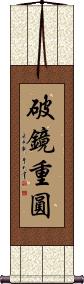
破鏡重圓 is about a husband and wife who were separated and reunited.
About 1500 years ago in China, there lived a beautiful princess named Le Chang. She and her husband Xu De Yan loved each other very much. But when the army of the Sui Dynasty was about to attack their kingdom, disposed of all of their worldly possessions and prepared to flee into exile.
They knew that in the chaos, they might lose track of each other, so the one possession they kept was a bronze mirror which is a symbol of unity for a husband and wife. They broke the mirror into two pieces, and each of them kept half of the mirror. They decided that if separated, they would try to meet at the fair during the 15th day of the first lunar month (which is the lantern festival). Unfortunately, the occupation was brutal, and the princess was forced to become the mistress of the new commissioner of the territory, Yang Su.
At the Lantern Festival the next year, the husband came to the fair to search for his wife. He carried with him his half of the mirror. As he walked through the fair, he saw the other half of the mirror for sale at a junk market by a servant of the commissioner. The husband recognized his wife's half of the mirror immediately, and tears rolled down his face as he was told by the servant about the bitter and loveless life that the princess had endured.
As his tears dripped onto the mirror, the husband scratched a poem into his wife's half of the mirror:
You left me with the severed mirror,
The mirror has returned, but absent are you,
As I gaze in the mirror, I seek your face,
I see the moon, but as for you, I see not a trace.
The servant brought the inscribed half of the mirror back to the princess. For many days, the princess could not stop crying when she found that her husband was alive and still loved her.
Commissioner Yang Su, becoming aware of this saga, realized that he could never obtain the princess's love. He sent for the husband and allowed them to reunite.
This proverb, 破鏡重圓, is now used to describe a couple who has been torn apart for some reason (usually divorce) but have come back together (or remarried).
It seems to be more common these days in America for divorced couples to reconcile and get married to each other again. This will be a great gift if you know someone who is about to remarry their ex.
Not the results for Torn that you were looking for?
Below are some entries from our dictionary that may match your Torn search...
| Characters If shown, 2nd row is Simp. Chinese |
Pronunciation Romanization |
Simple Dictionary Definition |
繻 𦈡 see styles |
xū xu1 hsü |
multicolored silk; piece of silk torn in two, used to verify the holder's identity by matching up the two halves |
乱離 see styles |
ranri らんり |
(adj-t,adv-to,adj-no) dispersed (of citizens in a war-torn country, etc.) |
併攏 并拢 see styles |
bìng lǒng bing4 long3 ping lung |
to draw together; to place side by side (e.g. one's fingers, two halves of a torn sheet of paper etc) |
弊垢 see styles |
bì gòu bi4 gou4 pi kou heiku |
torn and dirty |
裂裳 see styles |
liè cháng lie4 chang2 lieh ch`ang lieh chang resshō |
The torn robe (of Buddhism), i.e. split into eighteen pieces, like the Hīnayāna sects. |
金杖 see styles |
jīn zhàng jin1 zhang4 chin chang konjō |
The golden staff broken into eighteen pieces and the skirt similarly torn, seen in a dream by king Bimbisāra, prophetic of the eighteen divisions of Hīnayāna. |
もげる see styles |
mogeru もげる |
(v1,vi) (kana only) to be torn off; to come off |
乾陀羅 干陀罗 see styles |
gān tuó luó gan1 tuo2 luo2 kan t`o lo kan to lo Kendara |
(or 乾陀越 or 乾陀衞 or 乾陀婆那) Gandhāra, an ancient kingdom in the north of the Punjab, 'Lat. 35° 5N., Long. 71°16E. ' ( Eitel); famous as a centre of Buddhism. Śākyamuni, in a former life, is said to have lived there and torn out his eyes to benefit others, 'probably a distortion of the story of Dharmavivardhana, who as governor of Gandhāra was blinded by order of a concubine of his father, Aśoka. ' Eitel. M. W. associates Gandhāra with Kandahar. Also, name of a fragrant tree, and of a yellow colour. |
割れる see styles |
wareru われる |
(v1,vi) (1) to break; to be smashed; (2) to split; to crack; to fissure; to be torn; (3) to be divided; to cleave; (4) to come to light; to be identified; to be established; to become clear |
弊垢衣 see styles |
bì gòu yī bi4 gou4 yi1 pi kou i heiku e |
torn and dirty clothes |
捥げる see styles |
mogeru もげる |
(v1,vi) (kana only) to be torn off; to come off |
板挟み see styles |
itabasami いたばさみ |
being stuck between a rock and a hard place; being in a dilemma; being torn between conflicting demands |
板挾み see styles |
itabasami いたばさみ |
being stuck between a rock and a hard place; being in a dilemma; being torn between conflicting demands |
永定門 永定门 see styles |
yǒng dìng mén yong3 ding4 men2 yung ting men |
Yongdingmen, front gate of the outer section of Beijing's old city wall, torn down in the 1950s and reconstructed in 2005 |
破ける see styles |
yabukeru やぶける |
(v1,vi) to get torn; to wear out; to be frustrated; to break |
破れる see styles |
yabureru やぶれる |
(v1,vi) (1) to get torn; to tear; to rip; to break; to wear out; (v1,vi) (2) to be broken off (of negotiations, etc.); to break down; to collapse; to fall into ruin |
破れ傘 see styles |
yaburegasa; yaburegasa やぶれがさ; ヤブレガサ |
(1) broken umbrella; torn umbrella; (2) (kana only) shredded umbrella plant (Syneilesis palmata) |
紛争国 see styles |
funsoukoku / funsokoku ふんそうこく |
country in conflict; war-torn country |
綻びる see styles |
hokorobiru ほころびる |
(v1,vi) (1) (kana only) (See 綻ぶ・ほころぶ・3) to come apart at the seams; to be ripped; to be torn; (v1,vi) (2) (kana only) (See 綻ぶ・ほころぶ・1) to begin to open; to begin to bloom; (v1,vi) (3) (kana only) (See 綻ぶ・ほころぶ・2) to smile broadly; to break into a smile |
肉離れ see styles |
nikubanare にくばなれ |
(n,vs,vi) pulled or torn muscle |
點斷式 点断式 see styles |
diǎn duàn shì dian3 duan4 shi4 tien tuan shih |
designed to be torn off along a line of perforations |
七花八裂 see styles |
shichikahachiretsu しちかはちれつ |
(noun/participle) being torn to pieces |
兵荒馬亂 兵荒马乱 see styles |
bīng huāng mǎ luàn bing1 huang1 ma3 luan4 ping huang ma luan |
(idiom) war-torn; ravaged by war; in a state of utter chaos |
兵連禍結 兵连祸结 see styles |
bīng lián huò jié bing1 lian2 huo4 jie2 ping lien huo chieh |
ravaged by successive wars; war-torn; war-ridden |
千切れる see styles |
chigireru ちぎれる |
(v1,vi) (1) (kana only) to be torn off; to come off; (v1,vi) (2) (kana only) to be torn to pieces; to be torn to shreds |
四分五裂 see styles |
sì fēn wǔ liè si4 fen1 wu3 lie4 ssu fen wu lieh shibungoretsu; shibugoretsu しぶんごれつ; しぶごれつ |
(idiom) fragmented; scattered; in disarray; at sixes and sevens (n,vs,vi) (yoji) torn asunder; disrupted and disorganized |
心如刀割 see styles |
xīn rú dāo gē xin1 ru2 dao1 ge1 hsin ju tao ko |
to feel as if having one's heart cut out (idiom); to be torn with grief |
板ばさみ see styles |
itabasami いたばさみ |
being stuck between a rock and a hard place; being in a dilemma; being torn between conflicting demands |
等活地獄 等活地狱 see styles |
děng huó dì yù deng3 huo2 di4 yu4 teng huo ti yü toukatsujigoku / tokatsujigoku とうかつじごく |
{Buddh} (See 八大地獄・はちだいじごく) Sañjīva (one of the Eight Greater Hells); hell of being torn to pieces and revived over and over The first of the eight hot hells, in which the denizens are chopped, stabbed, ground, and pounded, but by a cool wind are brought back to life, to undergo renewed torment. Also 更活. |
粉身碎骨 see styles |
fěn shēn suì gǔ fen3 shen1 sui4 gu3 fen shen sui ku |
lit. torn body and crushed bones (idiom); fig. to die horribly; to sacrifice one's life |
Click here for more Torn results from our dictionary
The following table may be helpful for those studying Chinese or Japanese...
| Title | Characters | Romaji (Romanized Japanese) | Various forms of Romanized Chinese | |
| Broken Mirror Rejoined | 破鏡重圓 破镜重圆 | pò jìng chóng yuán po4 jing4 chong2 yuan2 po jing chong yuan pojingchongyuan | p`o ching ch`ung yüan pochingchungyüan po ching chung yüan |
|
| In some entries above you will see that characters have different versions above and below a line. In these cases, the characters above the line are Traditional Chinese, while the ones below are Simplified Chinese. | ||||

Successful Chinese Character and Japanese Kanji calligraphy searches within the last few hours...



