Many custom options...


And formats...



Tone in Chinese / Japanese...
Buy a Tone calligraphy wall scroll here!
Win / Victory
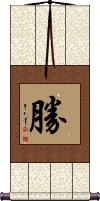
勝 is a single character that means to win or be victorious.
This can also be translated: To overcome; success; to beat; to defeat; to surpass; superior to; to get the better of; better than; surpassing; superb.
In another context, this can mean beautiful (scenery); scenic spot; or scenic beauty.
In Taiwanese Mandarin, this can be pronounced with the first tone (sheng1) and mean: Able to bear; equal to (a task).
In Japan, this can also be the name Masaru.
In Korea, this has the same meaning but can also be the surname Sŭng.
This in-stock artwork might be what you are looking for, and ships right away...
Not the results for Tone that you were looking for?
Below are some entries from our dictionary that may match your Tone search...
| Characters If shown, 2nd row is Simp. Chinese |
Pronunciation Romanization |
Simple Dictionary Definition |
律 see styles |
lǜ lu:4 lü ritsuji りつじ |
More info & calligraphy: Ritsu(1) law (esp. ancient East Asian criminal code); regulation; (2) {Buddh} vinaya (rules for the monastic community); (3) (abbreviation) (See 律宗) Ritsu (school of Buddhism); (4) (abbreviation) (See 律詩) lüshi (style of Chinese poem); (5) (also りち) (musical) pitch; (6) (See 十二律,呂・2) six odd-numbered notes of the ancient chromatic scale; (7) (abbreviation) (See 律旋) Japanese seven-tone gagaku scale, similar to Dorian mode (corresponding to: re, mi, fa, so, la, ti, do); (n,n-suf,ctr) (8) step (in traditional Eastern music, corresponding to a Western semitone); (personal name) Ritsuji vinaya, from vi-ni, to 1ead, train: discipline: v. 毘奈耶; other names are Prātimokṣa, śīla, and upalakṣa. The discipline, or monastic rules; one of the three divisions of the Canon, or Tripiṭaka, and said to have been compiled by Upāli. |
どーん see styles |
doon ドーン |
tone; (personal name) Dohrn |
の see styles |
no の |
(particle) (1) (occasionally ん, orig. written 乃 or 之) (See 乃) indicates possessive; (particle) (2) nominalizes verbs and adjectives; (particle) (3) (See が・1) substitutes for "ga" in subordinate phrases; (particle) (4) (often ん) (at sentence-end, falling tone) indicates a confident conclusion; (particle) (5) (feminine speech) (at sentence-end) indicates emotional emphasis; (particle) (6) (at sentence-end, rising tone) indicates question |
去 see styles |
qù qu4 ch`ü chü kyo |
to go; to go to (a place); (of a time etc) last; just passed; to send; to remove; to get rid of; to reduce; to be apart from in space or time; to die (euphemism); to play (a part); (when used either before or after a verb) to go in order to do something; (after a verb of motion indicates movement away from the speaker); (used after certain verbs to indicate detachment or separation) Go, go away; gone, past; depart, leave; to remove, dismiss; the 去 tone. |
反 see styles |
fǎn fan3 fan sori そり |
contrary; in reverse; inside out or upside down; to reverse; to return; to oppose; opposite; against; anti-; to rebel; to use analogy; instead; abbr. for 反切[fan3 qie4] phonetic system (prefix) (1) anti-; (2) (See 反定立) antithesis; (3) (abbreviation) (See 反切) fanqie; traditional Chinese spelling system in which two characters are used: the first one for the onset, the second one for rhyme and tone; (surname) Sori To turn over, turn or send back; contrary; to rebel. |
呂 吕 see styles |
lǚ lu:3 lü roi ろい |
pitchpipe, pitch standard, one of the twelve semitones in the traditional tone system (1) (abbreviation) {music} bass range (in Japanese music); (2) (See 十二律,律・6) six even-numbered notes of the ancient chromatic scale; (3) (See 呂旋) Japanese seven-tone gagaku scale similar to Mixolydian mode (corresp. to: re, mi, fa, so, la, ti, do); (surname) Roi |
嘞 see styles |
lei lei5 lei |
sentence-final particle similar to 了[le5], but carrying a tone of approval |
声 see styles |
chika ちか |
(1) {Buddh} (See 六境) voice; sound; (2) {ling} (also read せい) (See 四声,声点) tone (of Chinese character); tone mark; (3) stress (in pronunciation); intonation; accent; (female given name) Chika |
挫 see styles |
cuò cuo4 ts`o tso |
obstructed; to fail; to oppress; to repress; to lower the tone; to bend back; to dampen |
格 see styles |
gé ge2 ko wataru わたる |
square; lattice; grid; frame; compartment; partition; slot (within a larger unit); (bound form) standard; norm; specification; (bound form) character; disposition; moral quality; style; aesomethingetic tone; (bound form) rhetorical form; stylistic pattern; (bound form) (linguistics) grammatical case; (literary) to correct; to rectify; (literary) to arrive at; to reach; (literary) to obstruct; to hinder; (literary) to investigate exhaustively; classifier for compartments, slots or cells within a larger unit (hist) (See 律令) amendment (to ritsuryō); (given name) Wataru A rule, line, pattern; reach, research, science. |
聲 声 see styles |
shēng sheng1 sheng shō こえ |
sound; voice; tone; noise; reputation; classifier for sounds (out-dated kanji) voice śabda. Sound, tone, voice, repute; one of the five physical senses or sensations, i.e. sound, the聲入, 聲根, or聲塵, cf. 六 and 十二入. |
音 see styles |
yīn yin1 yin riri りり |
sound; noise; note (of musical scale); tone; news; syllable; reading (phonetic value of a character) (n,n-suf) (1) sound; noise; (2) (speech) sound; (3) (See 訓・1) Chinese-derived reading of a kanji; (female given name) Riri Sound, note, that which is heard. |
KY see styles |
ky ky ky keewai; keiwai(sk) / keewai; kewai(sk) ケーワイ; ケイワイ(sk) |
(slang) socially tone-deaf; unable to read the room (from Japanese KY, acronym of 空気が読めない "kuuki ga yomenai") (noun or adjectival noun) (1) (slang) (abbreviation) (from 空気 (kūki) and 読めない (yomenai)) (See 空気が読めない) unable to read the situation; unable to pick up on the mood (e.g. of a conversation); person who is unable to read the room; (2) (abbreviation) (from 危険 (kiken) and 予知 (yochi)) danger prevention (e.g. in the workplace) |
一下 see styles |
yī xià yi1 xia4 i hsia ichishita いちした |
(after a verb) a bit; a little (indicating brief duration, or softening the tone, or suggesting giving something a try); all at once; suddenly (See 命令一下・めいれいいっか) something handed down (usu. an order); (surname) Ichishita (to) strike once |
一度 see styles |
yī dù yi1 du4 i tu ittaku いったく |
for a time; at one time; one time; once (adverbial noun) (1) once; one time; on one occasion; (2) temporarily; for a moment; (adverbial noun) (1) once; one time; on one occasion; (2) one degree; one tone; one musical interval; (surname) Ittaku |
一聲 一声 see styles |
yī shēng yi1 sheng1 i sheng |
first tone in Mandarin (high, level tone) See: 一声 |
上声 see styles |
joushou / josho じょうしょう |
(1) rising tone (in Chinese); (2) (of a Japanese accent) having a high, flat tone |
上聲 上声 see styles |
shǎng shēng shang3 sheng1 shang sheng |
falling and rising tone; third tone in modern Mandarin See: 上声 |
中音 see styles |
chuuon / chuon ちゅうおん |
(1) {music} mediant; (2) baritone; contralto; (3) medium tone; medium pitch |
主音 see styles |
zhǔ yīn zhu3 yin1 chu yin shuon しゅおん |
keynote; principal tone; tonic; vowel {music} tonic; keynote |
二聲 二声 see styles |
èr shēng er4 sheng1 erh sheng |
second tone See: 二声 |
人気 see styles |
ninki にんき |
(noun - becomes adjective with の) (1) popularity; public favor; (2) condition (e.g. market); tone; character; nature |
仄声 see styles |
sokusei / sokuse そくせい |
(See 平声・1) oblique tones (the three tones of Chinese that exclude the high-level, or first, tone) |
仄聲 仄声 see styles |
zè shēng ze4 sheng1 tse sheng |
oblique tone; nonlevel tone; uneven tone (the third tone of Classical Chinese) See: 仄声 |
仄韻 see styles |
sokuin そくいん |
(See 仄声,平韻) oblique-tone rhyme (of Chinese) |
低調 低调 see styles |
dī diào di1 diao4 ti tiao teichou / techo ていちょう |
low pitch; quiet (voice); subdued; low-key; low-profile (noun or adjectival noun) inactive; slow; sluggish; slack; low tone; undertone; dullness; (market) weakness |
低音 see styles |
dī yīn di1 yin1 ti yin teion / teon ていおん |
bass low tone; bass; low voice |
佗歌 see styles |
wabiuta わびうた |
sad song; singing in a lonesome tone |
促聲 促声 see styles |
cù shēng cu4 sheng1 ts`u sheng tsu sheng |
entering tone (synonym of 入聲|入声[ru4 sheng1]) |
入声 see styles |
nisshou; nissei / nissho; nisse にっしょう; にっせい |
entering tone (in Chinese) |
Click here for more Tone results from our dictionary
The following table may be helpful for those studying Chinese or Japanese...
| Title | Characters | Romaji (Romanized Japanese) | Various forms of Romanized Chinese | |
| Win Victory | 勝 胜 | shou / sho | shèng / sheng4 / sheng | |
| In some entries above you will see that characters have different versions above and below a line. In these cases, the characters above the line are Traditional Chinese, while the ones below are Simplified Chinese. | ||||

Successful Chinese Character and Japanese Kanji calligraphy searches within the last few hours...



