Many custom options...


And formats...



Not what you want?
Try other similar-meaning words, fewer words, or just one word.
To Have a Good Time in Chinese / Japanese...
Buy a To Have a Good Time calligraphy wall scroll here!
Personalize your custom “To Have a Good Time” project by clicking the button next to your favorite “To Have a Good Time” title below...
1. Year-In Year-Out Have Abundance
2. Beauty / Beautiful / Handsome
3. Unselfish: Perfectly Impartial
4. Monkey
5. Karma
6. Islam
Year-In Year-Out Have Abundance
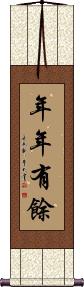
年年有餘 is a common proverb or wish of prosperity you'll hear around the time of Chinese New Year.
Directly translated character by character, it means “Year Year Have Surplus.” A more natural English translation including the deeper meaning would be “Every Year may you Have Abundance in your life.”
On a side note, this phrase often goes with a gift of something related to fish. This is because the last character, “yu” which means surplus or abundance, has exactly the same pronunciation in Mandarin as the word for “fish.”
This is also one of the most common titles for traditional paintings that feature koi fish.
In China, this phrase might make an odd wall scroll - a customer asked especially for this common phrase which is why it appears here. See my other abundance-related words if you want a wall scroll that will seem more comfortable in Chinese culture.
Note: This can be pronounced in Korean, but it's not a commonly used term.
See Also: Prosperity | Good Fortune
Beauty / Beautiful / Handsome
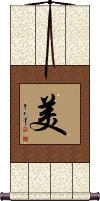
美 is often used to describe the beauty of a woman.
However, when applied to a man, it can mean handsome. It's also the first character in the word for “beauty salon” which you will see all over China and Japan.
This can be used as the given name for a girl (spell it or say it as “Mei” or “May”).
For a bit of trivia: The title for the “USA” in Chinese is “Mei Guo” which literally means “Beautiful Country.” This name was bestowed at a time before Chairman Mao came to power and decided that China didn't like the USA anymore (even though we fought together against the Japanese in WWII). But these days, Chinese people love Americans (but have a distaste for American politics and policy). But I digress...
美 is also how “Beautiful” is written in Japanese Kanji and Korean Hanja. 美 can also mean: very satisfactory; good; to be pleased with oneself; abbreviation for the USA; fine; handsome; admirable; madhura; sweet; and/or pleasant.
See Also: Beautiful Woman | Beautiful Girl
Unselfish: Perfectly Impartial
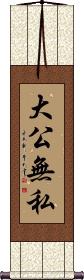
大公無私 is a Chinese proverb that comes from an old story from some time before 476 BC. About a man named Qi Huangyang, who was commissioned by the king to select the best person for a certain job in the Imperial Court.
Qi Huangyang selected his enemy for the job. The king was very confused by the selection, but Qi Huangyang explained that he was asked to find the best person for the job, not necessarily someone that he liked or had a friendship with.
Later, Confucius commented on how unselfish and impartial Qi Huangyang was by saying, “Da Gong Wu Si” which, if you look it up in a Chinese dictionary, is generally translated as “Unselfish” or “Just and Fair.”
If you translate each character, you'd have something like
“Big/Deep Justice Without Self.”
Direct translations like this leave out a lot of what the Chinese characters really say. Use your imagination, and suddenly you realize that “without self” means “without thinking about yourself in the decision” - together, these two words mean “unselfish.” The first two characters serve to drive the point home that we are talking about a concept that is similar to “blind justice.”
One of my Chinese-English dictionaries translates this simply as “just and fair.” So that is the short and simple version.
Note: This can be pronounced in Korean, but it's not a commonly used term.
See Also: Selflessness | Work Unselfishly for the Common Good | Altruism
Monkey
Year of the Monkey / Zodiac Sign
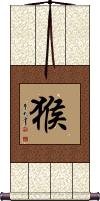
猴 is the monkey character in Chinese.
猴 means ape in Japanese due to an error made long ago as Japan absorbed Chinese characters.
If you were born in the year of the monkey, you . . .
Are smart, brave, active, and competitive.
Like new things.
Have a good memory.
Are quick to respond
Have an easy time winning people's trust.
Are, however, not very patient.
See also our Chinese Zodiac page.
Note: This character does have the meaning of monkey in Korean Hanja but is not used very often.
Karma (of your past lives)
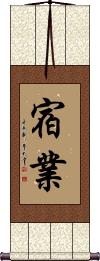
宿業 is the Buddhist concept of Past Karma. Simply put, it's the sum of all the good and bad from all previous lives (perhaps earlier in your current life). This term is not commonly used outside of the Buddhist faith (you'll have a tough time finding a non-Buddhist Asian person that knows this word).
Other ways to translate this are “The karma of previous existence,” “The karma remaining from prior existences,” or simply “Former karma.”
See Also: Buddhism
Islam
(phonetic version)
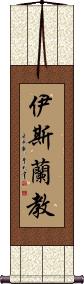
伊斯蘭教 both means and sounds like “Islam” in Mandarin Chinese.
The first three characters sound like the word “Islam,” and the last character means “religion” or “teaching.” It's the most general term for “Islam” in China. The highest concentration of Muslims in China is Xinjiang (the vast region in northwest China that was called The East Turkistan Republic until 1949 and is sometimes called Chinese Turkistan, Uyghuristan). Here you will find Uygurs, Kazakhs, Kyrgyz, and others that are descendants of Turkmen (possibly mixed with Persians and Arabs). Many of their ancestors were traders who traveled the silk road to buy and sell spices and silk and exchange other goods from the Orient and the Middle East.
I spent some time in Xinjiang and got to know this community. They are strong people who can endure much. They are friendly and love to have a good time. I was a stranger but was treated by villagers (near China's border with Afghanistan) as if I was a good friend.
However, I have heard that it's best not to cross them, as in this land, the law is the blade, and everything is “eye for an eye.” The Chinese government has little control in Xinjiang, with almost no police officers except in the capital of Urumqi (so it's a 60-hour roundtrip train ride to seek the aid of law enforcement in most cases).
While few seem devout, there are at least small mosques in every village. And you will never see a man or woman outside without a head covering.
It should be noted that these people are all citizens of China, but they are officially of the Caucasian race. A visit to Xinjiang will change your idea of what it means to be Chinese.
This in-stock artwork might be what you are looking for, and ships right away...

Gallery Price: $31.00
Your Price: $16.88
Gallery Price: $65.00
Your Price: $39.88

Gallery Price: $90.00
Your Price: $49.88

Gallery Price: $60.00
Your Price: $36.88


Gallery Price: $61.00
Your Price: $33.88
Gallery Price: $60.00
Your Price: $39.88

Gallery Price: $61.00
Your Price: $33.88

Gallery Price: $61.00
Your Price: $33.88
Gallery Price: $240.00
Your Price: $148.88


Gallery Price: $53.00
Your Price: $29.00
Gallery Price: $71.00
Your Price: $39.00
Not the results for To Have a Good Time that you were looking for?
Below are some entries from our dictionary that may match your To Have a Good Time search...
| Characters If shown, 2nd row is Simp. Chinese |
Pronunciation Romanization |
Simple Dictionary Definition |
貪玩 贪玩 see styles |
tān wán tan1 wan2 t`an wan tan wan |
to only want to have a good time; to just want to have fun, and to shy away from self-discipline |
遊ぶ see styles |
asobu(p); asubu(ok) あそぶ(P); あすぶ(ok) |
(v5b,vi) (1) to play (games, sports); to enjoy oneself; to have a good time; (v5b,vi) (2) to mess about (with alcohol, gambling, philandery, etc.); (v5b,vi) (3) to be idle; to do nothing; to be unused; (v5b,vi) (4) to meet up (with friends); to hang out; (v5b,vi) (5) to give oneself up (to gambling, drinking, etc.); (v5b,vi) (6) (as 〜に遊ぶ) to go to (for pleasure or for study); (v5b,vi) (7) (See もてあそぶ・2) to tease (someone); to play (with); (v5b,vi) (8) {baseb} to intentionally throw a ball to lower the batter's concentration |
併せもつ see styles |
awasemotsu あわせもつ |
(transitive verb) to have two things (at the same time) (e.g. good and bad points); to also have something (in addition to something else) |
併せ持つ see styles |
awasemotsu あわせもつ |
(transitive verb) to have two things (at the same time) (e.g. good and bad points); to also have something (in addition to something else) |
合せ持つ see styles |
awasemotsu あわせもつ |
(transitive verb) to have two things (at the same time) (e.g. good and bad points); to also have something (in addition to something else) |
あわせ持つ see styles |
awasemotsu あわせもつ |
(transitive verb) to have two things (at the same time) (e.g. good and bad points); to also have something (in addition to something else) |
合わせ持つ see styles |
awasemotsu あわせもつ |
(transitive verb) to have two things (at the same time) (e.g. good and bad points); to also have something (in addition to something else) |
有意義に過ごして下さい see styles |
yuuiginisugoshitekudasai / yuiginisugoshitekudasai ゆういぎにすごしてください |
(expression) Have a good time! |
有意義に過ごしてください see styles |
yuuiginisugoshitekudasai / yuiginisugoshitekudasai ゆういぎにすごしてください |
(expression) Have a good time! |
Variations: |
tanoshimu たのしむ |
(transitive verb) (1) to enjoy; to take pleasure in; to have a good time; to have fun; (transitive verb) (2) (dated) to look forward to |
Variations: |
tanoshimu たのしむ |
(transitive verb) (1) to enjoy; to take pleasure in; to have a good time; to have fun; to amuse oneself; (transitive verb) (2) (dated) to look forward to |
Variations: |
yuuiginisugoshitekudasai / yuiginisugoshitekudasai ゆういぎにすごしてください |
(expression) have a good time! |
Variations: |
awasemotsu あわせもつ |
(transitive verb) to have two things (at the same time) (e.g. good and bad points); to also have something (in addition to something else) |
Variations: |
awasemotsu あわせもつ |
(transitive verb) to have two things (at the same time) (e.g. good and bad points); to also have something (in addition to something else) |
The following table may be helpful for those studying Chinese or Japanese...
| Title | Characters | Romaji (Romanized Japanese) | Various forms of Romanized Chinese | |
| Year-In Year-Out Have Abundance | 年年有餘 年年有馀 | nián nián yǒu yú nian2 nian2 you3 yu2 nian nian you yu niannianyouyu | nien nien yu yü niennienyuyü |
|
| Beauty Beautiful Handsome | 美 | bi | měi / mei3 / mei | |
| Unselfish: Perfectly Impartial | 大公無私 大公无私 | dà gōng wú sī da4 gong1 wu2 si1 da gong wu si dagongwusi | ta kung wu ssu takungwussu |
|
| Monkey | 猴 | hóu / hou2 / hou | ||
| Karma (of your past lives) | 宿業 宿业 | shukugou / shukugo | sù yè / su4 ye4 / su ye / suye | su yeh / suyeh |
| Islam | 伊斯蘭教 伊斯兰教 | yī sī lán jiào yi1 si1 lan2 jiao4 yi si lan jiao yisilanjiao | i ssu lan chiao issulanchiao |
|
| In some entries above you will see that characters have different versions above and below a line. In these cases, the characters above the line are Traditional Chinese, while the ones below are Simplified Chinese. | ||||

Successful Chinese Character and Japanese Kanji calligraphy searches within the last few hours...



