Many custom options...


And formats...



Not what you want?
Try other similar-meaning words, fewer words, or just one word.
To Appreciate in Chinese / Japanese...
Buy a To Appreciate calligraphy wall scroll here!
Personalize your custom “To Appreciate” project by clicking the button next to your favorite “To Appreciate” title below...
1. You must endure a harsh winter to appreciate the warmth of springtime
2. No man knows what he owes to his parents until he comes to have children of his own
3. Thankfulness
You must endure a harsh winter to appreciate the warmth of springtime
You must know hardship to appreciate happiness
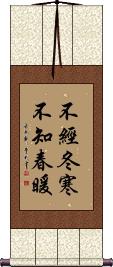
This literally translates as: Without having experienced the cold of winter, one cannot appreciate the warmth of spring.
Figuratively, this means: One cannot truly appreciate happiness without having gone through hardship.
There are many contrasts in life. One simply cannot fully know what joy is without having experienced misery, difficulty, and pain. How could you explain “light” if you did not have “darkness” to compare it to?
Embrace hardship, as it makes the good times seem even better.
No man knows what he owes to his parents until he comes to have children of his own
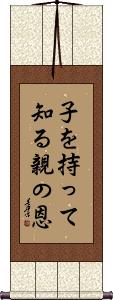
子を持って知る親の恩 literally translates as: Only after you have a baby, you would appreciate your parents (feel the way they do, etc).
This is a bit like the “walk a mile in another man's shoes” saying. Basically, it's about you cannot fully understand the plight of others until you experience it yourself. It also shows appreciation for the plight of parents.
This Japanese proverb can also be translated a few more ways:
No man knows what he owes to his parents till he comes to have children of his own.
One knows not what one owes to one's parents till one comes to have children of one's own.
Only after you have a baby, you will appreciate your parents or feel the way they do.
Only after becoming a parent yourself do you realize how much you owe [how indebted you are] to your own parents.
Note: Because this selection contains some special Japanese Hiragana characters, it should be written by a Japanese calligrapher.
Thankfulness
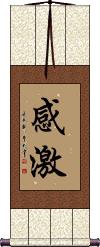
感激 is thankfulness or being grateful for what you have.
It is an attitude of gratitude for learning, loving, and being. Appreciate the little things that happen around you and within you every day. Think positively. Thankfulness brings contentment.
Different meaning in Japanese - more like "deep emotion," "impression," "inspiration" - not recommended for a Japanese audience.
Joyfulness / Happiness
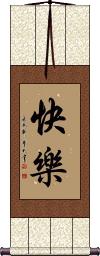
快樂 or joyfulness is an inner sense of peace and happiness.
You appreciate the gifts each day brings. Without joyfulness, when the fun stops, our happiness stops. Joy can carry us through hard times even when we are feeling very sad.
快樂 can also mean pleasure, enjoyment, delight, cheerfulness, or merry. In some ways, this is the essence that makes someone perceived as a charming person.
See Also: Happiness
Beauty Shop / Beauty Salon
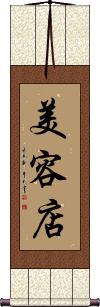
美容店 is how to write “Beauty Shop” or “Beauty Salon.”
If you own such a business, this will make a nice wall scroll to hang up - and many of your Asian customers will be able to read and appreciate it.
When traveling in China, you will see signs like this in the window of any place that offers full services of hair styling, manicures, pedicures, and often shampoo with head and back massage.
However, as a handmade wall scroll, this becomes a very fancy piece of artwork that shows the high class of your business (a great sign for your window if you don't get direct sunlight).
Appreciation of Truth by Meditation
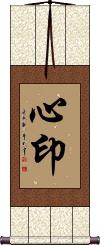
心印 is a Buddhist concept that simply stated is “appreciation of truth by meditation.”
It's a deep subject, but my understanding is that you can find truth through meditation, and once you've found the truth, you can learn to appreciate it more through further meditation. This title is not commonly used outside of the Buddhist community (your Asian friends may or may not understand it). The literal translation would be something like “the mind seal,” I've seen this term translated this way from Japanese Buddhist poetry. But apparently, the seal that is stamped deep in your mind is the truth. You just have to meditate to find it.
Soothill defines it this way: Mental impression, intuitive certainty; the mind is the Buddha-mind in all, which can seal or assure the truth; the term indicates the intuitive method of the Chan (Zen) school, which was independent of the spoken or written word.
Reference: Soothill-Hodous Dictionary of Chinese Buddhism
See Also: Zen
Not the results for To Appreciate that you were looking for?
Below are some entries from our dictionary that may match your To Appreciate search...
| Characters If shown, 2nd row is Simp. Chinese |
Pronunciation Romanization |
Simple Dictionary Definition |
感激 see styles |
gǎn jī gan3 ji1 kan chi kangeki かんげき |
More info & calligraphy: Thankfulness(n,vs,vi) deep emotion; impression; inspiration |
賞 赏 see styles |
shǎng shang3 shang masaru まさる |
to bestow (a reward); to give (to an inferior); to hand down; a reward (bestowed by a superior); to appreciate (beauty) (n,n-suf) prize; award; (given name) Masaru to reward, award |
労る see styles |
itawaru いたわる |
(transitive verb) (1) (kana only) to pity; to sympathize with; to sympathise with; to treat with sympathy; to console; to be kind to; to appreciate; (2) (kana only) to tend to (e.g. an injury); to care for; to nurse; to soothe |
升值 see styles |
shēng zhí sheng1 zhi2 sheng chih |
to rise in value; to appreciate |
品味 see styles |
pǐn wèi pin3 wei4 p`in wei pin wei |
to sample; to taste; to appreciate; one's taste (i.e. in music, literature, fashion, food and drink etc); good taste |
增值 see styles |
zēng zhí zeng1 zhi2 tseng chih |
to appreciate (financially); to increase in value; value-added (accountancy) |
弄ぶ see styles |
moteasobu もてあそぶ |
(transitive verb) (1) to play with (a toy, one's hair, etc.); to fiddle with; (2) to toy with (one's emotions, etc.); to trifle with; (3) to do with something as one pleases; (4) to appreciate |
心領 心领 see styles |
xīn lǐng xin1 ling3 hsin ling |
I appreciate your kindness (conventional reply to turn down an offer) |
惜福 see styles |
xī fú xi1 fu2 hsi fu |
to appreciate one's good fortune |
感悟 see styles |
gǎn wù gan3 wu4 kan wu |
to come to realize; to appreciate (feelings) |
昇值 升值 see styles |
shēng zhí sheng1 zhi2 sheng chih |
to rise in value; to appreciate |
欣賞 欣赏 see styles |
xīn shǎng xin1 shang3 hsin shang |
to appreciate; to enjoy; to admire |
漲價 涨价 see styles |
zhǎng jià zhang3 jia4 chang chia |
to appreciate (in value); to increase in price |
玩ぶ see styles |
moteasobu もてあそぶ |
(transitive verb) (1) to play with (a toy, one's hair, etc.); to fiddle with; (2) to toy with (one's emotions, etc.); to trifle with; (3) to do with something as one pleases; (4) to appreciate |
玩器 see styles |
wán qì wan2 qi4 wan ch`i wan chi |
elegant plaything; object to appreciate |
玩賞 玩赏 see styles |
wán shǎng wan2 shang3 wan shang |
to appreciate; to take pleasure in; to enjoy |
絵心 see styles |
egokoro えごころ |
(1) artistic taste; aptitude for painting; ability to appreciate art; (2) desire to paint |
翫ぶ see styles |
moteasobu もてあそぶ |
(transitive verb) (1) to play with (a toy, one's hair, etc.); to fiddle with; (2) to toy with (one's emotions, etc.); to trifle with; (3) to do with something as one pleases; (4) to appreciate |
詩心 see styles |
utako うたこ |
poetic sentiment or inspiration; poetic inclination or taste; poem-composing mood; ability to appreciate poetry; (female given name) Utako |
讚賞 赞赏 see styles |
zàn shǎng zan4 shang3 tsan shang |
to admire; to praise; to appreciate |
買う see styles |
kau かう |
(transitive verb) (1) to buy; to purchase; (transitive verb) (2) to value (highly); to think highly of; to have a high opinion of; to appreciate; to recognize; (transitive verb) (3) to incur (someone's anger, displeasure, etc.); to elicit (e.g. sneers); to invite (e.g. scorn); to evoke; to arouse; to win (someone's favour); (transitive verb) (4) to accept; to take on; to take up; (transitive verb) (5) to pay for (a prostitute, geisha, etc.) |
賞識 赏识 see styles |
shǎng shí shang3 shi2 shang shih |
to appreciate; to recognize the worth of something; appreciation |
賞鑒 赏鉴 see styles |
shǎng jiàn shang3 jian4 shang chien |
to appreciate (a work of art) |
鑑賞 鉴赏 see styles |
jiàn shǎng jian4 shang3 chien shang kanshou / kansho かんしょう |
to appreciate (as a connoisseur) (noun, transitive verb) appreciation (of art, music, poetry, etc.) |
領情 领情 see styles |
lǐng qíng ling3 qing2 ling ch`ing ling ching |
to feel grateful to sb; to appreciate the kindness |
領略 领略 see styles |
lǐng lüè ling3 lu:e4 ling lu:e ryouryaku / ryoryaku りょうりゃく |
to have a taste of; to realize; to appreciate (noun/participle) understanding; comprehending to understand |
驚賞 惊赏 see styles |
jīng shǎng jing1 shang3 ching shang |
surprised and admiring; to appreciate with surprise |
體味 体味 see styles |
tǐ wèi ti3 wei4 t`i wei ti wei |
body odor; to appreciate a subtle taste |
體諒 体谅 see styles |
tǐ liàng ti3 liang4 t`i liang ti liang |
to empathize; to allow (for something); to show understanding; to appreciate |
労わる see styles |
itawaru いたわる |
(irregular okurigana usage) (transitive verb) (1) (kana only) to pity; to sympathize with; to sympathise with; to treat with sympathy; to console; to be kind to; to appreciate; (2) (kana only) to tend to (e.g. an injury); to care for; to nurse; to soothe |
Click here for more To Appreciate results from our dictionary
The following table may be helpful for those studying Chinese or Japanese...
| Title | Characters | Romaji (Romanized Japanese) | Various forms of Romanized Chinese | |
| You must endure a harsh winter to appreciate the warmth of springtime | 不經冬寒不知春暖 不经冬寒不知春暖 | bù jīng dōng hán bù zhī chūn nuǎn bu4 jing1 dong1 han2 bu4 zhi1 chun1 nuan3 bu jing dong han bu zhi chun nuan | pu ching tung han pu chih ch`un nuan pu ching tung han pu chih chun nuan |
|
| No man knows what he owes to his parents until he comes to have children of his own | 子を持って知る親の恩 | ko wo motte shiru oya no on kowomotteshiruoyanoon | ||
| Thankfulness | 感激 | kangeki | gǎn jī / gan3 ji1 / gan ji / ganji | kan chi / kanchi |
| Joyfulness Happiness | 快樂 快乐 | kai raku / kairaku | kuài lè / kuai4 le4 / kuai le / kuaile | k`uai le / kuaile / kuai le |
| Beauty Shop Beauty Salon | 美容店 | měi róng diàn mei3 rong2 dian4 mei rong dian meirongdian | mei jung tien meijungtien |
|
| Appreciation of Truth by Meditation | 心印 | shin nin / shinnin | xīn yìn / xin1 yin4 / xin yin / xinyin | hsin yin / hsinyin |
| In some entries above you will see that characters have different versions above and below a line. In these cases, the characters above the line are Traditional Chinese, while the ones below are Simplified Chinese. | ||||

Successful Chinese Character and Japanese Kanji calligraphy searches within the last few hours...



