Many custom options...


And formats...



Thanks in Chinese / Japanese...
Buy a Thanks calligraphy wall scroll here!
Personalize your custom “Thanks” project by clicking the button next to your favorite “Thanks” title below...
Gratitude / Thanks
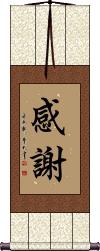
感謝 is gratitude; the feeling of being grateful or thankful.
You can think of this as being a formal way of expressing thankfulness in Chinese, Japanese Kanji, and old Korean Hanja.
Thank You / Xie Xie
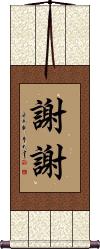
謝謝 is how to say thank you in Chinese. It is pronounced a bit like “shea shea” as in the English word for shea butter. Except you pronounce the X like “sh” but with your tongue firmly at the bottom of your mouth.
Unless you are putting this wall scroll near the exit of your store or restaurant to thank customers for coming, it is a bit of an odd selection. A gift of thanks to another person should be a more personal selection with more meaning than a simple thank you. Although common to write xie xie inside a card or letter of thanks.
Technically, this can be pronounced in Japanese but in Japan, it’s still the Chinese way to say thank you. It’s like an English speaker saying "gracias" (Spanish word for thank you).
Hsieh
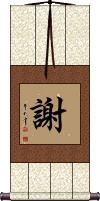
謝 is the Chinese character for the Taiwanese surname Hsieh.
This is also a surname in mainland China where it is romanized as Xie. The meaning is thanks or thank you.
Diamond
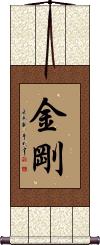
金剛 is a common way to call diamonds in Chinese and Japanese.
Traditionally, there were not that many diamonds that made their way to Asia, so this word does not have the deep cultural significance that it does in the west (thanks mostly to De Beers' marketing). Therefore, this word was kind of borrowed from other uses.
This title can also refer to vajra (a Sanskrit word meaning both thunderbolt and diamond that originally refers to an indestructible substance); hard metal; pupa of certain insects; Vajrapani, Buddha's warrior attendant; King Kong; adamantine; Buddhist symbol of the indestructible truth.
Gassho
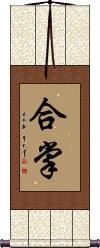
合掌 is the act of greeting someone (can also be done when departing) with hands brought together prayerfully.
In India, this would be accompanied by the verbal greeting and blessing of “Namaste.” In China, Japan, and Korea, this is how Buddhists will greet each other. Sometimes done by people who are not devout Buddhists in China, Japan, and Korea to show respect, reverence, or great thanks to someone for a gift, forgiveness, or some honor that has been bestowed.
In Japan, this is almost always associated with a deep bow. In China, where bowing is not an everyday occurrence, there may be a shallow bow, but the act will be done with deep feeling. Korean culture seems to have more bowing than China but less than Japan.
See Also: Namaste
Tea Fate
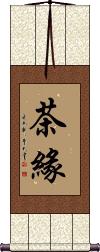
茶緣 is a special title for the tea lover. This kind of means “tea fate,” but it's more spiritual and hard to define. Perhaps the tea brought you in to drink it. Perhaps the tea will bring you and another tea-lover together. Perhaps you were already there, and the tea came to you. Perhaps it's the ah-ha moment you will have when drinking the tea.
I've been told not to explain this further, as it will either dilute or confuse the purposefully-ambiguous idea embedded in this enigma.
I happen to be the owner of a piece of calligraphy written by either the son or nephew of the last emperor of China, which is the title he wrote. It was given to me at a Beijing tea house in 2001. 茶緣 is where I learned to love tea after literally spending weeks tasting and studying everything I could about Chinese tea. I did not understand the significance of the authorship or the meaning of the title at all. Some 10 years later, I realized the gift was so profound and had such providence. Only now do I realize the value of a gift that it is too late to give proper thanks for. It was also years later that I ended up in this business and could have the artwork properly mounted as a wall scroll. It has been borrowed for many exhibitions and shows and always amazes native Chinese and Taiwanese who read the signature. This piece of calligraphy I once thought was just a bit of ink on a thin and wrinkled piece of paper, is now one of my most valued possessions. And fate has taught me to be more thankful for seemingly simple gifts.
These search terms might be related to Thanks:
Appreciation and Love for Your Parents
Appreciation of Truth by Meditation
Gratitude / Thanks
Thankfulness
Not the results for Thanks that you were looking for?
Below are some entries from our dictionary that may match your Thanks search...
| Characters If shown, 2nd row is Simp. Chinese |
Pronunciation Romanization |
Simple Dictionary Definition |
礼 see styles |
reiji / reji れいじ |
More info & calligraphy: Respect |
謝 谢 see styles |
xiè xie4 hsieh ja じゃ |
More info & calligraphy: Chea(surname) Ja To thank; return (with thanks), decline; fall; apologize; accept with thanks. |
感謝 感谢 see styles |
gǎn xiè gan3 xie4 kan hsieh kansha かんしゃ |
More info & calligraphy: Gratitude / Thanks(n,vs,vt,vi) thanks; gratitude; appreciation; thankfulness |
大丈夫 see styles |
dà zhàng fu da4 zhang4 fu5 ta chang fu masurao ますらお |
More info & calligraphy: Man of Character(adjectival noun) (1) safe; secure; sound; problem-free; without fear; all right; alright; OK; okay; (adverb) (2) certainly; surely; undoubtedly; (int,adj-na) (3) (colloquialism) no thanks; I'm good; that's alright; (4) (だいじょうぶ only) (archaism) (See 大丈夫・だいじょうふ) great man; fine figure of a man; (given name) Masurao a great man |
答 see styles |
dá da2 ta tō こたえ |
to answer; to reply; to respond answer; reply; response; solution A bamboo hawser, to draw out, to respond, reply, return thanks. |
虧 亏 see styles |
kuī kui1 k`uei kuei |
to lose (money); to have a deficit; to be deficient; to treat unfairly; luckily; fortunately; thanks to; (used to introduce an ironic remark about sb who has fallen short of expectations) |
お礼 see styles |
orei / ore おれい |
(1) (polite language) thanks; gratitude; (2) (polite language) manners; etiquette; (3) (polite language) bow; (4) (polite language) reward; gift; (5) (polite language) ceremony; ritual |
万謝 see styles |
bansha ばんしゃ |
(noun/participle) many thanks; sincere apologies |
依蒙 see styles |
yī méng yi1 meng2 i meng emō |
thanks to |
労い see styles |
negirai ねぎらい |
appreciation; thanks; gratitude |
厚礼 see styles |
kourei / kore こうれい |
heartfelt thanks |
多虧 多亏 see styles |
duō kuī duo1 kui1 to k`uei to kuei |
thanks to; luckily |
多謝 多谢 see styles |
duō xiè duo1 xie4 to hsieh tasha たしゃ |
many thanks; thanks a lot (noun/participle) (1) many thanks; hearty thanks; (noun/participle) (2) profuse apology |
奉還 奉还 see styles |
fèng huán feng4 huan2 feng huan houkan / hokan ほうかん |
to return with thanks; to give back (honorific) (noun, transitive verb) restoring (power, etc.) to the emperor; (place-name) Houkan |
御礼 see styles |
onrei / onre おんれい orei / ore おれい |
(1) (polite language) thanks; gratitude; (2) (polite language) manners; etiquette; (3) (polite language) bow; (4) (polite language) reward; gift; (5) (polite language) ceremony; ritual |
憑借 凭借 see styles |
píng jiè ping2 jie4 p`ing chieh ping chieh |
to rely on; to depend on; by means of; thanks to; something that one relies on |
憑藉 凭藉 see styles |
píng jiè ping2 jie4 p`ing chieh ping chieh |
to rely on; to depend on; by means of; thanks to; something that one relies on; also written 憑借|凭借[ping2 jie4] |
懇辭 恳辞 see styles |
kěn cí ken3 ci2 k`en tz`u ken tzu |
to decline with sincere thanks |
托福 see styles |
tuō fú tuo1 fu2 t`o fu to fu |
(old) thanks to your lucky influence (polite reply to health inquiries) |
拝謝 see styles |
haisha はいしゃ |
(n,vs,vi) giving thanks |
搭幫 搭帮 see styles |
dā bāng da1 bang1 ta pang |
to travel together; thanks to |
旗頭 see styles |
hatagashira はたがしら |
(1) leader; boss; (2) upper part of a flag; (3) (Okinawa) bamboo poles with an attached vertical flag and an elaborate display at the top that are used during the annual fertility and thanks-giving festivals |
気持 see styles |
kimochi きもち |
(1) feeling; sensation; mood; (2) preparedness; readiness; attitude; (3) (humble language) thanks; solicitude; sympathy; (adverb) (4) just a little; somewhat; slightly |
犒い see styles |
negirai ねぎらい |
appreciation; thanks; gratitude |
璧謝 璧谢 see styles |
bì xiè bi4 xie4 pi hsieh |
decline (a gift) with thanks |
璧還 璧还 see styles |
bì huán bi4 huan2 pi huan |
return (a borrowed object) with thanks; decline (a gift) with thanks |
由於 由于 see styles |
yóu yú you2 yu2 yu yü yoshio よしお |
due to; as a result of; thanks to; owing to; since; because (personal name) Yoshio |
礼状 see styles |
reijou / rejo れいじょう |
acknowledgment; acknowledgement; letter of thanks |
礼金 see styles |
reikin / rekin れいきん |
(1) money (given as thanks); reward money; fee; recompense; remuneration; honorarium; (2) key money; fee paid for rental rights |
祝謝 祝谢 see styles |
zhù xiè zhu4 xie4 chu hsieh |
to give thanks |
Click here for more Thanks results from our dictionary
The following table may be helpful for those studying Chinese or Japanese...
| Title | Characters | Romaji (Romanized Japanese) | Various forms of Romanized Chinese | |
| Gratitude Thanks | 感謝 | kan sha / kansha | gǎn xiè / gan3 xie4 / gan xie / ganxie | kan hsieh / kanhsieh |
| Thank You Xie Xie | 謝謝 / 謝々 谢谢 | shie shie / shieshie | xiè xie / xie4 xie / xie xie / xiexie | hsieh hsieh / hsiehhsieh |
| Hsieh | 謝 谢 | xiè / xie4 / xie | hsieh | |
| Diamond | 金剛 金刚 | kon gou / kongou / kon go | jīn gāng / jin1 gang1 / jin gang / jingang | chin kang / chinkang |
| Gassho | 合掌 | gasshou / gasho | hé zhǎng / he2 zhang3 / he zhang / hezhang | ho chang / hochang |
| Tea Fate | 茶緣 茶缘 | chá yuán / cha2 yuan2 / cha yuan / chayuan | ch`a yüan / chayüan / cha yüan | |
| In some entries above you will see that characters have different versions above and below a line. In these cases, the characters above the line are Traditional Chinese, while the ones below are Simplified Chinese. | ||||

Successful Chinese Character and Japanese Kanji calligraphy searches within the last few hours...



