Many custom options...


And formats...



Tenet in Chinese / Japanese...
Buy a Tenet calligraphy wall scroll here!
Personalize your custom “Tenet” project by clicking the button next to your favorite “Tenet” title below...
1. Self-Restraint / Self-Control
2. Sense of Shame / Sense of Honor / Integrity / Modesty
3. Patience / Perseverance / To Endure / Tolerant
Self-Restraint / Self-Control
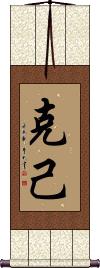
克己 can be translated as “self-denial,” “self-abnegation,” “self-restraint,” “self-discipline,” “self-mastery,” or selflessness.
As a tenet of Korean taekwondo, and other martial arts, this is often used with the title “self-control.”
Sense of Shame / Sense of Honor / Integrity / Modesty (Korean)
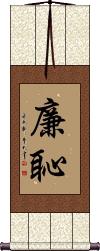
廉恥 simultaneously means “sense of honor” and “sense of shame” in Korean.
This term is often used as a tenet of Taekwondo, where the English terms “integrity” and “modesty” are applied.
廉恥 is also a Chinese word, though it is usually read with the “sense of shame” meaning, and is a poor choice for a wall scroll if your audience is Chinese.
Patience / Perseverance / To Endure / Tolerant
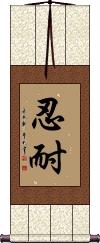
忍耐 is patience, the quiet hope, and trust that things will turn out right.
You wait without complaining. You are tolerant and accepting of difficulties and mistakes. You picture the end in the beginning and persevere to meet your goals.
忍耐 can also mean “to endure,” “restrain oneself,” or “forbearance,” and in some contexts, it can mean “perseverance” or “endurance.”
忍耐 is also used as a tenet of Taekwondo, Tang Soo Do, and other Korean martial arts where it's titled “Endurance” and romanized as “In Neh.”
 Note that when writing this as Kanji, Japanese will tend to write the first character in the form shown to the right. If you select our Japanese master calligrapher, please expect this Kanji form (yes,
it’s
just one stroke that is slightly different in location, crossing another stroke in the Japanese Kanji form).
Note that when writing this as Kanji, Japanese will tend to write the first character in the form shown to the right. If you select our Japanese master calligrapher, please expect this Kanji form (yes,
it’s
just one stroke that is slightly different in location, crossing another stroke in the Japanese Kanji form).
See Also: Peace | Harmony | Perseverance
Wu Wei / Without Action
Daoist / Taoist Tenet
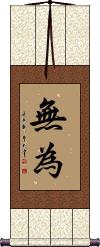
無為 or “Wu Wei” is a Daoist (Taoist) tenet that speaks to the idea of letting nature take its course.
Some will say it's about knowing when to take action and when not to. In reality, it's more about not going against the flow. What will happen is controlled by the Dao (Tao), for which one who follows the Dao will not resist or struggle against.
You can think of 無為 as the Chinese way to express “laissez-faire.”
There is a lot more to this concept, but if you are looking for this entry, you already know the expanded concept.
Warning: Outside of the Daoist context, this means idleness or inactivity (especially in Japanese, where not everyone knows this as a Daoist concept, though it does pair well with the Japanese concept of Wabi-Sabi).
Mind of the Beginner
Shoshin
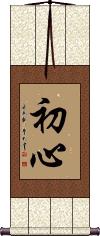
初心 is often translated in Japanese as “beginner's mind” or “beginner's spirit.”
In Chinese, the dictionary definition is “one's original intention.”
The first character means first, initial, primary, junior, beginning, or basic.
The second character means heart, mind, soul, or essence.
初心 is one of the five spirits of the warrior (budo) and is often used as a Japanese martial arts tenet. Under that context, places such as the Budo Dojo define it this way: The state of shoshin is that of a beginners mind. It is a state of awareness that always remains fully conscious, aware, and prepared to see things for the first time. The attitude of shoshin is essential to continued learning.
Purified Spirit / Enlightened Attitude
A Japanese martial arts title/concept
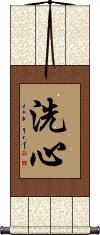
The first Kanji alone means to wash, bathe, primness, cleanse or purify.
The second Kanji means heart, mind, soul, or essence.
Together, these two Kanji create a word defined as “purified spirit” or “enlightened attitude” within Japanese martial arts.
洗心 is one of the five spirits of the warrior (budo) and is often used as a Japanese martial arts tenet. Under that context, it's often defined as a spirit that protects and harmonizes the universe. Senshin is a spirit of compassion that embraces and serves all humanity and whose function is to reconcile discord in the world. It holds all life to be sacred. It is the Buddha mind.
This title will only be familiar to Japanese who practice certain martial arts. Others may not recognize this word at all.
洗心 does not show up as a word in too many Chinese dictionaries, but it can be read and has the same meaning in Chinese.
 There is an issue with the first character. The original, and probably most correct version is shown above. However, many dojo documents and other sources have used a more simple first character. Arguments ensue about which version is correct. If you want to be correct in the Japanese language, use the "Select and Customize" button above. If you want to match the Kanji used by your dojo, click the Kanji shown to the right. There is a slightly different meaning with this first character which means before, ahead, previous, future, precedence.
Lingering Mind
Zanshin
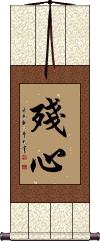
First off, 殘心 should only be used in the context of Japanese martial arts. In Chinese, it's a rather sad title (like a broken heart). In Chinese, the first character alone means destroyed, spoiled, ruined, injured, cruel, oppressive, savage, incomplete, or disabled. However, in Japanese, it's remainder, leftover, balance, or lingering.
The second character means heart, mind, soul, or essence in both languages.
殘心 is one of the five spirits of the warrior (budo) and is often used as a Japanese martial arts tenet. Under that context, places such as the Budo Dojo define it this way: The spirit of zanshin is the state of the remaining or lingering spirit. It is often described as a sustained and heightened state of awareness and mental follow-through. However, true zanshin is a state of focus or concentration before, during, and after the execution of a technique, where a link or connection between uke and nage is preserved. Zanshin is the state of mind that allows us to stay spiritually connected, not only to a single attacker but to multiple attackers and even an entire context; a space, a time, an event.
 In modern Japan (and Simplified Chinese), they use a different version of the first character, as seen to the right. Click on this character to the right instead of the button above if you want this modern Japanese version of lingering mind / zanshin.
No Mind / Mushin
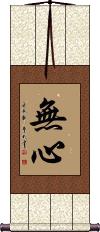
In Japanese, 無心 means innocent or without knowledge of good and evil. It literally means “without mind.”
無心 is one of the five spirits of the warrior (budo) and is often used as a Japanese martial arts tenet. Under that context, places such as the Budo Dojo define it this way: “No mind, a mind without ego. A mind like a mirror which reflects and dos not judge.” The original term was “mushin no shin,” meaning “mind of no mind.” It is a state of mind without fear, anger, or anxiety. Mushin is often described by the phrase “Mizu no Kokoro,” which means “mind like water.” The phrase is a metaphor describing the pond that clearly reflects its surroundings when calm but whose images are obscured once a pebble is dropped into its waters.
This has a good meaning in conjunction with Chan / Zen Buddhism in Japan. However, out of that context, it means mindlessness or absent-mindedness. To non-Buddhists in China, this is associated with doing something without thinking.
In Korean, this usually means indifference.
Use caution and know your audience before ordering this selection.
More info: Wikipedia: Mushin
Immovable Mind
fudoshin
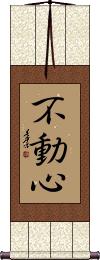
不動心 is one of the five spirits of the warrior (budo) and is often used as a Japanese martial arts tenet.
Under that context, places such as the Budo Dojo define it this way: An unshakable mind and an immovable spirit is the state of fudoshin. It is courage and stability displayed both mentally and physically. Rather than indicating rigidity and inflexibility, fudoshin describes a condition that is not easily upset by internal thoughts or external forces. It is capable of receiving a strong attack while retaining composure and balance. It receives and yields lightly, grounds to the earth, and reflects aggression back to the source.
Other translations of this title include unwavering mind, immovable mind, unwavering composure, imperturbability, steadfastness, keeping a cool head in an emergency, or keeping one's calm (during a fight).
The first two Kanji alone mean immobility, firmness, fixed, steadfastness, motionless, and idle.
The last Kanji means heart, mind, soul, or essence.
Together, these three Kanji create a title defined as “immovable mind” within the context of Japanese martial arts. However, in Chinese, it would mean “motionless heart,” and in Korean Hanja, “wafting heart” or “floating heart.”
These search terms might be related to Tenet:
1. Right Understanding / Right Perspective / Right View / Perfect View
Belief / Trust
Confucius: Golden Rule / Ethic of Reciprocity
Example is Better Than Precept
Firm Belief / Strong Faith
Golden Rule
Rule
The Guts Theory
Theory of Evolution
Trust in God / Belief in God
The following table may be helpful for those studying Chinese or Japanese...
| Title | Characters | Romaji (Romanized Japanese) | Various forms of Romanized Chinese | |
| Self-Restraint Self-Control | 克己 / 剋己 克己 | kokki / koki | kè jǐ / ke4 ji3 / ke ji / keji | k`o chi / kochi / ko chi |
| Sense of Shame Sense of Honor Integrity Modesty (Korean) | 廉恥 廉耻 | ren chi / renchi | lián chǐ / lian2 chi3 / lian chi / lianchi | lien ch`ih / lienchih / lien chih |
| Patience Perseverance To Endure Tolerant | 忍耐 | nin tai / nintai | rěn nài / ren3 nai4 / ren nai / rennai | jen nai / jennai |
| Wu Wei Without Action | 無為 无为 | mui | wú wéi / wu2 wei2 / wu wei / wuwei | |
| Mind of the Beginner | 初心 | sho shin / shoshin | chū xīn / chu1 xin1 / chu xin / chuxin | ch`u hsin / chuhsin / chu hsin |
| Purified Spirit Enlightened Attitude | 洗心 先心 | sen shin / senshin | xǐ xīn / xi3 xin1 / xi xin / xixin | hsi hsin / hsihsin |
| Lingering Mind | 殘心 残心 | zan shin / zanshin | cán xīn / can2 xin1 / can xin / canxin | ts`an hsin / tsanhsin / tsan hsin |
| No Mind Mushin | 無心 无心 | mu shin / mushin | wú xīn / wu2 xin1 / wu xin / wuxin | wu hsin / wuhsin |
| Immovable Mind | 不動心 | fu dou shin fudoushin fu do shin | ||
| In some entries above you will see that characters have different versions above and below a line. In these cases, the characters above the line are Traditional Chinese, while the ones below are Simplified Chinese. | ||||

Successful Chinese Character and Japanese Kanji calligraphy searches within the last few hours...



