Many custom options...


And formats...



Stick in Chinese / Japanese...
Buy a Stick calligraphy wall scroll here!
Personalize your custom “Stick” project by clicking the button next to your favorite “Stick” title below...
1. Have a Walking Stick at the Ready Before You Stumble
2. Fix the roof before the rain; Dig the well before you are thirsty
3. Bo Staff
4. Spare the Rod, Spoil the Child
6. Through the Ups and Downs of Life
8. Regardless of the Weather, We Overcome Troubles Together
9. There is one single thread binding my Way together
10. Guanxi
Have a Walking Stick at the Ready Before You Stumble
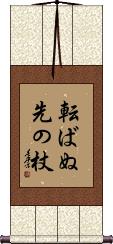
転ばぬ先の杖 is a Japanese proverb that literally translates as: Have a walking stick ready before stumbling.
This is similar to the English idiom, “A stitch in time saves nine.”
In simple terms, this means: Always being prepared in advance.
Note: Because this selection contains some special Japanese Hiragana characters, it should be written by a Japanese calligrapher.
See Also: Fix Roof Before the Rain; Dig the Well Before You Are Thirsty
Fix the roof before the rain; Dig the well before you are thirsty
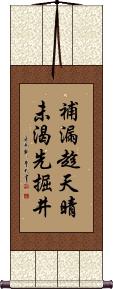
补漏趁天晴未渴先掘井 is a Chinese proverb that literally translates as: Mend the roof while the weather is fine, [and when you are] not yet thirsty, dig the well beforehand.
In simple terms, this means: Always being prepared in advance.
See Also: Have a Walking Stick at the Ready Before You Stumble
Bo Staff

棒 is the Kanji for bo staff.
In the context of martial arts, this is a bo staff. However, the actual meaning of this character is stick, club, cudgel, pole, rod, baton, or staff.
Spare the Rod, Spoil the Child
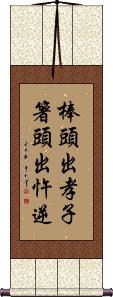
棒頭出孝子箸頭出忤逆 literally translates as:
A stick (or switch) produces filial sons; chopsticks produce disobedient [ones].
Figuratively, this means:
Strict discipline produces dutiful children, whereas indulgence produces disobedient ones.
This proverb is very similar to this English proverb:
“Spare the rod and spoil the child.”
Bojutsu / Bojitsu
The art of using a stick as a weapon
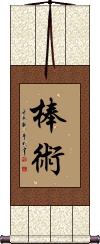
棒術 is the title Bōjutsu (though some use the romanization Bojitsu).
棒術 is a martial art centered around using a “bō” or staff as a weapon.
This title is a combination of the Japanese word “bō” (which means staff, stick, club, rod, pole, or cudgel) with the Japanese word “jutsu” (which means art or technique).
While this word can be pronounced in Chinese (bang shu), it's not a common term in China. Please consider this title to be “Japanese only.”
Through the Ups and Downs of Life
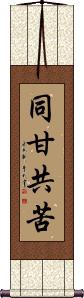
同甘共苦 is a Chinese proverb that talks of “shared delights and common hardships.”
This can be translated and understood in a few different ways, including...
To share life's joys and sorrows.
For better or for worse.
Through joys and sorrows of life.
Through all life's ups and downs.
To go through thick and thin.
To stick together through thick and thin.
To share the joys and sorrows of life.
To share pleasures and pains.
To partake in each other's joys and sorrows.
To take “for better or for worse.”
Unbridled Creativity
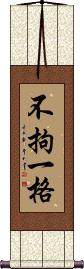
不拘一格 is a Chinese proverb that speaks of exploring different styles and not being stuck in conventional thinking.
It can also be translated as “not sticking to one pattern” or “not limited to one type (or style).” The most simple translation is “being creative” or “unbridled creativity.” Some may also say this means “not being stuck in a rut,” in the context of a designer or artist.
If you translate this, the first two characters mean “not stick to” or “not confine oneself to.”
The second two characters mean “one mode,” “one pattern,” “one form,” “one style,” or “one rule.”
Regardless of the Weather, We Overcome Troubles Together
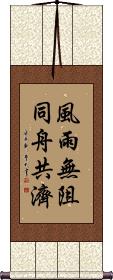
The first four characters are often translated as “Go ahead as planned regardless of the weather” or, “[Overcome] despite the rain and wind.” The last four characters can mean “Stick together” but literally means “Take the same boat [together].”
風雨無阻同舟共濟 is a Chinese proverb that suggests that you are willing (or should be willing) to overcome any adversity, and accomplish your task at hand. The second part (last four characters) is sometimes left off but this second part strongly suggests that you should overcome that adversity together.
There is one single thread binding my Way together
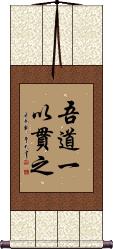
吾道一以貫之 is a phrase from the Analects of Confucius that translates as “My Way has one thread that runs through it.”
Other translations include:
My Way is penetrated by a single thread.
There is one single thread binding my Way together.
My Way is run through with a unifying thread.
My Way is Consistent.
And sometimes poetic license is taken, and it is translated as:
My Way is the only one; I'll treasure it and stick to it with humility until the end.
After this was said, some 2500+ years ago, another disciple of Confucius clarified the meaning by stating, “Our master's Way is to be loyal and have a sense of reciprocity.”
In Japanese, this is purported to be romanized as “Waga michi ichi wo motte kore wo tsuranuku,” though some will argue the true pronunciation.
Note: Sometimes written 吾道以一貫之 instead of 吾道一以貫之 with no difference in meaning.
Guanxi
The Chinese Concept of Relationship and Exchange of Favors
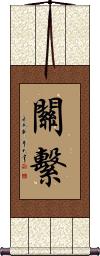
The dictionary definition is:
Relations/relationship, to concern, to affect, to have to do with, or connection.
But there's more to it...
In China, the relationship that you have with certain people can open doors for you. Having guanxi with someone also means they would never defraud you but are honor-bound to treat you fairly (of course, this goes both ways). Sometimes it is suggested that guanxi is the exchange of favors. 關繫 / 関繫 / 關係 is more about having a relationship that allows you to ask for and expect favors without shame.
There is no concept in western culture that exactly matches guanxi, but perhaps having a social or professional network is similar.
Note that there are some variations common within Chinese, Japanese Kanji, and Korean Hanja for this word... Japanese tend to use a Chinese alternate form as shown to the right for
the first character.
 There's also another alternate form of that first character (currently used as the official Simplified form in mainland China) which looks like the character shown to the right. It's basically the central radical of the alternate version shown above but without the “door radical” around it. In more free-flowing calligraphy styles, this version would be the likely choice for a calligrapher.
 In Modern Japanese, they use the character shown to the right.
They also tend to use this same form in Korean Hanja (I've only checked this word in my Korean dictionary, but it has not been confirmed by a translator's review).
 If that was not confusing enough, there is another alternate form of that second character. See right.
An Asian calligrapher of any nationality may use these forms at their discretion. However, They would tend to stick to the most common form used in their respective languages.
If you have any preference on any of these issues, please give us a special note with your order, and we'll make sure it's done the way you want.
These search terms might be related to Stick:
Bo Staff
Bond
Family Bond / Family Ties
Fix
Fix the Roof Before the Rain; Dig the Well Before You Are Thirsty
Gore
Never Put Off Until Tomorrow What You Can Do Today
No Place Like Home
Pierce
Push or Knock
Put Out a Burning Wood Cart With a Cup of Water
Rod
Set Your Heart Ablaze
Spare the Rod, Spoil the Child
Spear
Spike
The Mysterious Bond Between People
There’s No Place Like Home
The following table may be helpful for those studying Chinese or Japanese...
| Title | Characters | Romaji (Romanized Japanese) | Various forms of Romanized Chinese | |
| Have a Walking Stick at the Ready Before You Stumble | 転ばぬ先の杖 | koro ba nu saki no tsue korobanusakinotsue | ||
| Fix the roof before the rain; Dig the well before you are thirsty | 補漏趁天晴未渴先掘井 补漏趁天晴未渴先掘井 | bǔ lòu chèn tiān qíng wèi kě xiān jué jǐng bu3 lou4 chen4 tian1 qing2 wei4 ke3 xian1 jue2 jing3 bu lou chen tian qing wei ke xian jue jing | pu lou ch`en t`ien ch`ing wei k`o hsien chüeh ching pu lou chen tien ching wei ko hsien chüeh ching |
|
| Bo Staff | 棒 | bou / bo | bàng / bang4 / bang | pang |
| Spare the Rod, Spoil the Child | 棒頭出孝子箸頭出忤逆 | bàng tóu chū xiào zǐ zhù tóu chū wǔ nì bang4 tou2 chu1 xiao4 zi3 zhu4 tou2 chu1 wu3 ni4 bang tou chu xiao zi zhu tou chu wu ni | pang t`ou ch`u hsiao tzu chu t`ou ch`u wu ni pang tou chu hsiao tzu chu tou chu wu ni |
|
| Bojutsu Bojitsu | 棒術 棒术 | bou jutsu / boujutsu / bo jutsu | bàng shù / bang4 shu4 / bang shu / bangshu | pang shu / pangshu |
| Through the Ups and Downs of Life | 同甘共苦 | tóng gān gòng kǔ tong2 gan1 gong4 ku3 tong gan gong ku tonggangongku | t`ung kan kung k`u tungkankungku tung kan kung ku |
|
| Unbridled Creativity | 不拘一格 | bù jū yī gé bu4 ju1 yi1 ge2 bu ju yi ge bujuyige | pu chü i ko puchüiko |
|
| Regardless of the Weather, We Overcome Troubles Together | 風雨無阻同舟共濟 风雨无阻同舟共济 | fēng yǔ wú zǔ tóng zhōu gòng jì feng1 yu3 wu2 zu3 tong2 zhou1 gong4 ji4 feng yu wu zu tong zhou gong ji fengyuwuzutongzhougongji | feng yü wu tsu t`ung chou kung chi feng yü wu tsu tung chou kung chi |
|
| There is one single thread binding my Way together | 吾道一以貫之 吾道一以贯之 | ware dou tsurayuki waredoutsurayuki ware do tsurayuki | wú dào yī yǐ guàn zhī wu2 dao4 yi1 yi3 guan4 zhi1 wu dao yi yi guan zhi wudaoyiyiguanzhi | wu tao i i kuan chih wutaoiikuanchih |
| Guanxi | 關繫 / 関繫 / 關係 关系 / 関係 | kankei | guān xì / guan1 xi4 / guan xi / guanxi | kuan hsi / kuanhsi |
| In some entries above you will see that characters have different versions above and below a line. In these cases, the characters above the line are Traditional Chinese, while the ones below are Simplified Chinese. | ||||

Successful Chinese Character and Japanese Kanji calligraphy searches within the last few hours...



