Many custom options...


And formats...



Springtime in Chinese / Japanese...
Buy a Springtime calligraphy wall scroll here!
Personalize your custom “Springtime” project by clicking the button next to your favorite “Springtime” title below...
1. You must endure a harsh winter to appreciate the warmth of springtime
3. Flower Open / Blooming Flower
5. Wing Chun
You must endure a harsh winter to appreciate the warmth of springtime
You must know hardship to appreciate happiness
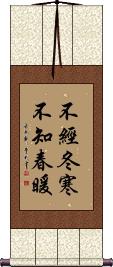
This literally translates as: Without having experienced the cold of winter, one cannot appreciate the warmth of spring.
Figuratively, this means: One cannot truly appreciate happiness without having gone through hardship.
There are many contrasts in life. One simply cannot fully know what joy is without having experienced misery, difficulty, and pain. How could you explain “light” if you did not have “darkness” to compare it to?
Embrace hardship, as it makes the good times seem even better.
Opening / Blooming Flowers
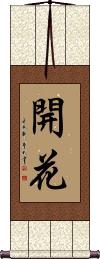
開花 literally means opening flowers (a verb).
開花 is also associated with Springtime, the beginning of something, or youth.
If you like flowers and Springtime, this is a great selection for you.
In Korean Hanja, this can be a metaphor for achieving enlightenment or becoming civilized (blooming civilization).
See Also: Flowers Fall
Flower Open / Blooming Flower
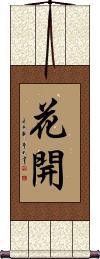
These two characters mean “flower open.”
花開 is also associated with Springtime, the beginning of something, or youth.
花開 is often followed by 花落 or “flower falls” (closes and loses its petals) which means “Things come and go” or “Youth comes and goes.”
If you like flowers and Springtime, this is a great selection for you. However, if you want the companion “flower falls” (flower withers), we offer that as a companion wall scroll or all together as a four-character phrase.
See Also: Flowers Fall
Wing Chun Kung Fu
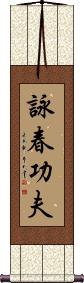
詠春功夫 is Wing Chun Kung Fu.
The first two characters literally mean “Singing Spring” (as in springtime).
The last two are “Kung Fu” (high skill).
Wing Chun
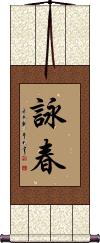
詠春 is a martial arts technique that has an oral history (versus a written one) so very little can be said for sure about its origins.
Wing Chun (or Wing Cheun) is a Chinese martial art that emphasizes short combat strokes.
The characters 詠春 literally mean “Singing Spring” (as in springtime).
If you are wondering, the spelling and pronunciation of this martial arts style in English come from the Cantonese pronunciation of these characters. The second character sounds similar in both Mandarin and Cantonese, but the first is quite different.
Note: This title can be pronounced in Japanese, but only a Japanese practitioner of Wing Chun would recognize or understand this title. It is not considered a Japanese word or martial art at all.
Spring Season
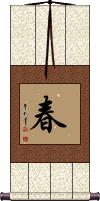
This in-stock artwork might be what you are looking for, and ships right away...
Gallery Price: $72.00
Your Price: $39.95
Gallery Price: $72.00
Your Price: $39.88

Gallery Price: $108.00
Your Price: $59.88
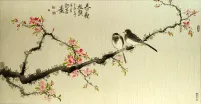
Gallery Price: $322.00
Your Price: $178.88
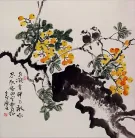
Gallery Price: $268.00
Your Price: $148.88
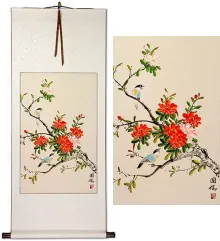
Not the results for Springtime that you were looking for?
Below are some entries from our dictionary that may match your Springtime search...
| Characters If shown, 2nd row is Simp. Chinese |
Pronunciation Romanization |
Simple Dictionary Definition |
春 see styles |
chūn chun1 ch`un chun haruji はるじ |
More info & calligraphy: Spring Season(n,adv) (1) spring; springtime; (2) New Year; (3) prime (of life); height (of one's prosperity); heyday; (4) adolescence; puberty; (5) sexuality; sexual desire; (personal name) Haruji |
春令 see styles |
chūn lìng chun1 ling4 ch`un ling chun ling |
spring; springtime; spring weather |
春光 see styles |
chūn guāng chun1 guang1 ch`un kuang chun kuang harumitsu はるみつ |
scenes of springtime; the radiance of spring; (fig.) a sight of something sexy or erotic; an indication of a love affair spring sunlight; scenery of spring; (given name) Harumitsu |
春季 see styles |
chūn jì chun1 ji4 ch`un chi chun chi haruki はるき |
springtime spring season; (female given name) Haruki |
春日 see styles |
chūn rì chun1 ri4 ch`un jih chun jih haruma はるま |
springtime (1) spring day; (2) spring sun; spring sunlight; (personal name) Haruma |
春筍 春笋 see styles |
chūn sǔn chun1 sun3 ch`un sun chun sun |
springtime bamboo shoots; fig. (of woman's fingers) tender and delicate |
春茶 see styles |
chūn chá chun1 cha2 ch`un ch`a chun cha |
tea leaves gathered at springtime or the tea made from these leaves |
春郊 see styles |
shunkou / shunko しゅんこう |
suburbs in springtime; fields in springtime; (given name) Shunkou |
春陽 see styles |
hinata ひなた |
spring sunshine; springtime; (female given name) Hinata |
春霞 see styles |
haruka はるか |
springtime haze; (female given name) Haruka |
芳春 see styles |
yoshiharu よしはる |
(rare) spring; springtime; (given name) Yoshiharu |
陽春 阳春 see styles |
yáng chūn yang2 chun1 yang ch`un yang chun youshun / yoshun ようしゅん |
see 陽春市|阳春市[Yang2 chun1 Shi4] spring; the springtime; (given name) Yōshun |
青春 see styles |
qīng chūn qing1 chun1 ch`ing ch`un ching chun aoharu あおはる |
youth; youthfulness youth; adolescence; springtime of life; (female given name) Aoharu |
垣繕う see styles |
kakitsukurou / kakitsukuro かきつくろう |
(rare) springtime repairing of fences after winter damage |
山笑う see styles |
yamawarau やまわらう |
(expression) (poetic term) mountain in springtime when all of the tree buds open at the same time; laughing mountain |
春の川 see styles |
harunokawa はるのかわ |
(exp,n) river in springtime |
春暖炉 see styles |
harudanro はるだんろ |
(rare) fireplace used in springtime |
うらうら see styles |
uraura うらうら |
(adverb taking the "to" particle) (onomatopoeic or mimetic word) gently and clearly shining (like the sun in springtime) |
はるの川 see styles |
harunokawa はるのかわ |
(exp,n) river in springtime |
青春時代 see styles |
seishunjidai / seshunjidai せいしゅんじだい |
one's youth; one's youthful days (years); the flower of one's youth; the springtime of one's life |
風和日麗 风和日丽 see styles |
fēng hé rì lì feng1 he2 ri4 li4 feng ho jih li |
moderate wind, beautiful sun (idiom); fine sunny weather, esp. in springtime |
プリンタン see styles |
purintan プリンタン |
springtime (fre: printemps); spring |
蛙の目借時 see styles |
kawazunomekaridoki かわずのめかりどき kaerunomekarudoki かえるのめかるどき kaerunomekaridoki かえるのめかりどき |
(expression) springtime mating of frogs (haiku term) |
蛙の目借り時 see styles |
kawazunomekaridoki かわずのめかりどき kaerunomekaridoki かえるのめかりどき |
(expression) springtime mating of frogs (haiku term) |
かえるの目借時 see styles |
kaerunomekarudoki かえるのめかるどき kaerunomekaridoki かえるのめかりどき |
(expression) springtime mating of frogs (haiku term) |
Variations: |
harunokawa はるのかわ |
(exp,n) river in springtime |
Variations: |
uraura; uraura ウラウラ; うらうら |
(adverb taking the "to" particle) (onomatopoeic or mimetic word) gently and clearly shining (like the sun in springtime) |
Variations: |
harugasumi はるがすみ |
springtime haze |
Variations: |
kaerunomekaridoki; kaerunomekarudoki(蛙no目借時); kawazunomekaridoki かえるのめかりどき; かえるのめかるどき(蛙の目借時); かわずのめかりどき |
(exp,n) (poetic term) springtime mating of frogs |
Variations: |
purantan(p); purintan プランタン(P); プリンタン |
springtime (fre: printemps); spring |
Click here for more Springtime results from our dictionary
The following table may be helpful for those studying Chinese or Japanese...
| Title | Characters | Romaji (Romanized Japanese) | Various forms of Romanized Chinese | |
| You must endure a harsh winter to appreciate the warmth of springtime | 不經冬寒不知春暖 不经冬寒不知春暖 | bù jīng dōng hán bù zhī chūn nuǎn bu4 jing1 dong1 han2 bu4 zhi1 chun1 nuan3 bu jing dong han bu zhi chun nuan | pu ching tung han pu chih ch`un nuan pu ching tung han pu chih chun nuan |
|
| Opening Blooming Flowers | 開花 开花 | kai ka / kaika | kāi huā / kai1 hua1 / kai hua / kaihua | k`ai hua / kaihua / kai hua |
| Flower Open Blooming Flower | 花開 花开 | huā kāi / hua1 kai1 / hua kai / huakai | hua k`ai / huakai / hua kai | |
| Wing Chun Kung Fu | 詠春功夫 咏春功夫 | yǒng chūn gōng fu yong3 chun1 gong1 fu yong chun gong fu yongchungongfu | yung ch`un kung fu yungchunkungfu yung chun kung fu |
|
| Wing Chun | 詠春 咏春 | ei haru / eiharu | yǒng chūn yong3 chun1 yong chun yongchun | yung ch`un yungchun yung chun |
| Spring Season | 春 | haru | chūn / chun1 / chun | ch`un / chun |
| In some entries above you will see that characters have different versions above and below a line. In these cases, the characters above the line are Traditional Chinese, while the ones below are Simplified Chinese. | ||||

Successful Chinese Character and Japanese Kanji calligraphy searches within the last few hours...



