Many custom options...


And formats...



Single in Chinese / Japanese...
Buy a Single calligraphy wall scroll here!
Personalize your custom “Single” project by clicking the button next to your favorite “Single” title below...
The Single Life
Dokushin-Kizoku
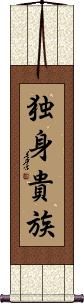
独身贵族 is a Japanese proverb that means “Single Aristocrat” or “Single Noble.”
The understood meaning is that single people can live freely without a spouse or kids to support them. To put it in an old cliché, they are footloose and fancy-free.
If you are a bachelor or bachelorette with few responsibilities and just a thirst for freedom and a worry-free life, this could be your title.
A Journey of 1000 Miles Begins with a Single Step
senri no michi mo ippo kara
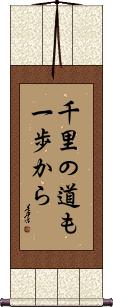
千里の道も一歩から is the Japanese version of an ancient Chinese proverb that means “a journey of a thousand miles begins with a single step.”
Some will also translate this as a 1000-mile road starts with one brick (a small amount).
In this case, the real measurement is an ancient Chinese “li” or 里, which is romanized as “ri” in Japanese. It's about half a kilometer, so three 里 would be a western mile. A journey of 333 miles begins with a single step, just doesn't sound as natural.
Note: Because this selection contains some special Japanese Hiragana characters, it should be written by a Japanese calligrapher.
There is one single thread binding my Way together
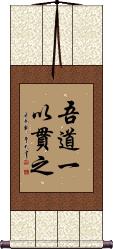
吾道一以貫之 is a phrase from the Analects of Confucius that translates as “My Way has one thread that runs through it.”
Other translations include:
My Way is penetrated by a single thread.
There is one single thread binding my Way together.
My Way is run through with a unifying thread.
My Way is Consistent.
And sometimes poetic license is taken, and it is translated as:
My Way is the only one; I'll treasure it and stick to it with humility until the end.
After this was said, some 2500+ years ago, another disciple of Confucius clarified the meaning by stating, “Our master's Way is to be loyal and have a sense of reciprocity.”
In Japanese, this is purported to be romanized as “Waga michi ichi wo motte kore wo tsuranuku,” though some will argue the true pronunciation.
Note: Sometimes written 吾道以一貫之 instead of 吾道一以貫之 with no difference in meaning.
A Journey of 1000 Miles Begins with a Single Step
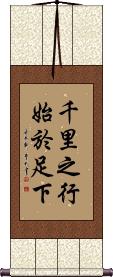
千里之行始於足下 is a Chinese proverb that means “a thousand-mile journey begins with the first step.”
This proverb figuratively means “big accomplishments come from an accumulation of little achievements made one by one.”
Lonely
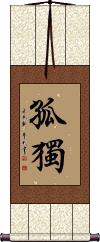
孤獨 means lonely, solitude, loneliness, and lonesome.
In some contexts, it can mean reclusive, isolated, single, or solo.
孤獨 is a Japanese word but not a good selection for a wall scroll.
In Chinese, this will relay a rather sad feeling to anyone who reads this calligraphy on your wall.
 The version shown to the left is the Traditional Chinese and ancient Japanese version. In modern Japan and China they often use a different more simplified version of the second character (as shown to the right). If you want this Japanese/Simplified version, please click on the character shown to the right instead of the button above.
This in-stock artwork might be what you are looking for, and ships right away...

Gallery Price: $65.00
Your Price: $39.88
These search terms might be related to Single:
Alone / a Lone Person
Alone / Solitary Existence
Alone With Only Your Shadow for Company
Fear Not Long Roads; Fear Only Short Ambition
Forgive Yourself / Release Yourself
Free Spirit
Free Will
Live Free or Die
Lone Wolf
Lonely Soul / Solitary
Melody / Song
Not Only Can Water Float a Boat, It Can Sink It Also
Only God Can Judge Me
Only the Sleepless Know the Length of Night
Opportunity Knocks Only Once
Peaceful / Tranquil / Calm / Free From Worry
Record
Release / Let Go
Release of Desires
Silent / Solitary
To Be Free / Freedom
You Are Only as Old as You Feel
You Only Live Once
Not the results for Single that you were looking for?
Below are some entries from our dictionary that may match your Single search...
| Characters If shown, 2nd row is Simp. Chinese |
Pronunciation Romanization |
Simple Dictionary Definition |
一 see styles |
yī yi1 i moto もと |
More info & calligraphy: One(numeric) one (chi: yī); (female given name) Moto eka. One, unity, monad, once, the same; immediately on (seeing, hearing, etc.). |
刀 see styles |
dāo dao1 tao tou / to とう |
More info & calligraphy: Katana(1) sword (esp. Japanese single-edged); katana; (2) (とう only) scalpel; (3) (とう only) (See 彫刻刀・ちょうこくとう) chisel; burin; graver; (4) (とう only) (See 刀銭) knife money (knife-shaped commodity money used in ancient China); (personal name) Tou sword |
禪 禅 see styles |
shàn shan4 shan yuzuri ゆずり |
More info & calligraphy: Zen / Chan / Meditation(out-dated kanji) (1) (Buddhist term) dhyana (profound meditation); (2) (abbreviation) Zen (Buddhism); (surname) Yuzuri To level a place for an altar, to sacrifice to the hills and fountains; to abdicate. Adopted by Buddhists for dhyāna, 禪 or 禪那, i.e. meditation, abstraction, trance. dhyāna is 'meditation, thought, reflection, especially profound and abstract religious contemplation'. M.W. It was intp. as 'getting rid of evil', etc., later as 靜慮 quiet meditation. It is a form of 定, but that word is more closely allied with samādhi, cf. 禪定. The term also connotes Buddhism and Buddhist things in general, but has special application to the 禪宗 q.v. It is one of the six pāramitās, cf. 波. There are numerous methods and subjects of meditation. The eighteen brahmalokas are divided into four dhyāna regions 'corresponding to certain frames of mind where individuals might be reborn in strict accordance with their spiritual state'. The first three are the first dhyāna, the second three the second dhyāna, the third three the third dhyāna, and the remaining nine the fourth dhyāna. See Eitel. According to Childers' Pali Dictionary, 'The four jhānas are four stages of mystic meditation, whereby the believer's mind is purged from all earthly emotions, and detached as it were from his body, which remains plunged in a profound trance.' Seated cross-legged, the practiser 'concentrates his mind upon a single thought. Gradually his soul becomes filled with a supernatural ecstasy and serenity', his mind still reasoning: this is the first jhāna. Concentrating his mind on the same subject, he frees it from reasoning, the ecstasy and serenity remaining, which is the second jhāna. Then he divests himself of ecstasy, reaching the third stage of serenity. Lastly, in the fourth stage the mind becomes indifferent to all emotions, being exalted above them and purified. There are differences in the Mahāyāna methods, but similarity of aim. |
門 门 see styles |
mén men2 men yuki ゆき |
More info & calligraphy: Gate(1) gate; (n,n-suf) (2) branch of learning based on the teachings of a single master; school; (n,n-suf) (3) {biol} phylum; division; (counter) (4) counter for cannons; (surname) Yuki A door; gate; a sect, school, teaching, especially one leading to salvation or nirvana. |
達磨 达磨 see styles |
dá mó da2 mo2 ta mo daruma だるま |
More info & calligraphy: Daruma / Damodharma; also 達摩; 達麼; 達而麻耶; 曇摩; 馱摩 tr. by 法. dharma is from dhara, holding, bearing, possessing, etc.; and means 'that which is to be held fast or kept, ordinance, statute, law, usage, practice'; 'anything right.' M.W. It may be variously intp. as (1) characteristic, attribute, predicate; (2) the bearer, the transcendent substratum of single elements of conscious life; (3) element, i.e. a part of conscious life; (4) nirvāṇa, i.e. the Dharma par excellence, the object of Buddhist teaching; (5) the absolute, the real; (6) the teaching or religion of Buddha; (7) thing, object, appearance. Also, Damo, or Bodhidharma, the twenty-eighth Indian and first Chinese patriarch, who arrived in China A.D. 520, the reputed founder of the Chan or Intuitional School in China. He is described as son of a king in southern India; originally called Bodhitara. He arrived at Guangdong, bringing it is said the sacred begging-bowl, and settled in Luoyang, where he engaged in silent meditation for nine years, whence he received the title of wall-gazing Brahman 壁觀婆羅門, though he was a kṣatriya. His doctrine and practice were those of the 'inner light', independent of the written word, but to 慧可 Huike, his successor, he commended the Laṅkāvatāra-sūtra as nearest to his views. There are many names with Dharma as initial: Dharmapāla, Dharmagupta, Dharmayaśas, Dharmaruci, Dharmarakṣa, Dharmatrāta, Dharmavardhana, etc. |
一道神光 see styles |
yī dào shén guāng yi1 dao4 shen2 guang1 i tao shen kuang ichidō no shinkō |
More info & calligraphy: Intuitive Wisdom / Inner Light |
千里の道も一歩から see styles |
senrinomichimoippokara せんりのみちもいっぽから |
More info & calligraphy: A Journey of 1000 Miles Begins with a Single Step |
匹 see styles |
pǐ pi3 p`i pi hiki ひき |
(bound form) matching; comparable to; (bound form) alone; single; one of a pair; classifier for horses, mules etc (Taiwan pr. [pi1]); classifier for cloth: bolt; horsepower (counter) (1) counter for small animals; (2) counter for rolls of cloth (two han in size); (3) roll of cloth; (counter) (1) counter for rolls of cloth (two han in size); (2) (archaism) counter for horses; (3) roll of cloth; (surname) Hiki |
単 see styles |
dān dan1 tan tan たん |
Japanese variant of 單|单 (prefix) (1) single; simple; (2) (abbreviation) (See 単試合) singles (tennis, badminton, etc.); (3) (abbreviation) (See 単勝式) win bet (bet which predicts the winner of a race); (surname) Tan |
單 单 see styles |
dān dan1 tan hitoe ひとえ |
bill; list; form; single; only; sole; odd number; CL:個|个[ge4] (female given name) Hitoe Single, alone; only; the odd numbers; poor, deficient; a bill, cheque, etc.; cf. 但. |
專 专 see styles |
zhuān zhuan1 chuan sen |
for a particular person, occasion, purpose; focused on one thing; special; expert; particular (to something); concentrated; specialized Single; special; solely. |
抉 see styles |
jué jue2 chüeh |
to pick out; to single out |
棹 see styles |
zhuō zhuo1 cho sao さお |
variant of 桌[zhuo1] (1) rod; pole; (2) neck (of a shamisen, etc.); shamisen; (3) beam (i.e. the crossbar of a balance); (4) single line (esp. as a flying formation for geese); (5) (slang) penis; (counter) (6) counter for flags (on poles); counter for long, thin Japanese sweets (e.g. youkan); (surname) Sao pole |
櫓 橹 see styles |
lǔ lu3 lu yagura やぐら |
scull (single oar worked from side to side over the stern of a boat) Japanese scull (oar attached to the rear of the boat by a traditional peg-in-hole oarlock); (1) turret; watchtower; (2) high wooden stage; scaffolding; (3) wooden frame (of a kotatsu); (4) (archaism) weapons storehouse; (surname) Yagura |
注 see styles |
zhù zhu4 chu chuu / chu ちゅう |
(bound form) to pour into; to flow into; to inject; (bound form) to focus (one's spirit, gaze etc) on a single point; to concentrate; (bound form) stake (in gambling); classifier for stakes, sums of money, transactions or beams of light; variant of 註|注[zhu4] (noun/participle) annotation; explanatory note; comment; (given name) Chuu Fix, record; flow. |
獨 独 see styles |
dú du2 tu doku |
alone; independent; single; sole; only Only, alone, solitary. |
略 see styles |
lüè lu:e4 lu:e ryaku りゃく |
brief; sketchy; outline; summary; to omit; (bound form before a single-character verb) a bit; somewhat; slightly; plan; strategy; to capture (territory) (n,n-suf) (1) abbreviation; omission; (2) outline; gist; (3) plan; strategy; scheme To mark off, define: abridge, outline, sketch; summarize in general; rather, somewhat. |
膳 see styles |
shàn shan4 shan zen ぜん |
meals (1) small dining table (usu. for a single person); serving tray (with legs); (2) (See 御膳・1) meal; food; serving; (counter) (3) counter for bowlfuls of rice; (counter) (4) counter for pairs of chopsticks; (place-name, surname) Zen cooked food |
虫 see styles |
chóng chong2 ch`ung chung mushi むし |
variant of 蟲|虫[chong2] (1) insect; bug; cricket; moth; (2) worm; roundworm; (3) (See 虫を殺す・むしをころす) one's emotions; one's feelings; (4) (See 虫気・むしけ) nervousness; fretfulness; (5) (See 本の虫・ほんのむし) person devoted to one thing; single-minded person; (6) valve core; (personal name) Mushi Insect, reptile; any creeping thing; animal, man as of the animal kingdom. |
銶 𨱇 see styles |
qiú qiu2 ch`iu chiu |
single-headed pick; stone chisel |
こ食 see styles |
koshoku こしょく |
(1) meal with family members eating separate foods; (2) eating alone (not with one's family); (3) food sold in single servings |
ゆに see styles |
yuni ゆに |
(prefix noun) (See 単一・たんいつ) uni-; single; unitary; sole; (female given name) Yuni |
一々 see styles |
ichiichi / ichichi いちいち |
(adv,n) (1) (kana only) one-by-one; separately; (2) (kana only) every single; each and every; without omission; fully; in detail |
一一 see styles |
yī yī yi1 yi1 i i kazuhiro かずひろ |
one by one; one after another (adv,n) (1) (kana only) one-by-one; separately; (2) (kana only) every single; each and every; without omission; fully; in detail; (male given name) Kazuhiro One by one, each, every one, severally. |
一事 see styles |
yī shì yi1 shi4 i shih ichiji いちじ |
one thing; (surname) Ichiji a single entity |
一住 see styles |
yī zhù yi1 zhu4 i chu ichisumi いちすみ |
(surname) Ichisumi a single abode |
一依 see styles |
yī yī yi1 yi1 i i kazuyo かずよ |
(female given name) Kazuyo same single basis |
一偈 see styles |
yī jié yi1 jie2 i chieh ichi ge |
a single verse |
一偏 see styles |
ippen いっぺん |
(suffix noun) (1) (obsolete) (after a noun) wholly; entirely; nothing but; wholeheartedly; devoted to; committed to; (noun or adjectival noun) (2) (archaism) intent; single-minded; wholehearted; (noun or adjectival noun) (3) (archaism) unbalanced; one-sided; prejudiced |
一元 see styles |
yī yuán yi1 yuan2 i yüan hitomoto ひともと |
(math.) single-variable; univariate (noun - becomes adjective with の) (1) single element; unitary; (2) one era; (3) {math} one unknown; (surname) Hitomoto |
Click here for more Single results from our dictionary
The following table may be helpful for those studying Chinese or Japanese...
| Title | Characters | Romaji (Romanized Japanese) | Various forms of Romanized Chinese | |
| The Single Life | 独身貴族 / 獨身貴族 独身贵族 | do kushin ki zoku dokushinkizoku | ||
| A Journey of 1000 Miles Begins with a Single Step | 千里の道も一歩から | sen ri no michi mo i-ppo ka ra senrinomichimoi-ppokara sen ri no michi mo i-po ka ra | ||
| There is one single thread binding my Way together | 吾道一以貫之 吾道一以贯之 | ware dou tsurayuki waredoutsurayuki ware do tsurayuki | wú dào yī yǐ guàn zhī wu2 dao4 yi1 yi3 guan4 zhi1 wu dao yi yi guan zhi wudaoyiyiguanzhi | wu tao i i kuan chih wutaoiikuanchih |
| A Journey of 1000 Miles Begins with a Single Step | 千里之行始於足下 千里之行始于足下 | qiān lǐ zhī xíng shǐ yú zú xià qian1 li3 zhi1 xing2 shi3 yu2 zu2 xia4 qian li zhi xing shi yu zu xia qianlizhixingshiyuzuxia | ch`ien li chih hsing shih yü tsu hsia chien li chih hsing shih yü tsu hsia |
|
| Lonely | 孤獨 孤独 | ko doku / kodoku | gū dú / gu1 du2 / gu du / gudu | ku tu / kutu |
| In some entries above you will see that characters have different versions above and below a line. In these cases, the characters above the line are Traditional Chinese, while the ones below are Simplified Chinese. | ||||

Successful Chinese Character and Japanese Kanji calligraphy searches within the last few hours...



