Many custom options...


And formats...



Sight in Chinese / Japanese...
Buy a Sight calligraphy wall scroll here!
Personalize your custom “Sight” project by clicking the button next to your favorite “Sight” title below...
Beautiful Sight
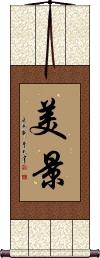
美景 can be translated as a beautiful view, beautiful scenery, or a beautiful sight.
Note: Not a commonly used word in modern Japanese.
Far-Sighted in Deep Thought
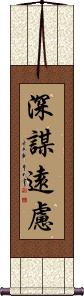
深謀遠慮 is a Chinese, Japanese, and Korean proverb that means “deep plans and distant thoughts,” “to plan far ahead,” or “far sight and deep design.”
Eyeballs / Eyes
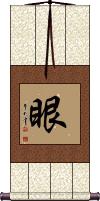
眼 is the simplest way to write eyes or eyeballs in Chinese, Japanese Kanji, and old Korean Hanja.
This can also mean eyesight, sight, vision, look, stare, glance, viewpoint, insight, perceptivity, the power of observation, or simply the eye.
Idea / Thought / Meaning
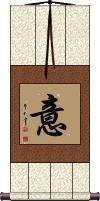
意 is the Chinese, Japanese Kanji, and old Korean Hanja for an idea, intention, meaning, thought, wish, desire, intention, feelings, and thoughts.
In Buddhism, this is the last of the six means of perception (the others are sight, hearing, smell, taste, and touch, and this one represents the mind). It does not literally mean “mind,” but rather something more like mental powers, intellect, intelligence, faculty of thought, or understanding in the Buddhist context.
Hearing a Hundred Times is Not as Good as Seeing Once
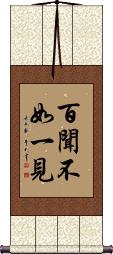
百聞不如一見 is a Chinese proverb that means “Seeing once is better than hearing one hundred times” which is similar to the idea of “Seeing is believing.”
You can also get the idea, “Seeing for oneself is better than hearing from many others.”
If you break it down directly, you get “100 hears/listens (is) not as-good (as) one sight.”
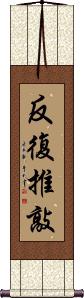
Push or Knock
To weigh one's words
During the Tang Dynasty, a man named Jia Dao (born in the year 779), a well-studied scholar and poet, went to the capital to take the imperial examination.
One day as he rides a donkey through the city streets, a poem begins to form in his mind. A portion of the poem comes into his head like this:
“The bird sits on the tree branch near a pond,
A monk approaches and knocks at the gate...”
At the same time, he wondered if the word “push” would be better than “knock” in his poem.
As he rides down the street, he imagines the monk pushing or knocking. Soon he finds himself making motions of pushing and shaking a fist in a knocking motion as he debates which word to use. He is quite a sight as he makes his way down the street on his donkey with hands and fists flying about as the internal debate continues.
As he amuses people along the street, he becomes completely lost in his thoughts and does not see the mayor's procession coming in the opposite direction. Jia Bao is blocking the way for the procession to continue down the road, and the mayor's guards immediately decide to remove Jia Bao by force. Jia Bao, not realizing that he was in the way, apologizes, explains his poetic dilemma and awaits his punishment for blocking the mayor's way.
The mayor, Han Yu, a scholar and author of prose himself, finds himself intrigued by Jia Dao's poem and problem. Han Yu gets off his horse and addresses Jia Bao, stating, “I think knock is better.” The relieved Jia Bao raises his head and is invited by the mayor to join the procession, and are seen riding off together down the street, exchanging their ideas and love of poetry.
In modern Chinese, this 反復推敲 idiom is used when someone is trying to decide which word to use in their writing or when struggling to decide between two things when neither seems to have a downside.
Undaunted After Repeated Setbacks
Persistence to overcome all challenges
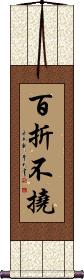
百折不撓 is a Chinese proverb that means “Be undaunted in the face of repeated setbacks.”
More directly translated, it reads, “[Overcome] a hundred setbacks, without flinching.” 百折不撓 is of Chinese origin but is commonly used in Japanese and somewhat in Korean (same characters, different pronunciation).
This proverb comes from a long, and occasionally tragic story of a man that lived sometime around 25-220 AD. His name was Qiao Xuan, and he never stooped to flattery but remained an upright person at all times. He fought to expose the corruption of higher-level government officials at great risk to himself.
Then when he was at a higher level in the Imperial Court, bandits were regularly capturing hostages and demanding ransoms. But when his own son was captured, he was so focused on his duty to the Emperor and the common good that he sent a platoon of soldiers to raid the bandits' hideout, and stop them once and for all even at the risk of his own son's life. While all of the bandits were arrested in the raid, they killed Qiao Xuan's son at first sight of the raiding soldiers.
Near the end of his career, a new Emperor came to power, and Qiao Xuan reported to him that one of his ministers was bullying the people and extorting money from them. The new Emperor refused to listen to Qiao Xuan and even promoted the corrupt Minister. Qiao Xuan was so disgusted that in protest, he resigned from his post as minister (something almost never done) and left for his home village.
His tombstone reads “Bai Zhe Bu Nao” which is now a proverb used in Chinese culture to describe a person of strong will who puts up stubborn resistance against great odds.
My Chinese-English dictionary defines these 4 characters as “keep on fighting despite all setbacks,” “be undaunted by repeated setbacks,” and “be indomitable.”
Our translator says it can mean “never give up” in modern Chinese.
Although the first two characters are translated correctly as “repeated setbacks,” the literal meaning is “100 setbacks” or “a rope that breaks 100 times.” The last two characters can mean “do not yield” or “do not give up.”
Most Chinese, Japanese, and Korean people will not take this absolutely literal meaning but will instead understand it as the title suggests above. If you want a single big word definition, it would be indefatigability, indomitableness, persistence, or unyielding.
See Also: Tenacity | Fortitude | Strength | Perseverance | Persistence
These search terms might be related to Sight:
1. Right Understanding / Right Perspective / Right View / Perfect View
Do Not Shed a Tear Until You See the Coffin
Dream / Vision
Not the results for Sight that you were looking for?
Below are some entries from our dictionary that may match your Sight search...
| Characters If shown, 2nd row is Simp. Chinese |
Pronunciation Romanization |
Simple Dictionary Definition |
意 see styles |
yì yi4 i kokoro こころ |
More info & calligraphy: Idea / Thought / Meaning(1) feelings; thoughts; (2) meaning; (personal name) Kokoro Manas, the sixth of the ṣaḍāyatanas or six means of perception, i.e. sight, hearing, smell, taste, touch, and mind. Manas means "mind (in its widest sense as applied to all the mental powers), intellect, intelligence, understanding, perception, sense, conscience, will". M.W. It is "the intellectual function of consciousness", Keith. In Chinese it connotes thought, idea, intention, meaning, will; but in Buddhist terminology its distinctive meaning is mind, or the faculty of thought. |
千里眼 see styles |
qiān lǐ yǎn qian1 li3 yan3 ch`ien li yen chien li yen senrigan せんりがん |
More info & calligraphy: Clairvoyance(1) clairvoyance; second sight; (2) clairvoyant clairvoyance |
深謀遠慮 深谋远虑 see styles |
shēn móu yuǎn lǜ shen1 mou2 yuan3 lu:4 shen mou yüan lü shinbouenryo / shinboenryo しんぼうえんりょ |
More info & calligraphy: Far-Sighted in Deep Thought(yoji) far sight and deep design |
図 see styles |
tú tu2 t`u tu hakaru はかる |
Japanese variant of 圖|图 (n,n-suf) (1) drawing; picture; diagram; figure; illustration; chart; graph; (2) sight; scene; (given name) Hakaru |
塵 尘 see styles |
chén chen2 ch`en chen chiri ちり |
dust; dirt; earth (1) dust; (2) trash; garbage; rubbish; dirt; (3) (usu. as 塵ほども...ない) negligible amount; tiny bit; (4) hustle and bustle (of life); worldly cares; impurities of the world; (5) (abbreviation) {sumo} (See 塵手水) ritual gestures indicating that a fight will be clean guṇa, in Sanskrit inter alia means 'a secondary element', 'a quality', 'an attribute of the five elements', e.g. 'ether has śabda or sound for its guṇa and the ear for its organ'. In Chinese it means 'dust, small particles; molecules, atoms, exhalations'. It may be intp. as an atom, or matter, which is considered as defilement; or as an active, conditioned principle in nature, minute, subtle, and generally speaking defiling to pure mind; worldly, earthly, the world. The six guṇas or sensation-data are those of sight, sound, smell, taste, touch, and thought. |
尖 see styles |
jiān jian1 chien togari とがり |
pointed; tapering; sharp; (of a sound) shrill; piercing; (of one's hearing, sight etc) sharp; acute; keen; to make (one's voice) shrill; sharp point; tip; the best of something; the cream of the crop (irregular okurigana usage) (kana only) diagonal move (in the game of go); (surname) Togari to be pointed |
瞖 翳 see styles |
yì yi4 i ei |
variant of 翳[yi4] timira, an affection of the eye, eye-film, cataract, dim sight, blindness. |
翳 see styles |
yì yi4 i ei さしば |
feather screen; to screen; to shade; cataract (kana only) dimness (of sight); (1) shade; shadow; (2) other side; back; background; large fan-shaped object held by an attendant and used to conceal the face of a noble, etc. A film; screen; fan; hide, invisible; translit. e, a. |
観 see styles |
guān guan1 kuan miru みる |
Japanese variant of 觀|观[guan1] (n,n-suf) (1) look; appearance; (n,n-suf) (2) spectacle; sight; (n,n-suf) (3) {Buddh} observation meditation; (suffix noun) (4) outlook on ...; view of ...; (female given name) Miru |
闆 板 see styles |
pàn pan4 p`an pan |
to catch sight of in a doorway (old) See: 板 |
霞 see styles |
xiá xia2 hsia yasumi やすみ |
rose-tinted sky or clouds at sunrise or sunset (1) (kana only) haze (esp. in spring); mist; (2) (kana only) dimness (of sight); (surname) Yasumi |
お目 see styles |
ome おめ |
(1) (honorific or respectful language) eye; eyes; (2) sight; vision; looking |
一撃 see styles |
ichigeki いちげき |
(noun, transitive verb) (1) one blow; one hit; one stroke; (noun, transitive verb) (2) summiting on the first attempt (oft. without prior knowledge about the route; in climbing); on-sight; flashing |
一晃 see styles |
yī huǎng yi1 huang3 i huang kazuteru かずてる |
(of passing time) in an instant; (of a sight) in a flash (given name) Kazuteru |
一覧 see styles |
ichiran いちらん |
(noun, transitive verb) (1) look; glance; sight; having a look at; looking over; glancing through; running one's eyes over; (2) summary; list; table; catalog; catalogue |
七大 see styles |
qī dà qi1 da4 ch`i ta chi ta shichidai |
Earth , water, fire, wind, space (or ether), sight, and perception 地, 水, 火, 風, 空, 見, 証識; cf. 大, 五大and 六境; 見大 and 六根; 識大 and 六識. |
七星 see styles |
qī xīng qi1 xing1 ch`i hsing chi hsing naboshi なぼし |
see 七星區|七星区[Qi1 xing1 Qu1] (archaism) {astron} (See 北斗七星) the Big Dipper (asterism); the Plough; the Plow; (personal name) Naboshi Ursa major; Worshipped in Japan as 妙見菩薩 Wonderful Sight Bodhisattva who protects this world. |
上根 see styles |
shàng gēn shang4 gen1 shang ken kamine かみね |
(place-name, surname) Kamine A man of superior character or capacity, e.g. with superior organs of sight, hearing, etc. |
九識 九识 see styles |
jiǔ shì jiu3 shi4 chiu shih kumi くみ |
(female given name) Kumi The kinds of cognition or consciousness (vijñāna); those of sight, hearing, smell, taste, touch, mind, mānas (or阿陁那識 ādāna), i.e. mental perception; 阿賴耶 ālāya, bodhi-consciousness, and 阿摩羅識 amala, purified or Buddha-consciousness. There is considerable difference as to the meaning of the last three. |
五力 see styles |
wǔ lì wu3 li4 wu li goriki |
pañcabalāni, the five powers or faculties — one of the categories of the thirty-seven bodhipakṣika dharma 三十七助道品; they destroy the 五障 five obstacles, each by each, and are: 信力 śraddhābala, faith (destroying doubt); 精進力 vīryabala, zeal (destroying remissness); 念 or 勤念 smṛtibala, memory or thought (destroying falsity); 正定力 samādhibala, concentration of mind, or meditation (destroying confused or wandering thoughts); and 慧力 prajñābala, wisdom (destroying all illusion and delusion). Also the five transcendent powers, i. e. 定力 the power of meditation; 通力 the resulting supernatural powers; 借識力 adaptability, or powers of 'borrowing' or evolving any required organ of sense, or knowledge, i. e. by beings above the second dhyāna heavens; 大願力 the power of accomplishing a vow by a Buddha or bodhisattva; and 法威德力 the august power of Dharma. Also, the five kinds of Mara powers exerted on sight, 五大明王. |
五妙 see styles |
wǔ miào wu3 miao4 wu miao gomyō |
The five wonders, i. e. of purified or transcendental sight, sound, taste, smell, and touch in the Pure-land. |
依地 see styles |
yī dì yi1 di4 i ti eji |
The ground on which one relies; the body, on which sight, hearing, etc., depend; the degree of samādhi attained; cf. 依身. |
偉観 see styles |
ikan いかん |
magnificent sight |
僻目 see styles |
higame ひがめ |
(1) squint; (2) sight error; (3) bias; misunderstanding; misjudgment; misjudgement |
光景 see styles |
guāng jǐng guang1 jing3 kuang ching mitsukage みつかげ |
circumstances; scene; about; probably scene; spectacle; sight; view; (given name) Mitsukage |
六入 see styles |
liù rù liu4 ru4 liu ju rokunyuu / rokunyu ろくにゅう |
{Buddh} six sense organs (eyes, ears, nose, tongue, body, and mind) ṣaḍāyatana; 六阿耶怛那 (or 六阿也怛那) the six entrances, or locations, both the organ and the sensation — eye, ear, nose, tongue, body, and mind; sight, hearing, smell, taste, touch, and perception. The six form one of the twelve nidanas, see 十二因緣. The 六根 are the six organs, the 六境 the six objects, and the 六塵 or guṇas, the six inherent qualities. The later term is 六處 q. v.; The "six entries" ṣaḍāyatana, which form one of the links in the chain of causaton, v. 十二因緣 the preceding link being觸contact, and the succeeding link 識 perception. The six are the qualities and effects of the six organs of sense producing sight, hearing, smell, taste, touch, and thought (or mental presentations). v. also 二入. |
六劍 六剑 see styles |
liù jiàn liu4 jian4 liu chien rokken |
六箭 The six swords (or arrows), i. e. the six senses, v. 六塵, which are defined as the qualities of sight, sound, smell, taste, touch, and mind. |
六塵 六尘 see styles |
liù chén liu4 chen2 liu ch`en liu chen rokujin |
The six guṇas, qualities produced by the objects and organs of sense, i. e. sight, sound, smell, taste, touch, and idea; the organs are the 六根, 六入, 六處, and the perceptions or discernments the 六識; cf. 六境. Dust 塵 is dirt, and these six qualities are therefore the cause of all impurity. Yet 六塵說法 the Buddha made use of them to preach his law. |
六境 see styles |
liù jìng liu4 jing4 liu ching rokkyou / rokkyo ろっきょう |
{Buddh} six objective fields of the senses (shape and colour, sound, scent, flavour, physical feeling, and mental presentation) The six fields of the senses, i. e. the objective fields of sight, sound, smell, taste, touch, and idea (or thought); rūpa, form and color, is the field of vision; sound, of hearing; scent, of smelling; the five flavors, of tasting; physical feeling, of touch; and mental presentation, of discernment; cf. 六入; 六處 and next. |
初見 see styles |
hatsumi はつみ |
(noun, transitive verb) (1) (form) seeing for the first time; first sight; first meeting; (2) {music} sight-reading; (surname, female given name) Hatsumi |
Click here for more Sight results from our dictionary
The following table may be helpful for those studying Chinese or Japanese...
| Title | Characters | Romaji (Romanized Japanese) | Various forms of Romanized Chinese | |
| Beautiful Sight | 美景 | bi kei / bikei | měi jǐng / mei3 jing3 / mei jing / meijing | mei ching / meiching |
| Far-Sighted in Deep Thought | 深謀遠慮 深谋远虑 | shinbouenryo / shinboenryo shinboenryo / shinboenryo | shēn móu yuǎn lǜ shen1 mou2 yuan3 lu:4 shen mou yuan lu: shenmouyuanlu: | shen mou yüan lü shenmouyüanlü |
| Eyeballs Eyes | 眼 | gan | yǎn / yan3 / yan | yen |
| Idea Thought Meaning | 意 | kokoro | yì / yi4 / yi | i |
| Hearing a Hundred Times is Not as Good as Seeing Once | 百聞不如一見 百闻不如一见 | bǎi wén bù rú yī jiàn bai3 wen2 bu4 ru2 yi1 jian4 bai wen bu ru yi jian baiwenburuyijian | pai wen pu ju i chien paiwenpujuichien |
|
| Push or Knock | 反復推敲 反复推敲 | fǎn fù tuī qiāo fan3 fu4 tui1 qiao1 fan fu tui qiao fanfutuiqiao | fan fu t`ui ch`iao fanfutuichiao fan fu tui chiao |
|
| Undaunted After Repeated Setbacks | 百折不撓 百折不挠 | hyaku setsu su tou hyakusetsusutou hyaku setsu su to | bǎi zhé bù náo bai3 zhe2 bu4 nao2 bai zhe bu nao baizhebunao | pai che pu nao paichepunao |
| In some entries above you will see that characters have different versions above and below a line. In these cases, the characters above the line are Traditional Chinese, while the ones below are Simplified Chinese. | ||||

Successful Chinese Character and Japanese Kanji calligraphy searches within the last few hours...



