Many custom options...


And formats...



Ship in Chinese / Japanese...
Buy a Ship calligraphy wall scroll here!
Personalize your custom “Ship” project by clicking the button next to your favorite “Ship” title below...
Katori
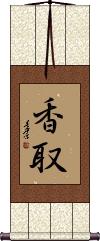
香取 is a Japanese name that romanizes as Katori.
This could refer to the ship by this name that served in the Japanese Navy until sunk by the USS Iowa in 1944. This can also be a person's name in Japan, or refer to the new city of Katori (香取市) in Chiba prefecture of Japan.
Smooth Sailing
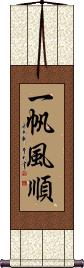
一帆風順 is just what you think it means. It suggests that you are on a trouble-free voyage through life, or literally on a sailing ship or sailboat. It is often used in China as a wish for good luck on a voyage or as you set out on a new quest or career in your life. Some may use this in place of “bon voyage.”
The literal meaning is “Once you raise your sail, you will get the wind you need, and it will take you where you want to go.” Another way to translate it is “Your sail and the wind follow your will.”
This is a great gift for a mariner, sailor, adventurer, or someone starting a new career.
Note: Can be understood in Korean Hanja but is rarely used.
See Also: Bon Voyage | Adventure | Travel
These search terms might be related to Ship:
If You Love Your Child, Send Them Out Into the World
Mark the Boat to Find the Lost Sword / Ignoring the Changing Circumstances of the World
Not Only Can Water Float a Boat, It Can Sink It Also
The Incompetent Boat Pilot Blames the River for His Shortcomings
Not the results for Ship that you were looking for?
Below are some entries from our dictionary that may match your Ship search...
| Characters If shown, 2nd row is Simp. Chinese |
Pronunciation Romanization |
Simple Dictionary Definition |
ログ see styles |
rogu ログ |
More info & calligraphy: Rog |
シッフ see styles |
shiffu シッフ |
ship; (personal name) Shif |
ロール see styles |
rooru ロール |
More info & calligraphy: Roll |
フリック see styles |
buriggu ブリッグ |
More info & calligraphy: Flick |
波羅末陀 波罗末陀 see styles |
bō luó mò tuó bo1 luo2 mo4 tuo2 po lo mo t`o po lo mo to haramada |
More info & calligraphy: Paramartha |
スケルトン see styles |
sukerudon スケルドン |
More info & calligraphy: Skelton |
ローリング see styles |
rooringu ローリング |
More info & calligraphy: Loring |
サンタマリア see styles |
santamaria サンタマリア |
More info & calligraphy: Santamaria |
上 see styles |
shàng shang4 shang noboru のぼる |
(bound form) up; upper; above; previous; first (of multiple parts); to climb; to get onto; to go up; to attend (class or university); (directional complement) up; (noun suffix) on; above (suffix) (1) from the standpoint of; from the viewpoint of; with respect to; in terms of; as a matter of; in view of; so far as ... is concerned; (suffix) (2) on; above; on top of; aboard (a ship or vehicle); (noun - becomes adjective with の) (3) the best; top; first class; first grade; (4) (See 下・2,中・6) first volume (of a two or three-volume set); first book; (expression) (5) (written on a gift's wrapping paper) with my compliments; (surname) Noboru uttarā 嗢呾羅; above upper, superior; on; former. To ascend, offer to a superior. |
倉 仓 see styles |
cāng cang1 ts`ang tsang kurataka くらたか |
barn; granary; storehouse; cabin; hold (in ship) warehouse; storehouse; cellar; magazine; granary; godown; depository; treasury; elevator; (surname) Kurataka warehouse |
円 see styles |
yuán yuan2 yüan meguru めぐる |
yen (Japanese currency); Japanese variant of 圓|圆 (1) circle; (n,n-pref) (2) entirety; whole; full; complete; (3) (slang) money; dough; moola; (4) enclosure inside a castle's walls; (5) (ksb:) soft-shelled turtle; (suffix) (6) suffix for ship names; suffix for names of people (esp. infants); suffix for names of swords, armour, musical instruments, etc.; suffix for names of dogs, horses, etc.; (1) yen; Japanese monetary unit; (2) circle; (female given name) Meguru |
出 see styles |
chū chu1 ch`u chu de で |
to go out; to come out; to arise; to occur; to produce; to yield; to go beyond; to exceed; (used after a verb to indicate an outward direction or a positive result); classifier for dramas, plays, operas etc (n,n-suf) (1) coming out; going out; outflow; efflux; rising (of the Sun or the Moon); (n,n-suf) (2) attending (work); appearing (on stage); one's turn to go on; (n,n-suf) (3) start; beginning; (n,n-suf) (4) origins; background; person (or item) originating from ...; graduate of ...; native of ...; member of ... (lineage); (n,n-suf) (5) architectural member that projects outward; (n,n-suf) (6) highest point of the stern of a ship; (n,n-suf) (7) (kana only) (usu. after the -masu stem of a verb as 〜出がある or 〜出がない, etc.) amount (comprising something); amount of time or effort required to do something; (surname) De To go out, come forth, put forth; exit; beyond. |
弭 see styles |
mǐ mi3 mi mi はず |
to stop; repress (1) (kana only) expectation that something took place, will take place or was in some state; it should be so; bound to be; expected to be; must be; (2) nock (of a bow); (3) nock (of an arrow); (4) (sumo) nock-shaped grip (between thumb and forefinger); (5) wooden frame on the tip of the mast of a Japanese ship that prevents the hawser from falling out Stop, put down. |
澪 see styles |
rei / re れい |
(1) waterway; channel; (2) wake (of a ship); (female given name) Rei |
筈 see styles |
guā gua1 kua hazu はず |
arrow end (1) (kana only) expectation that something took place, will take place or was in some state; it should be so; bound to be; expected to be; must be; (2) nock (of a bow); (3) nock (of an arrow); (4) (sumo) nock-shaped grip (between thumb and forefinger); (5) wooden frame on the tip of the mast of a Japanese ship that prevents the hawser from falling out |
胴 see styles |
dòng dong4 tung dou / do どう |
large intestine; torso (1) trunk; torso; body; abdomen; waist; (2) plastron (in kendo); touching the plastron (kimari-te in kendo); (3) frame (of a drum, etc.); sound box (of a shamisen, etc.); hull (of a ship); (4) (rare) {hanaf} (also written as 筒) (See 親・おや・2) dealer |
舟 see styles |
zhōu zhou1 chou fune ふね |
boat (1) ship; boat; watercraft; vessel; steamship; (2) tank; tub; vat; trough; (n-suf,ctr) (3) counter for boat-shaped containers (e.g. of sashimi); (surname, female given name) Fune boat |
舡 see styles |
gāng gang1 kang |
boat; ship |
航 see styles |
háng hang2 hang wataru わたる |
boat; ship; craft; to navigate; to sail; to fly (f,m) Wataru |
舳 see styles |
zhú zhu2 chu hezaki へざき |
poopdeck; stern of boat (See 舳先) bow (of a ship); prow; (surname) Hezaki |
舶 see styles |
bó bo2 po paku ぱく |
ship (archaism) large ship; (given name) Paku |
舷 see styles |
xián xian2 hsien gen げん |
side of a ship or an aircraft (See 船縁,船端) side of a boat; gunwale |
舸 see styles |
gě ge3 ko hayabune はやぶね hayafune はやふね |
barge (1) (archaism) fast-moving rowboat; (2) type of fast military ship |
船 see styles |
chuán chuan2 ch`uan chuan fune ふね |
boat; vessel; ship; CL:條|条[tiao2],艘[sou1],隻|只[zhi1] (suffix noun) ship; boat; vessel; (surname, female given name) Fune A boat, ship. |
艎 see styles |
huáng huang2 huang |
fast ship; see 艅艎, large warship |
艏 see styles |
shǒu shou3 shou |
bow of a ship |
艙 舱 see styles |
cāng cang1 ts`ang tsang |
cabin; the hold of a ship or airplane |
艫 舻 see styles |
lú lu2 lu ro ろ |
bow of ship (1) (See 船尾) stern; (2) (See 船首) bow |
艬 see styles |
chán chan2 ch`an chan |
large ship |
號 号 see styles |
hào hao4 hao gou / go ごう |
ordinal number; day of a month; mark; sign; business establishment; size; ship suffix; horn (wind instrument); bugle call; assumed name; to take a pulse; classifier used to indicate number of people (n,n-suf) (1) number; edition; make; model; issue; part of that group; (2) sobriquet; pen-name; (suffix) (3) suffix attached to names of ships, trains, airplanes, etc.; (personal name) Gou To roar, call, cry, scream; sign, mark, designation. |
Click here for more Ship results from our dictionary
The following table may be helpful for those studying Chinese or Japanese...
| Title | Characters | Romaji (Romanized Japanese) | Various forms of Romanized Chinese | |
| Katori | 香取 | katori | ||
| Smooth Sailing | 一帆風順 一帆风顺 | yī fán fēng shùn yi1 fan2 feng1 shun4 yi fan feng shun yifanfengshun | i fan feng shun ifanfengshun |
|
| In some entries above you will see that characters have different versions above and below a line. In these cases, the characters above the line are Traditional Chinese, while the ones below are Simplified Chinese. | ||||

Successful Chinese Character and Japanese Kanji calligraphy searches within the last few hours...



